
Meadow saffron has no safe home use. Every part of the plant contains colchicine, a poison with no antidote, and people have died after eating leaves they took for wild garlic [IPCS INCHEM, 1997; Brvar, 2004]. The same compound, purified and measured in fractions of a milligram, is a prescription medicine for gout. So if you came looking for the benefits of meadow saffron, here is the plain answer: they all come in a pharmacy bottle, and none of them come from the plant in the garden.
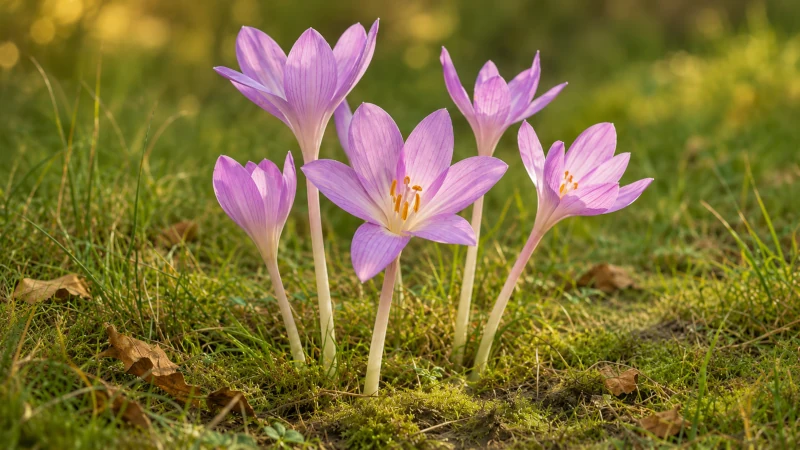
Meadow saffron at a glance
| Feature | Detail |
| Scientific name | Colchicum autumnale L. |
| Family | Colchicaceae |
| Other names | Autumn crocus, naked ladies, fall crocus; colchique (French); cólquico, azafrán silvestre (Spanish) |
| Size and leaves | 10 to 40 cm tall. Dark green, shiny, lance-shaped leaves appear in spring and die back before flowering. |
| Flowers | Pink, purple, or white; they open in autumn on bare stems. |
| Where it grows | Wet meadows and woodland clearings in southern, western, and central Europe. Widely planted as a garden ornamental. |
| Poisonous parts | All of them. Colchicine is most concentrated in the seeds and bulb. |
Source: [IPCS INCHEM, 1997].
Not saffron, and not a crocus
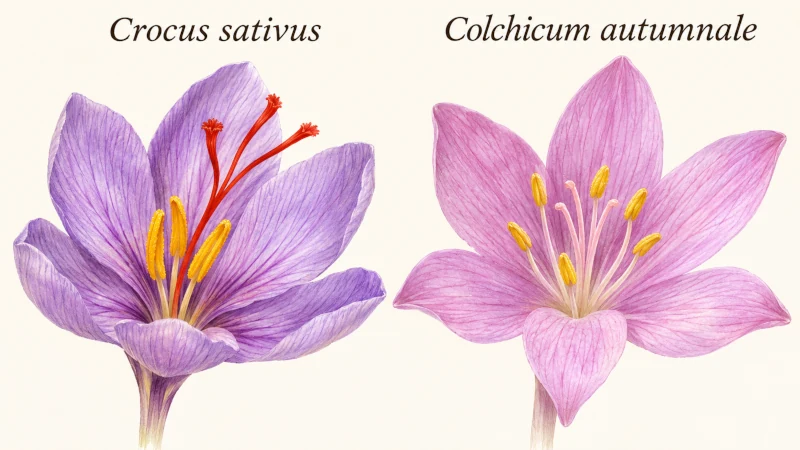
Meadow saffron is not the spice. Culinary saffron comes from Crocus sativus, a member of the iris family. Meadow saffron belongs to a different family altogether, and its other common name, autumn crocus, is just as misleading [Macquarie University, n.d.]. If you ever need to tell the flowers apart, count: a Colchicum flower has six stamens and three styles, while a true crocus has three stamens and one style [Macquarie University, n.d.]. Common names cause this sort of trouble elsewhere too. Cowslip, for one, is a name shared by two unrelated plants, one of them toxic.
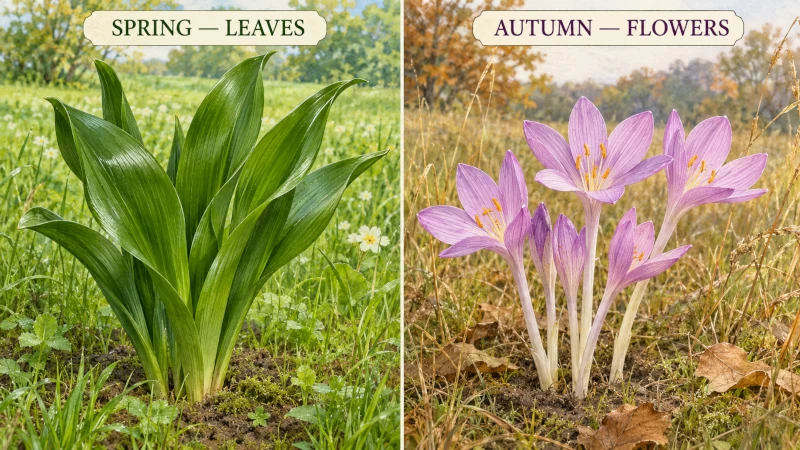
The plant also keeps an odd calendar. Its leaves come up in spring and wither, and months later the flowers rise from bare ground [IPCS INCHEM, 1997]. That gap sits behind most poisonings. In spring there is no flower to warn you.
What meadow saffron gave medicine: colchicine
Colchicine stops cells from building microtubules, the internal scaffolding they need to divide. That single action accounts for both the drug’s benefit and the multi-organ damage seen in poisoning [Medsafe, 2021].
Gout flares
For a gout flare, the American College of Rheumatology strongly recommends colchicine, an NSAID, or a glucocorticoid as first-line treatment [FitzGerald, 2020]. Colchicine is one good option among three. Which one suits you depends on your kidneys, your other medicines, and your history.
The approved dose is small: 1.2 mg at the first sign of a flare, then 0.6 mg an hour later, and no more than 1.8 mg in that hour [DailyMed, 2026]. More is not better. In the trial behind that dose, 184 people treated a flare with low-dose colchicine, a high-dose regimen of 4.8 mg over six hours, or placebo. About 38% on the low dose and 33% on the high dose met the trial’s pain-relief target, against 16% on placebo. Diarrhea struck 77% of the high-dose group and 23% of the low-dose group [Terkeltaub, 2010].
Read those numbers both ways. Colchicine clearly beat placebo, and most people still fell short of the target within a day. It is meant to be taken at the first sign of a flare, and it is not a general painkiller: the label says it should not be used for pain from other causes [DailyMed, 2026].
Preventing flares, and other approved uses
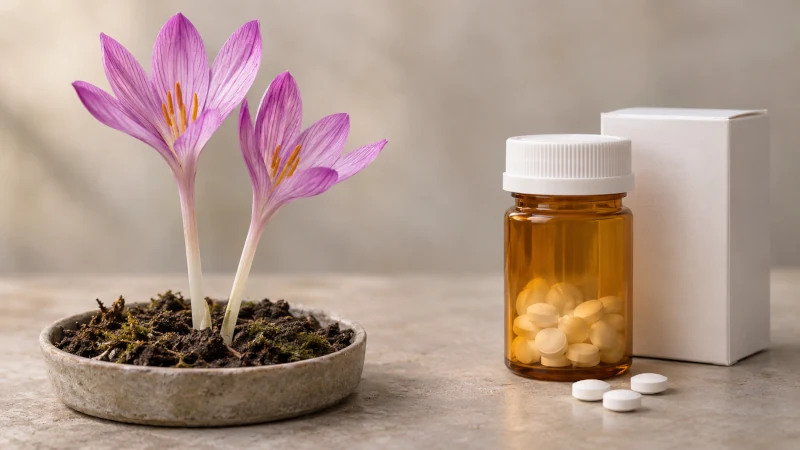
Doctors also prescribe 0.6 mg once or twice a day to prevent flares [DailyMed, 2026]. This matters most when you start urate-lowering treatment, a period when the guideline recommends anti-inflammatory cover for at least three to six months [FitzGerald, 2020]. Colchicine is approved for familial Mediterranean fever as well, and one brand, Lodoco, is approved to lower the risk of heart attack and stroke in certain adults with cardiovascular disease or risk factors [MedlinePlus, 2025].
Medicine is only part of gout care. It helps to know which foods trigger gout flares, and to take a sober look at herbs for joint and muscle pain, where the evidence for gout is thin. Meadowsweet, another plant that folk medicine links to gout, is not a gout remedy either.
Cancer research
Because colchicine blocks cell division, researchers have long studied it as a possible cancer drug. It is not used as one. The same action harms healthy dividing cells, and the narrow margin between an effective and a toxic dose rules it out [McLoughlin, 2020]. Work continues on related compounds that bind the same site on tubulin. That research gives no reason to take colchicine, or the plant, for cancer.
What the evidence supports
| Use | Strength of evidence | What it means for you |
| Prescription colchicine for gout flares | Strong: guideline recommendation backed by a randomized trial | A legitimate option, at the low labelled dose, with a prescriber who knows your other medicines. |
| Prescription colchicine for flare prevention, familial Mediterranean fever, cardiovascular risk | Established: approved indications | Used under ongoing medical supervision. |
| Colchicine or related compounds for cancer | Early-stage research; colchicine itself is too toxic | Not a treatment. |
| The plant as tea, tincture, powder, or food | None. Documented deaths. | Do not use it in any form. |
Why the meadow saffron plant can’t be used at home
The gap between a helpful dose and a deadly one is narrow, and toxicologists say no clear line separates the two [Finkelstein, 2010]. A full flare course is 1.8 mg. Deaths have been reported in adults after as little as 7 mg [Medsafe, 2021].
Now look at the plant. Colchicine makes up roughly 0.2 to 0.8% of the seeds and 0.4 to 0.6% of the bulb, and the standard toxicology monograph puts a lethal adult dose at about 5 g of seeds [IPCS INCHEM, 1997]. With ranges that wide, no tea, tincture, or powder made at home can deliver a known dose. Drying doesn’t help, and neither does heat. Colchicine survives both [IPCS INCHEM, 1997].
Foxglove tells the same story: a plant that yielded a real heart medicine and stays dangerous in the kitchen.
Meadow saffron poisoning
How people get poisoned
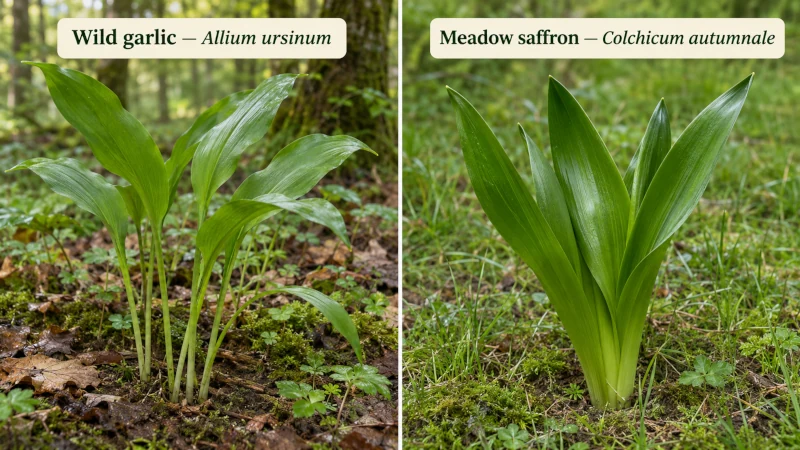
The classic mistake happens in spring. Foragers gathering wild garlic (Allium ursinum) pick meadow saffron leaves by mistake. Germany’s Federal Institute for Risk Assessment reports that these mix-ups rise every April and May across Europe [BfR, 2025]. One Slovenian hospital treated 16 adults for exactly this over 20 years. Fifteen developed bone marrow suppression, and four died [Razinger, 2021].
Three checks help. None is foolproof.
- Smell. Rub a leaf between your fingers. Wild garlic smells of garlic; meadow saffron does not. But once your fingers carry the smell, the next leaf will seem to have it too [BfR, 2025].
- Stalks. Wild garlic leaves rise from the ground on their own stalks. Meadow saffron leaves grow together into what looks like a single stem [RTV Slovenija, 2018].
- Flowers. Wild garlic blooms white in spring. Meadow saffron has no flower until autumn [RTV Slovenija, 2018].
The institute’s advice is the simplest: if you aren’t certain, don’t eat it. Buy wild garlic from a shop, or grow your own [BfR, 2025].
Other documented routes include children playing with the dried seed capsules, bulbs mistaken for onions, and milk from goats or sheep that grazed on the plant [IPCS INCHEM, 1997]. Dogs are at risk too. Any part of the plant, fresh or dried, can cause severe poisoning [Pet Poison Helpline, n.d.].
What poisoning looks like
| Stage | Timing | What happens |
| Delay | 2 to 12 hours after eating | Often nothing at all. |
| Stage 1 | First 24 hours | Nausea, vomiting, abdominal pain, and severe diarrhea, with heavy fluid loss. It can pass for food poisoning. |
| Stage 2 | About day 1 to day 7 | Multiple organs fail. The bone marrow stops producing blood cells, which opens the way to infection and bleeding; the heart, kidneys, and breathing can fail. Most deaths occur here. |
| Stage 3 | From about the second week | Survivors recover over weeks. Hair loss is common and temporary. |
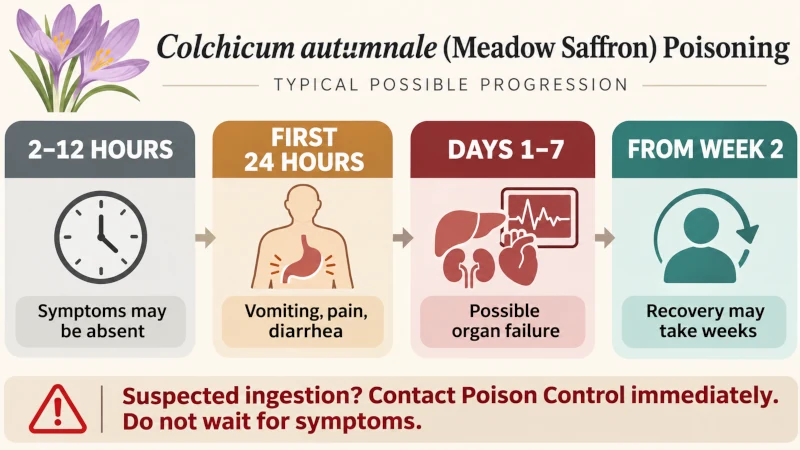
Sources: [Finkelstein, 2010; IPCS INCHEM, 1997].
The delay is the trap. Someone can feel fine for hours, then have what looks like a stomach bug, while the serious damage is still a day away. There is no antidote. Hospital care is supportive and includes activated charcoal given early [Medsafe, 2021; Finkelstein, 2010].
What to do if someone eats it
| Act before symptoms start. In the United States, call Poison Control on 1-800-222-1222 or use the webPOISONCONTROL online tool [Poison Control, 2026]. Elsewhere, call your local poison centre.Call emergency services at once if the person collapses, is hard to wake, or struggles to breathe.Bring a piece of the plant, or a photo of it. In one fatal case, the leftover plant the patient carried in was what allowed toxicologists to identify it [Brvar, 2004].Say what was eaten, how much, and when, even if the person feels well.For a pet, call your vet or a pet poison line straight away. |
If you take prescription colchicine
Side effects
Diarrhea is the most common, affecting about 23% of people treating a flare in trials. Nausea, vomiting, and stomach cramps also occur [DailyMed, 2026; MedlinePlus, 2025]. Stop the medicine and call your doctor straight away if you notice muscle pain or weakness, numbness or tingling in your fingers or toes, unusual bruising or bleeding, signs of infection, unusual tiredness, or pale or gray lips, tongue, or palms [MedlinePlus, 2025].
Drug and food interactions
This is where prescribed colchicine most often turns dangerous. Some medicines block the body’s routes for clearing it, and the FDA has recorded deaths in people taking standard doses alongside one of them, the antibiotic clarithromycin among them [FDA, 2009].
| Group | Examples named on the label |
| Strong CYP3A4 inhibitors | Clarithromycin, ketoconazole, ritonavir and other HIV protease inhibitors |
| P-glycoprotein inhibitors | Cyclosporine |
| Moderate CYP3A4 inhibitors | Diltiazem, verapamil, erythromycin, fluconazole |
| Food | Grapefruit and grapefruit juice |
| Statins and fibrates | Atorvastatin, simvastatin, gemfibrozil, fenofibrate: higher risk of muscle damage |
Source: [DailyMed, 2026].
If your kidneys or liver are impaired, colchicine must not be combined with the first two groups at all [DailyMed, 2026]. The table is not a complete list. Give your prescriber and pharmacist every medicine and supplement you take. You can also run your own list through the Drugs.com colchicine interaction checker before the appointment.
Pregnancy, breastfeeding, and fertility
Colchicine crosses the placenta. Published data in women treated for familial Mediterranean fever have not identified a drug-associated risk of major birth defects or miscarriage, though animal studies show harm to the embryo [DailyMed, 2026]. Whether to continue is a decision to make with your prescriber, ideally before you conceive.
Colchicine passes into breast milk in small amounts. LactMed estimates a nursing infant receives less than 10% of the mother’s weight-adjusted dose, reports no adverse effects in breastfed infants, and notes that many experts consider it compatible with breastfeeding. Milk levels peak two to four hours after a dose [LactMed, 2026]. In men, colchicine may rarely and temporarily reduce fertility [DailyMed, 2026].
None of this applies to the plant. Meadow saffron taken to end a pregnancy is a recognized cause of poisoning [IPCS INCHEM, 1997].
Who needs extra caution
- People with kidney or liver disease, who may need a lower dose or closer monitoring [DailyMed, 2026].
- People with blood disorders [MedlinePlus, 2025].
- Anyone taking a medicine in the table above.
- Children with gout. Colchicine is not recommended for gout in children [DailyMed, 2026].
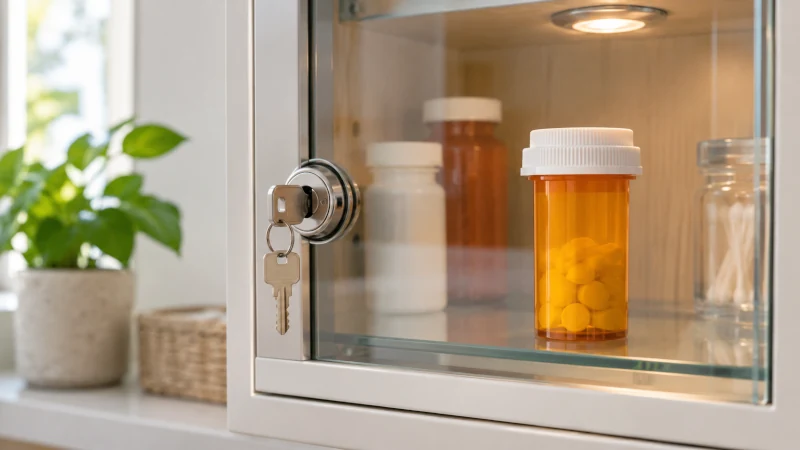
- Households with small children. In New Zealand poison-centre data, 43% of colchicine poisoning cases involved children aged one to four [Medsafe, 2021]. Lock the tablets away.
When to get medical help
- Go to an emergency department immediately after any overdose or accidental double dose, even if you feel fine. Warning signs include stomach pain, vomiting, diarrhea, unusual bleeding, and slow or irregular heartbeat or breathing [MedlinePlus, 2025].
- Call your doctor before taking more if a flare doesn’t ease, or if another starts within a few days [MedlinePlus, 2025].
- Have a first-ever hot, swollen joint examined instead of assuming it is gout, and treat a hot joint with a fever as urgent.
| HEALTH DISCLAIMER: This article is for general education. It is not medical advice and does not replace a diagnosis or treatment plan from a qualified health professional. Meadow saffron should never be eaten, brewed, or used as a home remedy. Colchicine is a prescription medicine: take it only as prescribed, and check with your doctor or pharmacist before combining it with other medicines or supplements, or if you are pregnant, breastfeeding, or living with kidney or liver disease. If you think someone has eaten meadow saffron or taken too much colchicine, contact a poison centre or emergency services immediately. |
Frequently Asked Questions
Is meadow saffron the same as saffron?
No. Saffron the spice comes from Crocus sativus, in the iris family. Meadow saffron is Colchicum autumnale, in a different family, and it is poisonous [Macquarie University, n.d.]. Never substitute one for the other.
How much meadow saffron is dangerous?
No amount is safe to eat. The toxicology monograph cites about 5 g of seeds as a lethal adult dose and records the death of a 16-year-old who ate about a dozen flowers [IPCS INCHEM, 1997]. Slovenian toxicologists consider about two plants life-threatening [RTV Slovenija, 2018]. Colchicine content varies widely, so any estimate is rough.
Does cooking or drying make it safe?
No. Colchicine is stable to heat and is not broken down by drying. Weight for weight, dried flowers contain more of it than fresh ones [IPCS INCHEM, 1997].
Is it safe to grow meadow saffron in the garden?
It is widely grown as an ornamental [IPCS INCHEM, 1997], and the danger comes from eating it. Plant it away from vegetable and herb beds, especially anything that resembles its leaves or bulbs. Keep children and dogs away from it, and wash your hands after handling it as a sensible precaution.
Can I take colchicine for other kinds of joint pain?
No. Colchicine is not a general painkiller, and the label states it should not be used for pain from other causes [DailyMed, 2026]. It is prescribed for specific conditions, at specific doses.
References
- German Federal Institute for Risk Assessment (BfR). Odour test with pitfalls: what to look out for when collecting wild garlic. View source
- Brvar M, Ploj T, Kozelj G, Mozina M, Noc M, Bunc M. Case report: fatal poisoning with Colchicum autumnale. Critical Care. View source
- DailyMed (U.S. National Library of Medicine). Colchicine tablets, USP 0.6 mg: prescribing information (AvKARE label). View source
- U.S. Food and Drug Administration. Colchicine (marketed as Colcrys) information. View source
- Finkelstein Y, Aks SE, Hutson JR, et al. Colchicine poisoning: the dark side of an ancient drug. Clinical Toxicology. View source
- FitzGerald JD, Dalbeth N, Mikuls T, et al. 2020 American College of Rheumatology Guideline for the Management of Gout. View source
- Jaeger A, Flesch F. Colchicum autumnale L. Poisons Information Monograph 142. View source
- Drugs and Lactation Database (LactMed). Colchicine. National Institute of Child Health and Human Development. View source
- Downing A, Atwell B, Marais K, Downing K. View source
- McLoughlin EC, O’Boyle NM. Colchicine-binding site inhibitors from chemistry to clinic: a review. View source
- MedlinePlus (U.S. National Library of Medicine). Colchicine: drug information. View source
- Medsafe (New Zealand Medicines and Medical Devices Safety Authority). View source
- Pet Poison Helpline. Autumn crocus. View source
- National Capital Poison Center (Poison Control). Poisonous and non-poisonous plants: an illustrated list. View source
- Razinger G, Kozelj G, Gorjup V, Grenc D, Brvar M. Accidental poisoning with autumn crocus (Colchicum autumnale): a case series. View source
- RTV Slovenija. Wife and husband die due to plant poisoning. View source
- Terkeltaub RA, Furst DE, Bennett K, Kook KA, Crockett RS, Davis MW. View source


