If you’ve come here looking up mountain holly as a herbal remedy, start with the one fact that matters most. The plant usually sold and decorated with under that name — European or Christmas holly, Ilex aquifolium — has bright red berries that are poisonous, and there is no tested safe dose for taking any part of it as a medicine. [Poison Control] Its leaves do have a long history in folk medicine for fever and rheumatism, but that reputation rests on tradition and a few animal studies, not on human trials. [PMC] Below is what the plant actually is, what’s genuinely known about it, and how to stay safe around it.
First, a naming mix-up worth clearing up
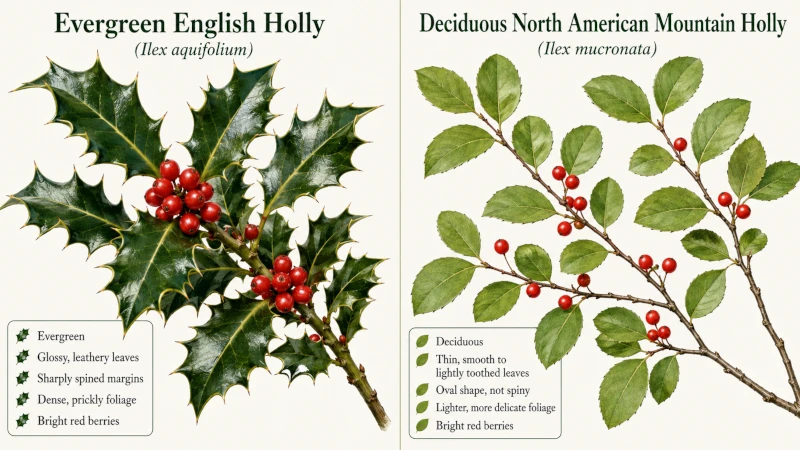
“Mountain holly” is a common name that gets attached to more than one plant, which causes real confusion. In North American botany, it properly refers to Ilex mucronata (long known as Nemopanthus mucronatus) — a deciduous shrub of bogs and wet woods that drops its leaves in winter. [Native Plant Trust]
The plant most people mean when they talk about holly at Christmas — glossy, spiny, evergreen, with red winter berries — is Ilex aquifolium, also called English holly, European holly, or Christmas holly. [ScienceDirect] The evergreen leaves, the spines, the Christmas use, and the European forests all point to Ilex aquifolium, so that’s the plant covered here. If you’re specifically after the North American wetland shrub, that’s a different plant with little medicinal literature of its own.
Mountain holly at a glance
The quick version, before the detail:
| Scientific name | Ilex aquifolium L. |
| Family | Aquifoliaceae (the holly family) |
| Common names | English holly, European holly, Christmas holly, common holly |
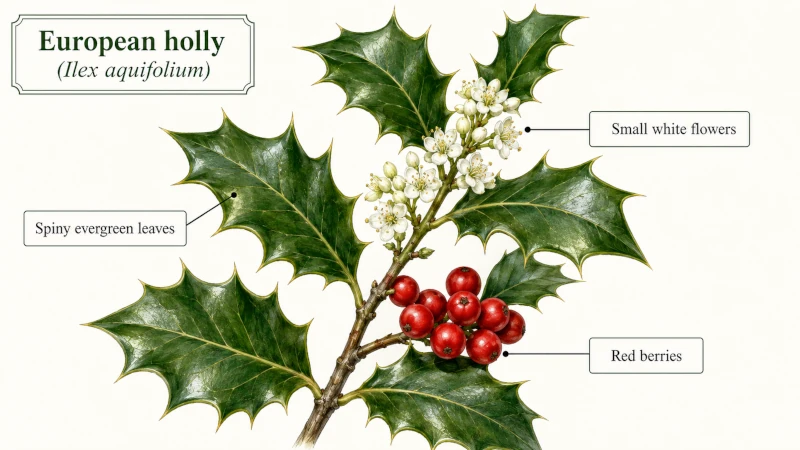
| Plant type | Evergreen shrub or small tree, roughly 1–10 m tall |
| Leaves | Dark green, stiff, glossy, with spiny edges |
| Flowers | Small, white to pinkish, in late spring and early summer |
| Berries | Bright red, persist through winter — poisonous if eaten |
| Part used in folk medicine | The leaves, in traditional infusions |
| Key safety note | Berries are toxic, especially to children and pets |
What’s actually in the leaves and berries
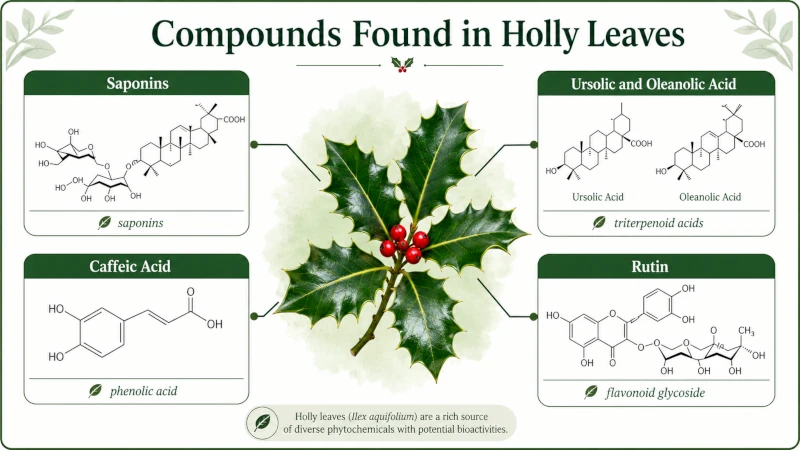
Holly leaves contain a fairly well-catalogued mix of plant compounds: triterpene saponins, triterpenoids such as ursolic and oleanolic acid, polyphenols including caffeic acid, and flavonoids such as rutin. [Pachura et al., 2021] The berries’ toxicity is linked mainly to saponins, and a cyanogenic glycoside has also been identified in the fruit. [PMC]
One correction is worth making, because it shows up in a lot of older herbal write-ups: European holly does not contain caffeine or theobromine. When chemists measured both in European Ilex aquifolium and in South American yerba mate (Ilex paraguariensis), the caffeine and theobromine turned up only in yerba mate. [Pachura et al., 2021] So the common claim that holly is a heart stimulant “because of theobromine” doesn’t hold for this species — it comes from mistaking one Ilex for another.
What folk tradition has used it for
European holly leaves have a documented place in folk medicine. They were traditionally brewed and taken as a fever-reducer, a diuretic, and an astringent, and used for intermittent fevers, rheumatism, and as an expectorant; older texts also mention uses for jaundice and other serious conditions. [PMC] Those are historical uses, not endorsements. None has been confirmed in controlled human studies, and some — like the old practice of using holly bark to prevent seizures — have no scientific basis at all.
What the research actually shows — and doesn’t
Here is the honest state of the evidence. The studies on Ilex aquifolium itself are mostly laboratory and animal work. Leaf extracts have shown moderate antibacterial activity in the lab. [PMC] In rats bred for obesity and metabolic problems, standardized saponin and terpenoid fractions from holly leaves lowered liver fat and improved some blood-lipid measures over eight weeks. [Zucker rat study, 2022]
That’s an interesting signal about the plant’s chemistry, but it’s a long way from showing that brewing holly-leaf tea does anything comparable — or anything safe — in people. There are no human clinical trials establishing that holly treats fever, arthritis, high cholesterol, or any other condition. Where you see confident health claims for holly, they lean on tradition or early animal data, not on proven effects in humans.
The part that matters most: holly is toxic
This is where careful sourcing counts, because holly is one of the more common plant-exposure calls to poison centers during the winter holidays. [Evens & Stellpflug, 2012]
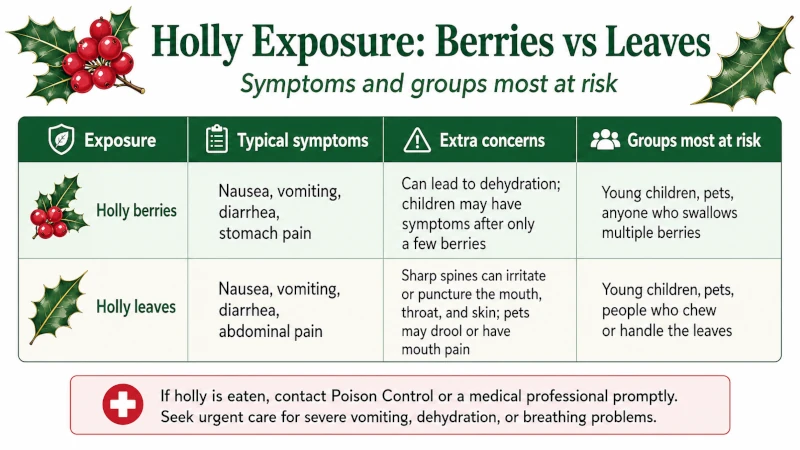
The berries. Holly berries are poisonous if eaten, with saponins as the main culprit. [Poison Control] Swallowing them tends to cause nausea, vomiting, and diarrhea, which can lead to dehydration — especially in small children. The National Capital Poison Center reports that children have developed symptoms after swallowing as few as two berries. [Poison Control] Serious poisoning generally takes a number of berries, and deaths are very rare; the danger is real but often overstated in the most alarming write-ups. [Evens & Stellpflug, 2012] Even so, “rarely fatal” is not “safe.”
The leaves. The spiny leaves pose two separate problems. The spines can cut or puncture the mouth, throat, and gut if swallowed, and the leaf can cause stomach upset — nausea, vomiting, diarrhea, cramping. [Poison Control] Some toxicology sources treat the foliage as far less of a poisoning concern than the berries, but that’s not a reason to brew and drink it.
At a glance:
| Part of plant | Main concern | Typical symptoms | Most at risk |
| Berries | Saponins (and a cyanogenic glycoside) | Nausea, vomiting, diarrhea, dehydration | Young children, pets |
| Leaves | Sharp spines; gut-irritant compounds | Mouth/throat cuts, stomach upset | Children, pets, gardeners |
Warning signs and what to do
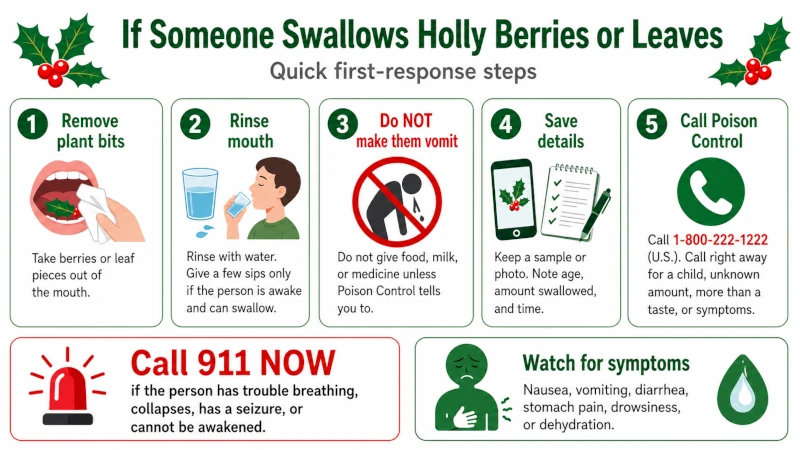
If a person or pet swallows holly, remove any plant material left in the mouth and offer a few sips of water. [Poison Control] Watch for vomiting, diarrhea, drooling, belly pain, and signs of dehydration. In the United States you can reach Poison Control at 1-800-222-1222 or use the online tool at poison.org; outside the U.S., contact your local poison center or emergency number. Get urgent care for persistent vomiting, severe abdominal pain, dehydration (little urination, dizziness, lethargy), trouble breathing, or any time a young child has swallowed berries.
Holly and pets
Dogs and cats that nibble holly usually get mild, self-limiting stomach upset — vomiting and diarrhea — and most recover quickly; the leaf spines often stop them eating much. [ScienceDirect] Call your veterinarian or the ASPCA Animal Poison Control Center if your animal has eaten holly and seems unwell.
Why you won’t find a “holly tea” dose here
Older herbals give recipes — so many grams of dried leaf per liter, a few cups a day. We’ve left those out on purpose. There is no established safe or effective dose of holly leaf for any condition; the plant’s saponins and other compounds can irritate the gut; even traditional sources concede it “demands careful dosage” and can cause nausea and vomiting; and the berries on the same plant are outright poisonous. With safer, better-studied options available for fever, aches, and the other complaints holly was traditionally used for, there’s no good reason to self-treat with it.
Who should take particular care
- Children — most at risk from the berries; keep cut holly and any dropped berries out of reach.
- People who are pregnant or breastfeeding — there’s no safety data, so avoid it.
- Anyone with a digestive condition — holly’s compounds can irritate the gut.
- Anyone on regular medication — herb–drug interactions for holly are essentially unstudied, which is its own reason for caution; ask a pharmacist or doctor before trying any herbal preparation.
Decorating with holly, and a note for wildlife
A practical seasonal point: when fresh holly comes indoors, the berries dry and drop, which puts them within reach of crawling children and pets. Poison Control suggests removing the berries before you decorate. [Poison Control] Outdoors, holly earns its keep — the berries are winter food for blackbirds, thrushes, and other birds, so leaving wild holly in place supports local wildlife. In some areas wild holly is also protected from being uprooted or stripped, so it’s worth checking local rules before cutting.
| Health Disclaimer This article is for general education and information only. It is not medical advice and is not a substitute for diagnosis or treatment from a qualified healthcare professional. Holly (Ilex aquifolium) is a toxic plant; nothing here should be read as a recommendation to eat it or take it as a remedy. If you are pregnant, breastfeeding, taking medication, or managing a health condition, talk to your doctor or pharmacist before using any herbal product. If you suspect holly poisoning, contact your local poison center or emergency services right away. |
Frequently Asked Questions
Is mountain holly the same as Christmas holly?
Not exactly. “Mountain holly” is a loose common name. In North American botany it refers to Ilex mucronata (once called Nemopanthus mucronatus), a deciduous wetland shrub. The evergreen, spiny, red-berried plant most people picture and decorate with is Ilex aquifolium — English or Christmas holly — which is what this article covers.
Are holly berries poisonous to humans?
Yes. The berries contain saponins and can cause nausea, vomiting, and diarrhea, sometimes with dehydration. Poison Control notes that children have had symptoms after swallowing as few as two berries. Serious cases are uncommon and deaths are very rare, but the berries should be kept away from children and pets.
Can you safely drink holly leaf tea?
There is no established safe or effective dose of holly leaf for any condition, and even traditional sources warn it can cause nausea and vomiting. Given the lack of human evidence and the plant’s toxicity, it’s not recommended as a home remedy.
Does holly contain caffeine?
European holly (Ilex aquifolium) does not. Lab analyses found caffeine and theobromine only in its South American relative yerba mate (Ilex paraguariensis). The old claim that holly is a stimulant “because of theobromine” comes from confusing the two species.
What should I do if my child or pet eats holly?
Remove any plant material left in the mouth and offer a few sips of water. Watch for vomiting, diarrhea, drooling, and belly pain. In the U.S., call Poison Control at 1-800-222-1222 or use poison.org; for pets, call your vet or the ASPCA Animal Poison Control Center. Seek urgent care for persistent vomiting, severe pain, breathing trouble, or signs of dehydration.
References
- National Capital Poison Center. “Holly Berries: A Beautiful Decoration but a Poisonous Snack.” Poison.org. View source
- National Capital Poison Center. “Not Just the Berries: Be Wary of Holly Leaves and Roots.” Poison.org. View source
- Evens ZN, Stellpflug SJ. “Holiday Plants with Toxic Misconceptions.” West J Emerg Med. 2012;13(6):538–542. View source
- Pachura N, et al. “Biological Potential and Chemical Profile of European Varieties of Ilex.” Foods. 2021;11(1):47. View source
- Kupczyński R, et al. “Effect of Saponins and Terpenoids from Leaves of Ilex aquifolium on Lipid Metabolism of Obese Zucker Rats.” 2022. View source
- “Identification and Quantitation of Ursolic and Oleanolic Acids in Ilex aquifolium L. Leaf Extracts.” (folk uses, constituents, fruit toxin). View source
- Native Plant Trust, Go Botany. “Ilex mucronata (mountain holly).” View source
- ScienceDirect Topics / Small Animal Toxicology. “Ilex aquifolium — overview.” View source
