
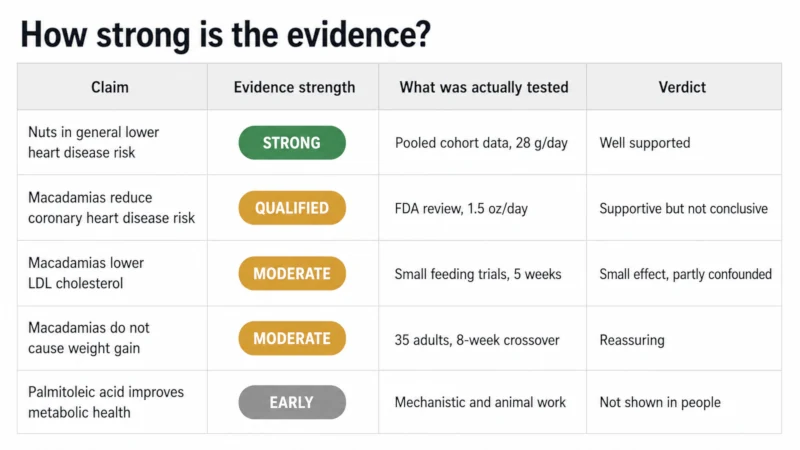
The most defensible claim about the benefits of macadamia nuts is also the most specific one anybody has made about them. In 2017 the FDA agreed that food labels could say eating 1.5 ounces of macadamias a day, as part of a diet low in saturated fat and cholesterol, “may reduce the risk of coronary heart disease” — provided the label also says “supportive but not conclusive” [FDA qualified health claim for macadamia nuts, 2017]. That hedge is doing real work, and this page keeps it.
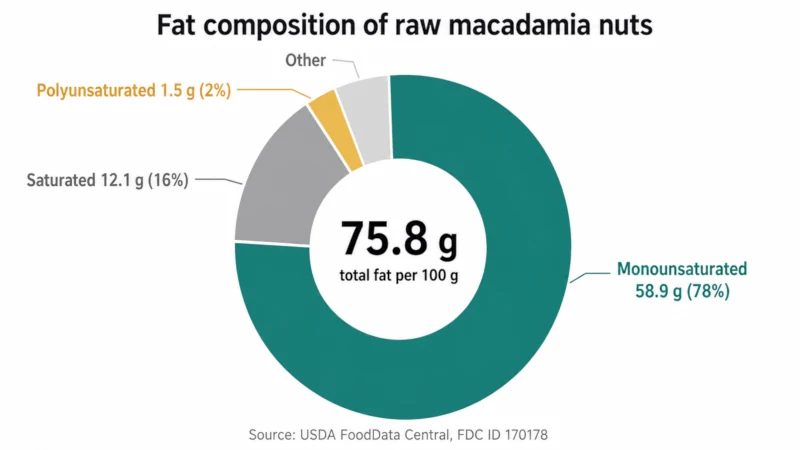
Macadamias are the fattiest nut you can buy: about 204 calories and 21.5 grams of fat in a one-ounce handful, roughly 78 percent of it monounsaturated [USDA FoodData Central, 2019]. They are also, unusually among nuts, barely studied. What follows is what the trials found, what they did not, and the safety details worth knowing before macadamias become a habit.
What’s actually in a macadamia nut
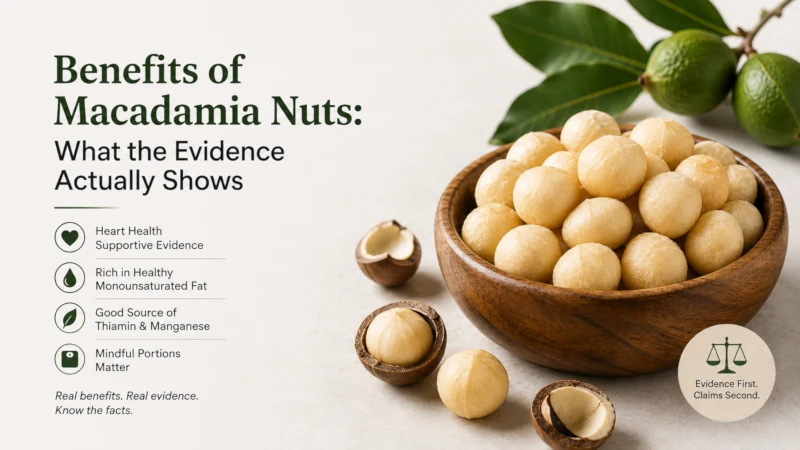
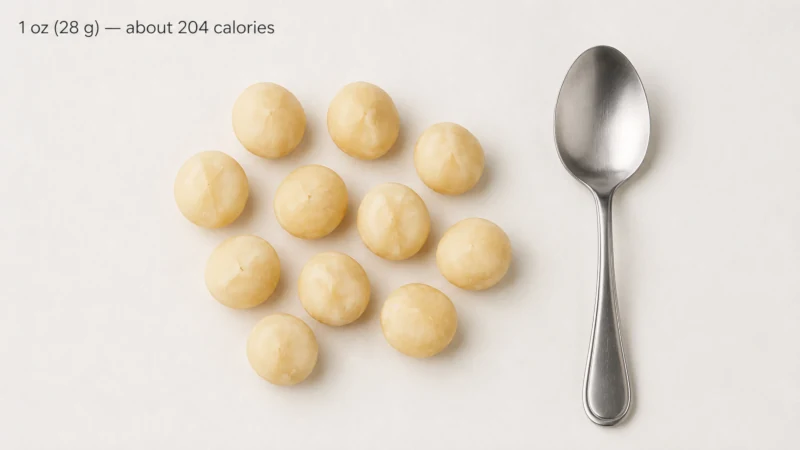
Macadamias come from two Australian trees, Macadamia integrifolia and Macadamia tetraphylla; the nuts sold as food are these species and hybrids of them [MSD Veterinary Manual, 2024]. A one-ounce serving is roughly 10 to 12 kernels.
| Nutrient | Per 1 oz (28 g, ~10–12 kernels) | Per 100 g |
| Calories | 204 kcal | 718 kcal |
| Total fat | 21.5 g | 75.8 g |
| — Monounsaturated | 16.7 g | 58.9 g |
| — Saturated | 3.4 g | 12.1 g |
| — Polyunsaturated | 0.4 g | 1.5 g |
| Protein | 2.2 g | 7.9 g |
| Carbohydrate | 3.9 g | 13.8 g |
| Fiber | 2.4 g (9% DV) | 8.6 g |
| Thiamin (B1) | 0.34 mg (28% DV) | 1.20 mg |
| Manganese | 1.17 mg (51% DV) | 4.13 mg |
| Copper | 0.21 mg (24% DV) | 0.76 mg |
| Magnesium | 37 mg (9% DV) | 130 mg |
| Iron | 1.0 mg (6% DV) | 3.69 mg |
| Calcium | 24 mg (2% DV) | 85 mg |
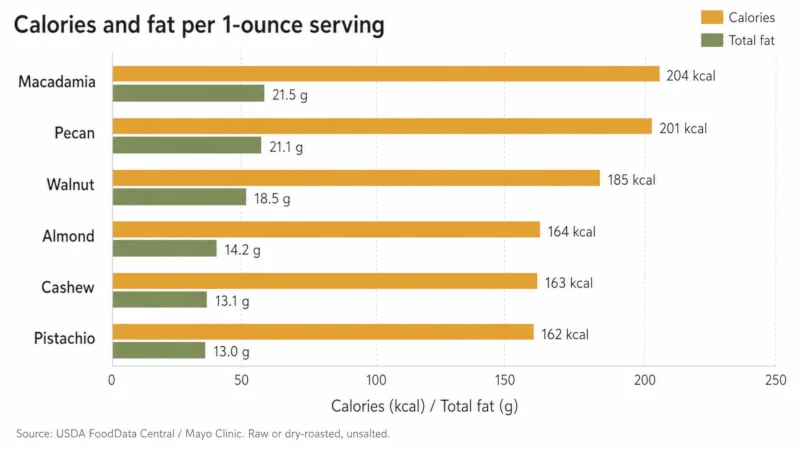
Source: USDA FoodData Central, “Nuts, macadamia nuts, raw” (FDC ID 170178). DV = Daily Value. Per-ounce figures are calculated from the per-100-gram values.
Two numbers stand out. Manganese and thiamin are genuinely high for a food eaten in small amounts — one ounce covers about half a day of manganese and a quarter of your thiamin. The fat is unusual too: macadamias carry the highest total fat and the highest monounsaturated fat of any edible nut, with very little polyunsaturated fat [Journal of Nutritional Science, 2023].
Note what is not here. Macadamias are not a meaningful protein source — 2.2 grams an ounce is less than half what you get from almonds or pistachios. Calcium, at about 2 percent of the Daily Value per ounce, is a rounding error.
Benefits of macadamia nuts, ranked by evidence
Heart health: strong for nuts, supportive but not conclusive for macadamias
The strongest evidence is not about macadamias at all. It is about nuts as a category. Pooled cohort data suggest that one 28-gram serving of nuts a day is associated with roughly 29 percent lower coronary heart disease risk and about 21 percent lower cardiovascular disease risk, and a meta-analysis of tree-nut trials found average reductions of about 4.7 mg/dL in total cholesterol and 4.8 mg/dL in LDL [Journal of Nutritional Science, 2023]. The same pattern shows up across the tree nuts this site covers, from walnuts to cashews.
Macadamias plausibly share in that benefit. The FDA’s 2017 review concluded the macadamia-specific evidence was strong enough for a qualified claim, and not strong enough for an unqualified one [FDA, 2017]. That is an honest summary of where things stand.
Cholesterol: a real effect, smaller than older studies implied
Several small controlled-feeding trials found that macadamia-rich diets lowered total and LDL cholesterol. In one, 25 adults with mildly elevated cholesterol ate 42.5 g of macadamias per 2,100 calories for five weeks and saw total and LDL cholesterol fall compared with an average American diet [Griel et al., Journal of Nutrition, 2008]. An earlier trial in men with high cholesterol found the same direction of effect [Garg et al., Journal of Nutrition, 2003].
There is a catch most summaries leave out. Three of the four older feeding studies also cut saturated fat by 5 to 6 percent of energy in the macadamia arm, so part of the cholesterol drop belongs to the saturated fat reduction rather than to the nuts [Journal of Nutritional Science, 2023].
The cleanest test of macadamias on their own is the 2023 MAC Study from Loma Linda University. Thirty-five adults with abdominal obesity and at least one cardiometabolic risk factor ate their usual diet plus macadamias at 15 percent of daily calories for eight weeks, then their usual diet without nuts for eight weeks. Total cholesterol fell 2.1 percent and LDL fell 4 percent — but neither result reached statistical significance, and saturated fat intake did not change [Journal of Nutritional Science, 2023]. Cholesterol lowering was larger in participants with overweight than in those with obesity.
Read together: expect a small nudge, not a treatment. If your LDL is high, macadamias are a reasonable food choice and a poor substitute for the plan you and your doctor make.
Weight: they do not appear to cause gain
The obvious worry with a 204-calorie handful is the scale. In the MAC Study, eight weeks of macadamias at 15 percent of calories produced no significant change in weight, BMI, waist circumference or percent body fat; the average difference was a 350-gram reduction that did not reach significance [Journal of Nutritional Science, 2023]. That is a useful, boring result. It is not evidence that macadamias cause weight loss.
Palmitoleic acid: interesting, unproven
Macadamias are one of very few foods rich in palmitoleic acid — about 17 to 19 percent of their monounsaturated fat, roughly 13 grams per 100 grams of nut [Journal of Nutritional Science, 2023; USDA, 2019]. Palmitoleate has been proposed as a “lipokine” that might reduce fat production in the liver and improve insulin resistance. That research is early and largely mechanistic, and no one has shown that eating macadamias produces those effects in people. It is a reason for researchers to keep looking, not a reason to buy nuts.
Thiamin, manganese and copper: quiet but real
An ounce of macadamias supplies about 28 percent of the Daily Value for thiamin, 51 percent for manganese and 24 percent for copper [USDA FoodData Central, 2019]. None of that treats anything. It does mean macadamias earn their spot in the snack rotation on nutrition grounds and not just on taste.
What macadamia nuts will not do
They have not been shown to lower blood pressure — that signal exists for cashews, not for macadamias. They will not reverse heart disease, prevent hardening of the arteries, detox anything, or stand in for a prescribed cholesterol medication. They are not a metabolic miracle for low-carb diets; they are simply a food that happens to be low in carbohydrate. And there is no human outcome evidence that macadamia polyphenols do anything measurable for your arteries.
Macadamia oil: what it is good for
Macadamia oil is even more monounsaturated than the whole nut, and it contains very little polyunsaturated fat — the fraction most prone to going rancid. That composition is why it holds up reasonably well to heat.
Brands publish widely varying smoke points for macadamia oil, from around 390°F for cold-pressed versions to well above 450°F for refined ones, and no independent standard settles the question. Treat any single figure you see as a marketing number rather than a measurement. Mayo Clinic’s practical guidance on nut oils applies here: they behave differently from vegetable oils and turn bitter if you overheat them [Mayo Clinic, 2026]. The oil also has none of the fiber of the whole nut, and it is still about 120 calories a tablespoon.
Side effects, interactions, and who should be careful
Tree nut allergy — the serious one
Macadamia is a tree nut, and US law requires packaged foods to name the specific tree nut on the label [FDA, 2026]. Reactions range from hives and lip swelling to anaphylaxis, which can involve throat swelling, difficulty breathing and shock.
Call 911 if you or someone else has:
- trouble breathing, wheezing, or a tight throat
- swelling of the lips, tongue or face
- widespread hives together with vomiting, dizziness or fainting
Use prescribed epinephrine first if it is available, then call 911 [FDA, 2026]. If you already know you react to tree nuts, do not test macadamias without an allergist.
Calories add up faster than with other nuts
At roughly 204 calories an ounce, macadamias are the most calorie-dense common nut — about 25 percent more than almonds and 40 percent more than pistachios for the same weight [Mayo Clinic, 2026]. Mayo Clinic suggests roughly 4 to 6 servings of unsalted nuts a week, a serving being a 1-ounce handful. Eating them out of a large bag in front of the television is the reliable way to overshoot.
Salt, coatings and rancidity
Roasted macadamias are usually salted, which matters if you are managing blood pressure. Chocolate-coated and honey-roasted versions are a different food with a different calorie and sugar profile. Because macadamias are so oil-rich, they also go rancid: store them airtight in the refrigerator or freezer, and discard any that smell like old paint or crayons.
Whole nuts are a choking hazard for children under about four years old [Mayo Clinic, 2026].
Pregnancy, breastfeeding and medications
For anyone without a nut allergy, macadamias are an ordinary food during pregnancy and breastfeeding, and there is no good evidence that avoiding nuts in pregnancy prevents allergy in the child. Macadamias have no established drug interactions. They are, however, a dense addition of fat and calories, so if you take medication for cholesterol, blood pressure or diabetes, or you are working on weight, mention the change to your doctor or a registered dietitian rather than assuming it is neutral.
Never give macadamias to a dog
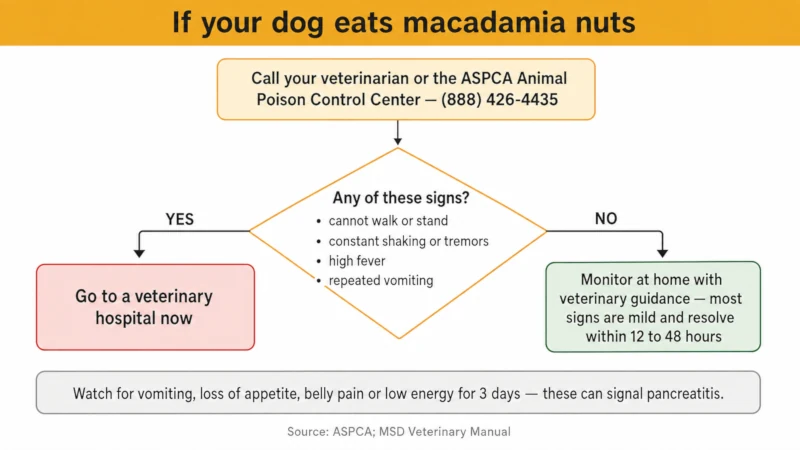
Dogs are the only species in which this reaction has been reported. Ingestion typically causes weakness — often in the hind legs — along with vomiting, unsteadiness, tremors, fever and depression, usually within 12 hours. Signs have been reported at doses as low as 2.4 grams per kilogram of body weight, and most dogs recover within 12 to 48 hours [MSD Veterinary Manual, 2024]. Because macadamias are so fatty, the ASPCA notes that pancreatitis is a rare additional risk [ASPCA, 2015].
If your dog eats macadamias, call your veterinarian or the ASPCA Animal Poison Control Center at (888) 426-4435 right away, and get to a veterinary hospital if the dog cannot walk, shakes constantly, or runs a high fever [ASPCA, 2015].
A realistic portion
The FDA’s qualified claim is built on 1.5 ounces a day, and the trials used amounts in that range [FDA, 2017]. A 1-ounce handful of unsalted macadamias, swapped in for a less useful snack rather than added on top of one, is the version most likely to help.
| Health Disclaimer: This article is for general education and information only. It is not medical advice and is not a substitute for diagnosis or treatment by a qualified healthcare professional. Macadamia nuts are a tree nut and can cause severe, potentially life-threatening allergic reactions in some people. If you think you are having an allergic reaction, call 911 or seek emergency care immediately. If you are pregnant or breastfeeding, have a known tree nut allergy, take prescription medication, or manage a condition such as high cholesterol, diabetes or heart disease, talk to your doctor, pharmacist or a registered dietitian before making significant changes to your diet. Macadamia nuts are toxic to dogs. Keep them out of reach of pets, and call your veterinarian or the ASPCA Animal Poison Control Center at (888) 426-4435 if your dog eats any. |
Frequently Asked Questions
How many macadamia nuts should I eat a day?
About 10 to 12 kernels — one ounce — is a sensible daily portion, and the FDA’s qualified heart-health claim is based on 1.5 ounces. Choose unsalted, and remember that an ounce is roughly 204 calories.
Are macadamia nuts good for cholesterol?
Modestly, at best. Older controlled-feeding trials showed lower total and LDL cholesterol, but those diets also cut saturated fat. The one trial that isolated macadamias in free-living adults found reductions of about 2 percent in total cholesterol and 4 percent in LDL that were not statistically significant.
Are macadamia nuts fattening?
They are the most calorie-dense common nut, but adding them to a normal diet for eight weeks did not increase weight or body fat in a randomized trial. Portion still matters — eating them straight from a large bag is an easy way to overshoot.
Can dogs eat macadamia nuts?
No. Macadamias cause weakness, vomiting, tremors and fever in dogs, sometimes at small doses. Call your veterinarian or the ASPCA Animal Poison Control Center at (888) 426-4435 if your dog eats any.
Is macadamia oil good for cooking?
It is very high in monounsaturated fat and low in the polyunsaturated fat that oxidizes fastest, so it tolerates heat reasonably well. Published smoke points vary widely between brands and refinement levels, so do not rely on a specific number, and avoid overheating it — nut oils turn bitter.
Are raw macadamia nuts safe to eat?
Yes. The macadamia species grown for food contain only trace amounts of cyanogenic glycosides in the kernel. The high levels belong to inedible relatives such as Macadamia ternifolia, which are not sold as food [Dahler et al., Australian Journal of Botany, 1995].
References
- U.S. Food and Drug Administration. “FDA Completes Review of Qualified Health Claim Petition for Macadamia Nuts and the Risk of Coronary Heart Disease.” FDA Constituent Update, July 24, 2017. → View source
- U.S. Department of Agriculture, Agricultural Research Service. FoodData Central: “Nuts, macadamia nuts, raw” (FDC ID 170178), SR Legacy, 2019. → View source
- Jones JL, Rajaram S, Sabaté J, et al. “Macadamia nut effects on cardiometabolic risk factors: a randomised trial.” Journal of Nutritional Science, vol. 12, 2023, e55. DOI: 10.1017/jns.2023.39. → View source
- Griel AE, Cao Y, Bagshaw DD, Cifelli AM, Holub B, Kris-Etherton PM. “A Macadamia Nut-Rich Diet Reduces Total and LDL-Cholesterol in Mildly Hypercholesterolemic Men and Women.” The Journal of Nutrition, vol. 138, no. 4, 2008, pp. 761–767. DOI: 10.1093/jn/138.4.761. → View source
- Garg ML, Blake RJ, Wills RBH. “Macadamia Nut Consumption Lowers Plasma Total and LDL Cholesterol Levels in Hypercholesterolemic Men.” The Journal of Nutrition, vol. 133, no. 4, 2003, pp. 1060–1063. DOI: 10.1093/jn/133.4.1060. → View source
- Mayo Clinic Staff. “Nuts and your heart: Eating nuts for heart health.” Mayo Clinic, January 21, 2026. → View source
- U.S. Food and Drug Administration. “Food Allergies.” FDA, content current as of March 11, 2026. → View source
- Hayes C. “Macadamia Nut Toxicosis in Dogs.” MSD Veterinary Manual, full review September 2024. → View source
- ASPCA. “Animal Poison Control Alert: Macadamia Nuts are Toxic to Dogs.” ASPCA, October 13, 2015. → View source
- Dahler JM, McConchie CA, Turnbull CGN. “Quantification of Cyanogenic Glycosides in Seedlings of Three Macadamia (Proteaceae) Species.” Australian Journal of Botany, vol. 43, 1995, pp. 619–628. DOI: 10.1071/bt9950619. → View source
