
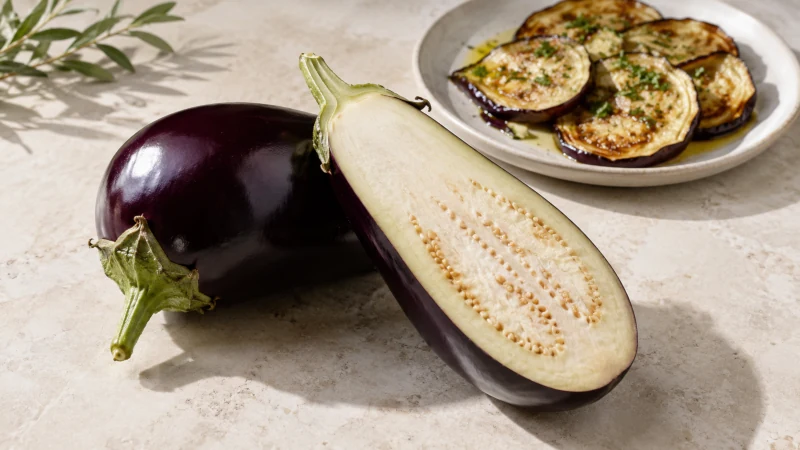
Eggplant earns a place in your kitchen for straightforward reasons: it’s low in calories, high in fiber, and easy to build a meal around. The most reliable health benefits of eggplants come from that fiber, from the plant pigments in the deep purple skin, and from a plainer fact that rarely gets credit — eggplant helps you eat more vegetables, which is one of the best-supported things you can do for long-term health. You’ll also see eggplant described as a kidney “diuretic,” a liver tonic, or a cancer preventive. Those claims don’t hold up. The honest picture is less dramatic and more useful, so let’s get it right.
What eggplant actually is
Botanically, eggplant is a fruit — the fruit of Solanum melongena, a member of the nightshade family that also includes tomatoes, peppers, and potatoes. It comes in more shapes and colors than most people realize: the familiar glossy purple globe, but also slender lavender Japanese types, small green or white varieties, and striped ones. The flesh is creamy and mild, which is why it soaks up whatever you cook it with.
Eggplant nutrition at a glance
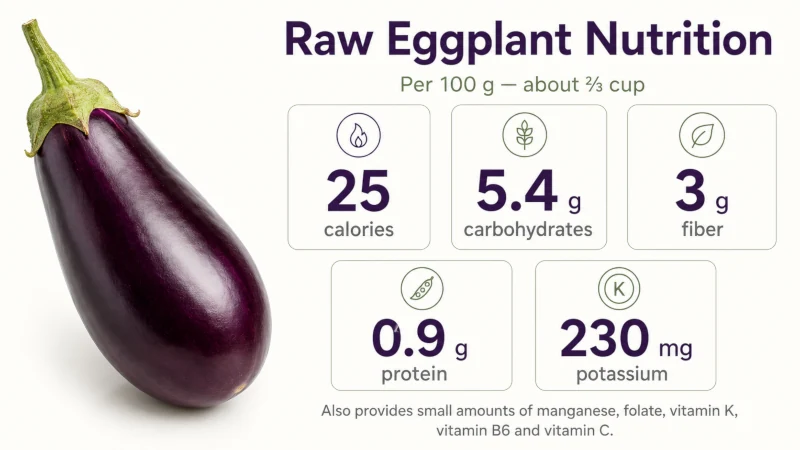
Eggplant is mostly water and fiber, with very little fat or protein. It isn’t a standout source of any single vitamin or mineral — instead it delivers small amounts of many of them Arthritis Foundation, 2025. That’s a fair way to think about it: a light, fiber-carrying vegetable rather than a nutrient powerhouse.
Here’s roughly what 100 grams of raw eggplant (about two-thirds of a cup, cubed) provides, based on USDA data. Values shift a little by variety and how it’s measured.
| Per 100 g raw (about ⅔ cup) | Amount |
| Calories | ~25 |
| Carbohydrate | ~5.4 g |
| Fiber | ~3 g |
| Protein | ~0.9 g |
| Fat | ~0.2 g |
| Potassium | ~230 mg |
| Manganese, folate, vitamin K, B6, C | small amounts |
Source: USDA FoodData Central. Cooking changes the numbers, especially calories, if you add oil.
The real health benefits of eggplants
Fiber that supports digestion and regularity
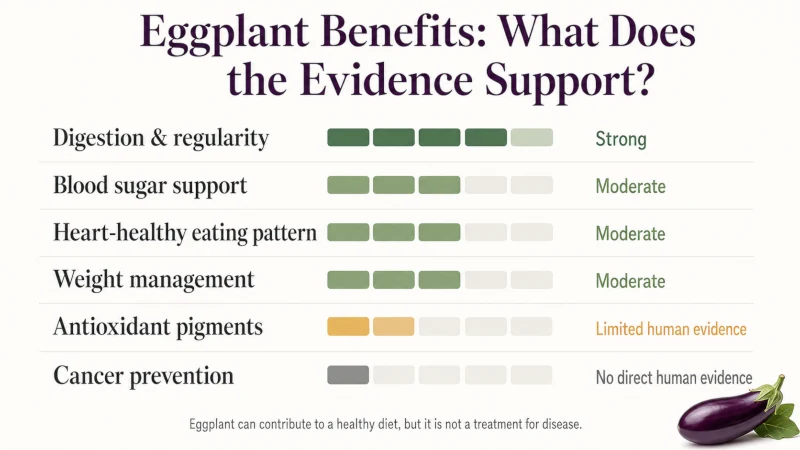
This is eggplant’s strongest, best-established benefit. Fiber adds bulk, holds water, and moves through your digestive tract largely intact, which helps you stay regular and supports gut health CDC, 2024. Most US adults get only about half the recommended 22 to 34 grams of fiber a day, so a fiber-carrying vegetable like eggplant is an easy way to close part of that gap. If regularity is your main concern, eggplant fits naturally alongside other foods that help with constipation.
Steadier blood sugar
Because your body doesn’t break fiber down, it doesn’t spike your blood sugar the way refined carbohydrates can, and it slows the absorption of sugar from the rest of your meal CDC, 2024. Swapping a starchy side for roasted eggplant, or bulking out a dish with it, is a small change that points in a helpful direction. Eggplant’s polyphenols are also being studied for effects on sugar absorption, but that research is early — treat the fiber, not the pigments, as the dependable part.
Support for heart health
Two things connect eggplant to heart health, and they deserve different confidence levels. First, fiber helps lower cholesterol by reducing how much fat and cholesterol your body absorbs, which is well established CDC, 2024. Second, the anthocyanins that color eggplant’s skin belong to a family of plant pigments that observational studies link to lower cardiovascular risk — for example, higher anthocyanin intake has been associated with a reduced risk of heart attack in women Cassidy et al., 2013.
The caveat matters: that research looks at overall dietary patterns and anthocyanins from many foods (berries most of all), not at eggplant specifically, and it can’t prove cause and effect. More broadly, eating plenty of vegetables and fruit is tied to lower risk of heart disease American Cancer Society, 2024. Eggplant is a reasonable contributor to that pattern, not a treatment. If blood pressure is your focus, eggplant works best as one piece of a bigger plate — see foods that lower blood pressure.
Antioxidants and that purple skin
The deep color of eggplant skin comes from anthocyanins, plant pigments that act as antioxidants. One eggplant anthocyanin, nasunin, has drawn research interest for protecting cells from oxidative damage in laboratory studies. That’s genuinely interesting, but “works in a test tube” and “does something measurable in your body when you eat dinner” are different bars. Human antioxidant trials have often been inconclusive. The practical takeaway: leave the skin on when you can, since that’s where the pigments live, and enjoy the color for what it reliably is — a sign you’re eating a varied, plant-rich diet.
A useful food for weight management
Eggplant is filling for very few calories. Fiber moves slowly through the stomach, which helps you feel full longer and can reduce how much you eat overall CDC, 2024. Used in place of higher-calorie ingredients — as a base instead of pasta, or as the bulk in a hearty dish — it lets you keep the volume of a meal while trimming calories. How you cook it decides whether that advantage survives.
Cancer: what’s true, and what isn’t
Here’s where careful language matters most. Some compounds in eggplant have shown anti-cancer activity in test-tube and animal studies. That’s a starting point for research, not evidence that eating eggplant prevents cancer in people, and no human studies show that it does. What is well supported is broader: diets rich in vegetables and fruit are linked to a lower risk of several cancers, and fiber specifically is associated with lower colon cancer risk American Cancer Society, 2024. Eggplant helps you eat that way. Claiming more than that isn’t supported.
Claims about eggplant that don’t hold up
You may come across eggplant sold as a diuretic for kidney stones, a “digestive tonic” that stimulates the liver, or a “detox” food. These describe a folk-medicine tradition, not clinical evidence, and there’s no good human research showing eggplant treats kidney stones, fluid retention, or liver and gallbladder conditions. Eggplant is a healthy vegetable. It is not a remedy, and it shouldn’t replace care for any diagnosed condition.
Is eggplant safe? Nightshades, solanine, and who should be careful
Eggplant, like all nightshades, contains small amounts of naturally occurring compounds called glycoalkaloids — solanine is the best known. These help the plant repel insects and can be toxic in large amounts, but no research suggests the levels in eggplant reach that kind of toxicity in humans Arthritis Foundation, 2025. (The real caution with nightshades is potatoes that have turned green, which develop much higher solanine and shouldn’t be eaten.)
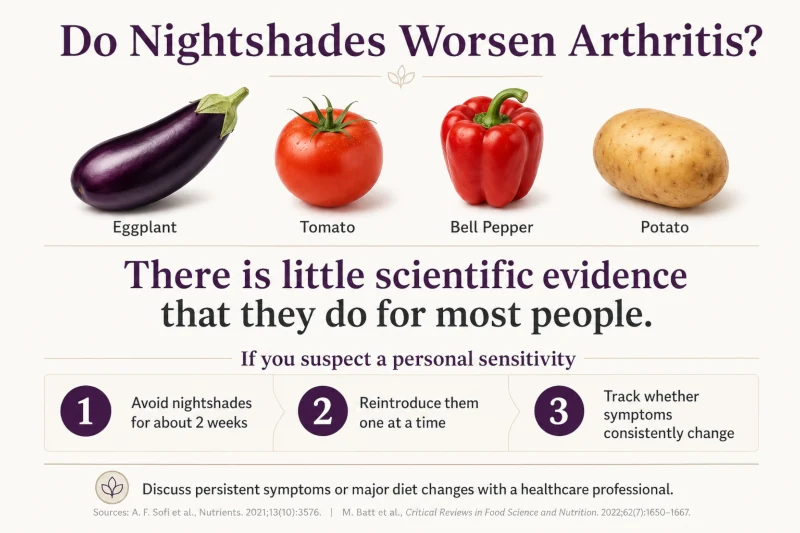
The most persistent worry is that nightshades worsen arthritis or inflammation. According to the Arthritis Foundation, there’s little scientific evidence on either side of that question. Some people say they feel worse after eating them; controlled research hasn’t confirmed a link, and doctors and dietitians generally don’t recommend cutting these nutritious foods for that reason Arthritis Foundation, 2025.
Raw vs. cooked
Eggplant is almost always cooked, and for good reason: raw, it’s spongy, bitter, and hard to enjoy. Cooking improves the taste and texture. You don’t need to fear a few thin raw slices in a dish, but there’s no benefit to eating it raw either, so cook it the way you like it.
Who should be cautious
- People with rheumatoid arthritis or another autoimmune condition who suspect nightshades trigger their symptoms. There’s no proof of a link, but if you want to test it, the Arthritis Foundation suggests removing nightshades for about two weeks, then reintroducing them one at a time with a few days between each to see whether symptoms change Arthritis Foundation, 2025.
- Anyone with a known nightshade allergy. Food allergies can be serious.
- If you take medication or have a chronic condition, talk with your doctor before making eggplant or any single food a centerpiece of a treatment plan.
How to prepare eggplant so it’s actually good for you
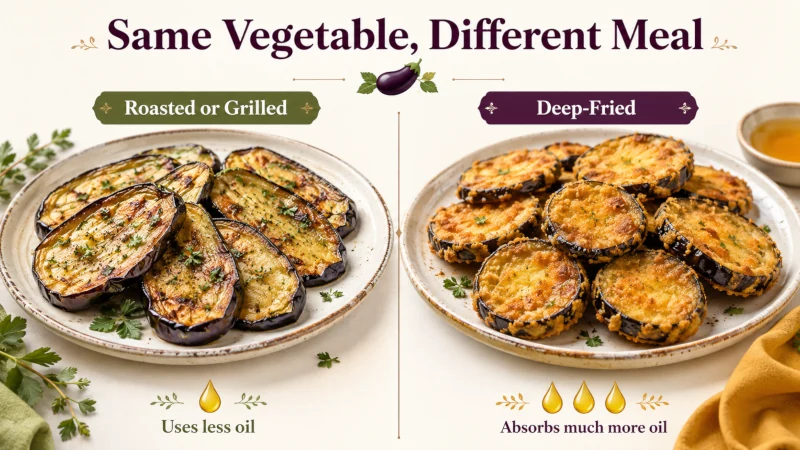
Eggplant’s one nutritional catch is that its spongy flesh drinks up oil. Deep-fried eggplant can absorb so much that a light vegetable turns into a high-calorie one, which cancels much of the reason to eat it.
Better everyday methods keep the benefits intact:
- Roast or grill it. High heat brings out natural sweetness with a modest amount of oil.
- Bake it with a brush of olive oil, herbs, and garlic for one of the simplest and healthiest preparations.
- Salt slices before cooking if you want to draw out moisture and any bitterness; it also helps the flesh absorb less oil.
- Leave the skin on when the variety allows, to keep the pigments.
A classic example is escalivada, the Catalan dish of eggplant and peppers roasted until smoky. It’s a good template: vegetables, real heat, a little good oil.
When to talk to a doctor
Eggplant is safe for the vast majority of people. Seek medical care if you have signs of a food allergy after eating it — hives, swelling of the lips or throat, or trouble breathing can be an emergency; in the US, call 911. And if you have a new, persistent change in digestion, or a specific condition you’re trying to manage through diet, bring it to your doctor rather than relying on any single food.
| Health Disclaimer: This article is for general education and information only. It is not medical advice and is not a substitute for diagnosis, treatment, or guidance from a qualified healthcare professional. Do not start, stop, or change any medication, supplement, or diet based on this page alone. If you are pregnant or breastfeeding, have a chronic condition, or take prescription medication, talk with your doctor or a registered dietitian before making major changes. If you think you are having a medical emergency, call 911. |
Frequently Asked Questions
Is eggplant good for you?
Yes. It’s low in calories, a decent source of fiber, and contains antioxidant plant pigments. Its clearest benefits come from fiber — supporting digestion, steadier blood sugar, and heart health as part of a vegetable-rich diet CDC, 2024.
Does eggplant help with weight loss?
It can help. Eggplant is filling for very few calories, and using it in place of higher-calorie ingredients cuts calories while keeping meals satisfying CDC, 2024. The exception is deep-fried eggplant, which soaks up oil and adds calories back.
Is raw eggplant safe to eat?
Eating a small amount raw isn’t dangerous for most people, but eggplant is bitter and spongy uncooked, and there’s no health advantage to eating it raw. Cooking makes it taste better and easier to digest.
Do nightshades like eggplant cause inflammation or worsen arthritis?
For most people, no. The Arthritis Foundation says there’s little scientific evidence that nightshades worsen arthritis. If you suspect they affect you, try removing them for two weeks and reintroducing them one at a time Arthritis Foundation, 2025.
Does eggplant prevent cancer?
There’s no evidence that eating eggplant prevents cancer. Some compounds show activity in lab studies only. What is supported is that a diet rich in vegetables and fruit overall is linked to lower risk of some cancers American Cancer Society, 2024.
Should I leave the skin on?
When the variety is tender enough, yes. The anthocyanin pigments that give eggplant its color sit in the skin, and the skin adds fiber.
References
- U.S. Department of Agriculture, Agricultural Research Service. “Eggplant, raw.” FoodData Central (FDC ID 2685577), 2024. → View source
- Centers for Disease Control and Prevention. “Fiber: The Carb That Helps You Manage Diabetes.” Reviewed May 2024. → View source
- Arthritis Foundation. “What You Should Know About Nightshades and Arthritis.” Updated December 18, 2025. → View source
- American Cancer Society. “Guideline for Diet and Physical Activity for Cancer Prevention.” → View source
- Cassidy A, et al. “High anthocyanin intake and reduced risk of myocardial infarction in young and middle-aged women.” Circulation, 2013. PMC3762447. → View source
