Contents
This complete guide explains nitric oxide for blood pressure and heart health, including foods, lifestyle habits, and supplement safety.
Medical disclaimer: This article is for educational purposes only and is not medical advice. If you have high blood pressure, heart disease, kidney disease, are pregnant, or take prescription medications, talk with a qualified clinician before changing treatment or starting supplements.

Nitric Oxide for Blood Pressure
Nitric oxide (NO) is a tiny signal your blood vessel lining uses to help regulate how relaxed or tight your arteries are. When NO signaling is working well, blood can move more easily and blood pressure may be a little lower.[1] [2]
For most people, the safest way to support NO is food-first (nitrate-rich vegetables) plus regular movement and good sleep. Studies and meta-analyses suggest dietary nitrate can modestly lower blood pressure and improve vascular function in some settings.[3] [4] [5] Exercise interventions are also associated with improvements in endothelial function and NO-related markers in people with hypertension.[7] This is supportive care, not a replacement for guideline-based blood pressure treatment.[8]
What nitric oxide does
Think of your arteries like flexible pipes. The inner lining (endothelium) sends chemical messages that influence how wide or narrow the pipe becomes. NO is one of the most important of these messages. It helps the muscle layer in artery walls relax, improving blood flow.[1] [2]
High blood pressure has many drivers (genetics, kidneys, salt sensitivity, vessel stiffness, stress, sleep, etc.). NO is one piece of the system—important, but not the only lever.
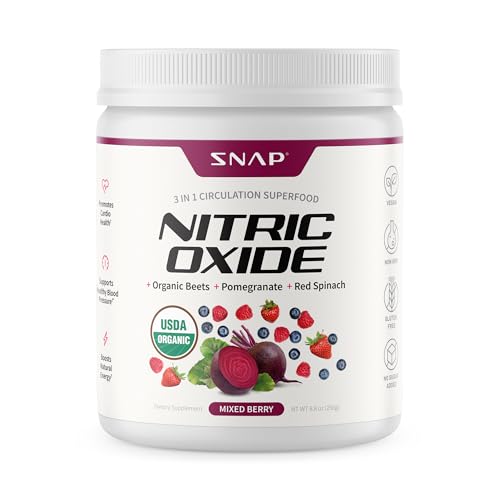
Heart Health & Circulation Support: This plant-based nitric oxide supplement is formulated with organic beetroot to support healthy circulation and heart health, helping you maintain an active lifestyle.
Two main NO pathways you’ll hear about
1) Dietary nitrate pathway
Nitrate from vegetables can be converted to nitrite and then to NO-related signaling. Oral bacteria help start this conversion, which is why the mouth can matter.[3]
Nitrate foods (greens/beets)
↓ (oral bacteria help)
Nitrite
↓
NO-related effects
2) Enzyme pathway
Your body can also produce NO through enzyme systems that use amino acids. These pathways can be affected by inflammation, oxidative stress, and chronic disease states.[1] [2]
The priority order that keeps you safe
- Priority 1: Measure and track your blood pressure correctly (this is how you know what’s real). (BP tracking)
- Priority 2: Add nitrate-rich vegetables most days. (NO foods)
- Priority 3: Move regularly (walking + simple strength). (Lifestyle)
- Priority 4: Consider supplements only if appropriate and monitored. (Supplements)
Quick reference
Nitrate-rich food starters
| Food | Easy serving idea | Notes |
| Arugula | Big salad base | Often a strong nitrate source |
| Spinach | Saute, omelet, smoothie | High oxalate; stone-prone people may need caution |
| Beets | Roast, shred, juice | Can discolor urine/stool (usually harmless) |
| Lettuce | Salads/wraps | Nitrate content varies by type |
| Celery | Snack or soup | Moderate source |
What to track for a 2–4 week test
Supplements
Safety: who should be cautious
Be extra cautious (and involve your clinician) if you take blood pressure medications, have symptoms of low blood pressure, have kidney disease, or are pregnant/breastfeeding. Kidney function and blood pressure regulation are tightly linked to NO biology.[12] If you feel faint, have chest pain, or have stroke symptoms, seek urgent care.
Common mistakes
- Changing three things at once (you won’t know what helped).
- Not measuring BP consistently (random readings = random conclusions).
- Expecting NO support to replace meds (guidelines still matter).[8]
- Using strong antibacterial mouthwash daily while focusing on nitrate foods (may blunt the pathway).[9] [10]
A simple 14-day starter plan
- Most days: 1–2 servings nitrate-rich vegetables (greens + optional beets).
- Most days: 20–40 minutes walking or similar activity.
- 3 days/week: simple strength routine (as tolerated).
- Track BP consistently (see BP tracking).
- If you use mouthwash: note whether it’s antibacterial; avoid changing dental care without professional advice.
Frequently Asked Questions
- Does nitric oxide cure high blood pressure? No. It’s one supportive lever, not a replacement for medical care.[8]
- Do nitrate foods really help? Meta-analyses suggest modest BP improvements in some settings.[5]
- Does mouthwash matter? Antibacterial mouthwash can blunt oral nitrate reduction and has been associated with BP changes in some studies.[9] [10]
- Do I need supplements? Often not first. Start with food + movement + measurement.
Micro Ingredients offers a max strength nitric oxide booster supplement with an L-Arginine and L-Citrulline complex. Made with potent bisected tablets that are easy-to-use and separate.

Recommended reading
- Nitric Oxide and Blood Pressure
- Nitric Oxide Foods
- Nitric Oxide Supplements for Blood Pressure
- Mouthwash, Oral Bacteria, and Nitric Oxide
- Lifestyle Habits That Support Nitric Oxide
References
- [1] Carlström M, Montenegro MF. Nitric Oxide Signaling and Regulation in the Cardiovascular System: Recent Advances. Pharmacol Rev. 2024. https://pubmed.ncbi.nlm.nih.gov/38866562/
- [2] Rodionov RN, et al. Nitric Oxide in Hypertension. Int J Mol Sci. 2021. (Open access via PMC) https://pmc.ncbi.nlm.nih.gov/articles/PMC8109558/
- [3] Lidder S, Webb AJ. Vascular effects of dietary nitrate via the nitrate-nitrite-nitric oxide pathway. Br J Clin Pharmacol. 2013. https://pmc.ncbi.nlm.nih.gov/articles/PMC3575935/
- [4] d’El-Rei J, et al. Beneficial Effects of Dietary Nitrate on Endothelial Function and Blood Pressure Levels. Curr Hypertens Rep. 2016. https://pmc.ncbi.nlm.nih.gov/articles/PMC4819099/
- [5] Norouzzadeh M, et al. Plasma nitrate, dietary nitrate, blood pressure, and vascular health biomarkers: systematic review and dose-response meta-analysis of RCTs. Nutr J. 2025. https://pubmed.ncbi.nlm.nih.gov/40128734/
- [6] Olas B. The Cardioprotective Role of Nitrate-Rich Vegetables. Nutrients. 2024. (Open access via PMC) https://pmc.ncbi.nlm.nih.gov/articles/PMC10931520/
- [7] Liang C, et al. Exercise interventions for the effect of endothelial function in hypertension patients: systematic review and meta-analysis. 2024. (Open access via PMC) https://pmc.ncbi.nlm.nih.gov/articles/PMC11180684/
- [8] 2025 AHA/ACC/AANP/AAPA/ABC/ACCP/ACPM/AGS/AMA/… Guideline for the Prevention, Detection, Evaluation, and Management of High Blood Pressure in Adults. Hypertension. 2025. https://www.ahajournals.org/doi/10.1161/HYP.0000000000000249
- [9] Bondonno CP, et al. Antibacterial mouthwash blunts oral nitrate reduction and increases blood pressure in treated hypertensive adults. 2015. https://pubmed.ncbi.nlm.nih.gov/25359409/
- [10] Joshipura K, et al. Over-the-counter mouthwash use, nitric oxide and hypertension risk. Blood Press. 2020. (Open access via PMC) https://pmc.ncbi.nlm.nih.gov/articles/PMC7125030/
- [11] Luo P, et al. Does L-citrulline supplementation and watermelon intake reduce blood pressure in middle-aged and older adults? Systematic review & meta-analysis of RCTs. 2025. https://pubmed.ncbi.nlm.nih.gov/40789388/
- [12] Lee J, et al. Nitric oxide in the kidney: its physiological role and pathophysiological implications. 2008. (Open access via PMC) https://pmc.ncbi.nlm.nih.gov/articles/PMC3894485/
Last updated: 2026-01-21