
If you’re asking what the caimito plant health benefits really are, here’s the honest short version: caimito is a genuinely pleasant, vitamin C–containing tropical fruit, and it comes with a long folk-medicine reputation — but almost everything written about it as a “remedy” comes from tradition and from laboratory or animal studies, not from research in people. The fruit is a nice thing to eat. The medicinal claims deserve a much more careful read, and a couple of the traditional preparations you’ll see online are not safe to try at home.
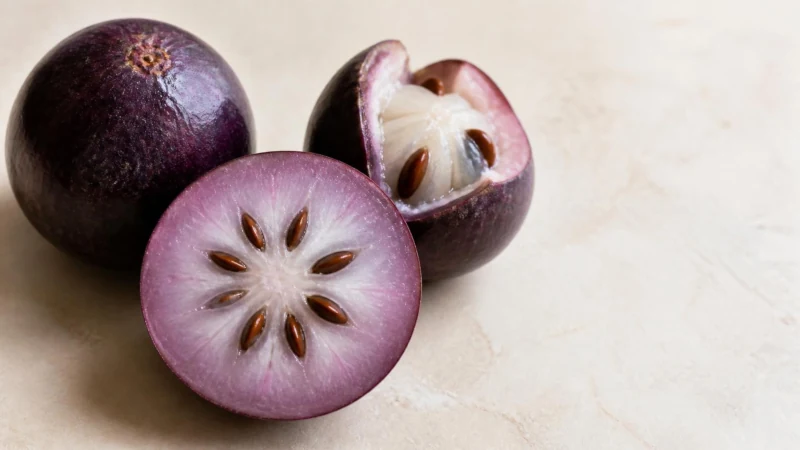
Caimito (Chrysophyllum cainito), better known in English as star apple, is the round, purple-or-green fruit that reveals a star pattern when you slice it across the middle. It grows across tropical America and, in the US, in the warmest parts of southern Florida [Morton, Fruits of Warm Climates, 1987]. Below is what stands up, what’s only promising, and what’s purely traditional — plus how to actually eat the fruit without the bitter, sticky parts that make first-timers wince.
What is the caimito plant?
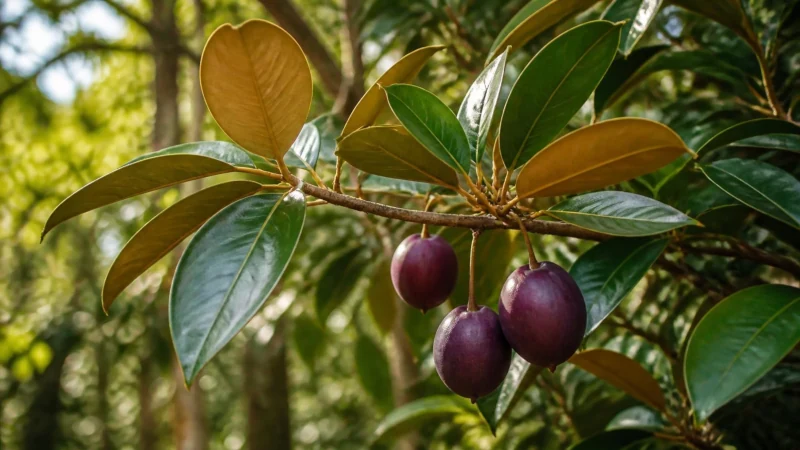
The star apple is a fast-growing evergreen tree in the Sapotaceae family, reaching anywhere from about 25 to 100 feet tall, with glossy leaves that are green on top and a distinctive silky, golden-brown underneath [Morton, Fruits of Warm Climates, 1987]. The tree is often planted as an ornamental for exactly that two-toned foliage.
The fruit is 2 to 4 inches across, with smooth skin that’s usually deep purple or pale green. Inside is soft, sweet, milky-white pulp arranged around a core of seed cells that form the “star” when the fruit is cut in half. Botanists generally place its origin in the West Indies rather than Central America, though it’s now naturalized from southern Mexico to Panama and grown around the Caribbean; it reached Florida via USDA seed introductions in the early 1900s [Morton, Fruits of Warm Climates, 1987]. You’ll also see it called cainito, purple star apple, or milk fruit.
Caimito nutrition facts (per 100 g)
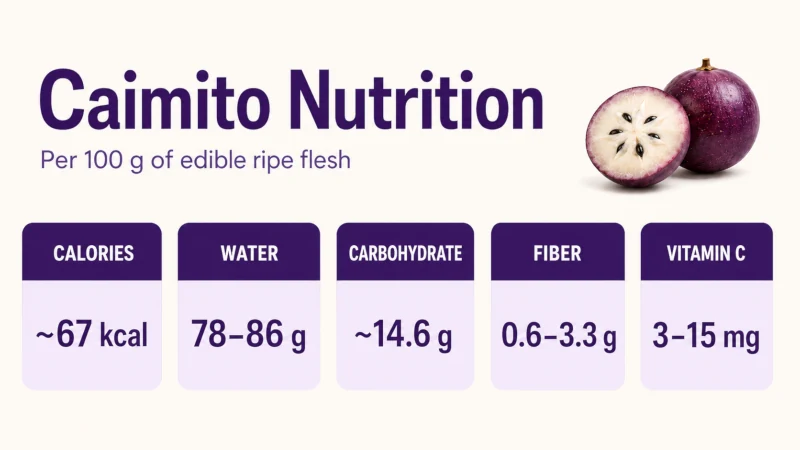
As food, caimito is a sweet, moderate-calorie fruit — most of its energy comes from carbohydrate, and it’s low in fat and protein. The values below are from analyses in Cuba and Central America and are given as ranges, because ripeness and variety change the numbers.
| Per 100 g of edible flesh | Amount |
| Calories | ~67 |
| Water | 78–86 g |
| Carbohydrate | ~14.6 g |
| Protein | 0.7–2.3 g |
| Fiber | 0.6–3.3 g |
| Vitamin C (ascorbic acid) | 3–15 mg |
| Calcium | 7–17 mg |
| Phosphorus | 16–22 mg |
| Iron | 0.3–0.7 mg |
| B vitamins (thiamine, riboflavin, niacin) | small amounts |
| Carotene (provitamin A) | trace |
Source: Morton, 1987
What stands out — and what doesn’t
The useful takeaways are modest and real. Caimito gives you some vitamin C, a little fiber, and small amounts of calcium, phosphorus, and iron, along with trace carotene the body can turn into vitamin A. What it is not is a standout source of any single nutrient — its vitamin C, for instance, is well below what you’d get from citrus, kiwi, or guava. Treat it as a tasty, hydrating fruit rather than a nutritional powerhouse, and be aware that the sweetness means real sugar: something worth keeping in mind if you’re managing blood sugar.
Caimito health benefits: what the evidence actually shows
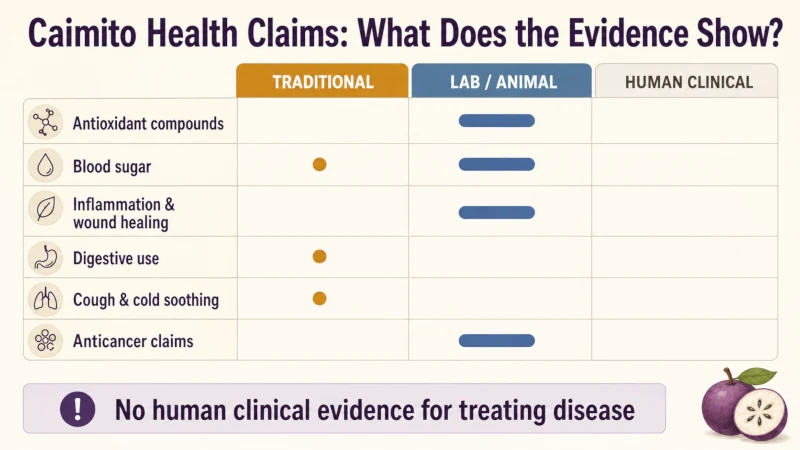
Here’s the key thing to understand before the list. Caimito has been studied mostly in test tubes and in animals. As of now, it has not been tested in human clinical trials for any health condition — the published research is a collection of laboratory assays and studies in mice, rats, and rabbits [Doan & Le, 2020]. That doesn’t make the findings worthless; it makes them early. Promising in a petri dish is a long way from “works in people,” and the honest label for most of what follows is “interesting, unproven.”
Antioxidant compounds (laboratory evidence)
This is the best-supported piece, and it’s still lab work. The pulp and peel of star apple contain polyphenols and anthocyanins, and in a well-known chemistry study, extracts from the fruit showed strong antioxidant activity in a standard DPPH free-radical test, with researchers identifying several polyphenolic antioxidants including cyanidin-3-O-glucoside [Luo et al., 2002]. Later reviews echo that the leaves, bark, and fruit are rich in antioxidant compounds [Doan & Le, 2020].
What that means in practice: eating a colorful, polyphenol-containing fruit is a reasonable part of a varied diet. It does not mean caimito “fights free radicals” in your body in any measured, health-changing way — antioxidant activity in a tube doesn’t automatically translate to a benefit you’d feel or that a doctor could track.
Blood sugar (animal studies + tradition — with a real safety catch)
Leaf and bark preparations have a traditional reputation for lowering blood sugar, and some animal work points the same direction. In one study, an aqueous extract of caimito stem bark showed antidiabetic activity in the lab through mechanisms like glucose-uptake stimulation and α-glucosidase inhibition [Doan & Le, 2020].
But the most instructive study here is also a warning. When researchers gave diabetic rabbits an aqueous decoction of caimito leaves, it did lower blood sugar at higher concentrations — and at a concentration of 30 g per liter it proved toxic: the animals stopped eating and died within weeks [Koffi et al., 2009]. That is exactly the range some online “recipes” tell people to brew and drink daily. It’s a clear reason not to self-treat with homemade leaf or bark decoctions, and a reason anyone on diabetes medication should be especially cautious, since combining a blood-sugar-lowering plant with medication can push glucose too low.
Inflammation, pain, and wound healing (animal and lab)
Caimito leaf extracts have shown anti-inflammatory and pain-reducing effects in mice, and leaf preparations sped wound healing in animal models — findings summarized across the research literature [Doan & Le, 2020]. Traditionally, the leaves have also been applied directly to skin. These are plausible leads for future study, not established treatments, and there’s no human evidence to say caimito reduces inflammation or heals wounds in people.
Digestive and “anti-diarrhea” use (traditional)
Caimito’s bark is rich in tannins, which are astringent — the same class of compounds that makes strong tea or unripe fruit feel drying in the mouth. Traditionally, a decoction of the astringent bark has been used to help stop diarrhea and dysentery, and slightly unripe fruit has been eaten in Venezuela for intestinal upset [Morton, Fruits of Warm Climates, 1987].
The astringency gives this use a plausible mechanism, but “plausible and traditional” isn’t the same as “proven,” and there’s an important flip side: eaten in excess, the unripe fruit causes constipation [Morton, Fruits of Warm Climates, 1987]. For everyday digestive complaints, the herbs that actually have evidence behind them are a better place to start than a caimito preparation — and diarrhea that’s severe, bloody, or lasting more than a couple of days is a reason to see a doctor, not to reach for a folk remedy.
Soothing coughs, sore throats, and colds (traditional)
Because the ripe fruit is soft and mucilaginous, it’s long been eaten to soothe irritation in the throat and chest, and decoctions of the fruit, rind, or leaves have a traditional role as a “pectoral” for coughs and colds [Morton, Fruits of Warm Climates, 1987]. This is comfort-measure territory: a soft, cool fruit can feel nice on a raw throat, much as warm fluids do, but there’s no evidence it shortens or treats a respiratory infection. If you’re building a plate to get through a cold, foods with actual immune-support evidence will do more.
The cancer claim (very early lab work — read this carefully)
You’ll find caimito listed as a cancer remedy, and the roots of that are twofold: a folk tradition (Morton records that people in Miami have sought the leaves to brew as a cancer treatment) and a handful of laboratory experiments in which fruit or bark extracts showed activity against cancer cell lines, such as osteosarcoma and liver-cancer cells in a dish [Morton, Fruits of Warm Climates, 1987]; [Doan & Le, 2020]. Cell-line activity is where thousands of substances look promising and almost all of them go no further. There is no human evidence that caimito prevents or treats any cancer, and it should never be used in place of real cancer care. If cancer is the concern, that’s a conversation for an oncologist.
How to eat caimito safely
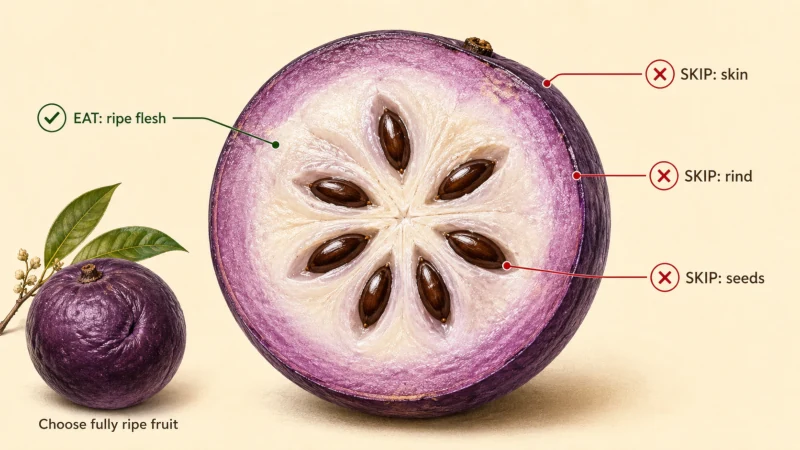
The fruit is easy to enjoy once you know the one rule: eat only the ripe flesh, and keep the rest out of your mouth.
- Pick fully ripe fruit. A ripe caimito has dull, slightly wrinkled skin and gives a little when pressed. Unripe fruit is gummy, astringent, and genuinely inedible [Morton, Fruits of Warm Climates, 1987].
- Don’t bite into it. The skin and rind — roughly a third of the fruit — aren’t edible, and the skin carries a bitter latex. Cut the fruit in half and spoon out the soft flesh, taking care not to let the latex from the skin touch the part you eat [Morton, Fruits of Warm Climates, 1987].
- Skip the seeds. Leave the seed cells and core behind; the seeds are not for eating (more on why in the safety section).
- Serve it chilled. It’s best cold, on its own or spooned into a fruit salad.
Side effects, safety, and who should avoid it
For most people, the ripe flesh eaten in normal amounts is simply food. The cautions are mainly about the other parts of the plant and the traditional medicinal preparations.
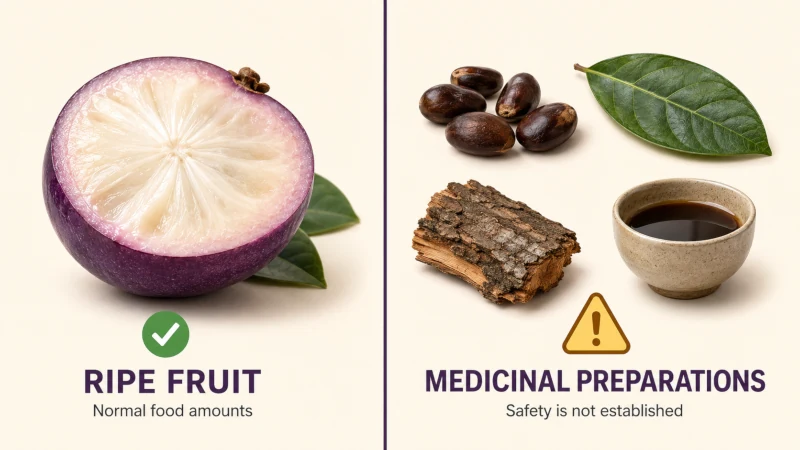
- The seeds contain a natural cyanide-releasing compound. Caimito seeds contain about 1.2% lucumin, a bitter cyanogenic glycoside [Morton, Fruits of Warm Climates, 1987]. Don’t eat, crush, or brew the raw seeds. This is a good reason to be especially careful around children, who might not know to spit them out.
- Homemade leaf and bark decoctions are not safe to self-dose. As noted above, a caimito leaf decoction was toxic and lethal to animals at a concentration that overlaps popular online “recipes” [Koffi et al., 2009]. There’s no established safe human dose, so treating yourself with concentrated leaf or bark preparations is a real risk, not a gentle one.
- Diabetes and blood-sugar medication. Because leaf and bark preparations can lower blood sugar in animals, using them alongside insulin or other glucose-lowering drugs could add up to hypoglycemia. If you have diabetes, talk to your doctor or pharmacist before using any caimito preparation medicinally — and don’t stop prescribed treatment.
- Pregnancy and breastfeeding. There’s no reliable human safety data for medicinal caimito preparations in pregnancy or breastfeeding, and the plant carries toxicity signals in animal studies. The sensible course is to enjoy the ripe fruit in normal food amounts if you like it, and avoid concentrated leaf, bark, or seed preparations.
- Overdoing the unripe fruit backfires. Eaten in excess, slightly unripe caimito causes constipation [Morton, Fruits of Warm Climates, 1987].
- Allergy. As with any food, an individual allergy is possible; stop if you react.
When to see a doctor
Caimito is not the right response to a real medical problem. Get medical care rather than relying on a caimito remedy if you have diarrhea that is bloody, severe, or lasts more than two days, or that comes with a high fever or signs of dehydration; blood sugar you’re trying to control with plant preparations; a persistent cough or chest illness that isn’t improving; or any symptom that worries you. In the US, start with primary care or urgent care for non-emergencies, and call 911 for anything severe or rapidly worsening, such as trouble breathing or chest pain.
| Health Disclaimer: This article is for general education and information only. It is not medical advice and is not a substitute for diagnosis or treatment from a qualified healthcare professional. Caimito seeds, leaves, and bark contain naturally active compounds, some of which have shown toxicity in animal studies, and plant preparations can interact with prescription medicines. If you are pregnant or breastfeeding, take medication for diabetes or any other condition, or are considering caimito for a health problem rather than simply eating the fruit, talk to your doctor or pharmacist first. Do not use caimito preparations in place of proven treatment for diabetes, cancer, infections, or any serious condition. For severe symptoms such as trouble breathing, chest pain, high fever, or signs of dehydration, seek urgent care or call 911. |
Frequently Asked Questions
Is caimito (star apple) good for you?
The ripe fruit is a reasonable, hydrating snack that supplies some vitamin C, a little fiber, and small amounts of minerals [Morton, Fruits of Warm Climates, 1987]. It isn’t an outstanding source of any one nutrient, and it’s fairly sweet, so it’s best thought of as an enjoyable fruit rather than a health remedy.
Does caimito cure diabetes?
No. Leaf and bark preparations have lowered blood sugar in animals and have a traditional antidiabetic reputation, but caimito has never been shown to treat diabetes in people, and one animal study found a leaf decoction toxic at higher concentrations [Koffi et al., 2009]. If you have diabetes, keep to your prescribed plan and talk to your doctor before trying any plant preparation.
Can you eat caimito seeds or the skin?
No. The skin and rind aren’t edible and the skin has a bitter latex, so you cut the fruit and spoon out only the soft flesh [Morton, Fruits of Warm Climates, 1987]. The seeds contain lucumin, a natural cyanide-releasing compound, and should not be eaten or crushed [Morton, Fruits of Warm Climates, 1987].
How do you know when a caimito is ripe?
Look for dull, slightly wrinkled skin and a fruit that feels a little soft when pressed. Firm, glossy, unripe fruit is gummy and astringent and not worth eating [Morton, Fruits of Warm Climates, 1987].
Is caimito safe during pregnancy?
The ripe fruit in normal food amounts is a different matter from medicinal preparations. There’s no reliable safety data for concentrated leaf, bark, or seed preparations in pregnancy or breastfeeding, and the plant shows toxicity signals in animals — so avoid those preparations and check with your doctor if you’re unsure.
Are the health benefits of caimito proven?
Mostly not. The antioxidant, blood-sugar, anti-inflammatory, and anticancer findings come from laboratory and animal studies, and the digestive and respiratory uses are traditional. There are no human clinical trials showing caimito treats any condition [Doan & Le, 2020].
References
- Morton, J. F. “Star Apple (Chrysophyllum cainito).” Fruits of Warm Climates, Miami, FL, 1987, pp. 408–410. Hosted by Purdue University NewCROP. View source
- Doan, H. V., & Le, T. P. “Chrysophyllum cainito: A Tropical Fruit with Multiple Health Benefits.” Evidence-Based Complementary and Alternative Medicine, 2020, article 7259267. PMID 32148550; PMCID PMC7049829; DOI 10.1155/2020/7259267. View source
- Luo, X. D., Basile, M. J., & Kennelly, E. J. “Polyphenolic Antioxidants from the Fruits of Chrysophyllum cainito L. (Star Apple).” Journal of Agricultural and Food Chemistry, 2002;50(6):1379–1382. PMID 11879006. View source
- Koffi, N’G., Ernest, A. K., Marie-Solange, T., Beugré, K., & Noël, Z. G. “Effect of Aqueous Extract of Chrysophyllum cainito Leaves on the Glycaemia of Diabetic Rabbits.” African Journal of Pharmacy and Pharmacology, 2009;3(10):501–506. (Côte d’Ivoire.) View source
