
Here is the short version. Rubbing certain vitamins on your skin can lighten a sun spot, slowly and partially. Swallowing those same vitamins as pills has never been shown to do it. The topical ingredients with the best human evidence are retinoids (the vitamin A family) and, to a lesser degree, vitamin C and niacinamide (vitamin B3). Vitamin E, which appears on almost every list of vitamins for age spots, has the weakest case of the four.
And before any of that: a flat brown mark on sun-exposed skin is usually harmless, but not always. Getting it identified first is the single most useful thing on this page.
What an age spot actually is
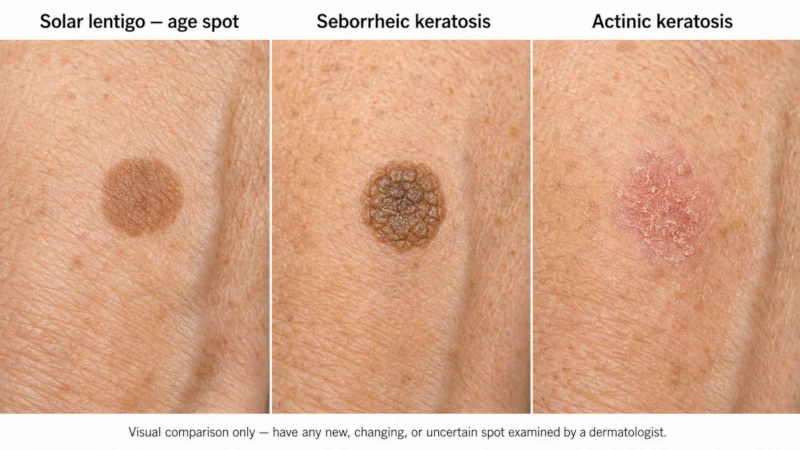
The medical name is solar lentigo (plural: lentigines). Age spot, sun spot, liver spot and senile freckle all describe the same thing: a flat, well-defined patch of extra pigment on skin that has taken years of ultraviolet light [DermNet, solar lentigo, reviewed November 2025]. They cluster where the sun lands hardest — backs of hands, forearms, face, upper back, shins.
One detail is worth knowing because it explains why treatment is slow. In a solar lentigo, the number of pigment-producing cells is normal or only slightly raised. What changes is how much melanin those cells make and how much of it the surrounding skin cells hold onto [DermNet, 2025]. You are not removing extra cells. You are trying to persuade normal cells to make and keep less pigment, which takes months.
They are also common. DermNet, a New Zealand dermatology resource, reports solar lentigines in up to 90% of people with lighter skin (Fitzpatrick types I and II) over the age of 60, and notes they are also frequent in Asian populations, where they tend to appear on the face [DermNet, 2025]. Unlike freckles, they do not fade over winter.
Age spots themselves cause no symptoms. No itch, no pain, no bleeding. They are benign. But they are a visible record of UV exposure, and DermNet lists them as an independent risk factor for melanoma — not because a spot turns into cancer, but because the skin around it has taken the damage that raises risk.
Get the spot identified before you treat it
The American Academy of Dermatology recommends seeing a board-certified dermatologist before using any cream or lotion on an age spot, for a specific reason: several other things look like one. Seborrheic keratoses, actinic keratoses and skin cancer all become more common with age and sun exposure [AAD, What can get rid of age spots?]. Fade a skin cancer with a brightening cream and you have hidden it while it grows.
That is not a scare tactic; it is a sequencing problem. A dermatologist can tell you in one visit whether the mark is a lentigo, and can then say whether an over-the-counter product is worth your money or whether a prescription or procedure would work better.
The evidence, vitamin by vitamin
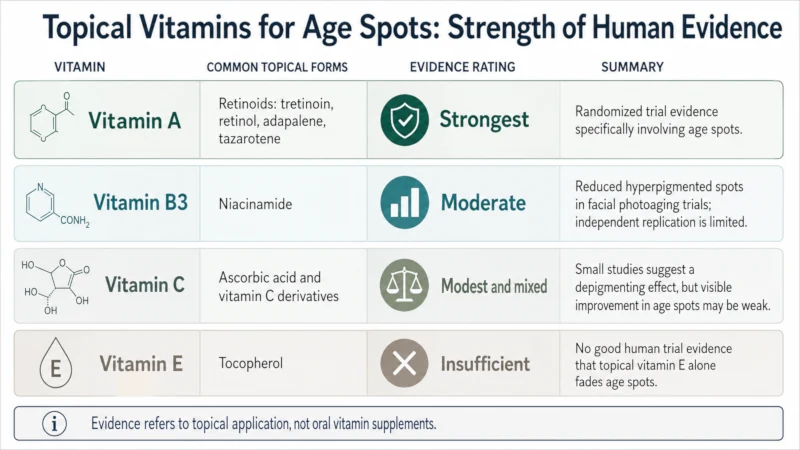
The four vitamins usually named for age spots do not sit in the same evidence tier. Here is where each one honestly lands.
| Vitamin (topical) | What the human evidence shows | Evidence strength |
| Vitamin A (retinoids: tretinoin, retinol, adapalene, tazarotene) | Randomized trial data specifically in age spots; also the topical partner in the best-supported combination treatment | Strongest of the four |
| Vitamin B3 (niacinamide) | Reduces hyperpigmented spots in facial photoaging trials; most key studies industry-authored | Moderate, with conflict-of-interest caveats |
| Vitamin C (ascorbic acid and derivatives) | Depigmenting effect across small trials; the one trial done directly on age spots found the effect weak | Modest and mixed |
| Vitamin E (tocopherol) | No good human trials for fading age spots; mainly used to stabilize vitamin C formulas | Insufficient |
Vitamin A and retinoids: the best case of the four
This is the one with a landmark trial behind it. In a 10-month randomized, double-blind study published in the New England Journal of Medicine, 58 patients applied either 0.1% tretinoin or a vehicle cream daily to the face, upper arms, or both; the tretinoin group’s liver spots improved significantly [Rafal et al., NEJM, 1992]. That is old research, but it is the kind rarely done for cosmetic ingredients: randomized, controlled, and measured on age spots specifically.
A 2025 systematic review of 41 clinical trials covering 3,234 patients found the most commonly effective topical treatment for solar lentigines was a prescription combination of mequinol 2% with tretinoin 0.01%, with efficacy reported between 52.6% and over 80%, best on facial spots [Mardani et al., Journal of Cosmetic Dermatology, 2025]. The vitamin A derivative is doing part of that work.
The AAD lists retinoids — retinol, tretinoin, adapalene gel and tazarotene — among the over-the-counter ingredients that can fade dark spots [AAD, How to fade dark spots]. Worth knowing: over-the-counter retinol is a weaker relative of prescription tretinoin, so results are generally slower and smaller. Expect months, not weeks, and expect some dryness and flaking early on.
Vitamin B3 (niacinamide): reasonable, with a caveat about who funded it
Niacinamide works differently from the others. Rather than blocking pigment production, it interferes with the handoff of melanin from pigment cells to skin cells. In the study that established this, niacinamide inhibited that transfer by 35–68% in laboratory models, and the accompanying clinical work in Japanese women found reduced facial hyperpigmentation and increased skin lightness [Hakozaki et al., British Journal of Dermatology, 2002].
A separate 12-week double-blind, half-face trial in 50 women with facial photoaging found 5% niacinamide reduced hyperpigmented spots, fine lines, red blotchiness and sallowness compared with the vehicle on the other side of the same face [Bissett et al., Dermatologic Surgery, 2005].
Two honest qualifications. Both of those studies were authored by researchers at Procter & Gamble, a company selling niacinamide-containing skincare, which does not make the results wrong but does mean independent replication would strengthen the case. And both measured general facial hyperpigmentation in photoaged skin rather than solar lentigines specifically. Niacinamide also does not appear on the AAD’s list of over-the-counter dark-spot ingredients, which is itself informative.
On the practical side, niacinamide is one of the gentlest actives available. Most people tolerate 4–5% without irritation, and it layers well with sunscreen.
Vitamin C: real, but weaker on age spots than the marketing suggests
Vitamin C inhibits tyrosinase, an enzyme in the melanin production line, and the AAD includes it among the over-the-counter ingredients that can fade dark spots [AAD, How to fade dark spots]. A 2023 systematic review of seven randomized trials with 139 participants total concluded that topical vitamin C helps uneven, wrinkled skin and has depigmenting properties, but that long-term use is needed for visible change and larger studies are still required [Correia & Magina, Journal of Cosmetic Dermatology, 2023]. One hundred and thirty-nine people across seven trials is a thin base to stand on.
The most directly relevant trial is more sobering. Twenty-seven Japanese women with age spots on both sides of the face applied a 6% ascorbate-2-phosphate lotion to one side and a placebo to the other, twice daily for 24 weeks. After six months, the visual pigmentation scores were not significantly different between the two sides. Instrument-measured skin lightness did improve on the treated side, and the researchers described the result as a weak but significant anti-pigmenting effect [Ishikawa et al., Archives of Dermatological Research, 2019].
Read that as a realistic forecast: half a year of twice-daily use, a measurable change, and possibly not one you or anyone else would notice by eye. Vitamin C is a defensible ingredient. It is not an eraser.
Vitamin E: the weakest link on the list
Vitamin E is a genuine antioxidant and a decent moisturizing ingredient, and it stabilizes vitamin C in serums, which is why the two are so often sold together. What it does not have is human trial evidence for fading age spots. It is absent from the AAD’s list of over-the-counter ingredients that fade dark spots [AAD, How to fade dark spots], and it did not surface as an effective topical monotherapy in the 2025 systematic review of solar lentigine treatments [Mardani et al., 2025].
If it is in a formula alongside vitamin C, fine. Buying it on its own to treat spots is not supported.
Do oral vitamin supplements fade age spots?
There is no good evidence that swallowing vitamin C, E, A or B3 lightens an existing age spot. That claim circulates widely, but it does not trace back to trials in people with solar lentigines. The research showing benefit — all of it discussed above — involves products applied to the skin, at concentrations far higher than anything reaching the skin through the bloodstream.
Correcting a real deficiency is a different matter, and worth doing for its own sake. But a well-nourished person adding a vitamin pill should not expect their hands to look different.
Eating well still earns its place, just for different reasons. If you want the food angle, the site’s guides to the best vitamin C rich foods and vitamin A benefits, food sources and safe intake cover which foods actually deliver meaningful amounts — and, in the case of vitamin A, where “more” becomes a problem.
What works better than vitamins on age spots
If the goal is visible fading rather than incremental improvement, procedures outperform creams. The 2025 systematic review reported success rates by modality across 41 trials [Mardani et al., 2025]:
| Treatment | Reported success range |
| Picosecond laser | 67.9% – 93.0% |
| Intense pulsed light (IPL) | 74.6% – 90% |
| Q-switched laser | 36.4% – 76.6% |
| Cryotherapy (freezing) | 37% – 71.4% |
| Mequinol 2% + tretinoin 0.01% (topical, prescription) | 52.6% – over 80% (facial) |
| Pulsed dye laser | 27% – 57% |
| Trichloroacetic acid chemical peel | 12% – 46% |
| Fractional CO₂ laser | 8% – 23% |
Those ranges are wide because the trials measured different things in different populations, and the reviewers could not pool them into a meta-analysis. Treat them as a rough ordering, not a promise. The reviewers also noted that pulsed dye laser and IPL were less likely to leave post-inflammatory darkening behind, while cryotherapy carried the more severe side effects.
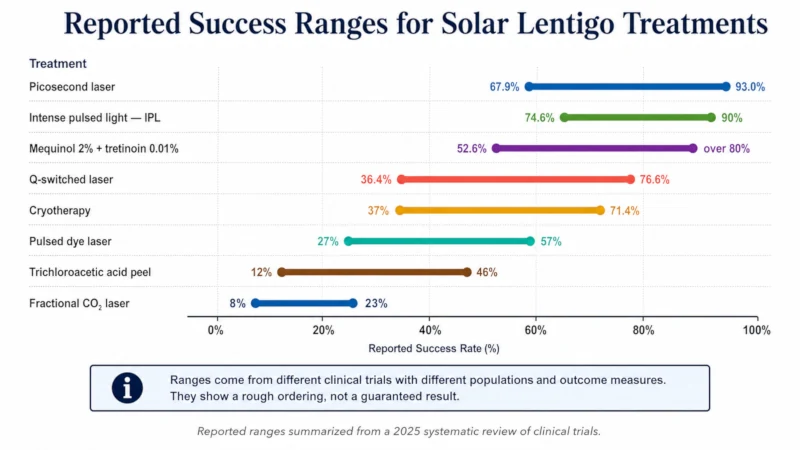
The AAD makes the same broad point in plainer terms: procedures work faster but cost more and carry a higher risk of side effects, while creams require applying something once or twice a day for weeks to months [AAD, What can get rid of age spots?]. Cryotherapy can leave a permanently lighter halo around the treated spot or, occasionally, a darker one.
Sun protection is the part that decides whether any of it lasts
Age spots come back. Every source above says so. The AAD is explicit that after any treatment, preventing recurrence means seeking shade, covering up with sun-protective clothing and a wide-brimmed hat, and applying sunscreen that is broad-spectrum, SPF 30 or higher, and water resistant [AAD, What can get rid of age spots?]. DermNet adds that rigorous sun protection on its own reduces the risk of new lentigines and may modestly lighten the ones you already have [DermNet, 2025].
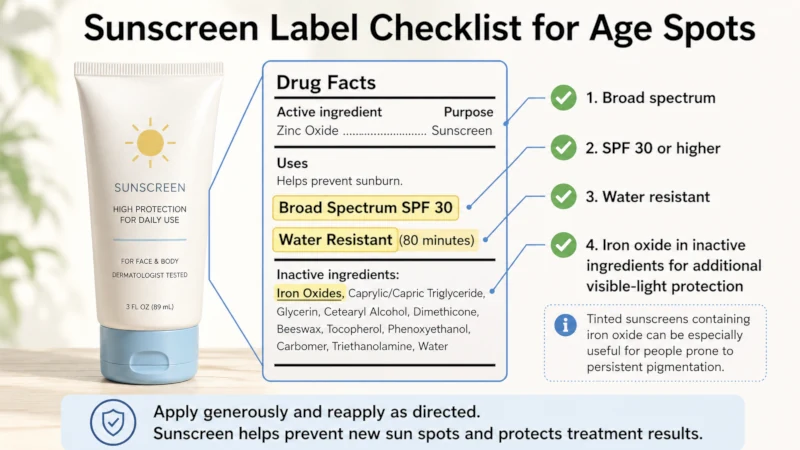
One refinement for anyone with a medium or deeper skin tone: visible light, not just UV, drives pigmentation. The AAD recommends a tinted sunscreen containing iron oxide, listed among the inactive ingredients, alongside the usual SPF 30, broad-spectrum and water-resistant criteria [AAD, How to fade dark spots].
Safety: side effects, interactions and who should be careful
On the skin
- Retinoids commonly cause dryness, redness, peeling and stinging in the first few weeks, and increase sun sensitivity. Start every other night and use sunscreen daily.
- Vitamin C serums are formulated at a low pH to penetrate, which can sting or irritate sensitive or compromised skin.
- Niacinamide is usually well tolerated; irritation appears more often at higher concentrations than lower ones.
- Patch test any new active on the inner forearm for 48 hours before using it on your face, and stop anything that burns rather than pushing through.
Swallowed as supplements
These upper limits are the daily ceilings above which harm becomes more likely. They are not targets, and they are not a reason to take a supplement.
| Vitamin | Adult upper limit | What happens above it |
| Vitamin C | 2,000 mg/day (all sources) | Diarrhea, nausea, abdominal cramps; kidney-stone concerns in susceptible people |
| Vitamin E | 1,000 mg/day (supplements) | Increased bleeding risk, including hemorrhagic stroke |
| Vitamin A (preformed) | 3,000 mcg RAE/day (≈10,000 IU) | Liver abnormalities; birth defects if taken in pregnancy |
| Niacin / niacinamide | 35 mg/day (supplements) | Nicotinic acid: flushing from about 30 mg. Niacinamide at 500 mg/day or more: diarrhea, easy bruising, more bleeding from wounds; 3,000 mg/day or more: nausea, vomiting, liver damage |
Sources for the table above: NIH Office of Dietary Supplements — Niacin, Vitamin C, Vitamin E and Vitamin A and Carotenoids.
Medication interactions worth raising with a pharmacist
- Vitamin E can inhibit platelet function and antagonize vitamin K–dependent clotting factors, so large doses alongside anticoagulants or antiplatelet drugs such as warfarin raise bleeding risk.
- Vitamin C supplements may interact with chemotherapy and radiation therapy; the NIH notes it is unclear whether antioxidants protect tumor cells or healthy ones, so this is a conversation to have before starting, not after.
- High-dose nicotinic acid (1,500 mg/day or more) can raise blood sugar and interfere with diabetes medications.
- Orlistat reduces vitamin A absorption.
Pregnancy and breastfeeding
Excess preformed vitamin A early in pregnancy can cause birth defects, and oral retinoid medications such as isotretinoin are strongly linked to them [NIH Office of Dietary Supplements, Vitamin A]. Topical retinoids are a separate question from oral ones, but many clinicians advise pausing them during pregnancy; ask your obstetric provider rather than deciding from a label. Beta-carotene from food is not associated with these risks. Age spots are cosmetic — there is no urgency that justifies taking a chance here.
Who should be more cautious
- Anyone with an undiagnosed spot. Identification first, treatment second.
- People with medium to deep skin tones considering lasers, peels or cryotherapy, because of a higher risk of post-inflammatory darkening or permanent lightening.
- Anyone taking several prescription medicines — a pharmacist can screen for interactions in a minute, with no appointment.
- People taking anticoagulants, on cancer treatment, or with liver disease, before adding any high-dose supplement.
Skip over-the-counter “skin lightening” products
The FDA advises consumers not to use over-the-counter skin lightening products and states plainly that there are no FDA-approved or legally marketed OTC skin lightening products. Agency laboratory testing has repeatedly found high levels of mercury, hydroquinone, or both — often undeclared on the label. Reported harms include kidney damage, neurological effects, and skin rashes, facial swelling and permanent discoloration (ochronosis) [U.S. Food and Drug Administration, updated June 2026]. The agency notes that children and pregnant people face heightened risk.
The AAD makes a related point: skin care products imported from other countries have been found to contain undisclosed steroids or mercury [AAD, How to fade dark spots]. If a product promises to bleach spots in days, that promise is the warning.
When to stop treating and see a doctor
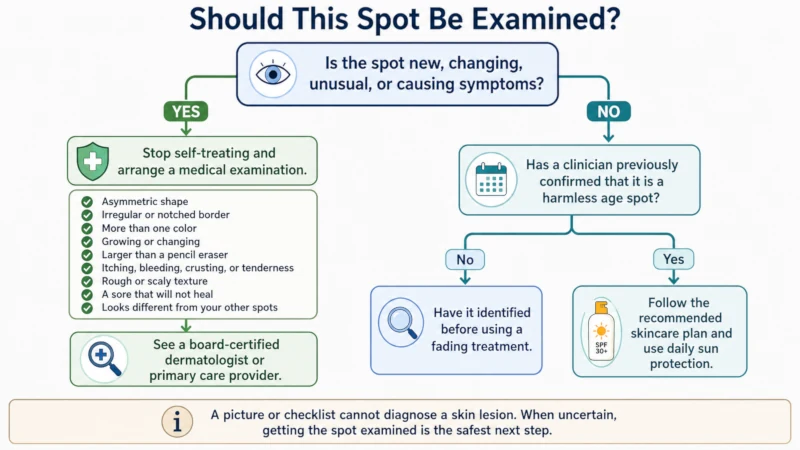
A true age spot is flat, one even shade, stable in shape, and causes no symptoms. Anything that departs from that description needs eyes on it.
Make an appointment with a dermatologist or your primary care provider if a spot:
- Is asymmetric, has an irregular or notched border, contains more than one color, is larger than a pencil eraser, or has changed over recent weeks or months
- Itches, bleeds, crusts, or becomes tender
- Sits on skin that is rough or scaly to the touch, which can point to an actinic keratosis rather than a lentigo
- Is a sore that will not heal, or a new growth that appeared and grew quickly
- Looks different from every other spot on your body
If you are unsure, that uncertainty is itself the reason to go. Skin cancer found early is highly treatable, and a dermatologist can settle the question in a single visit. Many practices and urgent care clinics can see you quickly; you do not need to wait for an annual physical.
| HEALTH DISCLAIMER: This article is for general education and is not medical advice, diagnosis or treatment. Flat brown marks on the skin can look alike and be treated very differently — what appears to be an age spot may be a seborrheic keratosis, an actinic keratosis, or a skin cancer. Have a new, changing or uncertain spot examined by a board-certified dermatologist before applying any fading product to it. Talk with your doctor or pharmacist before starting any supplement or prescription-strength topical, particularly if you are pregnant or breastfeeding, taking anticoagulants or cancer treatment, living with liver disease, or taking several medicines. If a spot bleeds, itches, will not heal, or changes in size, shape or color, seek medical care rather than continuing to self-treat. |
Frequently Asked Questions
How long before a vitamin serum makes a difference to an age spot?
Months, if at all. The trial that tested vitamin C directly on age spots ran twice-daily application for 24 weeks and found the change measurable by instrument but not by visual scoring. Give any topical a fair, bounded trial — three to six months — and judge it against a photograph taken on day one, not against memory.
Is niacinamide or vitamin C better for age spots?
Neither has been tested head-to-head on age spots specifically, so the honest answer is that nobody knows. Niacinamide is gentler and better tolerated; vitamin C has the AAD’s nod for fading dark spots. Many people use both, and a retinoid at night is likely to do more than either.
Can taking a vitamin C or vitamin E pill lighten age spots?
There is no evidence for it. The pigment sits in the outer layers of the skin, and no trial has shown that oral supplementation reaches it in a way that fades an existing spot. Correcting a genuine deficiency is worthwhile for other reasons.
Will age spots come back after laser or freezing treatment?
They can, and they will if the sun exposure that caused them continues. Every source consulted here treats daily sun protection as the part that determines whether results hold. Consistent sunscreen, shade and covering up also reduce the number of new spots that form.
Are age spots dangerous?
The spots themselves are benign and cause no symptoms. What they signal is cumulative UV damage, and DermNet lists solar lentigines as an independent risk factor for melanoma. That makes regular skin checks sensible — not because a lentigo will turn into cancer, but because skin that develops them is skin that has taken the exposure.
References
- American Academy of Dermatology. “What can get rid of age spots?” aad.org, last updated September 28, 2021. View source
- American Academy of Dermatology. “How to fade dark spots in darker skin tones.” aad.org, last updated March 10, 2025. View source
- DermNet (New Zealand). “Solar lentigo.” Last reviewed November 2025. View source
- U.S. Food and Drug Administration. “FDA Warns Consumers of Skin Products Containing Mercury and/or Hydroquinone.” Content current as of June 1, 2026. View source
- Rafal ES, Griffiths CEM, Ditre CM, Finkel LJ, Hamilton TA, Ellis CN, Voorhees JJ. “Topical tretinoin (retinoic acid) treatment for liver spots associated with photodamage.” New England Journal of Medicine. 1992;326(6):368–374. DOI 10.1056/NEJM199202063260603. View source
- Hakozaki T, Minwalla L, Zhuang J, et al. “The effect of niacinamide on reducing cutaneous pigmentation and suppression of melanosome transfer.” British Journal of Dermatology. 2002;147(1):20–31. DOI 10.1046/j.1365-2133.2002.04834.x. PMID 12100180. View source
- Bissett DL, Oblong JE, Berge CA. “Niacinamide: A B vitamin that improves aging facial skin appearance.” Dermatologic Surgery. 2005;31(7 Pt 2):860–865. DOI 10.1111/j.1524-4725.2005.31732. PMID 16029679. View source
- Correia G, Magina S. “Efficacy of topical vitamin C in melasma and photoaging: A systematic review.” Journal of Cosmetic Dermatology. 2023;22(7):1938–1945. DOI 10.1111/jocd.15748. View source
- Ishikawa Y, Niwano T, Hirano S, Numano K, Takasima K, Imokawa G. “Whitening effect of L-ascorbate-2-phosphate trisodium salt on solar lentigos.” Archives of Dermatological Research. 2019;311(3):183–191. DOI 10.1007/s00403-019-01892-2. View source
- Mardani G, Nasiri MJ, Namazi N, Farshchian M, Abdollahimajd F. “Treatment of Solar Lentigines: A Systematic Review of Clinical Trials.” Journal of Cosmetic Dermatology. 2025;24(4):e70133. DOI 10.1111/jocd.70133. PMID 40145274. PMCID PMC11948172. View source
- National Institutes of Health, Office of Dietary Supplements. “Niacin — Fact Sheet for Consumers.” Updated March 22, 2021. View source
- National Institutes of Health, Office of Dietary Supplements. “Vitamin C — Fact Sheet for Health Professionals.” View source
- National Institutes of Health, Office of Dietary Supplements. “Vitamin E — Fact Sheet for Consumers.” View source
- National Institutes of Health, Office of Dietary Supplements. “Vitamin A and Carotenoids — Fact Sheet for Health Professionals.” View source
