
If you want the short version: prickly pear is a genuinely nutritious cactus food, and a handful of small human studies suggest it may nudge cholesterol, blood sugar, and oxidative stress in the right direction. But the effects are modest, most trials are small, and a lot of what you’ll read online runs well ahead of the science. This guide separates the prickly pear health benefits that hold up in human research from the ones that are still traditional use or early lab work — and tells you how to eat it, and when to be careful.
Prickly pear, also called nopal, tuna, or Indian fig, is the fruit and pads of Opuntia ficus-indica, a cactus native to Mexico and now grown across the Mediterranean, the American Southwest, and beyond Drugs.com Prickly Pear monograph, 2026. Two different foods come off the same plant: the sweet, jewel-colored fruit, and the flat green pads (nopales or cladodes) eaten as a vegetable. That distinction matters more than it sounds, because the evidence often points to the pads rather than the fruit.
What Is Prickly Pear?
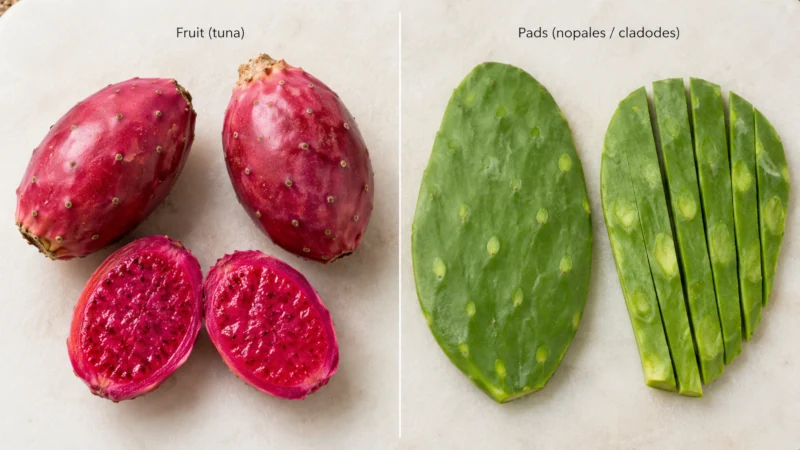
The plant is a member of the cactus family, built for dry, rocky, hot climates. Its pads are the flattened, paddle-shaped stems; the fruit grows along their top edges and ripens to orange, red, or deep magenta. Both the fruit and the pads are edible once you get past the defenses: fine, barbed bristles called glochids that lodge painfully in skin and have to be removed before anything reaches your plate Healthline, 2025.
In the kitchen, the two parts go different ways. Nopales are diced or sliced into eggs, tacos, salads, and soups, with a green-bean tartness. The fruit is sweeter — closer to watermelon — and turns up in juice, jams, candies, cocktails, and syrups. In Mexican folk medicine the plant has a long history, particularly as a traditional treatment for diabetes, and researchers have been picking through those uses for decades Drugs.com Prickly Pear monograph, 2026.
Prickly Pear Nutrition at a Glance
Most of prickly pear’s real, well-established value is nutritional. One cup (about 149 grams) of raw prickly pear fruit provides roughly Healthline, 2025:
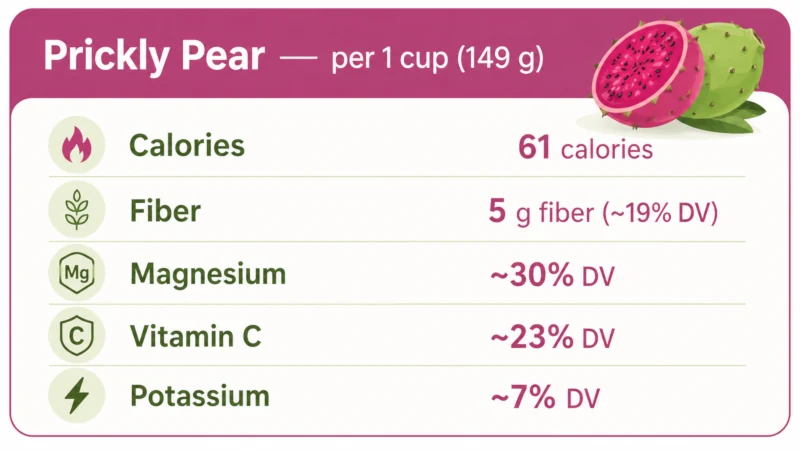
| Nutrient | Amount (per 1 cup / 149 g) |
| Calories | 61 |
| Fiber | 5 g (~19% of the Daily Value) |
| Magnesium | ~30% of the Daily Value |
| Vitamin C | ~23% of the Daily Value |
| Potassium | ~7% of the Daily Value |
| Calcium | ~6% of the Daily Value |
Two things stand out. First, the fiber — a mix of soluble and insoluble — which does the quiet work behind several of the effects below. Second, the color: the pigments that make the fruit red and purple are betalains, plant compounds with antioxidant activity, and they sit alongside a solid dose of vitamin C Healthline, 2025. Magnesium and potassium round it out as a low-calorie, mineral-rich fruit.
Prickly Pear Health Benefits, Graded by Evidence
Here’s where careful reading pays off. The benefits below are ordered from best-supported to most speculative, and each is labeled for how strong the human evidence actually is.
Antioxidant activity and oxidative stress — promising, limited
This is one of the more convincing findings. In a small crossover study of 18 healthy volunteers, eating 250 grams of fresh prickly pear pulp twice a day for two weeks reduced markers of oxidative damage to body fats and improved antioxidant status — and it did so more than a comparable dose of vitamin C alone, which points to the betalains and other compounds doing part of the work Drugs.com Prickly Pear monograph, 2026. It’s a single small trial, but a well-designed one, and it lines up with what the fruit’s chemistry would predict.
Cholesterol and heart health — promising, limited
Several small human studies point the same direction. In one, 250 grams a day of prickly pear pulp for four weeks lowered total and LDL (“bad”) cholesterol in both healthy people and those with an inherited high-cholesterol condition Drugs.com Prickly Pear monograph, 2026. An earlier study of 29 people also found reduced cholesterol Drugs.com Prickly Pear monograph, 2026. A 2020 systematic review of prickly pear and blood lipids reported that fruit consumption was tied to significant drops in total cholesterol versus placebo in nearly every study reviewed Drugs.com Prickly Pear monograph, 2026.
The likely mechanism is the soluble fiber (pectin), which binds cholesterol in the gut, plus plant sterols such as beta-sitosterol. Keep the size of the effect in perspective, though: a meta-analysis of five randomized trials found statistically significant reductions in total cholesterol, body-mass index, body fat, and blood pressure, but the effects were small, the studies were mixed in quality, and the changes weren’t large enough to be clinically decisive on their own Drugs.com Prickly Pear monograph, 2026. In other words: a reasonable helper alongside the basics, not a substitute for them. If cholesterol or triglycerides are your reason for reading, our guide on how to lower triglycerides naturally covers the steps with the strongest evidence.
Blood sugar — mixed, and it depends on which part you eat
This is the benefit most often oversold, and the honest picture is more interesting than the hype. A systematic review of 20 human studies found that the pads (cladodes) and certain combined nopal products produced significant reductions in blood glucose and insulin — but the sweet fruit, on its own, mostly showed no significant effect Gouws et al., Medicina, 2019. The review’s bottom line was blunt: there isn’t enough evidence to recommend prickly pear fruit as a therapy for type 2 diabetes, though the pads look promising enough to warrant more study Gouws et al., Medicina, 2019.
That fits the biology. The pads are high in fiber and gel-forming mucilage, which can slow how fast sugar is absorbed from a meal — most useful when the nopales are eaten with the food, not hours apart. The fruit is sweeter and behaves less like a blood-sugar brake. Prickly pear has been used in Mexican folk medicine for diabetes for generations, and that tradition is part of why it’s studied at all — but tradition and proof aren’t the same thing. If you’re managing blood sugar through food, our roundup of diabetic-friendly foods puts prickly pear in context with better-established options. Whatever you do, don’t treat nopal as a replacement for prescribed diabetes medication.
Hangover symptoms — early, one small trial
There’s a single, often-cited randomized trial here, and it’s worth describing precisely so you know what it does and doesn’t show. Volunteers took an extract of Opuntia ficus-indica — not the fruit, and taken five hours before drinking — and the next day reported a roughly 40% drop in the inflammatory marker C-reactive protein and moderately less nausea, dry mouth, and food aversion than with placebo. Overall hangover severity was only modestly reduced Drugs.com Prickly Pear monograph, 2026. So: a real but small effect, from a supplement taken preventively, in one study. Interesting, not a cure.
Liver, inflammation, and other early research — early / preclinical
Prickly pear has a long traditional link to liver complaints, and some modern reviews suggest its antioxidant and anti-inflammatory compounds could support liver health — but this rests mostly on laboratory and animal work, with human data still thin Healthline, 2025. An anti-inflammatory compound (beta-sitosterol) has been isolated from the plant, and cladode extracts show wound-healing and anti-ulcer activity in rats Drugs.com Prickly Pear monograph, 2026. These are legitimate leads, not established human benefits.
Traditional uses — historical, low evidence
Prickly pear carries centuries of folk use that’s worth knowing without mistaking it for proof. Native peoples in the Americas applied the juice and split pads as poultices to burns, wounds, and bruises, drawing on the pads’ soothing mucilage Drugs.com Prickly Pear monograph, 2026. The astringent fruit was a traditional remedy for diarrhea, and the juice was taken as a syrup to calm coughs.
Flower preparations were used as a diuretic for scanty urine and bladder irritation. Animal studies lend some plausibility — cladode polysaccharides speed wound healing in rats, and flower infusions increase urine output in rats — but none of these traditional uses has been confirmed in solid human trials Drugs.com Prickly Pear monograph, 2026. For the traditional respiratory angle, our guide to foods for cold and flu sticks to what the evidence supports.
Evidence Summary
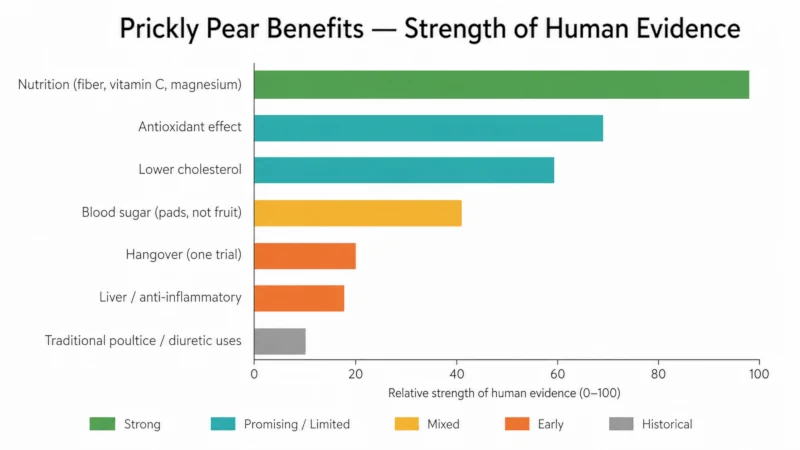
| Benefit | Strength of human evidence |
| Nutrition (fiber, magnesium, vitamin C) | Strong — established |
| Antioxidant / lower oxidative stress | Promising — one good small trial |
| Lower total and LDL cholesterol | Promising but limited — small studies, modest effect |
| Blood sugar (pads/cladodes) | Mixed — pads promising, fruit mostly no effect |
| Hangover symptoms (extract, before drinking) | Early — a single small trial |
| Liver, anti-inflammatory, wound healing | Early — mostly lab and animal data |
| Traditional poultice, anti-diarrheal, diuretic uses | Historical — not confirmed in humans |
Grades reflect the consistency and quality of human studies, not laboratory or animal work.
How to Eat and Use Prickly Pear
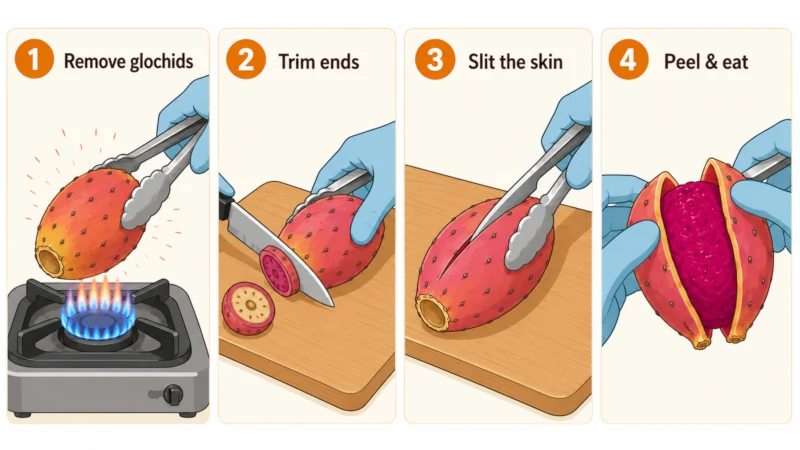
The single most important step is safety in handling: the glochids. Whether you buy fruit or pads, many markets sell them de-spined, but check anyway. Wear gloves, use tongs, and scrub or singe off any remaining bristles before peeling Healthline, 2025.
For the fruit, slice off both ends, cut a shallow slit down the skin, and peel it back to reveal the pulp. It’s full of hard seeds — edible in small amounts, but see the safety note below. Eat it fresh, blend it into juice, or cook it down.
For the pads (nopales), scrape off the bristles and the small “eyes,” trim the edge, then dice or slice. They’re good grilled, sautéed, or simmered into eggs, salads, and stews. Because the blood-sugar signal in the research comes from the pads eaten as part of a meal, nopales alongside your food are the more evidence-aligned way to use prickly pear if that’s your goal.
Prickly pear also comes as capsules, powders, and juices. Here the honesty has to be firm: study doses and forms vary widely, there’s no established supplement dose, and extracts are far less studied for side effects than the food itself Healthline, 2025. If you’re considering a supplement rather than the food, that’s the point to loop in a doctor or pharmacist.
Side Effects, Safety, and Who Should Be Careful
Eaten as food in normal amounts, prickly pear is generally well tolerated. The most common issues are related to its fiber — eat a lot and you may get diarrhea, bloating, nausea, or indigestion Healthline, 2025. On the plant itself, the most frequently reported reaction is contact dermatitis, usually from the glochids Drugs.com Prickly Pear monograph, 2026.
One less obvious risk deserves attention: eating large quantities of the seeds has, in rare cases, caused a blockage in the large intestine that required medical treatment Drugs.com Prickly Pear monograph, 2026. Enjoy the fruit, but don’t binge on the seed-heavy pulp, and be extra cautious if you have a history of bowel obstruction or slow gut motility.
On drug interactions, the sources genuinely disagree, and it’s worth naming that rather than picking the scarier version. Some drug-information databases rate the combination of prickly pear and diabetes medications as a moderate interaction, because both lower blood sugar and the effect can stack — a case report described low blood sugar in a person taking nopal with glipizide and metformin. Others, including the Drugs.com monograph, describe the interaction as theoretical and “not well documented” Drugs.com Prickly Pear monograph, 2026. The practical takeaway is the same either way: if you take medication for diabetes, or a diuretic (prickly pear may add to its effect), talk to your doctor and monitor rather than assume it’s nothing.
Pregnancy and breastfeeding: because safety data are lacking — especially for concentrated supplements and extracts — the cautious guidance is to avoid prickly pear supplements while pregnant or nursing, and to check with your doctor before using medicinal amounts Drugs.com Prickly Pear monograph, 2026.
Who should be most careful: people taking diabetes or blood-pressure/diuretic medication (monitor with a doctor’s guidance), anyone pregnant or breastfeeding (skip the supplements), people with a known cactus allergy, and anyone prone to bowel obstruction who might overdo the seeds.
When to Talk to a Doctor
Prickly pear is a food and a mild traditional remedy — not a treatment for any diagnosed condition. See a doctor or pharmacist before adding prickly pear supplements if you take prescription medication (especially for diabetes or blood pressure) or you’re pregnant or breastfeeding. And don’t use it to replace a medication you’ve been prescribed for blood sugar or cholesterol.
Seek prompt medical care if you develop signs of a serious allergic reaction (swelling, hives, trouble breathing), or severe abdominal pain, persistent vomiting, or an inability to pass stool after eating a large amount of seeds — a possible sign of intestinal blockage that needs urgent evaluation. In the U.S., call 911 or go to the nearest emergency room for breathing difficulty or severe, unrelenting abdominal pain.
Frequently Asked Questions
Does prickly pear lower blood sugar?
Sometimes — and it depends on which part you eat. In human studies, the pads (nopales/cladodes) and some combined nopal products lowered blood glucose, most likely by slowing sugar absorption when eaten with a meal, while the sweet fruit on its own generally showed no significant effect Gouws et al., Medicina, 2019. It shouldn’t replace diabetes medication, and if you take one, monitor your levels and talk with your doctor.
Is prickly pear good for cholesterol?
Small human studies suggest prickly pear pulp can modestly lower total and LDL cholesterol, probably through its soluble fiber and plant sterols Drugs.com Prickly Pear monograph, 2026. The effect is real but small, and the studies are limited — think of it as a supporting player alongside diet, exercise, and any prescribed treatment.
Can prickly pear prevent a hangover?
One randomized trial found that an Opuntia ficus-indica extract, taken about five hours before drinking, moderately reduced some hangover symptoms and inflammation the next day Drugs.com Prickly Pear monograph, 2026. It was a supplement used preventively, not the fruit, and the overall effect was modest — not a reliable fix, and no substitute for drinking less.
How do you eat prickly pear safely?
Remove the glochids (the fine bristles) first — wear gloves, use tongs, and scrub or singe them off before peeling. Eat the fruit fresh or juiced, and cook the pads into eggs, salads, or stews. Go easy on the seeds, since eating them in large quantities has rarely caused intestinal blockage Drugs.com Prickly Pear monograph, 2026.
Are there people who shouldn’t use prickly pear?
Anyone taking diabetes or diuretic medication should check with a doctor first, since prickly pear may add to those effects. People who are pregnant or breastfeeding should avoid prickly pear supplements because safety data are lacking, and anyone with a cactus allergy should steer clear Drugs.com Prickly Pear monograph, 2026. Eating the fruit or pads as normal food is fine for most other people.
| Health Disclaimer: This article is for general education and is not a substitute for professional medical advice, diagnosis, or treatment. Prickly pear is a food and a traditional remedy, not a treatment for any disease. Do not start, stop, or change any medication or supplement without talking to your doctor first. If you are pregnant, breastfeeding, taking prescription drugs (especially for diabetes or blood pressure), or managing a chronic condition, check with your physician or pharmacist before adding prickly pear supplements. Seek prompt medical care for a serious allergic reaction or for severe abdominal pain and vomiting after eating large amounts of seeds. |
References
- Drugs.com. (2026). Prickly Pear — Uses, Benefits & Dosage (medically reviewed; Wolters Kluwer). → View source
- Gouws CA, Georgousopoulou EN, Mellor DD, McKune A, Naumovski N. (2019). Effects of the Consumption of Prickly Pear Cacti (Opuntia spp.) and its Products on Blood Glucose Levels and Insulin: A Systematic Review. Medicina (Kaunas), 55(5):138. DOI 10.3390/medicina55050138. → View source
- Streit L. (medically reviewed by Marengo K, RD). (2025). Prickly Pear: Nutrition, Benefits, Recipes, and More. Healthline. → View source
