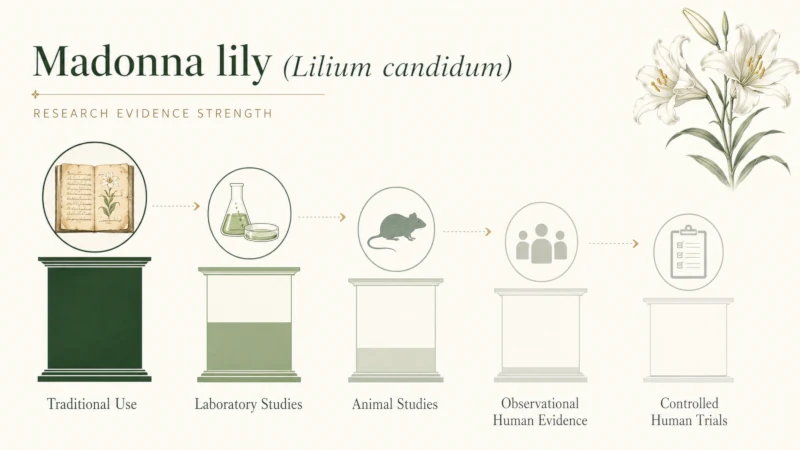
The Madonna lily has one of the longest paper trails of any European folk remedy for skin. Across Sardinia, Tuscany, the Catalan Pyrenees, the Balkans and the eastern Mediterranean, people have used its petals and bulbs on burns, wounds and irritated skin for centuries [Zaccai et al., Plants, 2020]. What that history does not come with is a single controlled trial in humans. The modern research on Lilium candidum amounts to laboratory work, one study in rats, and one small uncontrolled cosmetic study of a three-plant blend.
That is enough to say the traditional use is biologically plausible. It is not enough to put a homemade oil on a burn — and current US first aid advice actually points the other way.
There is also one thing about this plant that is genuinely dangerous, and it has nothing to do with your skin. If you have a cat, true lilies are among the most lethal plants you can bring into a house. That section is below, and it is the most important part of this page.
What the Madonna lily actually is
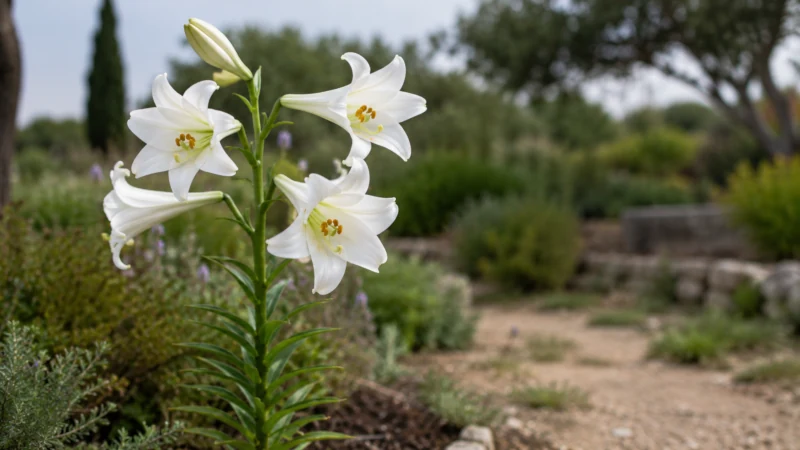
Lilium candidum — also called white lily, lis blanc in French and azucena in Spanish — is a bulbous perennial in the Liliaceae family. The stem, covered in small leaves, reaches roughly a meter, with white trumpet-shaped flowers at the tip. Traditional preparations use the flowers and the bulb.
Its origin is the Middle East rather than East Asia. Botanical sources place it in Lebanon and Israel and parts of Greece, from where it naturalized across Europe, North Africa and Mexico. In Israel it is now an endangered, legally protected species, with only a few wild populations left in the Carmel and Galilee regions [Zaccai et al., Plants, 2020]. If you are sourcing plant material, that is a reason to use cultivated garden stock and never wild-collect.
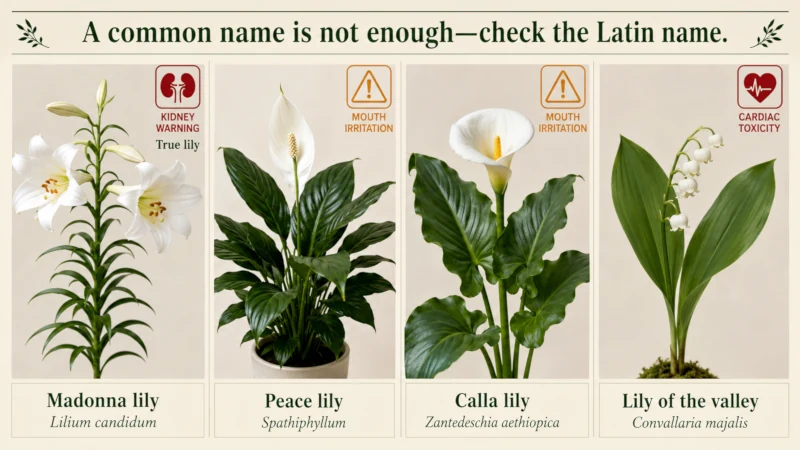
One naming point saves a lot of confusion. Many plants sold as “lily” are not Lilium at all. Peace lily, calla lily, lily of the valley and Peruvian lily are unrelated plants with different chemistry and different risks [FDA, 2021]. Madonna lily is a true lily.
What is in it
Gas chromatography–mass spectrometry work on the plant identified linalool, citronellal, caryophyllene, humulene and nerolidol, alongside the flavonol kaempferol. The bulbs also contain steroidal (spirostanol) saponins [Zaccai et al., Plants, 2020].
Those are recognizable, well-studied compounds, and that is exactly where a lot of herbal writing goes wrong. Kaempferol having anti-inflammatory activity in a cell culture tells you very little about what a jar of petal-infused olive oil does on human skin. The dose is unknown, the extraction is uncontrolled, and nothing in that chain has been measured.
What the research on Madonna lily actually shows
Sorted by how much weight each tier of evidence can carry:
| Type of evidence | What was found | How much it supports |
| Traditional use | Widespread topical use for burns, wounds, ulcers, skin and joint complaints across Mediterranean Europe and the Middle East | Strong documentation of use — not evidence of effect |
| Lab / cell studies | Anti-inflammatory, anti-diabetic, antiviral, antifungal and anti-cancer-cell activity of extracts and isolated compounds | Early-stage. Mechanism still unknown; authors call for clinical study |
| Animal study | Flower-extract ointments (5%, 10%, 20%) reduced burn wound area in 30 rats over 14 days; 20% performed best | One study, one species, standardized extract. Encouraging, not transferable |
| Human study | 21 volunteers, 28-day uncontrolled test of a serum containing 5% of a three-plant blend for under-eye darkening | Very weak. No control group, and the lily’s contribution cannot be separated |
| Safety testing | Screening of 10 isolated compounds; carcinogenicity and mutagenicity data absent for 9 of them | Thin in both directions — little evidence of harm, little evidence of safety |
The traditional record
Ethnopharmacological surveys record specific, consistent uses. In the Campidano Valley and Urzulei district of Sardinia, petals and a decoction of bulbs soaked in milk were applied as chest poultices, petals soaked in spirit were used on wounds, and an oil made from the flowers was used for mastitis. In the upper Lucca province of Italy, bulbs were used against shingles, and bulbs and flowers for skin and joint conditions. The plant also appears in anti-inflammatory and dermatological remedies from the Catalan district of the Eastern Pyrenees [Zaccai et al., Plants, 2020].
Consistency like that across separated regions is a reasonable signal that something is worth investigating. It is not the same as knowing it works.
The laboratory work
Ethanolic extracts of the bulbs and leaves increased glucose uptake in cultured mouse adipocytes, and extracts along with kaempferol, citronellal and humulene reduced release of the inflammatory signals interleukin-6 and interleukin-8 from human fibroblasts. The researchers suggest this may partly explain the plant’s wound-healing reputation, while stating plainly that the mechanism is unknown and that clinical studies are needed [Zaccai et al., Plants, 2020]. Separate in vitro work has reported activity against herpes simplex virus type 1, against yeasts, and against a breast cancer cell line.
One honest footnote that most write-ups leave out. A Slovak group screened ten compounds isolated from L. candidum for both tumor-inhibitory and potential carcinogenic activity, and noted that carcinogenic and mutagenic data for nine of those ten compounds simply do not exist in the scientific literature. Their electrochemical screening pointed to very low potential carcinogenicity, and the spirostanol saponins showed the highest inhibitory activity [Vachálková et al., Neoplasma, 2000]. That is not a reason for alarm. It is a reason to understand that the toxicology base for this plant is genuinely sparse.
The rat burn study
The most directly relevant piece of research is a 2020 study in the Journal of Medicinal Plants. Thirty Wistar rats with induced burn wounds were split into five groups: 1% silver sulfadiazine cream as the reference standard, eucerin as control, and ointments containing 5%, 10% and 20% hydro-alcoholic extract of L. candidum flowers. Wound area was measured daily for 14 days, with histology at the end. All three extract concentrations significantly reduced wound area compared with control, and the 20% ointment produced the best healing — on the measure used, better than silver sulfadiazine [Momtaz et al., Journal of Medicinal Plants, 2020].
That is a real, positive, well-described result, and it deserves to be taken seriously as a reason for further research. It is also thirty rats, a laboratory-standardized extract at a known concentration, in a manufactured ointment, on a controlled wound. None of those conditions describe a homemade preparation on a person.
The one human study
In 2009, 21 volunteers with periorbital hyperchromia — under-eye darkening — applied a serum containing 5% of a compound combining Pfaffia paniculata, Ptychopetalum olacoides and Lilium candidum twice daily for 28 days. Skin color was measured by colorimetry and volunteers completed a questionnaire. The reported improvement rate was around 90%, with no adverse reactions, and the authors stated that randomized clinical studies are still needed [Erlich et al., Journal of Cosmetic Dermatology, 2009].
Read what that can and cannot tell you. There was no placebo group, so any effect is inseparable from expectation and from normal variation. There were three plants in the formula, so nothing can be attributed to the lily. Twenty-one people is small. What it reasonably supports is that a cosmetic blend containing Madonna lily extract was tolerated by 21 people for four weeks.
Madonna lily and burns: where tradition and first aid disagree
This is the claim attached to the plant most often, so it deserves a direct answer rather than a hedge.
For a minor first-degree burn, the American Academy of Dermatology’s advice is to cool the burn immediately — immerse it in cool tap water or apply cold wet compresses for about 10 minutes or until the pain settles — then apply petroleum jelly two to three times daily and cover it with a nonstick sterile bandage. The same guidance says explicitly not to apply ointments, toothpaste or butter, because these may cause an infection, and not to apply topical antibiotics. Let blisters heal on their own without popping them, and consider an over-the-counter pain reliever [American Academy of Dermatology].
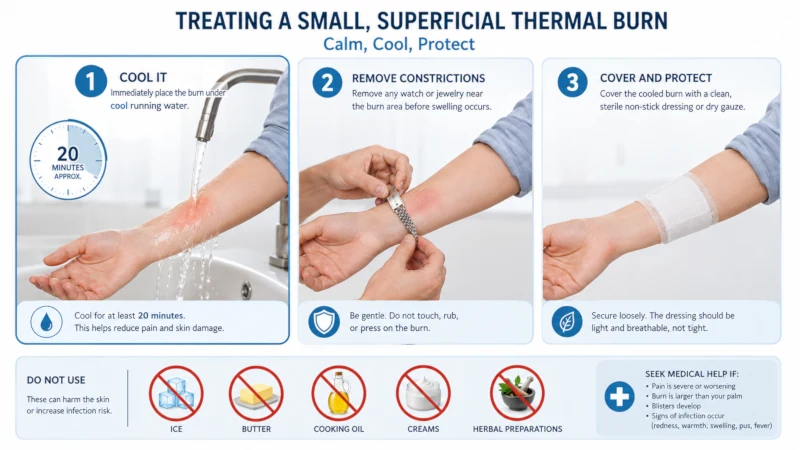
A petal-infused oil made at home sits squarely in the category that advice is warning about: an unsterilized plant preparation in a fat base, applied to damaged skin. It can introduce bacteria, and it makes the burn harder for a clinician to assess later.
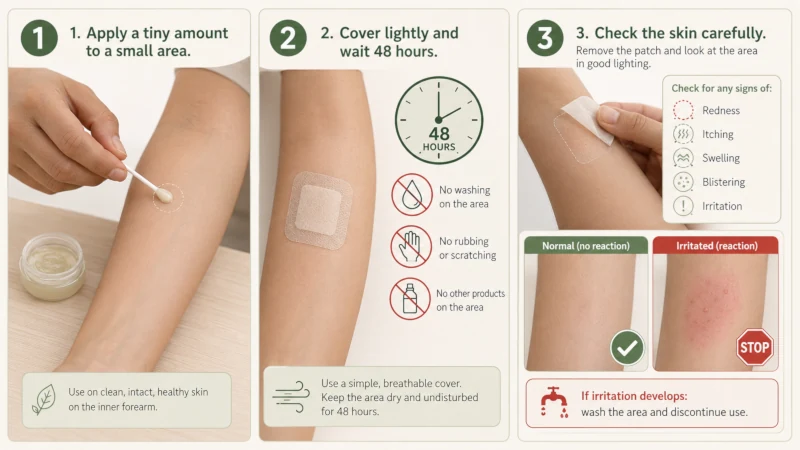
So the practical position is unglamorous but clear. Cool the burn with running water. Skip the oil. If you want to try a plant preparation on your skin, do it on intact, healed skin instead — and patch test it first on the inner forearm for 48 hours.
Go to an emergency room rather than treating a burn at home if the burn is very large, if the person is an infant or an older adult, or if the burn looks more severe than surface redness [American Academy of Dermatology].
Ear pain: the one traditional use to drop entirely
Older preparations describe dripping lily oil into the ear canal for earache. Leave that one in the past.
The problem is that you cannot see your own eardrum, and ear pain has causes that make dropping anything into the canal a bad idea — a perforated eardrum, an infection behind the drum, or referred pain from the jaw or throat. Mayo Clinic’s guidance for a suspected ruptured eardrum is direct: do not put medicine drops in the ear unless a healthcare professional prescribes them for an infection related to the perforation [Mayo Clinic, 2025].
Ear pain that comes with fever, drainage, hearing change, or that does not settle in a day or two needs an appointment with your primary care provider or an urgent care clinic, not a home preparation.
Boils and abscesses: keep the heat, drop the poultice
The traditional bulb poultice was applied hot to bring a boil to a head. The useful ingredient there is almost certainly the heat, and a warm damp washcloth delivers it without pressing mashed plant material onto skin that is inflamed and about to break open.
Mayo Clinic’s guidance is that you can usually care for a single small boil at home, but should not prick or squeeze it, since that can spread the infection. See a doctor if you have more than one boil at a time, or if a boil:
- Occurs on your face or affects your vision
- Worsens rapidly or is extremely painful
- Causes a fever
- Gets bigger despite self-care
- Has not healed in two weeks
- Keeps coming back
Rarely, bacteria from a boil or carbuncle enter the bloodstream, which can lead to sepsis and to infections deep in the body such as the heart lining or bone [Mayo Clinic, 2021]. That is the reason a stubborn boil is worth a real appointment rather than another week of poultices.
Cracked nipples during breastfeeding
Traditional sources list this use, and it is the one to set aside without much deliberation. Anything applied to the nipple ends up in an infant’s mouth. There is no safety data on Madonna lily during breastfeeding, no data on infant ingestion, and no consistency at all in the strength of a homemade infused oil.
Cracked nipples also usually have a fixable cause — most often latch or positioning. A lactation consultant, your OB-GYN, or your pediatrician can address the cause and tell you which topical products are appropriate to use in the meantime.
If you have a cat, read this section first
This is the most consequential thing on the page, and it applies whether or not you ever use the plant medicinally.
The FDA’s guidance is unambiguous: lilies in the true lily and daylily families are very dangerous for cats, and the entire plant is toxic — stem, leaves, flowers, pollen, and even the water in the vase. Eating a small amount of a leaf or petal, licking a few grains of pollen off its fur while grooming, or drinking vase water can cause a cat to develop fatal kidney failure in less than three days. The toxin has not been identified, and it affects only cats; dogs that eat lilies may get mild stomach upset but do not develop kidney failure [FDA, 2021].
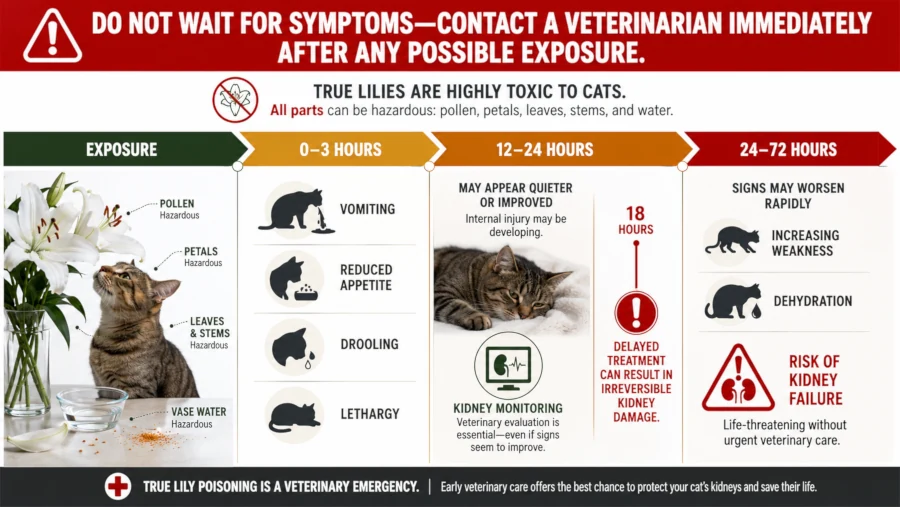
The timeline matters, because the early signs are easy to dismiss. Decreased activity, drooling, vomiting and loss of appetite appear 0 to 12 hours after ingestion. Signs of kidney damage — increased urination and dehydration — start around 12 to 24 hours. Kidney failure follows within 24 to 72 hours. Early veterinary treatment greatly improves the outlook, but if treatment is delayed 18 hours or more, the kidney failure is generally irreversible [FDA, 2021]. The ASPCA lists Lilium species as toxic to cats with kidney failure as the clinical sign, and the toxic principle recorded as unknown [ASPCA Animal Poison Control].
Madonna lily is a Lilium. If your cat has had any contact with one — chewed a leaf, licked pollen, drank vase water — call your veterinarian or the ASPCA Animal Poison Control Center at (888) 426-4435 straight away, before any symptoms appear. Bring the plant or a photo of it with you. Do not wait to see whether the cat gets sick; by the time the obvious signs arrive, the treatment window may have closed.
The simplest version of this advice: if you share a home with a cat, do not bring true lilies indoors at all, and do not plant them where an outdoor cat roams [FDA, 2021].
Safety, side effects, and who should avoid Madonna lily
This is the section that gets skipped most often on pages about this plant, and it is short for an honest reason: most of what follows is an absence of data rather than a list of findings.
- No established safe dose or strength. Nobody has determined what concentration, frequency or duration is safe on skin. The traditional recipes circulating online have no research behind their proportions.
- Side effects are not well characterized. That is not the same as “no side effects.” The studies that would find them have not been done.
- Skin reactions are the realistic risk. Handling cut flowers and bulbs is a well-documented cause of contact dermatitis among people who work with flowers, though the best-characterized allergens come from tulips and Peruvian lily rather than from L. candidum specifically. Treat it as a general plant-handling caution, and patch test on the inner forearm for 48 hours before wider use.
- Drug interactions are unknown, because no one has looked. NCCIH’s standing guidance applies: “natural” does not necessarily mean safe, interactions with prescription and over-the-counter medicines are possible, and you should tell your healthcare providers about any complementary products you use [NCCIH].
- Pregnancy and breastfeeding: avoid. There is no safety information either way, and no reason to accept an unquantified risk.
- Do not take it internally. Traditional preparations are external only, there is no dosing information, and the bulbs contain steroidal saponins.
- Keep it off broken skin. Open wounds, fresh burns, weeping eczema and active infections absorb more, sensitize more readily, and are the situations where a delay in proper care does the most damage.
People who should not self-treat with this or any herbal topical include infants and young children, anyone who is immunosuppressed or receiving chemotherapy, anyone with diabetes and a foot wound, and anyone with skin that is broken over a wide area.
When to stop and get medical care
Get seen the same day, at your primary care office or an urgent care clinic, if:
- Redness around a wound or boil is expanding, or the skin is hot, tight, glossy or increasingly painful
- You develop a fever, chills or nausea alongside a skin infection
- A boil is on your face, affects your vision, or has not healed in two weeks
- Ear pain comes with fever, drainage or a change in hearing, or is not improving after a day or two
- A burn is larger than the palm of your hand, is deep, or is on the face, hands, feet, joints or genitals
- A rash appears after starting a new medicine, or a wound simply is not healing
Call 911 for a severe burn, for a spreading infection with a high fever or confusion, or for any breathing difficulty or swelling of the face and throat after applying something new. For a suspected poisoning in a person, call Poison Help at 1-800-222-1222. For a suspected lily exposure in a cat, call your veterinarian or ASPCA Animal Poison Control at (888) 426-4435 [ASPCA].
Where this leaves the Madonna lily
An old, well-documented topical plant with an interesting chemistry and a genuinely promising animal result, sitting at the stage where somebody needs to run a proper human trial. Until that happens, it belongs in the same bracket as houseleek and several other traditional skin plants — worth knowing about, not worth relying on, and not worth using on the one thing it is most famous for. If you are weighing it against other options, the broader guide to herbs for skin issues sets out which plants have actually earned their reputation.
| HEALTH DISCLAIMER: This article is for general education and is not a substitute for advice, diagnosis or treatment from a qualified healthcare professional. The safety and effectiveness of Madonna lily have not been established by clinical research in people, and no safe dose or preparation strength exists. Talk to a doctor, dermatologist or pharmacist before using this or any herbal preparation — particularly if you are pregnant or breastfeeding, treating a child, taking prescription medicines, living with a long-term condition, or have a weakened immune system. Seek medical care for burns, ear pain, infections, or symptoms that are severe, worsening or not improving. In a poisoning emergency call Poison Help at 1-800-222-1222. For a medical emergency call 911. If a cat may have been exposed to any lily, call your veterinarian or ASPCA Animal Poison Control at (888) 426-4435 immediately. |
Frequently Asked Questions
Can I put Madonna lily oil on a burn?
Not as first aid. Cool the burn under cool running water for about 10 minutes, then use petroleum jelly and a nonstick sterile bandage; dermatologists advise against applying ointments or home substances to burns because of infection risk [American Academy of Dermatology]. The encouraging burn research on this plant was done in rats with a laboratory-standardized ointment, not with a homemade infusion on human skin.
Is Madonna lily safe to swallow or take as a supplement?
No. Traditional use is external only, there is no dosing information, and no modern safety data supports internal use. The bulbs contain steroidal saponins, and the plant has not been tested for oral safety.
Does Madonna lily help with dark circles or skin brightening?
The evidence is one uncontrolled 28-day study in 21 people using a serum that contained three plant extracts, one of which was Madonna lily. It reported improvement and no adverse reactions, and its authors called for randomized studies [Erlich et al., 2009]. You cannot separate the lily’s contribution from the other two plants, or from the absence of a placebo group.
Is Madonna lily the same as Easter lily or peace lily?
Easter lily is a different species in the same genus (Lilium longiflorum), and carries the same severe risk to cats. Peace lily is not a true lily at all — it contains insoluble calcium oxalate crystals that irritate the mouth and throat rather than causing kidney failure [FDA, 2021]. The common name is not a reliable guide to the risk; check the Latin name.
Are lilies dangerous to dogs too?
Not in the same way. Dogs that eat true lilies may have minor stomach upset but do not develop the kidney failure seen in cats, and the ASPCA lists Lilium species as non-toxic to dogs and horses [ASPCA]. Lily of the valley and gloriosa lily, which are not true lilies, are a serious danger to dogs [FDA, 2021].
Can the scent of lilies in a closed room make you feel unwell?
Strongly scented flowers in an unventilated room do trigger headache, nausea or congestion in some people, particularly anyone with fragrance sensitivity, migraine or asthma. That said, no study specific to this species was found in preparing this article, so treat it as a common-sense observation rather than an established effect. If a bouquet gives you a headache, move it out of the bedroom.
References
- Zaccai M, Yarmolinsky L, Khalfin B, Budovsky A, Gorelick J, Dahan A, Ben-Shabat S. “Medicinal Properties of Lilium candidum L. and Its Phytochemicals.” Plants, 2020;9(8):959. DOI 10.3390/plants9080959. PMID 32751398. View source
- Momtaz S, Dibaj M, Abdollahi A, Amin G, Bahramsoltani R, Abdollahi M, et al. “Wound healing activity of the flowers of Lilium candidum L. in burn wound model in rats.” Journal of Medicinal Plants, 2020;19(73):109–118. View source
- Vachálková A, Eisenreichová E, Haladová M, Mucaji P, Józová B, Novotný L. “Potential carcinogenic and inhibitory activity of compounds isolated from Lilium candidum L.” Neoplasma, 2000;47(5):313–318. PMID 11130250. View source
- Erlich R, et al. “Effects of a Brazilian herbal compound as a cosmetic eyecare for periorbital hyperchromia (‘dark circles’).” Journal of Cosmetic Dermatology, 2009;8(2):127–132. PMID 19527337. View source
- U.S. Food and Drug Administration, Center for Veterinary Medicine. “Lovely Lilies and Curious Cats: A Dangerous Combination.” FDA, content current as of September 16, 2021. View source
- ASPCA Animal Poison Control. “Toxic and Non-toxic Plants: Lily.” American Society for the Prevention of Cruelty to Animals. View source
- American Academy of Dermatology. “How to treat a first-degree, minor burn.” aad.org. View source
- Mayo Clinic Staff. “Ruptured eardrum (perforated eardrum) — Diagnosis & treatment.” Mayo Clinic, September 5, 2025. View source
- Mayo Clinic Staff. “Boils and carbuncles — Symptoms & causes.” Mayo Clinic, September 18, 2021. View source
- National Center for Complementary and Integrative Health. “5 Tips: What Consumers Need To Know About Dietary Supplements.” NIH. View source
