
Orthosiphon tea, also sold as Java tea, is a traditional herbal infusion brewed from the dried leaves of Orthosiphon aristatus — a plant native to Indonesia that has been used for centuries in Southeast Asia to increase urine output. The European Medicines Agency now recognizes it as a traditional herbal medicinal product, specifically as an adjuvant for flushing the urinary tract in minor urinary complaints, with formal dose limits and contraindications attached [EMA HMPC, 2021]. That recognition is narrow on purpose. Orthosiphon tea is not a proven treatment for kidney stones, weight loss, diabetes, gallbladder disease, or high cholesterol, and human evidence for those claims is either thin or absent.
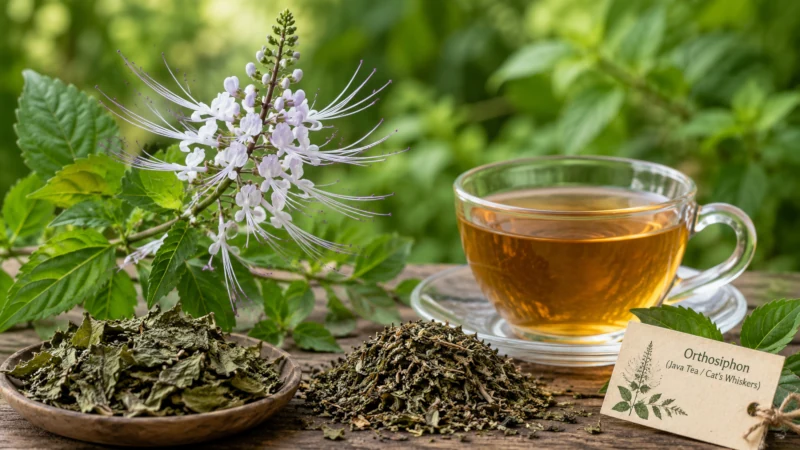
Here is what the leaf actually contains, the one use the evidence (modestly) supports, the claims that don’t hold up, how to brew it the way European pharmacopoeias specify, and the safety details worth knowing before you start a course.
What orthosiphon tea actually is
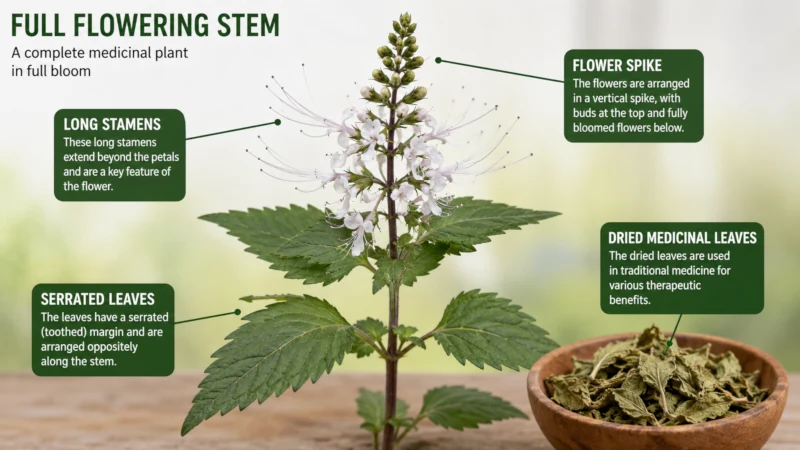
Orthosiphon aristatus is a perennial herb in the Lamiaceae (mint) family, native to Indonesia and now cultivated across Malaysia, Thailand, Myanmar, the Philippines, and tropical Australia. In Malay it is known as kumis kucing or misai kucing — “cat’s whiskers” — a name that comes from the long, white stamens that protrude from the flower like whiskers [Ashraf, 2018]. The leaves and stem tips are the medicinal parts; the dried leaf is what ends up in a tea bag.
A note on the botanical name. Older herbals and product labels use three different scientific names for the same plant: Orthosiphon grandiflorus, Orthosiphon stamineus, and Orthosiphon aristatus. They are synonyms. The current accepted name is Orthosiphon aristatus (Blume) Miq., and that is the name used in the European Pharmacopoeia monograph and the EMA assessment [EMA HMPC, 2021]. A lot of the scientific literature still uses O. stamineus — that is the same plant.
Active compounds
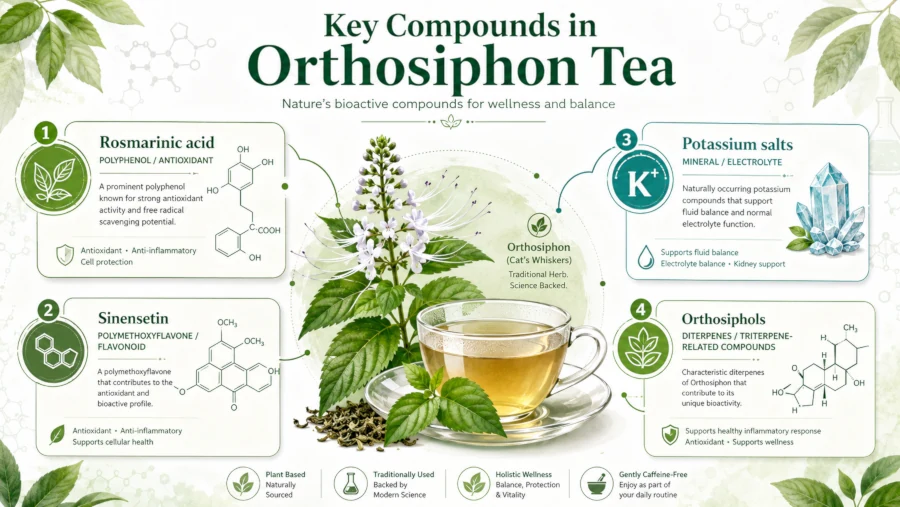
The European Pharmacopoeia monograph defines an authentic dried leaf as containing a minimum of 0.3% rosmarinic acid, with characteristic levels of the following constituents [EMA HMPC, 2021] [Ashraf, 2018]:
| Compound | Approximate level | Why it matters |
| Potassium salts | Up to ~3% | Long thought to drive the tea’s diuretic effect, though animal work has not fully confirmed potassium alone explains it. |
| Rosmarinic acid | 0.1–0.5% (min. 0.3% in pharmacopoeial leaf) | A caffeic acid derivative with antioxidant activity in lab studies. The most reliable quality marker. |
| Sinensetin | 0.1–0.19% | A lipophilic flavone studied for diuretic and anti-inflammatory effects in animals. |
| Eupatorin & tetramethylscutellarein | Variable | Flavones with antioxidant and lab-level enzyme-inhibition activity. |
| Diterpenes (orthosiphols A–E) | ~0.2% | Studied mainly for in-vitro anti-inflammatory and possible vasorelaxant activity. |
| Essential oil | 0.02–0.06% (up to 0.7%) | Mostly sesquiterpenes; contributes to the tea’s smell rather than its main action. |
That short list matters because the active fraction depends heavily on how the leaf is processed. A tap-water infusion extracts mainly the water-soluble fraction (potassium salts, rosmarinic acid); an ethanol extract pulls more of the lipophilic flavones. Most of the human safety and traditional-use record is for the water infusion.
The one use the evidence modestly supports: increasing urine output
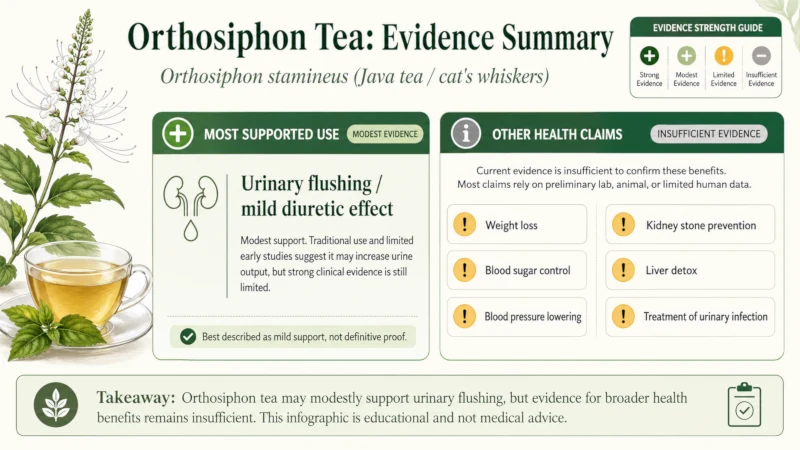
The European Medicines Agency reviewed roughly 95 years of medicinal use and concluded that Orthosiphon leaf preparations qualify as a traditional herbal medicinal product, with one approved indication: “to increase the amount of urine to achieve flushing of the urinary tract as an adjuvant in minor urinary tract complaints” [EMA HMPC, 2021].
The word traditional is doing work here. EU rules distinguish a “well-established medicinal use” (supported by good clinical trials) from a “traditional use” (long historical use plus plausible safety, but limited modern clinical evidence). Orthosiphon falls in the second category. The committee explicitly noted that current clinical data are insufficient for a well-established use claim — the approval rests on the long usage record, not on strong clinical efficacy [EMA HMPC, 2021].
What the evidence actually shows:
- Early human studies (1927–1928). Self-experiments in healthy volunteers drinking 400–500 ml of Orthosiphon infusion per day reported increased urine output.
- Crossover study, 40 healthy volunteers (Doan, 1992). A decoction equivalent to 10 g dried leaf taken in 600 ml across one day produced no significant change in 12- or 24-hour urine volume or sodium excretion vs. placebo [EMA HMPC, 2021].
- Open study in 67 patients with uratic diathesis (Tiktinsky, 1983). After 12 weeks, Java tea increased measured diuresis by about 15% and glomerular filtration rate by about 18% — but the effect was weaker than horsetail (Equisetum arvense), which increased diuresis by 24%. The study lacked a placebo arm and full baseline reporting, so the EMA assessor noted its relevance is hard to evaluate [EMA HMPC, 2021].
- Placebo-controlled trial in 76 nephrolithiasis patients (Premgamone, 2009). Daily dose of aqueous extract equivalent to 3.2–3.6 g dried leaf for 14 days produced no statistically significant difference vs. placebo on the primary symptom-score endpoint [EMA HMPC, 2021].
- Animal studies. Several rat studies show mild dose-dependent diuretic activity with aqueous and 50% ethanolic extracts (5–10 mg/kg and 700 mg/kg respectively), but the magnitude is consistently smaller than the reference drugs furosemide or hydrochlorothiazide [Adam, 2009] [EMA HMPC, 2021].
Read together, the picture is: a mild diuretic in animals, an uncertain diuretic in humans, with the strongest official support coming from how long it has been used safely rather than from how well the latest trials performed. It is reasonable to use it as an adjunct to drinking enough water during a minor urinary irritation. It is not a substitute for clinical care.
What orthosiphon tea has NOT been proven to do
Popular health pages — including some older versions of this one — list claims that current evidence does not support. The list below describes what the EMA review and other peer-reviewed reviews concluded rather than what marketers say.
Treat kidney stones
The EMA was explicit on this point. Kidney stones (renal gravel) require medical supervision to confirm the diagnosis and choose treatment. The agency declined to grant a traditional-use indication for renal gravel, judging that self-treating stones could cause real harm by delaying proper care [EMA HMPC, 2021]. The single clinical trial in stone patients found no benefit over placebo. If you have suspected kidney stones, see a clinician — review the broader foods for healthy bladder and kidneys guidance for everyday dietary support, but do not delay care.
Help with weight loss
A handful of French and Spanish traditional registrations list Orthosiphon as “an adjuvant to slimming regimes,” but the EMA committee chose not to include weight loss in the unified EU monograph indication [EMA HMPC, 2021]. Any short-term scale drop from drinking the tea is fluid loss from increased urination, not fat loss. The water comes back. For real dietary changes, see general guidance on juicing for weight loss and herbs that may support metabolism, and treat tea-driven weight loss as a number on a scale rather than a body composition change.
Lower blood pressure or cholesterol
Some traditional sources mention antihypertensive and “anticholesterol” effects. The evidence behind these is limited to animal experiments on isolated compounds — most notably methylripariochromene A in spontaneously hypertensive rats — and in-vitro work. There are no quality human trials demonstrating clinically meaningful blood pressure or cholesterol reduction in people [EMA HMPC, 2021] [Ashraf, 2018].
Treat diabetes
A 2022 PRISMA-based systematic review identified 31 papers on Orthosiphon stamineus and diabetes. The animal and mechanistic data are interesting — inhibition of α-amylase and α-glucosidase, partial protection of pancreatic β-cells, modulation of insulin signaling — but the authors concluded the work has “not been generally translated into clinical practice” [Li, 2022]. A single clinical trial has been registered for diabetic retinopathy but human efficacy data are not yet sufficient to recommend it for blood sugar control. People with diabetes considering the tea should talk to their healthcare provider first because of possible additive effects with blood-sugar-lowering medications.
Treat gallbladder problems
Old herbal manuals describe a “cholagogue” effect (promoting bile flow), and that claim is still circulated. It does not appear in the modern EMA assessment, the Ashraf 2018 review, or the 2022 diabetes review as a confirmed pharmacological effect [EMA HMPC, 2021] [Ashraf, 2018]. Gallbladder symptoms — particularly pain — need medical evaluation, not herbal self-treatment.
What lab and animal studies show beyond the diuretic effect
Most peer-reviewed work on Orthosiphon is in vitro or in rodents. Three areas have generated the most published activity, all with the same translational gap:
- Antioxidant activity. Ethanolic and aqueous leaf extracts scavenge DPPH free radicals in cell-free assays at IC50 values comparable to the synthetic antioxidant BHT — the active fraction is largely rosmarinic acid and the lipophilic flavones [Alshawsh, 2012].
- Antimicrobial activity. The aqueous extract has shown activity against some Gram-positive bacteria (S. aureus, S. agalactiae) in disc-diffusion testing at concentrations far higher than what a person could reach by drinking tea [Alshawsh, 2012]. A mouse study reported the aqueous extract reduced bacterial adhesion in experimental bladder/kidney infection [Sarshar, 2017].
- Anti-inflammatory activity. Orthosiphol diterpenes and the methoxylated flavones reduce nitric-oxide production in LPS-stimulated macrophage cell lines, sometimes at levels stronger than dexamethasone in the same assay [EMA HMPC, 2021].
None of these effects has been confirmed in a properly controlled human trial. They are best read as plausible mechanisms — not as clinical recommendations.
How to prepare and dose orthosiphon tea
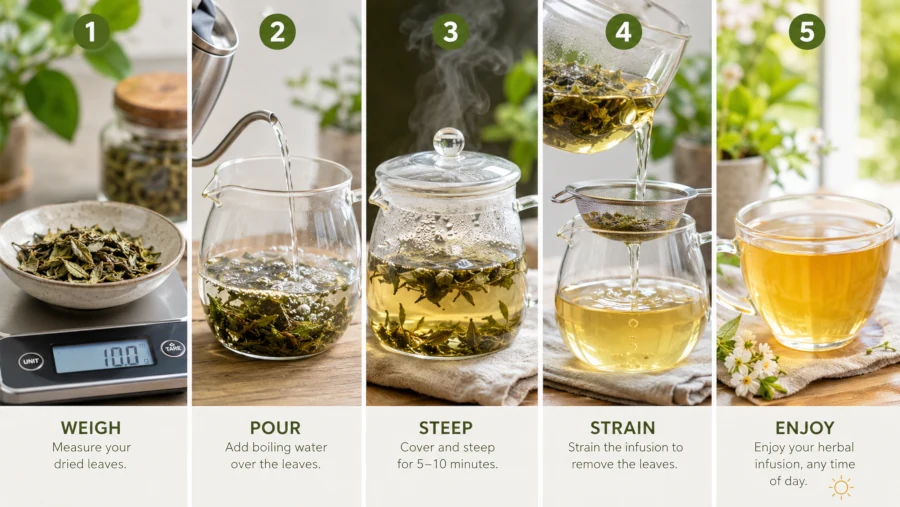
The EMA-harmonized monograph specifies the following preparation as the standard pharmacopoeial herbal tea [EMA HMPC, 2021]:
| Item | Pharmacopoeial standard |
| Dried leaf per cup | 2 to 3 grams |
| Water | 150 ml of boiling water |
| Steep time | Cover and steep for 5 to 10 minutes, then strain |
| Frequency | Two to three times per day |
| Daily total | 6 to 12 grams of dried leaf |
| Maximum duration without medical advice | 2 weeks. If symptoms persist beyond 2 weeks, see a healthcare provider. |
| Who can use this dose | Adults only. Not for use in pregnancy, lactation, or anyone under 18. |
A practical tip: this is a diuretic infusion, so drink the earlier cups during the day. A late-evening dose is likely to interrupt sleep. Drink plenty of additional water alongside it. For a fuller picture of dietary support for the urinary system, the article on urinary system herbal remedies outlines other traditional diuretic herbs (and how they compare), and Indian corn silk covers a closely related, well-tolerated diuretic herb that is often used alongside or instead of orthosiphon.
Safety, side effects, and who should avoid orthosiphon tea
Across nearly a century of marketed use in Europe, no serious adverse events have been reliably attributed to Orthosiphon leaf preparations at the recommended dose [EMA HMPC, 2021]. That is the encouraging headline. The detail is more nuanced, and the contraindications are not optional.
Reported side effects
In the largest placebo-controlled trial (76 nephrolithiasis patients), adverse events reported during Java tea use included myofascial pain, fatigue, back pain, abdominal pain, arthritis-like joint pain, gastrointestinal disturbance, and headache. Crucially, similar events occurred at comparable rates in the placebo group, and causality with Java tea was not confirmed [EMA HMPC, 2021].
One published case of hepatitis was reported in a 25-year-old woman who took capsules of orthosiphon together with green tea for two months. Green tea–containing products have themselves been associated with liver injury (and one was withdrawn in France/Spain in 2003 for that reason), so the assessor judged orthosiphon’s role as “doubtful but not excluded” [EMA HMPC, 2021]. No other hepatotoxicity cases have appeared in the literature.
Animal data note one consistent finding: small, statistically significant rises in blood urea nitrogen, creatinine, and blood glucose at high doses, all within the normal range. The investigators flagged this as a reason for caution but not a sign of toxicity [Adam, 2009].
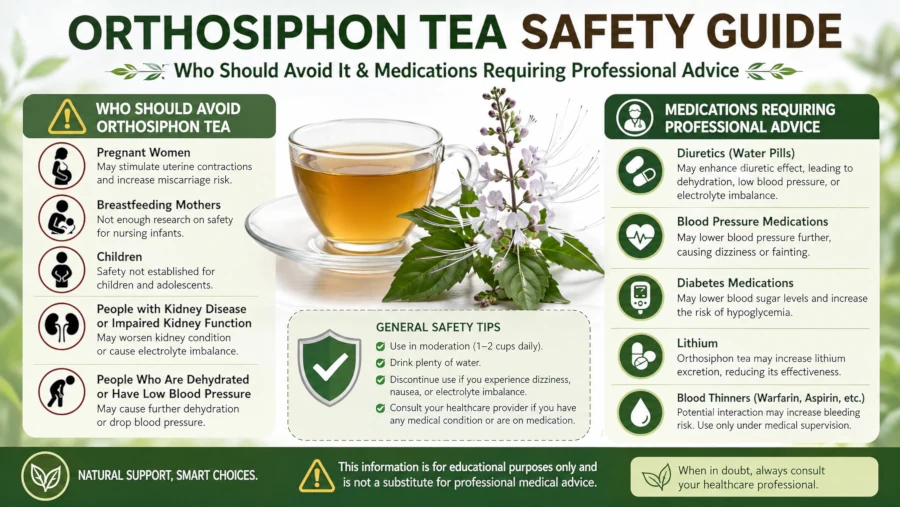
Who should NOT drink orthosiphon tea
The EMA monograph contraindicates use in the following groups [EMA HMPC, 2021]:
- Anyone with known hypersensitivity to Orthosiphon or other Lamiaceae herbs.
- Anyone with a condition that requires reduced fluid intake. This explicitly includes severe heart failure (cardiac edema) and severe renal disease. A diuretic added to a body that is already struggling to manage fluid is the wrong direction. Review the broader guidance on kidney-friendly foods instead, and talk to a kidney specialist before adding any herbal diuretic.
- Pregnant or breastfeeding women. There are no reproductive- or developmental-toxicity studies. The EMA does not recommend use during pregnancy or lactation on precautionary grounds.
- Children and adolescents under 18. Safety in this group has not been established and use is not recommended.
Drug interactions worth flagging
There are no confirmed clinical drug interactions, but several are theoretically plausible and worth a conversation with your pharmacist or doctor:
- Prescription diuretics (furosemide, hydrochlorothiazide, spironolactone) — additive effect on fluid and electrolyte loss.
- Lithium — any agent that affects urine output can change lithium levels.
- Antihypertensive medications — additive blood-pressure-lowering effect is theoretically possible.
- Diabetes medications — animal data suggest possible blood-sugar effects in either direction.
- Drugs metabolized by UGT enzymes — in-vitro work shows Orthosiphon extract can inhibit several UGT isoforms, which is the basis for some glucuronidation interactions. Clinical relevance has not been confirmed.
Realistic expectations
A useful way to think about orthosiphon tea: it is comparable to drinking an extra two or three glasses of mildly herb-flavored water. Some of that effect is the herb itself; a lot is just the extra fluid. You will urinate more, which can ease the feeling of urinary stinging or fullness during a minor irritation. You will not lose meaningful weight, treat infection, dissolve a stone, lower blood pressure, or fix a kidney problem with a tea bag. If symptoms persist beyond about two weeks, or if they are severe at any point, the next step is a clinician — not a stronger brew.
When to talk to a healthcare professional
Call your doctor or seek same-day care if any of the following apply:
- Fever, chills, flank pain, or back pain alongside urinary symptoms — possible kidney infection (pyelonephritis), which needs antibiotics, not tea.
- Visible blood in the urine. Always a reason to be evaluated, not self-treated.
- Severe abdominal or flank pain — possible kidney stone or other surgical emergency.
- Urinary symptoms that don’t improve within 48 hours of drinking more fluids — a true urinary tract infection generally needs antibiotic treatment, especially in men, in pregnancy, and in people with diabetes or kidney disease.
- Symptoms still present after 2 weeks of orthosiphon tea use — the EMA monograph says stop and see a clinician at this point.
- You take prescription medications (especially diuretics, lithium, blood pressure or diabetes drugs) — check before starting.
- You have any pre-existing heart, kidney, or liver disease.
| Health Disclaimer: This article is for general educational and informational purposes only. It is not a substitute for professional medical advice, diagnosis, or treatment. Orthosiphon tea is a traditional herbal product, not an approved treatment for any disease. Do not use it to self-treat suspected urinary tract infections, kidney stones, kidney disease, heart failure, diabetes, or any other medical condition. Always speak with a qualified healthcare provider before starting any herbal product, especially if you are pregnant, breastfeeding, taking prescription medication, or living with a chronic health condition. If you have severe pain, fever, blood in the urine, or symptoms that worsen or last more than two weeks, seek medical care promptly. |
Frequently asked questions
Is orthosiphon tea safe to drink every day?
For healthy adults, yes, in the short term. The EMA monograph allows daily use for up to two weeks at the standard dose without medical supervision. Beyond two weeks, or if symptoms persist, see a healthcare provider — the time limit exists because longer use has not been formally studied [EMA HMPC, 2021].
Will orthosiphon tea help me lose weight?
Not in any meaningful way. Any short-term drop in scale weight is water loss from increased urination — the water returns as soon as you rehydrate. Fat loss requires a sustained calorie deficit, not a diuretic. The EMA committee considered weight loss as a possible indication and chose not to support it [EMA HMPC, 2021].
Does orthosiphon tea contain caffeine?
No. Despite the name “Java tea,” orthosiphon has no botanical relation to Camellia sinensis (the source of black, green, and white tea) and contains no caffeine.
Can I drink orthosiphon tea if I take blood pressure medication?
Talk to your doctor or pharmacist first. There is no documented clinical interaction, but additive diuretic and blood-pressure effects are theoretically possible — especially if you are on a thiazide or loop diuretic. The conservative approach is to clear it with your prescriber before starting.
Are Orthosiphon aristatus, O. stamineus, and O. grandiflorus the same plant?
Yes. All three are synonyms for the same species. The current accepted scientific name is Orthosiphon aristatus (Blume) Miq.; O. stamineus is the most common name in the older scientific literature, and O. grandiflorus appears in some traditional herbal references [EMA HMPC, 2021].
How should I choose a quality orthosiphon tea?
Look for products that name the botanical species explicitly (Orthosiphon aristatus or Orthosiphon stamineus), use dried leaf (not stem or root), and ideally certify a minimum 0.3% rosmarinic acid content — the European Pharmacopoeia marker for an authentic preparation [EMA HMPC, 2021].
References
- European Medicines Agency, Committee on Herbal Medicinal Products (HMPC). (2021). Assessment report on Orthosiphon aristatus (Blume) Miq. var. aristatus, folium — Final – Revision 1. EMA/HMPC/486549/2020. 22 September 2021. → View source
- Ashraf K, Sultan S, Adam A. (2018). Orthosiphon stamineus Benth. is an Outstanding Food Medicine: Review of Phytochemical and Pharmacological Activities. Journal of Pharmacy & Bioallied Sciences, 10(3):109–118. doi:10.4103/jpbs.JPBS_253_17. PMID 30237681; PMCID PMC6142889. → View source
- Ameer OZ, Salman IM, Asmawi MZ, Ibraheem ZO, Yam MF. (2012). Orthosiphon stamineus: Traditional Uses, Phytochemistry, Pharmacology, and Toxicology. Journal of Medicinal Food, 15(8):678–690. → View source
- Li Z, Jiang H, Xu C, Gu L. (2022). A Systematic Review of Orthosiphon stamineus Benth. in the Treatment of Diabetes and Its Complications. Molecules, 27(2):444. PMID 35056765; PMCID PMC8781015. → View source
- Adam Y, Somchit MN, Sulaiman MR, Nasaruddin AA, Zuraini A, Bustamam AA, Zakaria ZA. (2009). Diuretic properties of Orthosiphon stamineus Benth. Journal of Ethnopharmacology, 124(1):154–158. PMID 19375494. → View source
- Alshawsh MA, Abdulla MA, Ismail S, Amin ZA, Qader SW, Hadi HA, Harmal NS. (2012). Free Radical Scavenging, Antimicrobial and Immunomodulatory Activities of Orthosiphon stamineus. Molecules, 17(5):5385–5395. PMID 22569417; PMCID PMC6268021. → View source
- Sarshar S, Brandt S, Asadi Karam MR, Habibi M, Bouzari S, Lechtenberg M, Dobrindt U, Qin X, Goycoolea FM, Hensel A. (2017). Aqueous extract from Orthosiphon stamineus leaves prevents bladder and kidney infection in mice. Phytomedicine, 28:1–9. PMID 28478807. → View source
- U.S. National Library of Medicine. (n.d.). MeSH Descriptor: Orthosiphon (Java Tea). Medical Subject Headings, D031342. → View source
