
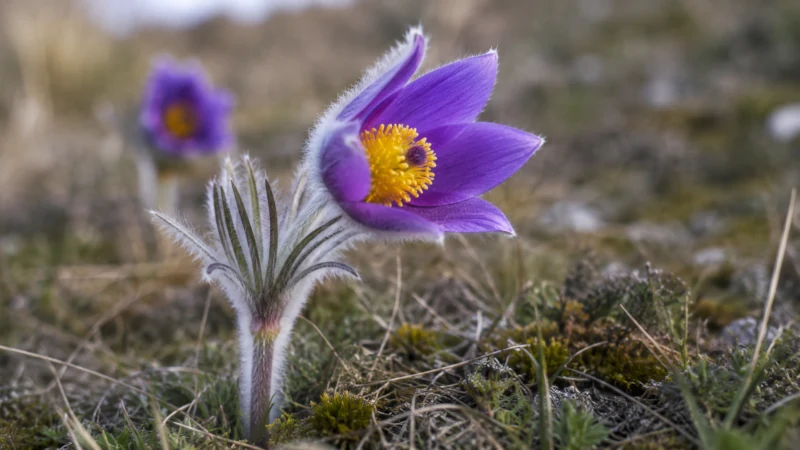
The pasque flower (Pulsatilla vulgaris) is one of Europe’s earliest spring bloomers — a low-growing, silky-haired plant whose purple bell-shaped flowers push through chalky grassland while most everything else is still dormant. European herbalists have reached for it for centuries, particularly as a sedative and a remedy for painful periods. But the gap between tradition and tested medicine is wide here: no human clinical trials have ever been conducted on this herb [Southern Cross University Monograph], the fresh plant is genuinely poisonous, and the Drugs.com professional monograph states plainly that it is “not recommended for human use” [Drugs.com, 2025].
That does not mean the plant is without biological interest — it contains compounds with documented antibiotic, antispasmodic, and sedative activity in laboratory settings. But those findings are a long way from a safe, effective treatment you can use at home. This page covers what the pasque flower actually is, what tradition claims, what science has and has not confirmed, and where the safety boundaries fall.
What Pasque Flower Is
Pasque flower belongs to the Ranunculaceae (buttercup) family. The accepted scientific name is Pulsatilla vulgaris Mill., though older references may list it as Anemone pulsatilla. Several related species — Pulsatilla pratensis and Pulsatilla patens — share both the common name and some traditional uses [Drugs.com, 2025]. In homeopathic medicine, it is usually P. pratensis that is used, not P. vulgaris, and the two should not be treated as interchangeable.
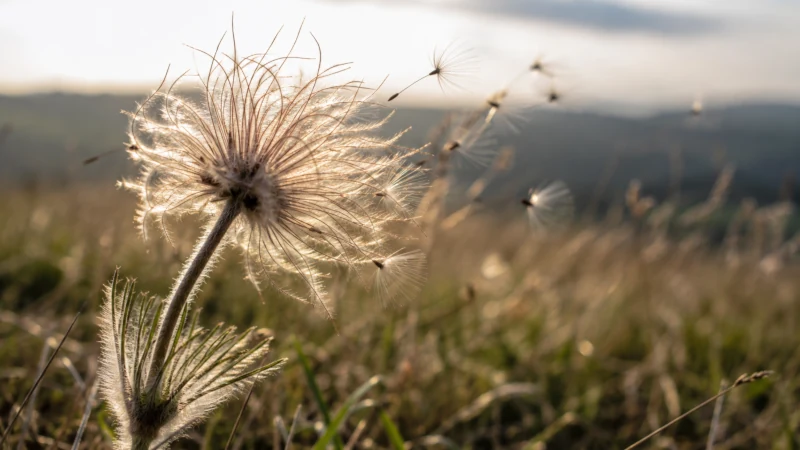
Other common names include Easter flower, meadow anemone, windflower, and wild crocus. The name “pasque” comes from the French word for Easter — Pâques — because the plant often flowers around that time in the Northern Hemisphere [SCU Monograph]. The name Anemone comes from the Greek word for wind: when the plant dries, its feathery seed heads blow apart in the lightest breeze.
It grows natively in dry meadows and chalky grasslands of Central and Northern Europe, and is also found in parts of Russia and southern England. The plant stands about 15 to 30 cm tall, covered in fine silky hairs, with finely divided leaves and large purple or violet flowers formed by six petal-like sepals [SCU Monograph]. It is a protected species in several countries and should not be wild-harvested.
Key Compounds: Ranunculin, Protoanemonin, and Anemonin
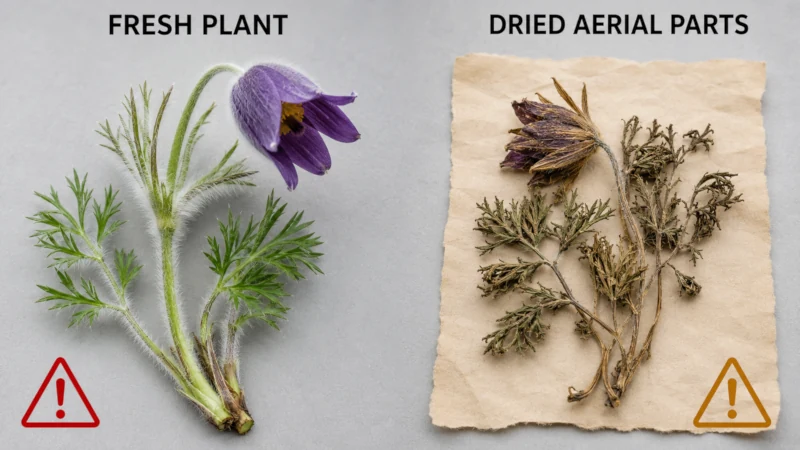
Understanding the chemistry of pasque flower matters because it explains both the plant’s biological activity and its toxicity. The fresh plant contains a glycoside called ranunculin. When the plant tissue is crushed or cut, an enzyme breaks ranunculin down into protoanemonin — a volatile, vesicant (blister-causing) compound that irritates the skin, mucous membranes, kidneys, and urinary tract [Drugs.com, 2025]. Protoanemonin is unstable and gradually dimerizes into anemonin, which is considered the main therapeutically active compound in the dried plant [SCU Monograph].
This conversion is the reason herbalists insist on using only the dried plant — drying allows much of the toxic protoanemonin to convert to anemonin. But the rate and completeness of this conversion are not reliably predictable [SCU Monograph], which is one reason standardized dosing is difficult.
The plant also contains small amounts of triterpenoid saponins, tannins, and volatile oil [SCU Monograph].
Traditional Medicinal Uses
European herbalists and the Eclectic physicians of the late 19th and early 20th centuries used the dried plant for a wide range of conditions. The American Botanical Council notes that small internal doses were used by the Eclectics particularly for conditions of the female reproductive system — including menstrual pain, absent periods, and uterine disorders — as well as for middle-ear pain, nervousness, insomnia, and skin problems [American Botanical Council, HerbalGram]. The Drugs.com professional monograph confirms traditional use in Europe for dysmenorrhea and other gynecological disorders, skin diseases, asthma, and eye infections [Drugs.com, 2025].
The most consistently cited traditional applications are:
Sedative and antispasmodic: Traditional herbalists used the dried plant to calm nervousness, ease insomnia, and reduce spasmodic cough — including whooping cough. The sundew plant is another herb historically used for spasmodic coughs, though for different reasons.
Menstrual complaints: Dried pasque flower was traditionally recommended for painful periods (dysmenorrhea) and scanty menstruation. This remains the use most commonly associated with the plant in herbal literature [SCU Monograph]. Other herbs with traditional associations to reproductive health include damiana, though the evidence base for each differs substantially.
Reproductive health: Some older herbal texts suggest the plant may influence ovarian function, though the mechanism was never identified and no human studies support this claim. The Drugs.com monograph documents a uterotonic effect (stimulation of uterine muscle) in animal studies, which is relevant to safety — particularly during pregnancy — rather than evidence of therapeutic benefit [Drugs.com, 2025].
Important context: Every one of these traditional uses rests on historical practice and clinical observation by individual practitioners. None has been tested in a controlled human trial.
What Laboratory and Animal Research Shows
While no clinical trials exist, there is a small body of laboratory and animal research worth describing accurately — neither overstating it as proof of benefit nor dismissing it entirely.
Antispasmodic activity: A 1998 study by Saify and colleagues tested an ethanol extract of Pulsatilla vulgaris on isolated rabbit jejunum (gut muscle) and found that cumulative doses reduced spontaneous contractions, achieving 100% inhibition at the highest dose [SCU Monograph — citing Saify et al., 1998]. The SCU monograph notes the study lacked a control comparison, but it does align with the plant’s longstanding reputation as a spasmolytic.
Antibiotic activity: Protoanemonin has documented antibacterial and antifungal properties in laboratory settings. Multiple early and mid-20th-century studies confirmed this activity [Drugs.com, 2025]. However, protoanemonin is also the toxic compound in the fresh plant, so these findings do not translate into a practical antimicrobial treatment.
Sedative and antipyretic effects: In animal studies, both protoanemonin and anemonin showed sedating effects. Anemonin also demonstrated antipyretic (fever-reducing) activity in animal models [Drugs.com, 2025].
Uterotonic activity: A documented uterotonic effect — meaning the extract can stimulate uterine muscle contraction — was recorded in animal studies [Drugs.com, 2025]. This is one reason the plant is contraindicated during pregnancy.
Anti-inflammatory potential: A 2006 study on anemonin (extracted from the related Pulsatilla chinensis) showed reduced production of inflammatory markers in rat intestinal cells [SCU Monograph — citing Duan, 2006]. Because the compound was from a different species and the study was in vitro, its relevance to P. vulgaris in humans is uncertain.
Evidence Summary
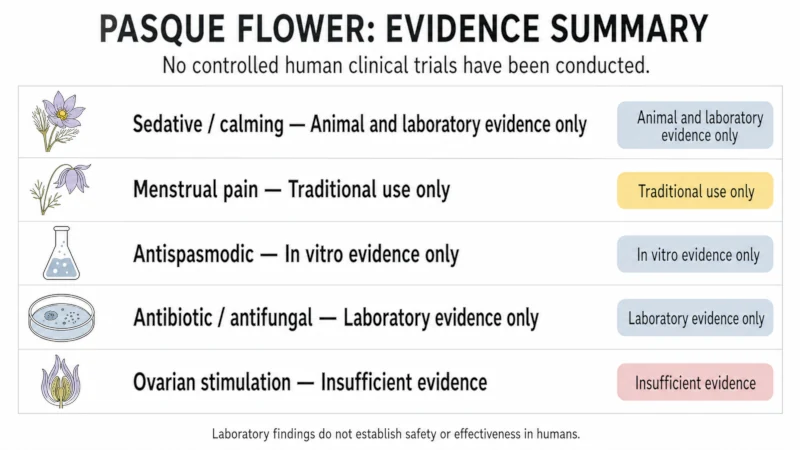
| Claimed Use | Best Available Evidence | Evidence Grade |
| Sedative / calming | Animal studies show sedating effects for protoanemonin and anemonin | Animal / in vitro only |
| Menstrual pain (dysmenorrhea) | Widespread traditional use; no controlled human trials | Traditional only |
| Antispasmodic | One in vitro study (rabbit gut tissue); no human data | In vitro only |
| Antibiotic / antifungal | Confirmed lab activity of protoanemonin (also the toxic compound) | Lab only |
| Ovarian stimulation | Uterotonic effect in animals; no evidence for ovarian-specific action in humans | Insufficient evidence |
Toxicity and Safety
This is the section that matters most. The fresh pasque flower is extremely toxic [Drugs.com, 2025]. Fresh plant material should never be ingested or applied to the skin. Protoanemonin causes blistering on contact and can damage the kidneys and urinary tract if swallowed [SCU Monograph]. Livestock deaths from grazing on protoanemonin-containing plants are documented, and animal studies have shown abortions and teratogenic (birth-defect-causing) effects [Drugs.com, 2025].
Dried preparations reduce but may not eliminate the risk. The SCU monograph states that dried aerial parts are considered nontoxic [SCU Monograph], but this view is not universal. The Drugs.com clinical overview flatly states that pasque flower is “no longer considered safe” and that it is “not recommended for human use” [Drugs.com, 2025]. These two positions genuinely disagree, and you should be aware of both rather than hearing only the more reassuring one.
Because the rate at which protoanemonin converts to anemonin during drying cannot be reliably predicted without chemical testing, the actual toxicity of any given batch of dried herb is uncertain [SCU Monograph]. This is not a theoretical problem — it means that two pouches of “dried pasque flower” could differ dramatically in safety.
Who Should Avoid Pasque Flower
Pregnancy and breastfeeding: Pasque flower is contraindicated during pregnancy. The Drugs.com monograph documents adverse effects and notes the plant’s uterine-stimulant activity [Drugs.com, 2025]. Avoid during lactation as well — no safety data exists [SCU Monograph].
Children: Use cautiously in children, if at all. The SCU monograph lists children as a caution group [SCU Monograph].
Kidney or urinary tract conditions: Because protoanemonin can irritate the kidneys and urinary tract, anyone with existing kidney disease or urinary problems should avoid this herb.
Anyone on medication: Drug interactions with pasque flower have not been formally studied [Drugs.com, 2025]. If you take any prescription medication, talk to your doctor or pharmacist before using it.
Fresh plant exposure: Never handle the fresh plant without gloves, and never ingest any part of it fresh. If you grow pasque flower in your garden as an ornamental (it is a beautiful spring-flowering perennial), treat it with the same respect you would give foxglove or monkshood.
Historical Dosing Information
There is no established modern therapeutic dose for pasque flower. The figures below come from traditional herbal references and older pharmacopeias, not from dose-finding clinical trials. They are included here for informational completeness, not as dosing recommendations.
The Drugs.com professional monograph reports classical doses of the dried herb at 0.1 to 0.4 g daily [Drugs.com, 2025]. The SCU monograph compiles figures from several herbal reference texts: dried aerial parts at 0.12 to 0.3 g taken three times daily as infusion; liquid extract (1:1, 25% alcohol) at 0.12 to 0.3 mL three times daily; or tincture (1:10, 40% alcohol) at 0.3 to 1.0 mL three times daily [SCU Monograph].
Given the Drugs.com assessment that pasque flower is “no longer considered safe,” self-dosing with preparations of unknown potency carries real risk. If you choose to use this herb, do so only under the guidance of a qualified herbal practitioner who can assess the quality of the preparation [SCU Monograph].
Pasque Flower in Homeopathy
Pulsatilla is one of the most widely used remedies in homeopathic practice and is available over the counter in many countries [Drugs.com, 2025]. Homeopathic preparations are extremely dilute — far more so than herbal extracts — and the toxicity concerns described above apply to herbal-strength preparations, not to the highly diluted homeopathic form. The question of whether homeopathic dilutions have therapeutic effects beyond placebo is a separate scientific debate and beyond the scope of this article.
When to Talk to a Healthcare Professional
If you are considering pasque flower for any of the conditions traditionally associated with it, a conversation with a qualified professional is the right first step — not because the herb is categorically off-limits, but because the conditions themselves deserve proper attention.
Painful or irregular periods can have causes — endometriosis, fibroids, thyroid dysfunction — that need diagnosis rather than self-treatment with an herb of uncertain safety. Your primary care doctor or gynecologist can help.
Persistent insomnia or anxiety can be symptoms of treatable conditions. A healthcare professional can rule out underlying causes and discuss evidence-based options. Our article on foods that support sleep covers gentler lifestyle approaches.
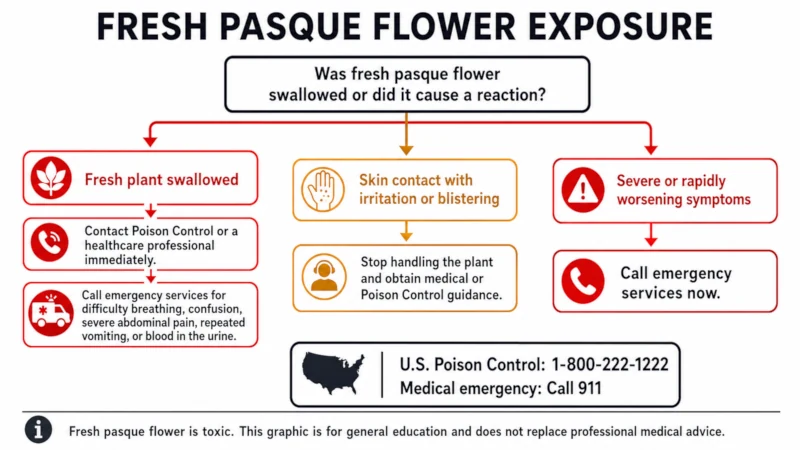
Seek urgent care if you or someone else has ingested fresh pasque flower and experiences skin blistering, vomiting, severe abdominal pain, blood in the urine, difficulty breathing, or confusion. In the United States, contact Poison Control at 1-800-222-1222 or call 911 for a medical emergency.
| Health Disclaimer: This article is for general education only and is not medical advice. Pasque flower (Pulsatilla vulgaris) is classified as toxic when fresh and is described by at least one major drug-information database as “no longer considered safe.” Nothing here should be read as a recommendation to prepare, take, or give this plant in any form without professional guidance. Do not use pasque flower during pregnancy or breastfeeding. Talk to a doctor or pharmacist before using any herbal product, especially if you take prescription medication, have a kidney or liver condition, or are caring for a child. If someone has ingested fresh plant material and shows symptoms, contact Poison Control at 1-800-222-1222 or call 911. |
Frequently Asked Questions
Is pasque flower safe to take?
The dried plant has a long history of use by trained herbalists, and some references describe dried preparations as nontoxic. However, the Drugs.com professional monograph states that pasque flower is “no longer considered safe” and is “not recommended for human use” [Drugs.com, 2025]. The fresh plant is unambiguously toxic. If you choose to use it, do so only under the supervision of a qualified herbal practitioner.
What is pasque flower used for in traditional herbal medicine?
The most common traditional uses are for painful or scanty periods (dysmenorrhea), nervousness, insomnia, and spasmodic cough. European and American Eclectic herbalists also used it for middle-ear pain, headaches, and skin conditions [Drugs.com, 2025]. None of these uses has been validated in clinical trials.
Is Pulsatilla the same as pasque flower?
Pulsatilla is the genus name, and “pasque flower” is the common name for several species within it. The species most discussed in European herbal medicine is Pulsatilla vulgaris. In homeopathy, the remedy labeled “Pulsatilla” usually comes from P. pratensis [Drugs.com, 2025]. The species are not identical and should not be treated interchangeably.
Can I take pasque flower while pregnant?
No. Pasque flower is contraindicated during pregnancy. It has documented uterine-stimulant activity in animal studies, and the Drugs.com monograph lists documented adverse effects and advises avoiding it during pregnancy and lactation [Drugs.com, 2025]; [SCU Monograph].
Does pasque flower interact with medications?
No drug interactions have been formally documented for Pulsatilla vulgaris [Drugs.com, 2025]. This does not mean interactions do not exist — it means they have not been studied. If you take any prescription medication, consult your doctor or pharmacist before using any herbal product.
References
- Drugs.com. “Pasque Flower Uses, Benefits & Dosage.” Medically reviewed. Last updated August 18, 2025. → View source
- Southern Cross University, Analytical Research Laboratory. “Anemone pulsatilla — Medicinal Plant Monograph.” Authored 2008. → View source
- American Botanical Council. “Pulsatilla.” HerbalGram, Issue 99. → View source
