
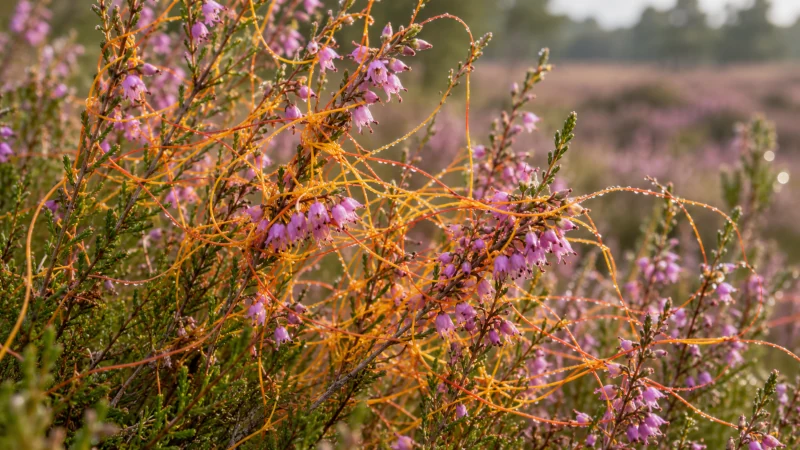
Dodder is the thread-thin, leafless vine you sometimes see draped over clover or heather like tangled orange string. It is a parasite, and for centuries herbalists also used it as medicine for sluggish digestion, liver complaints and slow-healing skin. The honest short answer on the dodder plant: those uses are traditional, not proven. Human evidence is limited to one small trial for an unrelated condition, and the most direct safety study found liver changes in rats given repeated doses. For most people, it is a fascinating plant to learn about rather than one to self-treat with.
What Is the Dodder Plant?
Dodder is the common name for Cuscuta, a genus of roughly 170 parasitic species found mainly in temperate and subtropical regions [Noureen et al., 2019]. Its stems look bare because the leaves have shrunk to tiny scales, and most species carry very little chlorophyll, so they make almost none of their own food [Mahr, UW–Madison Extension, 2026].
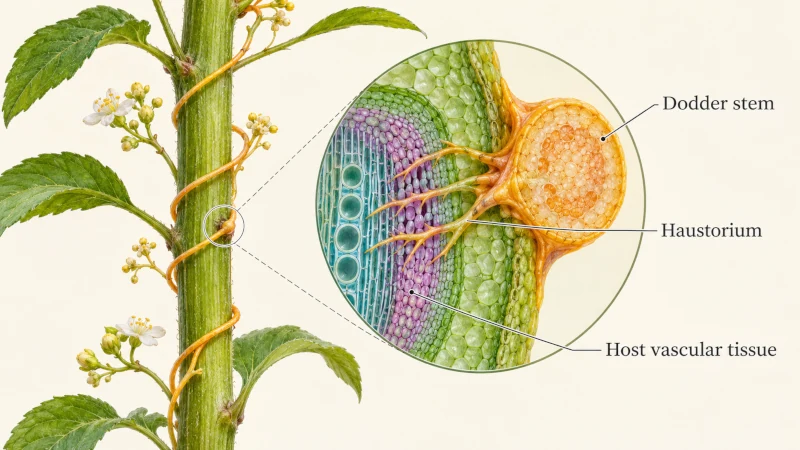
A seedling has only days to find a host. If it does not reach one within about 5 to 10 days, it dies. Once it wraps around a stem, it pushes specialized structures called haustoria into the host’s plumbing, its own soil root withers, and from then on it lives entirely off the host. Infected plants can be weakened or killed, depending on the species and timing, and a single dodder plant can produce thousands of hard-coated seeds that survive in soil for 20 years or more [Mahr, UW–Madison Extension, 2026].
The species most often described in European herbals is Cuscuta epithymum, usually called lesser dodder. It is native to most of Europe, reaching east into northwest China, and has been carried accidentally to the Americas and elsewhere. In northwestern Europe it favors dry heathland, climbing over gorse, common heather and clover [Wikipedia, 2026] — including the red clover that has its own herbal following.
Old herbalists liked the idea that dodder borrowed the healing powers of whatever it fed on. It makes good folklore, but nothing we reviewed supports it as a basis for using the plant.
| Dodder plant quick facts | |
| Scientific name | Cuscuta epithymum (the European medicinal species); genus Cuscuta |
| Common names | Lesser dodder, dodder, hellweed, strangle-tare; cuscute (French), cuscuta (Spanish) |
| Family | Convolvulaceae (older references use Cuscutaceae) |
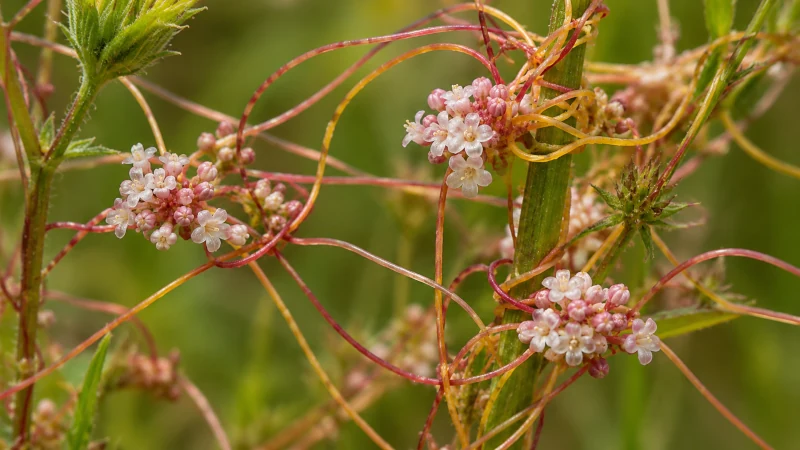
| Appearance | Thread-like pink, red, yellow or purple stems; scale-like leaves; clusters of small white or pink flowers |
| How it feeds | Holoparasite — attaches to hosts with haustoria and takes water and nutrients |
| Parts used traditionally | Whole herb in European tradition; seeds in Chinese medicine |
One name, many species
“Dodder” on a label can mean very different things. Reviews list more than a dozen species with medicinal histories, including C. reflexa in South Asia and C. chinensis across China, Korea, Vietnam, India and Thailand [Ahmadi et al., 2022; J Ethnopharmacol review, 2014]. Chinese medicine uses the seed of C. chinensis, often sold as Chinese dodder seed (tu si zi), while European herbals use the whole C. epithymum plant. Research on one species, or one plant part, does not automatically apply to another — something to keep in mind every time you see a dodder study quoted.
Traditional Uses of the Dodder Plant
Across folk traditions, dodder species have been used as a purgative, a diuretic, a sweat-inducing remedy, a worm treatment and a general tonic, and for itching and “bilious” (bile-related) complaints [Ahmadi et al., 2022]. Lesser dodder in particular is described as a mild laxative and mild diuretic associated with liver and kidney health [Ahmadi et al., 2022], and has been used for jaundice, liver and spleen disorders, rheumatism and low mood [Wikipedia, 2026].
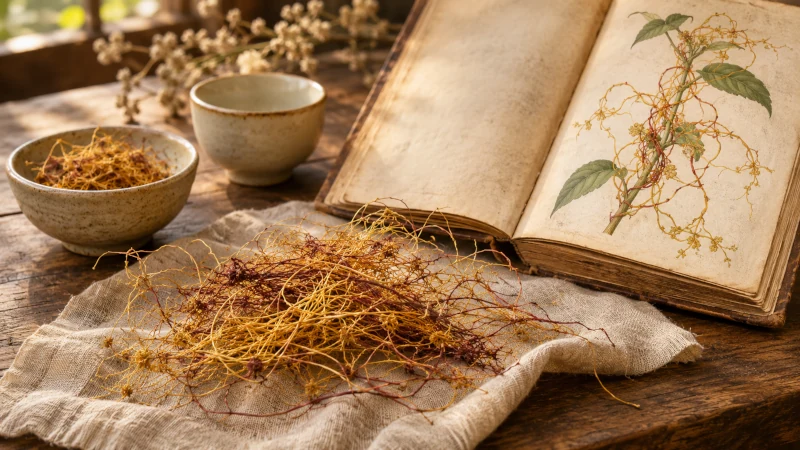
Popular herbal encyclopedias also describe whole-plant dodder as a cholagogue — something meant to help the gallbladder empty — and recommend boiled-plant poultices for slow-healing wounds and leg ulcers. These are records of how the plant has been used, not evidence that it works or is safe. If gallbladder trouble is what brought you here, diet changes and a proper medical workup have far better support; our guide to foods to eat with gallstones covers what helps and which symptoms need urgent care.
What the Research Actually Shows
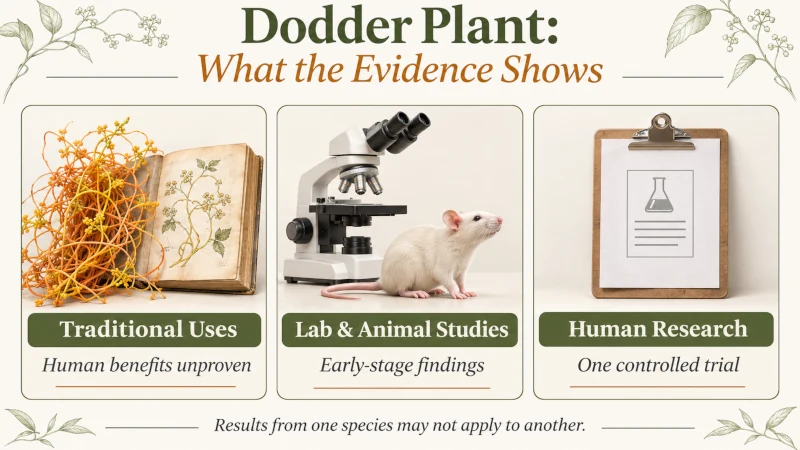
Lab and animal studies on various Cuscuta species report antioxidant, liver-protective, anti-inflammatory, antimicrobial and antitumor activity, among others [Noureen et al., 2019]. That list sounds impressive until you look at where the findings come from: almost all of it is test tubes and rodents. Very little has been tested in people.
| Claimed use | What the evidence is | How strong |
| Laxative, diuretic, gallbladder (cholagogue) | Traditional records; no human trials found | Traditional only — insufficient |
| Liver and kidney protection | Animal and lab studies, mostly on C. chinensis [J Ethnopharmacol review, 2014] | Early-stage — not shown in humans |
| Wound healing | One rat study of a C. chinensis extract gel [Nitthikan et al., 2024] | Early-stage — different species and formulation |
| Antitumor, antimicrobial, antioxidant | Lab and animal studies across species [Noureen et al., 2019] | Early-stage |
| Schizophrenia symptoms (add-on to medication) | One randomized, placebo-controlled trial of C. epithymum [Parvizi et al., 2019] | Limited — single small trial, needs replication |
The one human trial
The only controlled human study we found on lesser dodder had nothing to do with digestion. In an Iranian triple-blind trial, adults with schizophrenia took 500 mg C. epithymum capsules twice daily or a matching placebo for eight weeks, alongside their usual risperidone. The dodder group improved more on standard symptom and cognition scales, with gains in most positive and negative symptoms [Parvizi et al., 2019].
That is interesting, but it is one trial, and the published summary we reviewed did not report how many people took part or what side effects occurred. It is a reason for researchers to look further, not a reason for anyone to add an herb to psychiatric treatment on their own.
Liver, kidney and wound research: mostly animals and lab dishes
A 2014 systematic review of C. chinensis concluded that lab and animal work offers a plausible explanation for its traditional uses — most notably antioxidant effects relevant to liver and kidney disease — and stressed that human pharmacokinetic and toxicology studies are still needed to establish safety [J Ethnopharmacol review, 2014]. In 2024, a gel made from C. chinensis extract improved wound contraction in rats compared with an antibiotic cream, and the authors called for clinical trials [Nitthikan et al., 2024]. Neither finding tells you what a homemade lesser dodder tea or poultice will do on a person.
Dodder Plant Safety: The Liver Question
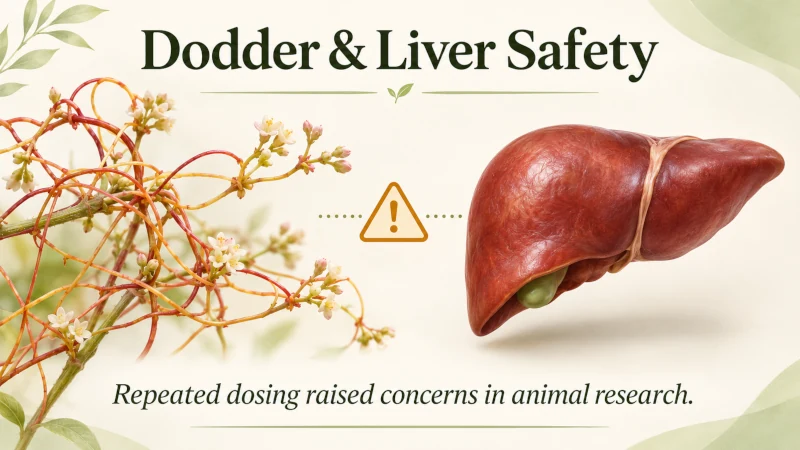
Here is the uncomfortable twist. The most direct safety study on lesser dodder points at the same organ the folk remedies claim to help.
Researchers in Iran tested an ethanol extract of C. epithymum in rats, mice and cell cultures. Single oral doses up to 5,000 mg/kg caused no deaths in rats. Injected into the abdomen of mice, though, it was considerably more toxic (LD50 about 155 mg/kg). When rats were given the extract by mouth every day for 28 days, the two higher doses (200 and 500 mg/kg) significantly raised liver damage scores on tissue examination, even though blood tests, body weight and kidneys looked normal. The extract was also about as toxic to normal cells as to cancer cells in the dish. The authors advised that practitioners prescribe it cautiously [Abedini et al., 2021].
These are animal results, and rat doses do not convert neatly to human cups of tea. But they are the best species-specific data available, and they argue against regular, long-term use — especially by anyone whose liver is already under strain. One review also notes that the seeds of a dodder species are described as poisonous, without naming which [Ahmadi et al., 2022]. No safe human dose for any dodder preparation has been established.
Side effects and interactions
Because dodder has mostly been studied in animals, its side effects in people are not well documented. Traditional descriptions of it as a laxative and diuretic suggest loose stools and increased urination are plausible, which matters if you are prone to dehydration.
We found no human studies on drug interactions with dodder. That is an absence of data, not proof of safety. Talk to a pharmacist before combining it with prescription medicine, particularly drugs that can affect the liver, diuretics or laxatives, and psychiatric medications such as antipsychotics.
Who should avoid dodder
- Pregnant or breastfeeding people. No pregnancy or breastfeeding safety data exist for any dodder species.
- Anyone with liver disease, abnormal liver tests, or heavy alcohol use, given the rat liver findings.
- People with known or suspected gallstones or gallbladder pain. Anything promoted to “move bile” deserves a doctor’s input first, because a blocked duct is an emergency.
- Children. No pediatric data exist.
- People taking prescription medicines without first checking with a pharmacist or prescriber.
- Anyone with an open wound, leg ulcer or infection. These need proper wound care. Varicose ulcers in particular heal slowly and need a clinician’s attention when skin breaks down — see our overview of varicose veins and their complications.
Warning signs: stop and call a doctor
Stop taking dodder and contact a healthcare provider promptly if you notice signs that can point to liver or bile-duct trouble [MedlinePlus, 2025]:
- yellowing of the skin or the whites of the eyes
- dark or brown urine
- pale or clay-colored stools
- itching that comes with any of the above
- nausea, vomiting or unusual fatigue
Seek urgent care for severe pain in the upper right abdomen, especially with fever or yellowing skin.
If You Still Want to Try It
Some readers will decide to try dodder anyway, and if that is you, a few steps lower the risk. Talk to your doctor or pharmacist first, and ask whether a baseline liver test makes sense. Buy from a supplier that names the exact species and plant part rather than just “dodder.” Keep use short rather than daily for months, and stop at the first sign of the symptoms above.
Herbal books give tea and poultice recipes, but none of those amounts has been tested for safety, so we do not repeat them here. If your real goal is supporting your liver, eating patterns have much stronger evidence than any single herb — see our guide to the best foods for the liver.
| HEALTH DISCLAIMER: This article is for general education and is not a substitute for medical advice, diagnosis or treatment. Dodder has not been proven safe or effective for any health condition in humans, and animal research has raised liver-safety concerns. Talk with a qualified healthcare professional before using dodder or any herbal remedy, especially if you are pregnant or breastfeeding, have a liver, kidney or gallbladder condition, take prescription medicine, or are considering it for a child. |
Frequently Asked Questions
Is the dodder plant poisonous?
Not acutely, as far as current data show: single oral doses of lesser dodder extract did not kill rats even at high levels. Repeated daily dosing for four weeks, however, caused liver changes in rats [Abedini et al., 2021], and one review notes that the seeds of an unnamed dodder species are described as poisonous [Ahmadi et al., 2022]. Treat it as a plant with real safety questions.
Is dodder the same as Chinese dodder seed (tu si zi)?
Not exactly. Chinese dodder seed comes from C. chinensis and related species and uses the seed, while European herbals use the whole C. epithymum plant [J Ethnopharmacol review, 2014; Ahmadi et al., 2022]. Results for one do not automatically apply to the other.
Can dodder help with gallbladder or liver problems?
There are no human studies showing that. The liver claims come from tradition and animal research on other species, while the one species-specific safety study found liver damage with repeated dosing in rats [Abedini et al., 2021]. Gallbladder pain needs a medical evaluation.
Does dodder kill the plants it grows on?
It can. Dodder weakens hosts and can kill them or cut crop yields, depending on the dodder species, the host and when infection happens [Mahr, UW–Madison Extension, 2026].
Can I put a dodder poultice on a wound?
The wound-healing research so far is a single rat study of a lab-made gel from a different species [Nitthikan et al., 2024]. Infected wounds and leg ulcers need proper medical care, and a homemade plant poultice is not sterile.
References
- Abedini MR, Paki S, Mohammadifard M, Foadoddini M, Vazifeshenas-Darmiyan K, Hosseini M. View source
- Ahmadi K, Omidi H, Amini Dehaghi M. A review on the botanical, phytochemical and pharmacological characteristics of Cuscuta spp. View source
- Cuscuta chinensis Lam.: a systematic review on ethnopharmacology, phytochemistry and pharmacology of an important traditional herbal medicine. J Ethnopharmacol. View source
- Jaundice. MedlinePlus Medical Encyclopedia. U.S. National Library of Medicine. View source
- Mahr S. Dodder, Cuscuta spp. University of Wisconsin–Madison Division of Extension, Wisconsin Horticulture. View source
- Nitthikan N, Preedalikit W, Supadej K, Chaichit S, Leelapornpisid P, Kiattisin K. View source
- Noureen S, Noreen S, Ghumman SA, Batool F, Bukhari SNA. The genus Cuscuta (Convolvolaceac): View source
- Parvizi M, Fadai F, Khodaei-Ardakani MR, Amin G, Abdi L, Noroozi M, Ansari I. View source
- Cuscuta epithymum. Wikipedia. View source


