

Catnip sends most cats into a rolling, purring frenzy. For people, the effects are much quieter and much less proven. Herbalists have used catnip (Nepeta cataria) for generations as a gentle bedtime tea and a remedy for an unsettled stomach, but no human trials show it works for either [PeaceHealth, 2015; Drugs.com, 2026]. One of the many catnip benefits with solid modern science behind it happens outside your body: its oil repels mosquitoes and other insects [Melo et al., 2021].
That doesn’t make a cup of catnip tea a bad idea for a healthy adult. In tea-sized amounts it’s rated possibly safe [TRC Natural Medicines, 2026]. But it isn’t for everyone. Skip it if you’re pregnant, don’t give it to babies or young children, and be careful combining it with anything that makes you sleepy.
What catnip is
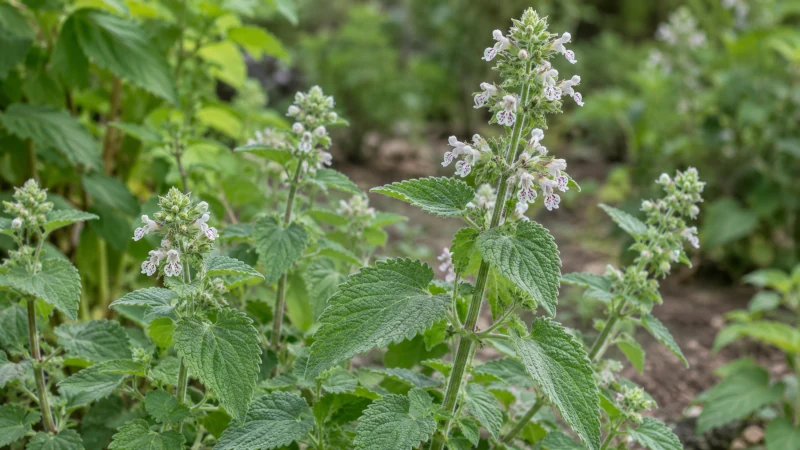
Catnip is a perennial herb in the mint family (Lamiaceae, once called Labiatae). Its native range runs from southern Europe across Asia to Japan, with a pocket in northwestern Morocco [Kew POWO, n.d.], and it now grows in North America too [PeaceHealth, 2015]. The plant is grayish-green with a minty smell, and its small flowers are white with crimson dots [PeaceHealth, 2015]. The leaves and flowering tops are what go into teas and tinctures.
| Catnip at a glance | |
| Scientific name | Nepeta cataria L. |
| Family | Lamiaceae (mint family) |
| Other common names | Catmint, catnep, catswort, field balm. “Catmint” also refers to a closely related species [Drugs.com, 2026]. |
| Native range | Southern Europe to Japan; northwestern Morocco [Kew POWO, n.d.] |
| Parts used | Leaves and flowering tops |
| Key aromatic compounds | Nepetalactones plus a shifting mix of other oils; more than 20 compounds have been identified, and levels vary with season and region [Drugs.com, 2026] |
That variability matters more than it sounds. Nepetalactones are thought to be the main reason cats react [Drugs.com, 2026], and they drive catnip’s effect on insects [Melo et al., 2021]. Yet one lab analysis of catnip essential oil found its biggest components were 1,8-cineole, α-humulene, α-pinene and geranyl acetate [Gilani et al., 2009]. Two bags of dried catnip may not be chemically alike, so a result from one study doesn’t automatically apply to the tea in your cupboard.
Catnip benefits: what the evidence shows
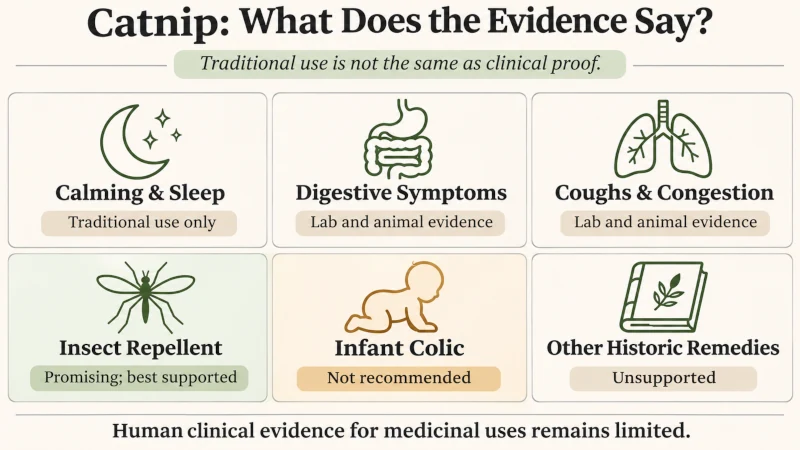
“Traditional” below means people have used catnip this way for a long time. It isn’t evidence that it works.
| Use | What’s known | Evidence level |
| Calming and sleep | Long traditional use; no human trials [PeaceHealth, 2015] | Traditional only |
| Gas, cramps, diarrhea | Oil relaxed isolated animal gut tissue [Gilani et al., 2009]; no human trials [Drugs.com, 2026] | Lab and animal only |
| Coughs and congestion | Oil relaxed isolated guinea-pig airway tissue [Gilani et al., 2009] | Lab and animal only |
| Insect repellent | Mechanism confirmed in insects [Melo et al., 2021]; small human studies of catnip-oil lotion [Drugs.com, 2026] | Promising; best supported |
| Infant colic | Not recommended for colicky babies [WebMD, 2025] | Avoid |
| Fevers, mumps, worms, morning sickness | No supporting research; some uses are unsafe | Unsupported |
Calming and sleep: a tradition without trials
Catnip’s oldest human job is as a mild nighttime tea, often blended with chamomile or lemon balm. PeaceHealth’s herbal monograph gives catnip its lowest evidence rating for insomnia: the use rests on tradition, and human trials are lacking [PeaceHealth, 2015].
Some people do feel drowsy after a cup, and interaction databases flag catnip for possible sleepiness [TRC Natural Medicines, 2026]. A warm, caffeine-free drink can be a pleasant part of winding down. Just don’t expect it to fix ongoing sleep trouble. Daily habits and cognitive behavioral therapy for insomnia (CBT-I) have far better evidence than any herbal tea, as our guide to natural remedies for insomnia explains. If you want a calming blend, this nervine tea guide covers chamomile, lemon balm, passionflower and linden, with the evidence for each.

Gas, cramps and diarrhea: a lab clue, not proof
Herbalists have long reached for catnip for gas, cramping and loose stools, and there’s a plausible reason it might help. In a 2009 lab study, catnip essential oil relaxed strips of rabbit intestine, apparently by blocking calcium channels and inhibiting an enzyme called phosphodiesterase, much as the drug papaverine does [Gilani et al., 2009]. The researchers suggested this could explain catnip’s traditional use for colic and diarrhea.
The catch: that was concentrated oil applied straight to isolated animal tissue, not tea swallowed by a person. No human trial has tested catnip for digestive symptoms [Drugs.com, 2026].
For occasional mild gas, a cup of catnip tea is a low-stakes thing to try, and fennel seeds are another traditional option for gas and bloating. For diarrhea, fluids matter far more than any herb. This guide to what to eat and drink when you have diarrhea covers rehydration and the signs that mean you should call a doctor.
Coughs and colds
The same study found catnip oil relaxed guinea-pig airway tissue, and the authors linked this to the herb’s traditional use for cough and asthma [Gilani et al., 2009]. There are no human trials. Catnip tea won’t treat bronchitis or asthma. A warm drink may feel soothing with a cold, but a cough that lingers, or comes with a high fever, chest pain or shortness of breath, needs a medical check.
Insect repellent: the best-supported use
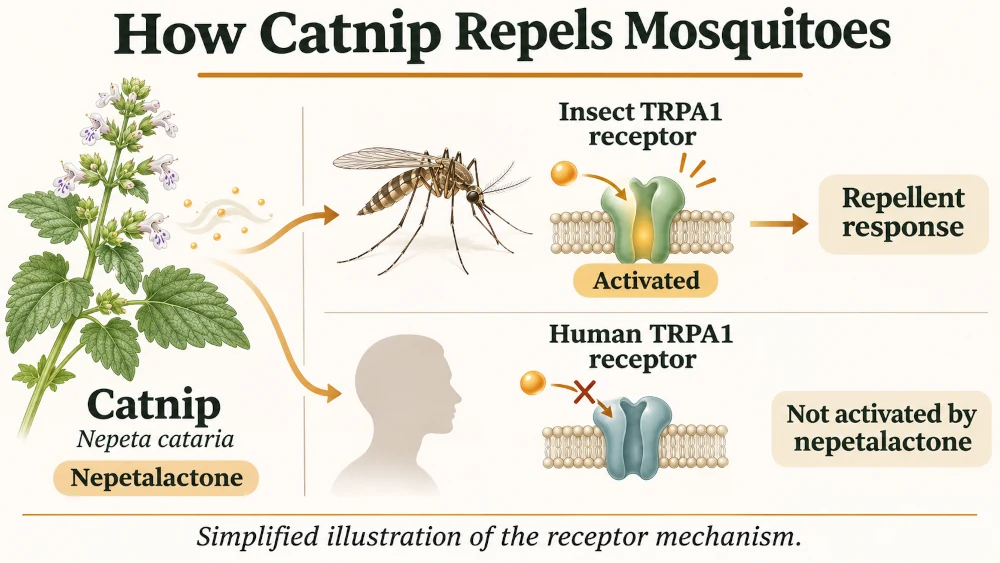
This is where catnip has real science behind it. In 2021, researchers at Northwestern and Lund universities showed that catnip and its main active compound, nepetalactone, repel mosquitoes and fruit flies by switching on an irritant receptor in insects called TRPA1. Mosquitoes bred without a working version of that receptor were no longer put off by catnip. Catnip did not activate the human version of TRPA1, which the authors say supports its use as a safe natural repellent [Melo et al., 2021].
Real-world evidence is promising but thin. In one human study, a lotion containing 15% catnip oil protected against black flies and mosquitoes for more than six hours, and several lab studies have found catnip oil matched or beat DEET against specific insects [Drugs.com, 2026]. These were small, short tests. If you’re travelling somewhere with mosquito-borne disease, use a registered repellent with a long track record and follow its label.
On skin, catnip oil has caused redness and eye irritation in some people [Drugs.com, 2026], so keep undiluted essential oil off your skin and away from your eyes.
Old remedies that don’t hold up
Older herbal books recommend catnip for a long list of problems, including fevers, mumps, smallpox, intestinal worms, urine retention, morning sickness and “hysteria,” sometimes given as an enema, even to children. None of these uses is backed by research, and some could do harm.
- Morning sickness. Catnip is rated likely unsafe in pregnancy because it may stimulate the uterus [TRC Natural Medicines, 2026].
- Infant colic, fussiness or gas. Catnip tea isn’t recommended for colicky babies [WebMD, 2025].
- Worms, mumps and fevers. These need a diagnosis. Intestinal worms need proper treatment, not a herbal enema.
- Enemas. There’s no evidence for catnip enemas. Never give one to a child.
How to make catnip tea

Put 1 to 2 teaspoons of dried catnip leaves and flowers in a cup [Restorative Medicine, n.d.], add hot water, and steep for up to 10 minutes [WebMD, 2025]. Strain and drink. Chamomile or mint can soften the slightly grassy taste.
WebMD’s guidance is that up to three cups a day is likely safe for healthy adults [WebMD, 2025], though no studies have looked at long-term daily use. There’s no clinical evidence to guide doses of tinctures, extracts or capsules [Drugs.com, 2026], so if you try catnip, stick with tea. Have your first cup in the evening, when drowsiness won’t matter.
Catnip side effects and safety
In tea-sized amounts, catnip is rated possibly safe for adults. Larger doses may cause headache, vomiting and a general feeling of being unwell [TRC Natural Medicines, 2026]. Stop drinking it if it keeps upsetting your stomach, and be cautious if you’re allergic to other mint-family plants [WebMD, 2025].
Smoking catnip is a different matter. It’s rated possibly unsafe and has been linked to a high that may impair judgment [TRC Natural Medicines, 2026].
Who should avoid catnip
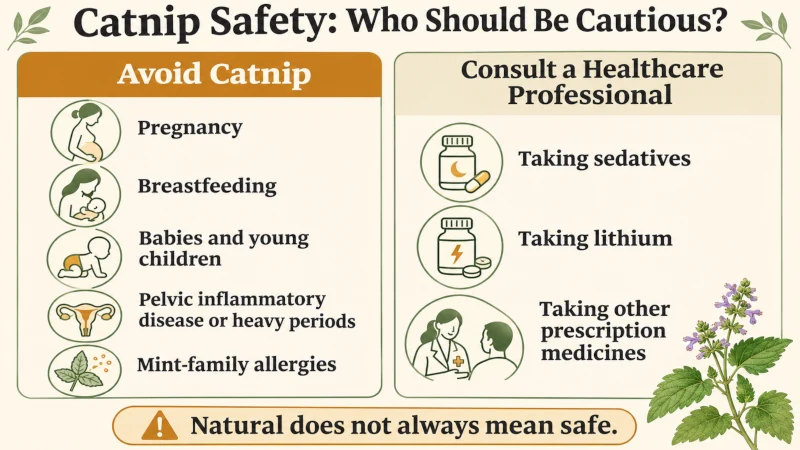
- Pregnant women. Catnip is rated likely unsafe in pregnancy because it may stimulate the uterus and could cause miscarriage [TRC Natural Medicines, 2026; PeaceHealth, 2015]. One herbal monograph takes a softer line, urging caution especially in the first two trimesters [Restorative Medicine, n.d.], but most sources say to avoid it.
- Breastfeeding mothers. There isn’t enough safety information, so avoid it [TRC Natural Medicines, 2026].
- Babies and young children. Catnip is rated possibly unsafe for children when taken by mouth [TRC Natural Medicines, 2026]. A published case report describes a young child with depressed central nervous system activity after consuming a large amount [Drugs.com, 2026].
- People with pelvic inflammatory disease (PID) or heavy periods. Catnip may make PID worse and cause heavy menstrual bleeding [TRC Natural Medicines, 2026].
- Anyone allergic to mint-family plants [WebMD, 2025].
Medication interactions
Sedatives. Catnip can add to the drowsiness from sleep medicines and other sedating drugs. Interaction lists include benzodiazepines, barbiturates, anticonvulsants, tricyclic antidepressants, prescription sleep aids, and over-the-counter products containing diphenhydramine or doxylamine, plus sedating herbs such as valerian, kava and hops [WebMD, 2025]. TRC Natural Medicines rates this a moderate interaction, warning of excessive sleepiness and slowed breathing [TRC Natural Medicines, 2026].
Lithium. Here the sources disagree. TRC Natural Medicines rates it a moderate interaction, reasoning that catnip may act as a diuretic and slow how fast the body clears lithium [TRC Natural Medicines, 2026]. Drugs.com reports no well-documented interactions [Drugs.com, 2026], and another monograph found no reported cases [Restorative Medicine, n.d.]. The risk is theoretical, but lithium levels have to stay within a narrow range, so ask your prescriber before trying catnip.
If you take any prescription medicine, check with a pharmacist before adding a herbal tea you plan to drink regularly. For a wider look at which calming herbs have evidence and which carry risks, see our guide to herbs for nervous system disorders.
When to see a doctor
Catnip tea isn’t a treatment for any medical condition. Get medical advice if:
- an adult has diarrhea for more than two days, or a child for more than 24 hours [MedlinePlus, n.d.]
- there’s blood or pus in the stool, or stools are black and tarry [MedlinePlus, n.d.]
- you have a fever of 102°F (39°C) or higher, severe belly or rectal pain, or signs of dehydration [MedlinePlus, n.d.]
- trouble sleeping goes on for weeks or affects how you function during the day
- you’re pregnant and have taken catnip
If a child has swallowed catnip oil, leaves or a lot of tea, call Poison Help at 1-800-222-1222 (US) right away; don’t wait for symptoms [HRSA Poison Help, n.d.]. Call 911 if they are hard to wake or having trouble breathing.
| HEALTHY DISCLAIMER: This article is for general information and isn’t a substitute for advice, diagnosis or treatment from a qualified health professional. Herbal products vary in strength and quality. If you’re pregnant, breastfeeding, giving herbs to a child, managing a health condition or taking any medication, talk to your doctor or pharmacist before using catnip. |
Frequently Asked Questions
Does catnip get humans high?
Not as a tea. Smoking dried catnip has been linked to a high that may impair judgment, and it’s rated possibly unsafe [TRC Natural Medicines, 2026]. As a tea, the most you’re likely to notice is mild drowsiness.
Is it safe to drink catnip tea every day?
For healthy adults, up to three cups a day is likely safe according to WebMD [WebMD, 2025], but no studies have looked at long-term daily use. Avoid it if you’re pregnant or breastfeeding, and check with a pharmacist if you take sedatives or lithium.
Can I give catnip tea to my baby for colic?
No. Catnip tea isn’t recommended for colicky babies [WebMD, 2025], and catnip is rated possibly unsafe for children [TRC Natural Medicines, 2026]. Talk to your pediatrician about colic, and call promptly if your baby has a fever, keeps vomiting or seems unusually sleepy.
Does catnip really repel mosquitoes?
Yes, in lab studies and small human trials. Catnip triggers an irritant receptor in insects that the human version doesn’t respond to [Melo et al., 2021], and a 15% catnip-oil lotion protected people for more than six hours in one study [Drugs.com, 2026]. It’s a reasonable choice for the backyard; where mosquitoes carry disease, use a registered repellent with a longer track record.
Is catnip the same as catmint?
The names overlap. “Catmint” is used as another name for Nepeta cataria and also for a closely related species [Drugs.com, 2026]. If you’re buying it to drink, check that the label says Nepeta cataria.
References
- Drugs.com. Catnip (professional monograph). View source
- Gilani AH, Shah AJ, Zubair A, Khalid S, Kiani J, Ahmed A, Rasheed M, Ahmad VU. Chemical composition and mechanisms underlying the spasmolytic and bronchodilatory properties of the essential oil of Nepeta cataria L. View source
- HRSA. Poison Help: What you can do. U.S. Department of Health and Human Services. View source
- Melo N, Capek M, Arenas OM, Afify A, Yilmaz A, Potter CJ, Laminette PJ, Para A, Gallio M, Stensmyr MC. The irritant receptor TRPA1 mediates the mosquito repellent effect of catnip. View source
- MedlinePlus. Diarrhea. National Library of Medicine. View source
- PeaceHealth Health Information Library. Catnip. View source
- Plants of the World Online. Nepeta cataria L. Royal Botanic Gardens, Kew. View source
- Restorative Medicine. Catnip monograph. View source
- TRC Natural Medicines. Catnip. Licensed monograph hosted by vital.ly; View source
- WebMD. Catnip Tea: Are There Health Benefits? Medically reviewed by Christine Mikstas, RD, LD, View source


