
Asafoetida is the dried, strong-smelling resin tapped from the root of the asafoetida plant, Ferula asafoetida. Most cooks know it by its Hindi name, hing. In the pinch-sized amounts used in cooking, it is likely safe for most adults [WebMD/TRC, 2026]. As a remedy, the honest summary is short. Two small trials of one supplement suggest it may ease bloating and fullness from indigestion, one trial from 1979 reported help for irritable bowel, and the rest of its long reputation, from asthma to whooping cough, rests on tradition and lab work.
There is also a real danger that older articles skip. Given to babies as a colic remedy, asafoetida has caused a life-threatening blood disorder. If you remember one thing from this page, make it that.
What the asafoetida plant is, and why it smells like that
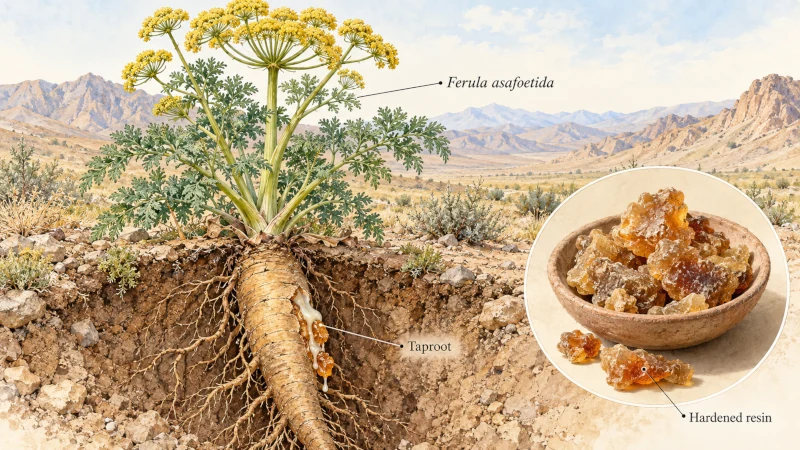
Ferula asafoetida is an herbaceous perennial in the carrot family (Umbelliferae, now usually called Apiaceae). It is native to central Asia, from eastern Iran to Afghanistan, and those two countries still grow most of the world’s supply [Mahendra & Bisht, 2012]. Despite what some older descriptions say, it is not a tree.
The spice comes from its thick taproot. Just before the plant flowers, harvesters expose the top of the root, cut it, and scrape off the milky sap that seeps out and hardens. They keep slicing and collecting for about three months, until the sap stops flowing [Mahendra & Bisht, 2012].
That hardened sap is an oleo-gum-resin: roughly 40–64% resin, about 25% gum, and 3–17% volatile oil. Sulfur compounds in the oil, mainly disulfides, cause the smell [Mahendra & Bisht, 2012]. The odor earned it the name “devil’s dung” in Europe [WebMD/TRC, 2026]. In Persia, where it went into almost every dish, it was called “food of the gods” [Mahendra & Bisht, 2012].
| Quick facts | |
| Scientific name | Ferula asafoetida (also spelled assa-foetida) |
| Family | Umbelliferae (Apiaceae), the carrot family |
| Other names | Hing (Hindi), asafétida (Spanish), férule persique (French), devil’s dung, stinking gum |
| Native range | Central Asia, eastern Iran to Afghanistan |
| Part used | Oleo-gum-resin from the root and rhizome |
Source for table: Mahendra & Bisht, 2012.
What the research shows about asafoetida
Asafoetida has a long list of traditional uses and very little testing in people. The Natural Medicines database, published through WebMD, rates the evidence as insufficient for every use it lists, including intestinal gas, irritable colon, stomach upset, asthma, and bronchitis [WebMD/TRC, 2026]. A 2012 review of its pharmacology lands in the same place: most findings come from animals and lab dishes, and the authors called for detailed study before clinical trials [Mahendra & Bisht, 2012].
Bloating, fullness, and indigestion: the most promising evidence
The best human data concern functional dyspepsia, the recurring upper-belly discomfort (fullness after meals, feeling full early, bloating) that has no ulcer or other visible cause.

In a 2018 randomized, double-blind trial, 43 adults with moderate to severe functional dyspepsia took either a placebo or two 250 mg capsules a day of Asafin, a proprietary blend of asafoetida resin and fenugreek fiber, for 30 days. The authors reported more symptom relief with asafoetida [Mala et al., 2018]
A 2025 trial of the same product randomized 62 adults to 250 mg a day or placebo for 14 days, and 56 finished. Early satiety, bloating, and heartburn improved more than with placebo; nausea did not. No significant side effects were reported, though seven people noticed the taste or smell of asafoetida in their mouth [Das et al., 2025].
Two things temper the excitement. Both trials were small and short, and both tested one company’s formulation. The 2025 study was funded by that manufacturer, Akay Natural Ingredients, and three of its authors work there [Das et al., 2025]; the 2018 trial shares the same senior author. The results may not carry over to the hing in your spice drawer, which is usually diluted with flour and gum. Call it promising, not proven.
If bloating is your main complaint, our guide to fennel seeds covers a related kitchen spice, and our overview of herbs for stomach issues compares the evidence for peppermint oil, ginger, and other common digestive herbs.
Irritable bowel: one trial from 1979
German researchers ran a double-blind trial in two groups of 50 people with irritable colon. Ninety-one could be evaluated, and asafoetida beat placebo at a statistically significant level [Rahlfs & Mössinger, 1979]. That is a real controlled trial. It is also nearly 50 years old, predates modern IBS criteria, and has not been repeated. Treat it as a reason for curiosity, not a treatment plan.
Asthma, coughs, and “nervous” complaints: tradition without trials
Asafoetida was once a standby for asthma, bronchitis, and whooping cough, partly on the old theory that its volatile oil leaves the body through the lungs [Mahendra & Bisht, 2012]. No human trials support those uses [WebMD/TRC, 2026]. The same is true of older claims about croup-like throat spasms and “nervous palpitations.”
Each of those symptoms deserves a proper diagnosis. Whooping cough can be dangerous, especially for babies, and asthma needs a treatment plan from a clinician. If breathing is your concern, our guide to natural asthma relief sorts the approaches with evidence from the ones without.
Lab and animal findings that get oversold
In animals and isolated tissue, asafoetida extracts relax intestinal muscle and lower blood pressure. Other animal and cell studies report anticoagulant, antioxidant, and anti-tumor effects [Mahendra & Bisht, 2012]. That explains the research interest. It does not show that eating asafoetida treats high blood pressure, prevents cancer, or lifts depression in people, all of which you will see claimed online. Some of these same effects, thinner blood and lower blood pressure, are the reason for the safety cautions further down.
Asafoetida evidence at a glance
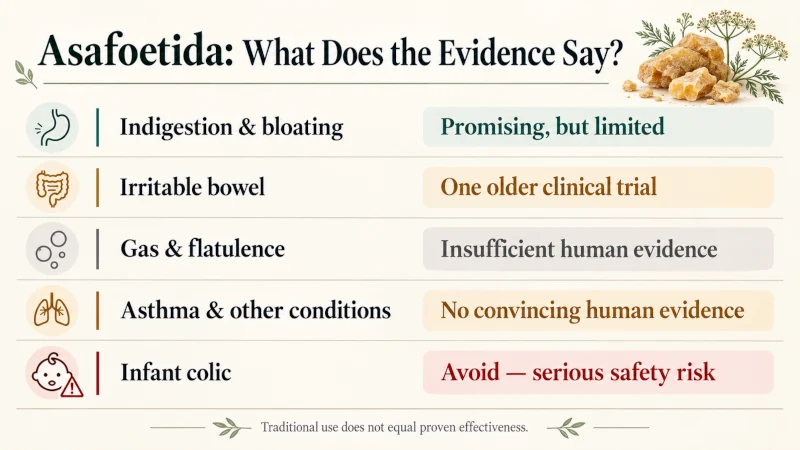
| Use | Best available evidence | Verdict |
| Functional dyspepsia (bloating, fullness, early satiety) | Two small, short, industry-funded RCTs of one proprietary formulation | Promising but limited |
| Irritable bowel | One double-blind trial from 1979, not repeated | Limited, outdated |
| Gas and flatulence | Traditional use; gut-muscle relaxation in lab and animal studies | Traditional; insufficient human evidence |
| Asthma, bronchitis, whooping cough | Traditional use only | Insufficient — do not use instead of care |
| Blood pressure, cancer, mood, libido | Animal and cell studies | Insufficient in humans |
| Infant colic | Case reports of life-threatening methemoglobinemia | Avoid |
Sources: Mahendra & Bisht, 2012; WebMD/TRC; Rahlfs & Mössinger, 1979; Mala et al., 2018; Das et al., 2025; Kelly et al., 1984; Al-Qahtani et al., 2020.
How to use asafoetida in the kitchen

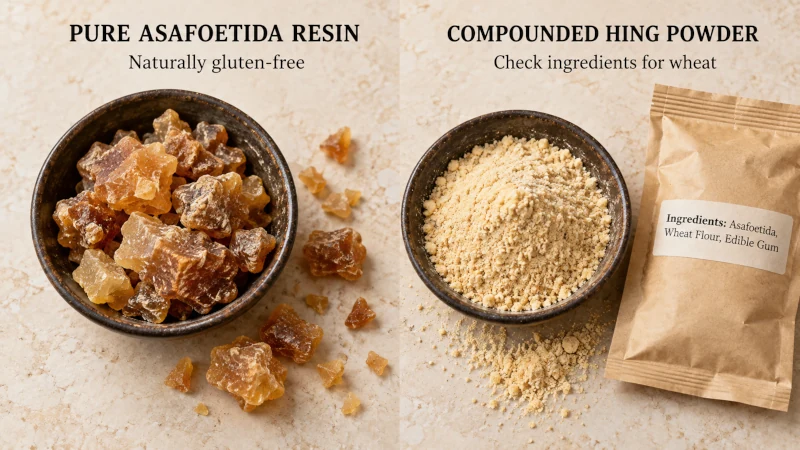
Use it by the pinch. Most hing is sold as a “compounded” powder, a small amount of resin mixed with edible gum and flour so it can be sprinkled and measured. Lumps of pure resin are also sold and need crushing before use [MedicineNet, 2026]. The traditional method is to heat it briefly in hot oil before the rest of the dish goes in [Mahendra & Bisht, 2012], then build a dal, vegetable curry, soup, or pickle on top [MedicineNet, 2026].
Keep it in an airtight container away from heat and light. Stored well, ground hing lasts about a year [MedicineNet, 2026], and the airtight part also keeps the smell out of the rest of your cupboard.
If you avoid gluten, read the label. The resin itself is gluten-free, but many compounded powders are bulked with wheat flour [MedicineNet, 2026]. People with celiac disease should buy only products labeled gluten-free.
Supplements, and why the old home remedies are gone
Asafoetida also comes as capsules and tinctures. There is no established medicinal dose [WebMD/TRC, 2026]. The two dyspepsia trials used 250 to 500 mg a day of one specific formulation [Das et al., 2025], which tells you little about other products. If you want to try a supplement for indigestion, check with your doctor or pharmacist first, especially if you take any medicine on the interaction list below.
Earlier versions of this page suggested swallowing up to eight gum “teardrops” a day and using asafoetida enemas for digestive spasms. We have removed both. Neither has been tested for safety or benefit, and cramping bad enough to consider an enema is a reason to get checked, not to self-treat.
Side effects, interactions, and who should avoid asafoetida
Common side effects
In food amounts, asafoetida is likely safe for most adults. Taken as medicine, it is rated possibly safe. Reported side effects include swollen lips, burping, gas, diarrhea, and headache; convulsions and blood disorders have also been reported [WebMD/TRC, 2026]. It can irritate the digestive tract, so people with a stomach or intestinal infection or another GI condition are advised not to use it medicinally [WebMD/TRC, 2026]. Regular handling of the raw spice has caused contact dermatitis on the fingertips in some people [Mahendra & Bisht, 2012].
Medication interactions
Interaction warnings for asafoetida come mostly from animal data and database cautions; we found no human studies that measured these interactions directly. That makes them precautionary, not proven. They are still worth taking seriously, because the effects involved are bleeding and blood pressure.
| Medication | Concern | How settled is it? |
| Blood thinners and antiplatelets (warfarin, heparin, enoxaparin, aspirin, clopidogrel) and NSAIDs such as ibuprofen and naproxen | Asafoetida might slow clotting, raising the chance of bruising and bleeding | Rated a moderate interaction by Natural Medicines/WebMD; a 2012 review also notes it may enhance warfarin. Based largely on animal data. |
| Blood pressure medicines (e.g., lisinopril-type ACE inhibitors, losartan, amlodipine, hydrochlorothiazide) | Asafoetida seems to lower blood pressure; combined, pressure could drop too low | Rated moderate by WebMD. Sources disagree on direction: MedicineNet links asafoetida to both high and low blood pressure. |
| Scheduled surgery | Possible added bleeding risk | Stop at least 2 weeks before surgery (WebMD). |
Sources: [WebMD/TRC, 2026] [Mahendra & Bisht, 2012] [MedicineNet, 2026]
Pregnancy and breastfeeding
Medicinal asafoetida is rated unsafe in pregnancy because it might cause miscarriage, and unsafe while breastfeeding because its compounds could pass into breast milk and cause blood disorders in the baby [WebMD/TRC, 2026]. Animal work points the same way: in rats, a resin extract prevented pregnancy in most of the animals treated [Mahendra & Bisht, 2012].
Sources differ on cooking amounts. MedicineNet advises pregnant women to avoid large amounts in food and is stricter still for nursing mothers [MedicineNet, 2026], while the WebMD database addresses medicinal use. A practical line: skip capsules, tinctures, and home remedies entirely, and ask your obstetrician or midwife about the pinch in your dal.
Babies: do not use asafoetida remedies
| Never give asafoetida or “hing water” to a baby. In 1984, doctors reported a 5-week-old who developed methemoglobinemia, a condition in which the blood cannot carry oxygen properly, after being given an asafoetida remedy for colic [Kelly et al., 1984]. A 2020 report described a life-threatening case in an infant given asafoetida (called heltit in Saudi Arabia) for colic; the baby arrived with blue-tinged skin and severe breathing distress and needed hospital treatment. The authors advise avoiding it in infants [Al-Qahtani et al., 2020]. The Natural Medicines database also rates it unsafe for infants [WebMD/TRC, 2026]. Call 911 if a baby has bluish or gray lips or skin, fast or labored breathing, or is unusually sleepy or hard to wake, especially after any herbal remedy. |
Who else should skip it
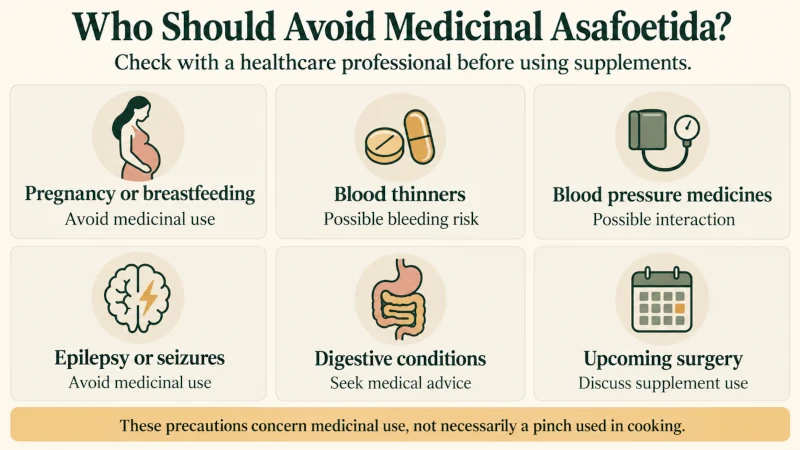
Avoid medicinal asafoetida, and talk to a doctor or pharmacist before using it, if you:
- Have a bleeding disorder, take a blood thinner, or have surgery coming up [WebMD/TRC, 2026]
- Have epilepsy or a history of seizures [WebMD/TRC, 2026]
- Have a stomach or intestinal infection or another GI condition [WebMD/TRC, 2026]
- Take blood pressure medicine or tend to run low [WebMD/TRC, 2026] [MedicineNet, 2026]
- Are pregnant or breastfeeding [WebMD/TRC, 2026]
- Have celiac disease (for compounded powders containing wheat) [MedicineNet, 2026]
When to get medical help
Call 911 or go to the emergency room for:
- Bluish or gray lips or skin, fast breathing, or unusual drowsiness in a baby or child
- Swelling of the lips, face, or throat with trouble breathing
- A seizure
- Vomiting blood, or black, tarry stools
See a doctor soon if:
- Indigestion or bloating keeps coming back, gets worse, or comes with weight loss, trouble swallowing, or yellowing of the skin or eyes
- You notice unusual bruising or bleeding while using asafoetida, especially with a blood thinner
- You feel dizzy or faint after taking an asafoetida supplement with blood pressure medicine
For more on which gut symptoms need attention, see our digestive health guides. And if your stomach trouble is mainly nausea, ginger has stronger evidence for that than asafoetida does.
| HEALTH DISCLAIMER: This article is for general education and is not medical advice, diagnosis, or treatment. Asafoetida is a cooking spice and a dietary supplement, not a proven treatment for any disease, and supplements are not reviewed by the FDA for safety or effectiveness before sale. Do not give asafoetida remedies to infants. Talk with a doctor, pharmacist, or registered dietitian before using asafoetida supplements, particularly if you are pregnant or breastfeeding, take blood thinners or blood pressure medicine, have epilepsy or a bleeding disorder, or have surgery scheduled. Do not delay care for symptoms that are severe or getting worse. In an emergency, call 911. |
Frequently Asked Questions
Is asafoetida safe to eat?
For most adults, yes, in the small amounts used in cooking [WebMD/TRC, 2026]. Medicinal doses are a different matter: avoid them in pregnancy, while breastfeeding, with bleeding disorders or epilepsy, and before surgery. Never give asafoetida to babies.
What does asafoetida do for digestion?
Two small, industry-funded trials of one supplement found less bloating, fullness, and early satiety than placebo in people with functional dyspepsia [Das et al., 2025] [Mala et al., 2018]. An older trial reported benefit for irritable bowel [Rahlfs & Mössinger, 1979]. Promising, but far from proven.
Is hing gluten-free?
Pure asafoetida resin is, but many compounded hing powders contain wheat flour [MedicineNet, 2026]. If you have celiac disease, buy only products labeled gluten-free.
Can I give hing water to my baby for gas or colic?
No. Asafoetida given to infants for colic has caused methemoglobinemia, a life-threatening problem with how blood carries oxygen [Kelly et al., 1984] [Al-Qahtani et al., 2020]. Talk to your pediatrician about colic instead.
Does asafoetida help asthma?
There is no human evidence that it does [WebMD/TRC, 2026]. Its reputation for asthma and coughs comes from traditional use. Keep using the treatment plan your clinician gave you.
Does asafoetida interact with blood thinners?
It might. Asafoetida may slow blood clotting, and the Natural Medicines database rates the combination with anticoagulants and antiplatelets as a moderate interaction [WebMD/TRC, 2026]. The concern rests mostly on animal data, but ask your doctor or pharmacist before combining a supplement with a blood thinner.
References
- Mahendra P, Bisht S. Ferula asafoetida: traditional uses and pharmacological activity. Pharmacognosy Reviews. View source
- Therapeutic Research Center, Natural Medicines, via WebMD. Asafoetida: uses, side effects, and more. View source
- Sruthi M (author), Sheikh Z (reviewer). What is asafetida? Benefits, side effects, and uses. MedicineNet. View source
- Rahlfs VW, Mössinger P. Asa foetida in the treatment of the irritable colon: a double-blind trial [German]. View source
- Mala KN, Thomas J, Syam DS, Maliakel B, Krishnakumar IM. Safety and efficacy of Ferula asafoetida in functional dyspepsia: a randomized, double-blinded, placebo-controlled study. View source
- Das S S, RM V, Aneesa PA, Joy Parappilly S, Natinga Mulakal J, Chakrapani PS B, Illathu Madhavamenon K. Ferula asafoetida oleo-gum resin alleviates dyspepsia symptoms through modulation of microbiome-gut-brain axis: a randomized, double-blind, placebo-controlled study. View source
- Kelly KJ, Neu J, Camitta BM, Honig GR. Methemoglobinemia in an infant treated with the folk remedy glycerited asafoetida. Pediatrics. View source
- Al-Qahtani S, Abusham S, Alhelali I. Severe methemoglobinemia secondary to Ferula asafoetida ingestion in an infant: a case report. View source


