
Turnips are two vegetables in one. The white-and-purple root is a mild, low-calorie stand-in for potatoes. The leafy tops are where most of the nutrition sits: one raw cup of turnip greens holds more vitamin K than an adult needs in a day, plus vitamin C, folate, and about 104 mg of calcium [Medical News Today, 2026] [NIH ODS, 2021]. Those are the real turnip health benefits, and they’re worth having. What turnips can’t do is flush uric acid out of your joints or “purify” your blood, claims that still circulate in older herbal writing. Here’s what holds up, what doesn’t, and who should go easy.
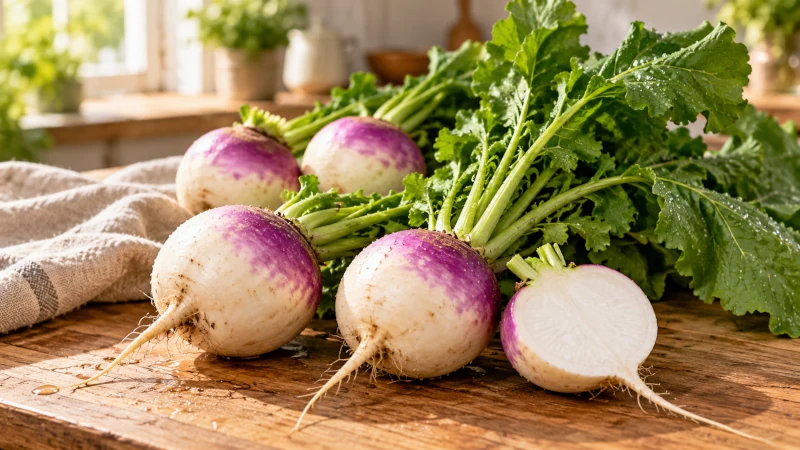
Turnip health benefits at a glance
| Benefit | What’s behind it | Strength of evidence |
| Calcium (greens) | About 104 mg per raw cup [Medical News Today, 2026] | Nutrient content: strong. How well turnip-green calcium is absorbed: likely good, not directly measured |
| Vitamin K (greens) | About 138 mcg per raw cup [Medical News Today, 2026] | Strong (nutrient content) |
| Vitamin C (root and greens) | 28 mg per medium root [USDA SNAP-Ed, n.d.]; 33 mg per raw cup of greens [Medical News Today, 2026] | Strong (nutrient content) |
| Lutein and zeaxanthin (greens) | About 12.2 mg per cup [WebMD, 2025b] | Good food source; eye benefit from food is limited, mostly observational |
| Weight management | 34 calories and 2 g fiber per medium root [USDA SNAP-Ed, n.d.] | Plausible; no turnip-specific trials |
| Cancer prevention | Glucosinolates, shared with other crucifers [National Cancer Institute, 2012] | Mixed human evidence [Linus Pauling Institute, 2017] |
| Gout relief, “blood cleansing” | Traditional claims only | Not supported |
Turnip nutrition facts: root vs. greens
| Nutrient | Medium turnip root (122 g) | 1 cup raw turnip greens (55 g) |
| Calories | 34 | 18 |
| Carbohydrate | 8 g | 3.9 g |
| Fiber | 2 g | 1.8 g |
| Protein | 1 g | 0.8 g |
| Vitamin C | 28 mg | 33 mg |
| Calcium | Small amount | 104 mg |
| Potassium | 233 mg | 163 mg |
| Vitamin K | Not listed | 138 mcg |
| Folate | Not listed | 107 mcg |
| Vitamin A | 0 mcg RAE | 319 mcg |
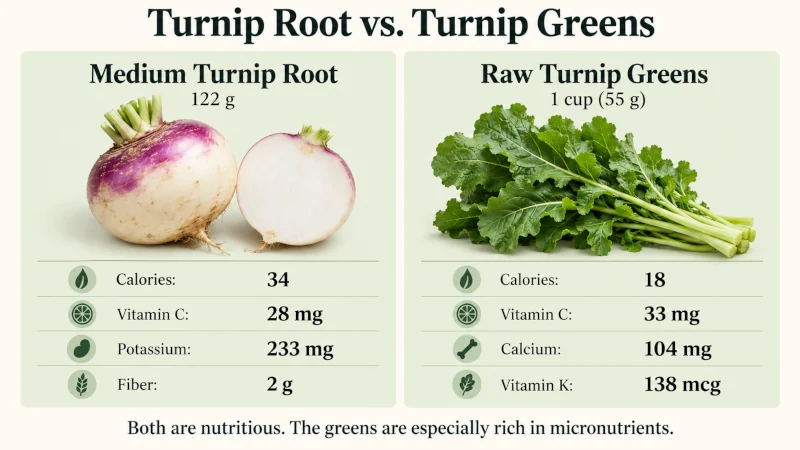
Root values: [USDA SNAP-Ed, n.d.]; root potassium: [WebMD, 2025]. Greens values: [Medical News Today, 2026].
Laid side by side, the pattern is hard to miss. The root is mostly water with a little starch and a useful dose of vitamin C. The greens, at about half the calories of a whole root, bring calcium, vitamin K, folate, and vitamin A that the root barely has. If your turnips come with their tops on, the tops aren’t garnish. They’re the better half.
What the evidence supports
Turnip greens are a real calcium source, with a caveat
Raw turnip greens carry about 104 mg of calcium per cup [Medical News Today, 2026], and cooked greens about 99 mg per half cup [NIH ODS, 2026]. A cup of nonfat milk has about 299 mg [NIH ODS, 2026]. So the familiar line that turnip greens have “more calcium than milk” is only true gram for gram, because a cup of raw greens weighs just 55 grams. Serving for serving, milk still wins.
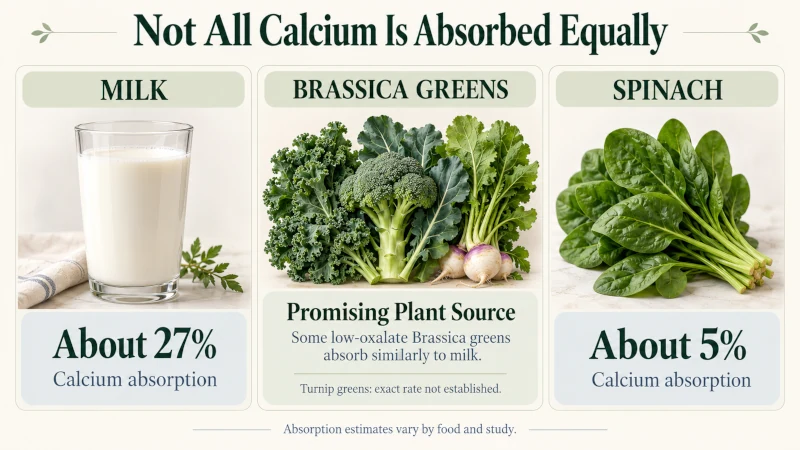
Where greens get interesting is absorption. Spinach looks calcium-rich on paper, but oxalate binds most of it, and only about 5% is absorbed, compared with roughly 27% from milk. Low-oxalate Brassica greens such as kale, broccoli, and cabbage absorb about as well as milk [NIH ODS, 2026]. Turnip greens belong to the same Brassica genus, which makes good absorption likely. We couldn’t find a published absorption measurement for turnip greens themselves, though, so treat them as a strong, probably well-absorbed plant source rather than a proven dairy replacement.
Building a dairy-free diet? Our guide to calcium benefits and daily needs shows how greens fit alongside fortified foods, and our look at spinach health benefits explains why that green’s calcium mostly goes unabsorbed.
More vitamin K than you need in a day
One raw cup of turnip greens has about 138 mcg of vitamin K [Medical News Today, 2026]. The adequate intake is 120 mcg a day for men and 90 mcg for women, and a half cup of frozen, boiled greens packs about 426 mcg [NIH ODS, 2021]. Vitamin K is essential for normal blood clotting, which is good news for most people and a reason for care if you take warfarin (see the safety section).
Vitamin C from both halves
A medium root supplies about 28 mg of vitamin C [USDA SNAP-Ed, n.d.], and a cup of raw greens about 33 mg [Medical News Today, 2026]. Neither is an orange, but eaten together in one meal they add up to a meaningful share of the day’s vitamin C.
Lutein for your eyes: good food, modest evidence
Turnip greens are one of the richer food sources of lutein and zeaxanthin, the yellow pigments that collect in the retina, at about 12.2 mg per cup [WebMD, 2025b]. The best evidence for these pigments comes from supplement studies in people who already have macular degeneration. The case that eating more greens protects healthy eyes rests on observational studies and is less certain [WebMD, 2025b]. Eat them because they’re good food, not as an eye treatment.
Fullness on very few calories
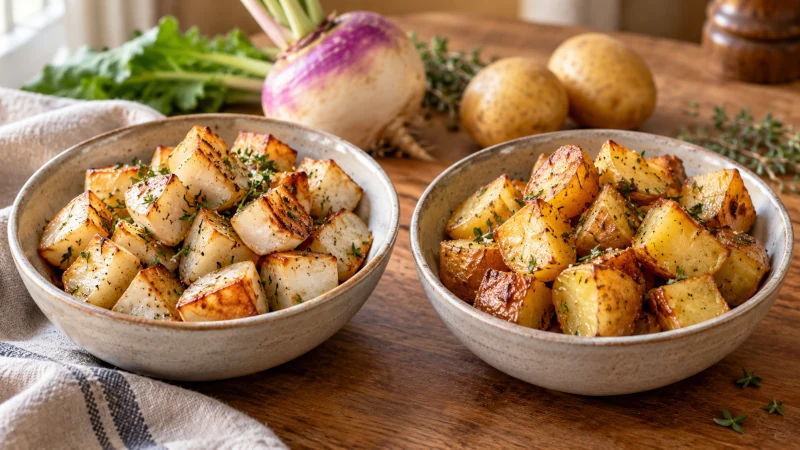
A medium turnip has 34 calories and 2 grams of fiber [USDA SNAP-Ed, n.d.]. That makes it an easy way to bulk up a plate. Swap half the potatoes in a mash or a tray of roasted vegetables for turnip, and the portion stays the same while the calories drop; our article on the health benefits of potatoes gives the potato side of that comparison. No trial has tested turnips specifically for weight loss, so call this a practical benefit rather than a proven one. For what actually drives fullness, see our guide to foods to eat to lose weight.
Glucosinolates and cancer: mixed evidence
Turnips are cruciferous vegetables, close relatives of cabbage and broccoli, and they contain sulfur compounds called glucosinolates [National Cancer Institute, 2012]. Chopping and chewing break these down into compounds researchers are studying for possible effects on cancer-related processes. In people, the results are mixed. Case-control studies often link higher cruciferous intake with lower risk of several cancers, but prospective cohort studies, which are less prone to recall bias, mostly don’t find the same association [Linus Pauling Institute, 2017] [National Cancer Institute, 2012].
The fair conclusion: turnips belong in a vegetable-rich diet that supports long-term health. They don’t prevent cancer on their own.
Old turnip claims that don’t hold up
Older herbal references, including the encyclopedia an earlier version of this page relied on, describe turnips as alkalizing, blood-purifying, and diuretic, and say they relieve gout by helping the body eliminate uric acid. We looked for human evidence behind those claims and found none.
Gout shows why this matters. Vegetables, even purine-rich ones, don’t appear to raise gout risk, so turnips are a perfectly good food if you have gout [Mayo Clinic, 2025]. But diet alone is unlikely to bring uric acid down enough to treat gout, and most people still need medication [Mayo Clinic, 2025]. If you’re managing gout, our list of gout-friendly foods is a better starting point than any single “cleansing” vegetable.
Turnips and your thyroid
Like other crucifers, turnips contain compounds that can interfere with the thyroid’s use of iodine when eaten in very large amounts. An earlier version of this article told people with hypothyroidism to avoid turnips. That goes further than the evidence. Very high cruciferous intakes caused hypothyroidism in animals, but in people the risk appears to depend mainly on iodine deficiency. In one human study, eating 150 grams of cooked Brussels sprouts a day for four weeks had no adverse effect on thyroid function [Linus Pauling Institute, 2017].
If you have a thyroid condition, normal portions of cooked turnips are unlikely to cause trouble. Keep your iodine intake adequate, avoid sudden, very large daily amounts of raw crucifers (raw juice routines are the usual culprit), and mention any big diet change to your clinician.
Who should be careful with turnips
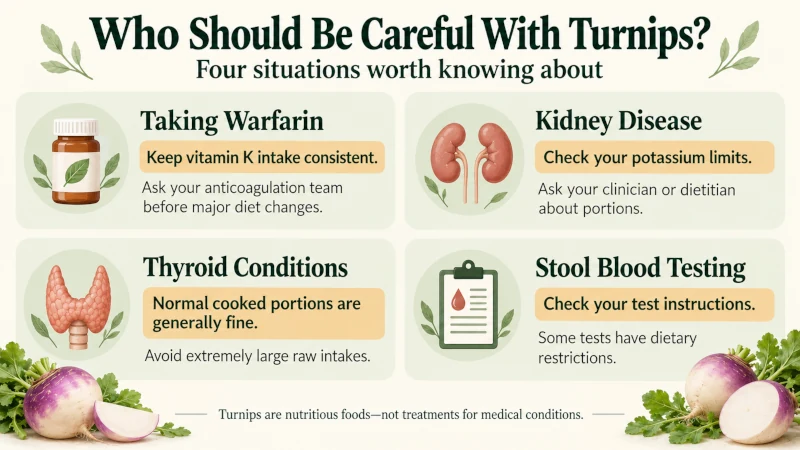
People taking warfarin. Turnip greens are very high in vitamin K. You don’t have to avoid them, but you do need to keep your vitamin K intake steady from week to week, because sudden changes can strengthen or weaken warfarin’s effect [NIH ODS, 2021]. Tell your anticoagulation clinic before you start eating greens regularly, and get prompt care for unusual bruising, bleeding gums, or blood in your urine or stool.
People with kidney disease. Turnips contain potassium. Kidneys that can’t clear excess potassium can let it build up, which may cause weakness, cramps, or a rapid heartbeat [WebMD, 2025]. If you have chronic kidney disease or have been told to limit potassium, ask your doctor or dietitian how turnips fit your plan.
Anyone scheduled for a stool blood test. Turnips are among the foods that can throw off some fecal occult blood tests, giving false results [WebMD, 2025]. Ask whether to avoid them in the days before the test.
People with thyroid disease. See the section above: cooked, normal portions are generally fine; very large raw amounts with low iodine are the concern [Linus Pauling Institute, 2017].
Pregnancy and breastfeeding. Turnips and their greens are everyday foods, and none of the sources we reviewed flag them as a concern at normal food amounts. As with any leafy green, wash the leaves well before eating [UMass Amherst, n.d.]. If you take warfarin or have a thyroid condition during pregnancy, the cautions above still apply.
How to choose, store, and cook turnips
Pick firm, smooth roots with no cracks or soft spots. Small and medium turnips tend to be sweeter than large ones, and the greens should be bright, not yellowing [UMass Amherst, n.d.]. Turnips picked after a frost are sweeter still [USDA SNAP-Ed, n.d.].
Cut the greens off when you get home. Store them in an open plastic bag in the fridge and use them within about four days; the roots keep for about a week in a bag in the fridge [UMass Amherst, n.d.].
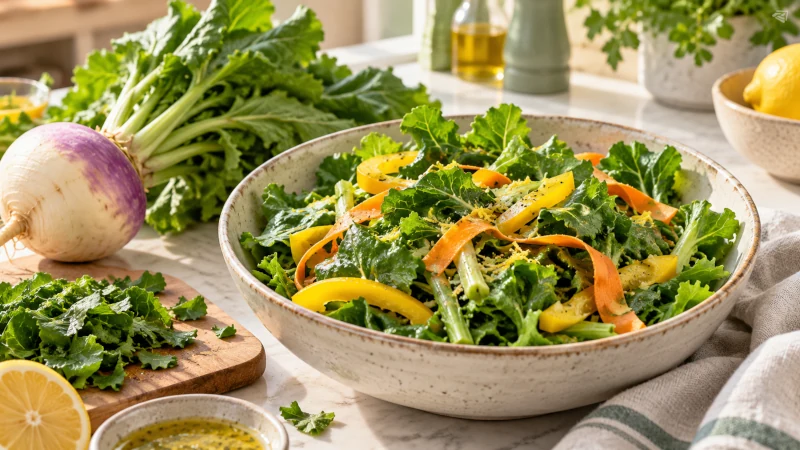
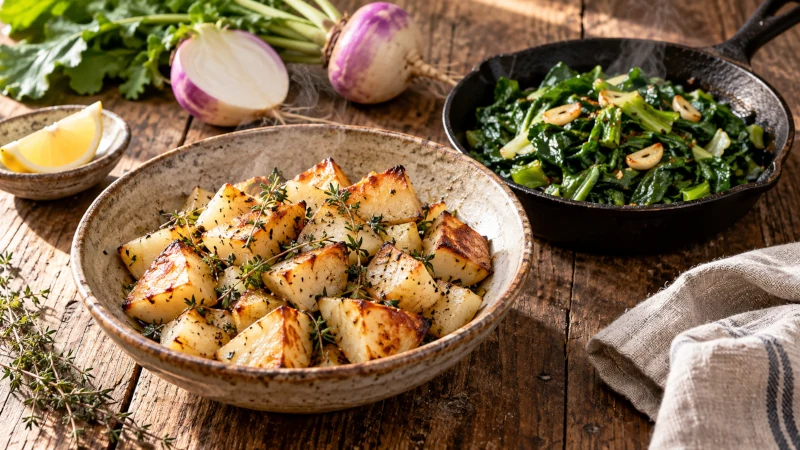
Small, young roots can be eaten raw, sliced thin for a peppery crunch. Larger roots should be peeled and cooked like potatoes, boiled and mashed or roasted. The greens are good sautéed in olive oil with garlic, onion, and a squeeze of lemon [UMass Amherst, n.d.], or added to soups and stews. If you’re cooking with glucosinolates in mind, steaming, microwaving, or stir-frying keeps more of them than boiling does [Linus Pauling Institute, 2017].
| HEALTH DISCLAIMER: This article is for general education and is not medical advice. Turnips are a nutritious food, not a treatment for gout, thyroid disease, cancer, or any other condition. If you take warfarin or another blood thinner, have kidney disease or a thyroid condition, are pregnant or breastfeeding and planning big diet changes, or have symptoms that worry you, talk with a qualified healthcare professional before relying on any food to manage your health. |
Frequently Asked Questions
Are turnip greens healthier than the turnip root?
Nutrient for nutrient, yes. A cup of raw greens has far more calcium, vitamin K, folate, and vitamin A than a whole root, for about half the calories [Medical News Today, 2026] [USDA SNAP-Ed, n.d.]. The root still earns its place as a low-calorie, vitamin C-rich vegetable.
Can you eat turnips raw?
Yes. Small, young roots are pleasant raw, and fresh greens can go into salads [UMass Amherst, n.d.]. The only thyroid concern linked to crucifers involves very large intakes, mainly in people who don’t get enough iodine [Linus Pauling Institute, 2017].
Are turnips good for gout?
They’re a fine food for people with gout, since vegetables, even purine-rich ones, don’t appear to raise gout risk. They won’t treat it, though; most people with gout still need medication to lower uric acid [Mayo Clinic, 2025].
Can I eat turnip greens if I take warfarin?
Usually yes, as long as your intake stays consistent. Sudden jumps or drops in vitamin K can change how warfarin works, so agree on a plan with your anticoagulation clinic [NIH ODS, 2021].
Do turnips raise blood sugar much?
A medium root has about 8 grams of carbohydrate, including 2 grams of fiber [USDA SNAP-Ed, n.d.], which is modest. If you have diabetes, count turnips as part of your carbohydrate plan like any other vegetable and check your own response.
References
- Ware M. Turnip greens: Health benefits, uses, and possible risks. Medical News Today. View source
- Bonvissuto D. Health Benefits of Turnips. WebMD. View source
- Lutein and Zeaxanthin for Vision. WebMD. View source
- U.S. Department of Agriculture, SNAP-Ed Connection. Seasonal Produce Guide: Turnips. n.d. View source
- University of Massachusetts Amherst. Produce Spotlight: Turnips. n.d. View source
- National Institutes of Health, Office of Dietary Supplements. Calcium: Fact Sheet for Health Professionals. View source
- National Institutes of Health, Office of Dietary Supplements. Vitamin K: Fact Sheet for Health Professionals. View source
- Linus Pauling Institute, Oregon State University. Cruciferous Vegetables. Micronutrient Information Center. View source
- National Cancer Institute. Cruciferous Vegetables and Cancer Prevention. View source
- Mayo Clinic Staff. Gout diet: What’s allowed, what’s not. Mayo Clinic. View source


