
Potatoes have an unfair reputation. Somewhere along the way the humble spud got lumped in with candy and chips as a food to feel guilty about — “just empty carbs.” That’s not what the science says. A plain potato is one of the more nutrient-dense staples you can put on a plate: real potassium, real fiber, real vitamin C, and more protein than most people expect, all for about 77 calories per 100 grams [USDA FoodData Central, 2023]. The health benefits of potatoes are genuine. What flips them from healthy to harmful is almost always what happens in the kitchen — the oil, the salt, the deep-fryer — not the potato itself.
Here’s the honest, useful version of what a potato does for you, what it doesn’t, and how to cook it so the good parts survive.
Are potatoes actually good for you? The short answer
Yes, when you keep them close to their natural state. Boiled, baked, or steamed with the skin on, a potato delivers potassium (more per serving than a banana), vitamin C, vitamin B6, fiber, and a surprisingly high-quality plant protein. It’s naturally fat-free, cholesterol-free, and very low in sodium [USDA FoodData Central, 2023].
The catch is preparation and portion. Deep-fried, drowned in butter, or loaded with cheese and bacon, the same potato becomes a very different food — and that’s where the “potatoes are unhealthy” idea comes from. The problem is the additions, not the tuber.
Potato nutrition facts: what’s really inside
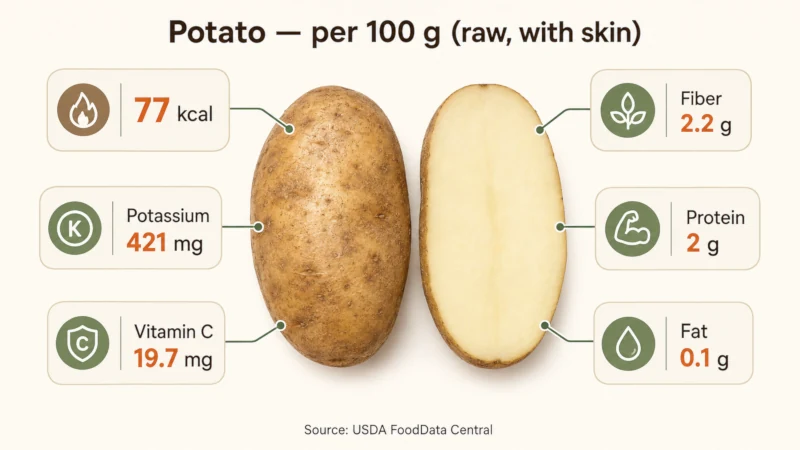
Numbers first. Here’s what one 100-gram serving of raw potato with skin contains, using US Department of Agriculture reference data:
| Nutrient | Per 100 g | Notes |
| Calories | 77 kcal | Low calorie density for a starchy food |
| Carbohydrate | 17.5 g | Mostly starch (~15 g); little sugar |
| Fiber | 2.2 g | More with the skin on |
| Protein | 2 g | High biological value for a plant |
| Fat | 0.1 g | Essentially fat-free |
| Potassium | 421 mg | ~9% of the 4,700 mg daily target |
| Sodium | 6 mg | Naturally very low |
| Vitamin C | 19.7 mg | ~22% of the Daily Value |
| Vitamin B6 | 0.3 mg | ~17% of the Daily Value |
Source: [USDA FoodData Central, 2023]
A few things stand out. The potassium-to-sodium ratio is excellent — high potassium, almost no sodium — which is exactly the profile that supports healthy blood pressure. The protein is modest in quantity but high in quality, well-balanced in the amino acids the body needs. And the starch is complex rather than sugary, which matters for how it’s digested.
What a potato doesn’t give you is worth knowing too: essentially no vitamin B12, very little vitamin A or vitamin E, and not much calcium. It’s a strong staple, not a complete diet on its own. Pairing potatoes with a green vegetable, dairy, or a source of healthy fat rounds out the meal. If you’re relying on plant foods, it’s also worth knowing where to find foods with vitamin B12, since potatoes won’t supply it.
A note on the skin
Some of a potato’s fiber and minerals sit just under the skin, so eating it skin-on adds nutrition. The trade-off: the skin is also where glycoalkaloids and any surface residues concentrate. For most conventionally grown potatoes that are firm and unblemished, eating the skin is fine after a good scrub. If a potato is green, sprouted, or you simply prefer to be cautious, peeling is reasonable (see the safety section).
The health benefits of potatoes, graded by the evidence
Not every claim about potatoes is equally solid. Here’s where the evidence is strong, where it’s promising, and where it’s mixed.
Potassium and blood pressure
Evidence: strong for the nutrient, supportive for potatoes as a source. Potassium helps the body shed sodium and relaxes blood-vessel walls, and diets rich in it are consistently linked to lower blood pressure. The American Heart Association points to potassium as a key reason the DASH eating pattern lowers blood pressure, and recommends getting it from food rather than pills for most people [American Heart Association, 2024]. A plain potato — high in potassium, nearly sodium-free — fits that pattern well, as long as you’re not adding salt back in by the tablespoon.
Fiber, fullness, and weight
Evidence: good. Potatoes are unusually filling for their calorie count, which is why they tend to satisfy hunger better than many refined-carb foods. The fiber (more when you eat the skin) supports digestion and helps steady the release of energy. Potatoes alone don’t cause weight gain; what drives it is the frying, the fat, and the overall calories. A boiled or baked potato is a sensible base for a weight-conscious plate — a fried one, much less so.
Vitamin C, B6, and everyday nutrition
Evidence: strong. A single serving covers a meaningful share of daily vitamin C (an antioxidant that supports immune function and collagen) and vitamin B6 (needed for protein metabolism and nervous-system function) [USDA FoodData Central, 2023]. Vitamin C is heat-sensitive, so how you cook matters: steaming and baking preserve more of it, while prolonged boiling and frying lose more.
Easy on the stomach
Evidence: modest, mostly traditional. Well-cooked, plain potatoes — think mashed or a simple boiled potato — are soft, bland, and easy to digest, which is why they often feel gentle when your stomach is unsettled. That’s a reasonable, real-world benefit. It’s worth being clear about the limits, though: a soothing, easy-to-digest food is not a treatment for ulcers, gastritis, or any diagnosed stomach condition. If you have persistent stomach pain, reflux, or digestive symptoms, that’s a conversation for your doctor, not something to manage with mashed potatoes alone.
Potatoes and blood sugar: the honest, complicated answer
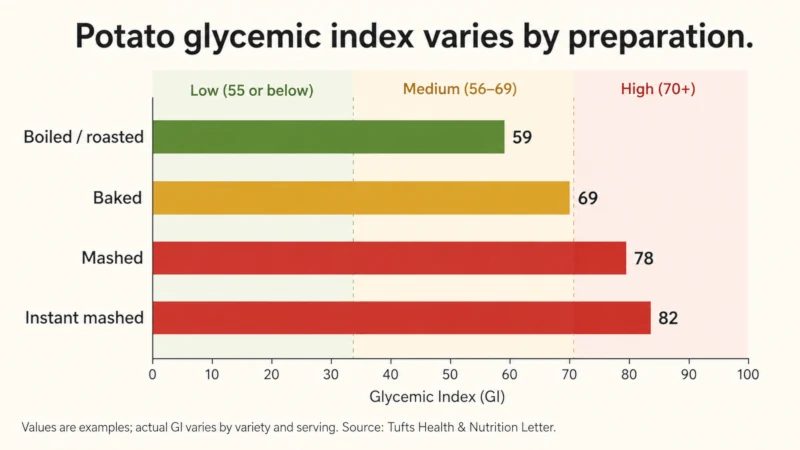
Evidence: genuinely mixed — and often misreported. You’ll see potatoes described as slow-digesting and easy on blood sugar. That’s only partly true, and for many preparations it’s simply wrong. Potatoes actually range from medium to high on the glycemic index, and the number swings a lot with variety and cooking method. Tufts nutrition experts summarize typical values as roughly 59 for boiled or roasted potatoes, 69 for baked, and 78–82 for mashed and instant [Tufts Health & Nutrition Letter, 2021]. In other words, a fluffy baked or instant-mashed potato can raise blood glucose fairly quickly.
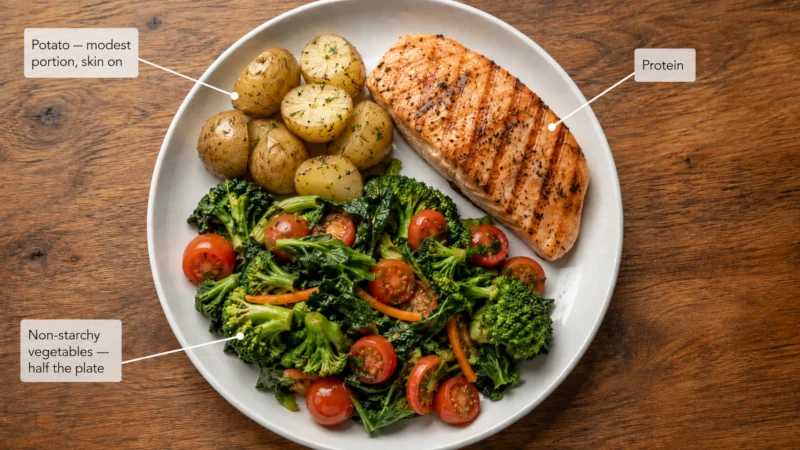
That doesn’t make potatoes off-limits if you have diabetes or prediabetes — it makes how you eat them the whole ballgame. Boiled waxy varieties eaten with the skin, kept to a sensible portion, and paired with protein, healthy fat, and non-starchy vegetables produce a much gentler glucose response than a large plain baked potato. For a fuller picture of building meals around this, see our guides to diabetic-friendly foods and understanding your blood sugar levels.
There’s also a genuinely interesting wrinkle here, covered in the cooking section below: cooling cooked potatoes changes how your body handles their starch.
Do potatoes really contain a natural sedative?
You may have read that potatoes contain diazepam — the active ingredient in Valium — and act as a natural calming agent. This one has a kernel of truth wrapped in a lot of exaggeration.
Researchers really did detect benzodiazepine-like compounds, including trace diazepam, in potato tubers (and in wheat and several other everyday foods). But the amounts were in the low parts-per-billion range — vanishingly small [Wildmann et al., Biochem Pharmacol, 1988]. To put that in perspective, a typical anti-anxiety dose of diazepam is measured in milligrams; the quantity in a potato is millions of times smaller and nowhere near enough to produce a sedative, calming, or “relaxing” effect. So no — eating potatoes will not tranquilize you, settle your nerves, or work like a mild medication. It’s a real scientific curiosity, not a health benefit you can use.
How you cook them matters more than the potato
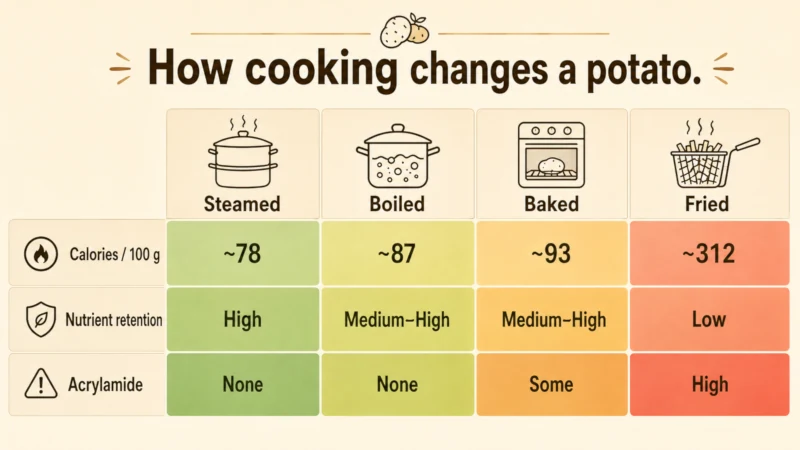
If there’s one takeaway, it’s this: the cooking method decides whether a potato is a health food or not.
| Method | Verdict | What happens |
| Steaming | Best | Preserves the most nutrients and adds nothing. |
| Boiling | Good | Some vitamin C and minerals leach out; less if cooked whole, skin-on. |
| Baking | Fine | Keeps most nutrients but nudges the glycemic response up in fluffy varieties. |
| Frying | Worst | ~312 kcal/100 g vs ~77 for a plain potato, plus a lot of added salt. |
Calorie figures: [USDA FoodData Central, 2023]
The acrylamide question
Here’s a point the everyday potato articles usually skip. When starchy foods like potatoes are cooked at high, dry heat — frying, roasting, baking past golden — they form acrylamide, a compound that causes cancer in laboratory animals at high doses. In people, the risk is less clear, but health agencies treat it as a reason for caution [FDA, 2024; American Cancer Society, 2024]. Boiling and steaming don’t produce it [FDA, 2024].
You don’t need to fear a roast potato, but a few habits lower your exposure: cook to a golden-yellow color rather than dark brown, don’t store raw potatoes in the refrigerator (cold storage can raise acrylamide during later cooking), and soak cut potatoes in water for 15–30 minutes before roasting or frying [American Cancer Society, 2024].
The cooling trick: resistant starch
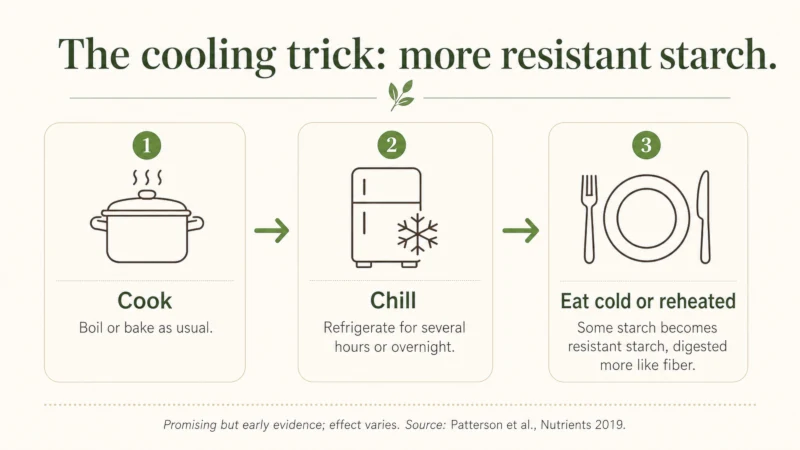
Cook a potato, chill it in the fridge, and some of its starch reorganizes into “resistant starch” — a form your small intestine doesn’t fully digest, so it behaves more like fiber. In a small controlled study of women with elevated fasting glucose, baked-then-chilled potatoes produced lower insulin and incretin responses than freshly boiled ones [Patterson et al., Nutrients, 2019]. This is promising rather than proven — the study was small and the effect varies with variety and reheating — but it’s a real, low-effort option: a potato salad made from cooled boiled potatoes, or leftover potatoes reheated the next day, may be a bit gentler on blood sugar than a hot, fresh one.
Safety: green potatoes, solanine, and who should be careful
Most of the time, potatoes are among the safest foods in your kitchen. But there’s one safety fact that gets repeated incorrectly all over the internet, and it’s worth getting right.
Green, sprouted, or bitter? Throw it out
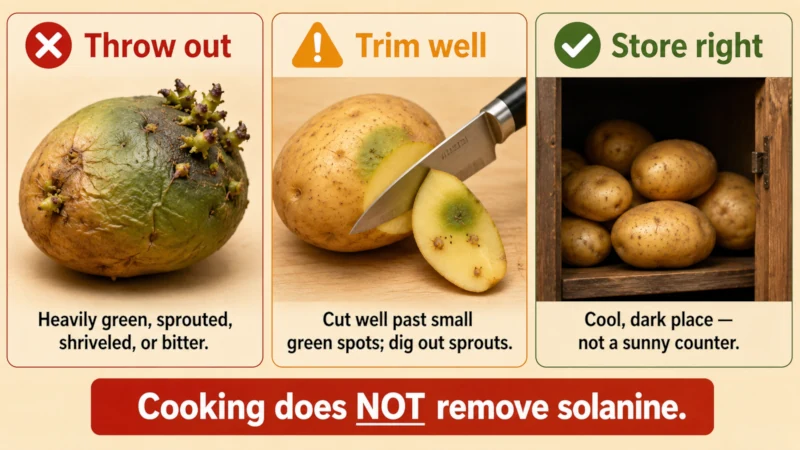
Potatoes naturally make glycoalkaloids — mainly solanine and chaconine — as a defense compound. In a normal, properly stored potato the levels are low and harmless (roughly 12–20 mg/kg). But light exposure, age, and damage push those levels up sharply: a green tuber can reach 250–280 mg/kg, with even higher concentrations in the green skin and in sprouts [Oregon State University Extension, 2025]. At high enough intake, solanine causes nausea, vomiting, stomach cramps, and headache.
Here’s the part people get wrong: cooking does not destroy solanine. It’s heat-stable — boiling, baking, frying, and microwaving don’t meaningfully remove it, so you can’t “cook the green out” of a bad potato [Oregon State University Extension, 2025; National Capital Poison Center, 2024].
What to do in practice:
- Discard potatoes that are heavily green, heavily sprouted, shriveled, or taste bitter.
- Trim generously — cut well past any small green patch and dig out sprouts and their bases — for potatoes that are only slightly affected.
- Store potatoes in a cool, dark place, not on a sunny counter, to slow greening and sprouting.
- When in doubt, throw it out. A cheap potato isn’t worth a rough night.
A separate, milder concern: potato skins can accumulate cadmium, a trace metal from soil and industrial pollution. This is a small consideration for most people, but it’s another reason to buy good-quality potatoes and to peel if you’re unsure of their source.
Who should take extra care
- People with chronic kidney disease. Damaged kidneys may not clear potassium well, and potatoes are potassium-rich. If you have CKD, don’t load up on high-potassium foods without guidance from your doctor or a registered dietitian — and be aware that boiling in plenty of water and draining can reduce potassium content.
- People taking certain blood-pressure medications. ACE inhibitors, ARBs, and potassium-sparing diuretics can raise potassium; ask your doctor or pharmacist before dramatically increasing potassium-rich foods or using potassium-based salt substitutes.
- People with diabetes or prediabetes. Potatoes fit a healthy plan, but portion, variety, preparation, and pairing matter (see the blood-sugar section).
- People managing gout or kidney stones. Potatoes are low in purines and fine for most, but overall diet and hydration matter more than any single food; our guide to gout-friendly foods covers the bigger picture.
- Pregnancy and breastfeeding. Ordinary cooked potatoes are a normal part of a healthy diet. The one clear caution is to avoid green, sprouted, or spoiled potatoes, since higher glycoalkaloid intake is best avoided in pregnancy.
Get prompt medical care if you develop vomiting, severe stomach pain, or neurological symptoms after eating potatoes that were green, sprouted, or noticeably bitter. In the US, call your doctor, contact Poison Control at 1-800-222-1222, or call 911 for severe symptoms.
| HEALTH DISCLAIMER: This article is for general education and information only. It is not medical advice and is not a substitute for diagnosis, treatment, or guidance from a qualified healthcare professional. Do not use it to self-diagnose or to delay seeking care. If you are pregnant, breastfeeding, have kidney disease, diabetes, or another medical condition, or take prescription medication, talk with your doctor, registered dietitian, or pharmacist before making significant dietary changes. If you think you are having a medical emergency, call 911. |
Frequently Asked Questions
Are potatoes fattening?
Not on their own. A plain boiled or baked potato is low in calories and quite filling. Weight gain comes from frying, from butter, cheese, and sour cream, and from overall calorie intake — not from the potato itself.
Are potatoes bad for people with diabetes?
They don’t have to be, but they need care. Potatoes range from medium to high on the glycemic index depending on variety and cooking method. Choose boiled, skin-on, waxy potatoes in modest portions, and pair them with protein, healthy fat, and non-starchy vegetables. Cooling cooked potatoes before eating may lower the glucose response a little.
Is it safe to eat a potato that has turned green or sprouted?
No — not safely. Green skin and sprouts signal higher levels of solanine, and cooking does not remove it because solanine is heat-stable. Trim small green spots generously, but discard any potato that’s heavily green, sprouted, or bitter.
Which cooking method is healthiest?
Steaming and boiling (skin-on) preserve the most nutrients and produce no acrylamide. Baking is fine. Frying is the least healthy — more calories, more oil, and more acrylamide.
Should I eat the skin?
For firm, unblemished, well-scrubbed potatoes, yes — the skin adds fiber and minerals. Peel if the potato is green or sprouted, or if you’re unsure of its source, since the skin also concentrates glycoalkaloids and any residues.
Do potatoes really contain Valium?
Only in trace amounts far too small to have any effect. Scientists have detected minute (parts-per-billion) levels of benzodiazepine-like compounds in potatoes, but nowhere near a dose that could calm or sedate you.
References
- U.S. Department of Agriculture, Agricultural Research Service. FoodData Central: Potatoes, raw (with skin). USDA, 2023. → View source
- American Heart Association. How Potassium Can Help Control High Blood Pressure. AHA, 2024. → View source
- U.S. Food and Drug Administration. Acrylamide. FDA, 2024. → View source
- U.S. Food and Drug Administration. Acrylamide Questions and Answers. FDA, 2024. → View source
- American Cancer Society. Acrylamide and Cancer Risk. ACS, 2024. → View source
- Oregon State University Extension Service. Glycoalkaloids in Potato Tubers (EM 9407). OSU, 2025. → View source
- National Capital Poison Center. Are Sprouted or Green Potatoes Safe to Eat? Poison.org, 2024. → View source
- Tufts Health & Nutrition Letter. What Potatoes Have the Highest Glycemic Index? Tufts University, 2021. → View source
- Patterson MA, et al. Chilled Potatoes Decrease Postprandial Glucose, Insulin, and GIP Compared to Boiled Potatoes. Nutrients, 2019;11(9):2066. PMID 31484331. → View source
- Wildmann J, et al. Occurrence of pharmacologically active benzodiazepines in trace amounts in wheat and potato. Biochem Pharmacol, 1988;37(19):3549–59. PMID 3178869. → View source
