
Leeks are a quietly useful vegetable, and the honest case for them is simpler than the old folk claims. One cup of chopped raw leek gives you about a third of a day’s vitamin K, a fair amount of folate and manganese, and a type of fiber your gut bacteria feed on — all for about 54 calories [USDA, SR Legacy; FDA, 2024]. Those are the health benefits of leeks you can count on. The bigger promises you may have read — that leeks flush out uric acid, clear up bronchitis or prevent cancer — rest on tradition, or on research into the onion family as a whole rather than on leeks.
Two groups should be a little deliberate with them: people who take warfarin, and people with irritable bowel syndrome.
What leeks are
Leeks belong to the allium genus with onions, garlic, shallots and chives. Botanists place Allium in the Amaryllidaceae family; older references, including the previous version of this page, list the lily family (Liliaceae), which is out of date [Kew POWO, 2026]. You’ll see the cultivated leek named Allium porrum or Allium ampeloprasum var. porrum, and Kew’s Plants of the World Online lists both A. porrum and A. ampeloprasum as accepted species [Kew POWO, 2026].
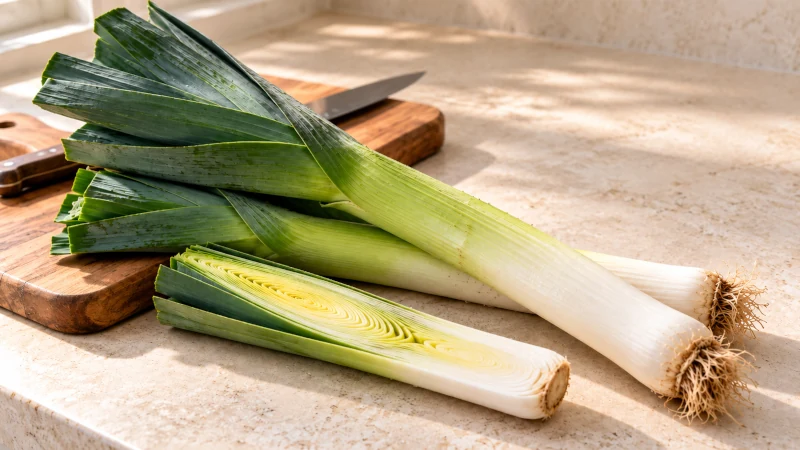
A leek doesn’t form a round bulb the way an onion does. What you eat is a long bundle of wrapped leaf layers: a white base, a pale-green middle and dark-green tops. It goes by poireau in French, puerro in Spanish and Porree in German, and its mild flavor once earned it the nickname “poor man’s asparagus.”
Leek nutrition: what’s in a cup
The old version of this article said leeks’ vitamin content is negligible. The USDA data says otherwise.
| Nutrient | Per 100 g raw | Per 1 cup chopped (89 g) | % Daily Value per cup |
| Calories | 61 kcal | 54.3 kcal | — |
| Fiber | 1.8 g | 1.6 g | 6% |
| Vitamin K | 47 mcg | 41.8 mcg | 35% |
| Folate (DFE) | 64 mcg | 57 mcg | 14% |
| Manganese | 0.48 mg | 0.43 mg | 19% |
| Iron | 2.1 mg | 1.87 mg | 10% |
| Vitamin C | 12 mg | 10.7 mg | 12% |
| Vitamin B6 | 0.23 mg | 0.2 mg | 12% |
| Vitamin A (RAE) | 83 mcg | 73.9 mcg | 8% |
| Magnesium | 28 mg | 24.9 mg | 6% |
| Calcium | 59 mg | 52.5 mg | 4% |
| Potassium | 180 mg | 160 mg | 3% |
| Lutein + zeaxanthin | 1900 mcg | 1691 mcg | — |
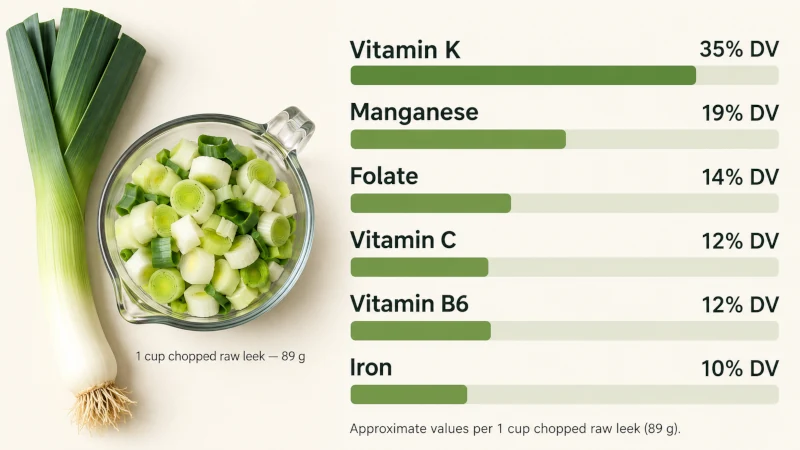
Source: USDA FoodData Central, “Leeks, (bulb and lower leaf-portion), raw,” FDC 169246 [USDA, SR Legacy]. Daily Values from FDA [FDA, 2024]. Per-cup figures are calculated from the per-100 g values.
Vitamin K is the standout: one cup covers about a third of the Daily Value. Manganese, folate, vitamin C, vitamin B6 and iron each land between roughly 10% and 20% — helpful, not dramatic. Leeks also carry lutein and zeaxanthin, two carotenoids associated with eye health [USDA, SR Legacy; WebMD, 2024].
One older claim needs correcting. Half a kilo of leeks (about five and a half cups) does supply around 10.5 mg of iron, but that’s a lot of leeks for one day, and it delivers about 23% of the calcium Daily Value, not a third [USDA, SR Legacy; FDA, 2024]. Leeks add minerals to a meal; they aren’t a main source of either. If you’re working on a specific mineral, our guides to magnesium-rich foods and foods high in calcium cover better-stocked options.
The health benefits of leeks, graded by the evidence
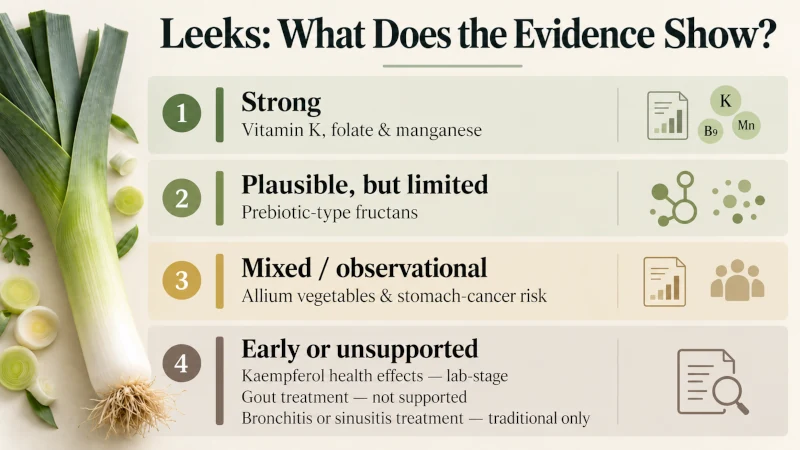
| Claim | Evidence | What it means for you |
| Good source of vitamin K, plus folate and manganese | Strong — measured nutrient content | A real, reliable contribution to your diet. |
| Fiber that feeds gut bacteria | Plausible, limited — leek fructans are prebiotic-type fibers; few leek-specific human studies | Likely helpful as part of a varied diet; can cause gas. |
| Lower stomach-cancer risk | Mixed, observational — allium vegetables as a group; results vary by region | Consistent with a healthy pattern; not protection you can rely on. |
| Anti-inflammatory / antioxidant (kaempferol) | Lab-stage — cell and animal studies | Interesting science, no proven effect in people. |
| Flushes uric acid, treats gout or kidney problems | No supporting evidence found | Fine to eat with gout; not a treatment. |
| Relieves bronchitis or sinusitis | Traditional only | Comfort food, not care. |
Vitamin K, folate and manganese (strong)
These are measured amounts, not hypotheses. Your body needs vitamin K to make the proteins that let blood clot, and it also activates proteins in bone [NIH ODS, 2021]. Whether eating more of it protects your bones is less settled: some studies link higher vitamin K intake with denser bones or fewer hip fractures, and others find no link [NIH ODS, 2021]. Folate helps your body make new cells, which is why needs rise in pregnancy [CDC, 2026].
A practical tip: cook or dress leeks with a little olive oil or butter. Vitamin K from vegetables is absorbed better when you eat it with some fat [NIH ODS, 2021].
Fiber that feeds gut bacteria (plausible, limited)
Leeks are rich in fructans, the same family of carbohydrates found in onions and garlic [Monash FODMAP, n.d.]. Reviews describe these fructans, mainly inulin-type, as prebiotics — food for beneficial gut bacteria [Ahmed et al., 2025]. What’s missing is direct evidence that eating leeks improves gut health in people; most of the research is about fructans in general.
Two caveats. The same fructans are why leeks can cause gas and bloating — the old version of this page got that part right. And a cup of leeks has only about 1.6 g of fiber, so leeks alone won’t fix constipation, even though low fiber intake is a common cause of it [USDA, SR Legacy; NIDDK, 2018]. Foods with stronger trial evidence, such as prunes and kiwifruit, are covered in our guide to foods for healthy digestion.
Stomach cancer risk (mixed, observational)
This is where leek headlines usually overreach. A 2011 meta-analysis of 19 case-control and 2 cohort studies, covering 543,220 people, found that those eating the most allium vegetables had a lower risk of stomach cancer than those eating the least (odds ratio 0.54). Separate analyses for leeks pointed the same way [Zhou et al., 2011]. The authors also warned that confounding and imperfect diet measurement mean the link still needs confirming.
A larger 2022 pooled analysis used individual data from 17 studies — 6,097 people with stomach cancer and 13,017 without. It found a smaller inverse association (odds ratio 0.71). The link was clear in Asian studies but absent in European ones, and the American estimate wasn’t statistically significant. The researchers urged caution in interpreting it [Dalmartello et al., 2022].
So eating allium vegetables fits with lower stomach-cancer risk in some populations. These are observational studies of the whole onion family, though, and they can’t show that leeks prevent cancer. Keep up with whatever screening your doctor recommends.
Kaempferol and other plant compounds (lab-stage)
Leeks are a notable source of the flavonoid kaempferol, along with the sulfur compounds typical of alliums [Ahmed et al., 2025]. In cell and animal studies these compounds show antioxidant and anti-inflammatory activity. The same review acknowledges that poor bioavailability and limited clinical validation stand between those findings and any health claim [Ahmed et al., 2025]. Treat stories about leeks fighting inflammation, diabetes or heart disease as early science.
Uric acid and gout (no supporting evidence)
The previous version of this page said leeks’ “alkalizing and diuretic effects” increase uric-acid elimination and help arthritis, gout and kidney disorders. We could not find clinical evidence for that, so it’s gone.
What is supported: if you have gout, leeks are a perfectly reasonable vegetable. Mayo Clinic notes that even high-purine vegetables don’t raise gout risk — and that diet alone usually can’t lower uric acid enough to treat gout without medicine [Mayo Clinic, 2025]. The factors that do matter include alcohol, sugar-sweetened drinks and purine-rich foods, mostly from animal sources [NIAMS, n.d.]. Our list of gout-friendly foods includes leeks among low-purine vegetables.
Bronchitis and sinusitis (traditional only)
Older herbals credit leeks with thinning mucus and acting as an antiseptic. We found no human studies testing leeks for bronchitis or sinusitis. A bowl of leek soup when you’re under the weather is comforting, and that’s all it should be asked to do.
Who should be careful with leeks
If you take warfarin
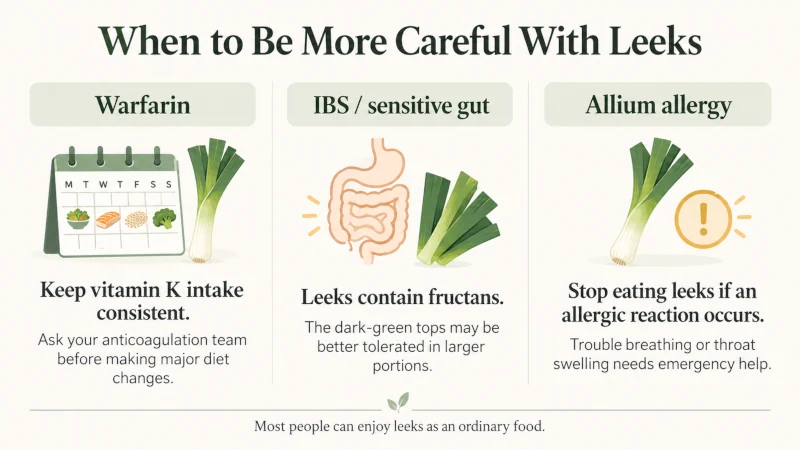
Vitamin K counteracts warfarin (Coumadin). The NIH advises people on warfarin and similar anticoagulants to keep their vitamin K intake consistent, because sudden changes can strengthen or weaken the drug [NIH ODS, 2021]. You don’t need to avoid leeks. Eat them in steady amounts — not a pot of leek soup one week and none the next — and tell your anticoagulation clinic before you change your diet much.
If you have IBS or a sensitive gut
Monash University, which developed the low-FODMAP diet, lists leek among the vegetables particularly rich in fructans [Monash FODMAP, n.d.]. According to Monash’s lab results as reported by FODMAP Everyday, the dark-green leaves were low-FODMAP at about 1 cup (75 g), while only about 14 g of the white bulb qualified [FODMAP Everyday, 2026]. If onions bother you, try the green tops first. Monash recommends working with a dietitian before starting a FODMAP diet rather than cutting foods on your own [Monash FODMAP, n.d.].
Allergy
Allium allergy exists, and reviews list it as a reason for caution [Ahmed et al., 2025]. If you get hives, swelling of the lips or throat, or wheezing after eating leeks, stop eating them and get medical help. Call 911 for trouble breathing.
Pregnancy and breastfeeding
As an ordinary vegetable, raw or cooked, leeks fit a healthy diet during pregnancy and breastfeeding; none of the sources we reviewed flag them. They add some folate, but food folate isn’t a substitute for folic acid. The CDC recommends that anyone who could become pregnant get 400 mcg of folic acid a day, because folic acid is the only form of folate shown to help prevent neural tube defects [CDC, 2026]. Our guide to foods high in folate explains how the two fit together. Wash leeks well: soil collects between the layers [WebMD, 2024].
How to clean, cook and store leeks

- Clean: cut off the root, slice the leek lengthwise and rinse it under running water, fanning the layers to wash out grit [WebMD, 2024].
- Use the greens: the dark tops are tougher, but sliced thin they sauté well, and they’re the part most people with IBS tolerate best [FODMAP Everyday, 2026].
- Raw: thinly sliced young leeks work as a salad topping [WebMD, 2024].
- Cooked: add them to soups, stews and beans, or roast them with other vegetables [WebMD, 2024]. Leeks and potatoes are a classic pairing — vichyssoise is the chilled version.
- Store: wrapped in a paper towel in the refrigerator for up to about five days [FODMAP Everyday, 2026].
When to talk to a doctor
Leeks are food, and most people can simply enjoy them. Check in with a professional if any of these apply:
- You take warfarin and plan a big change in how many leeks or leafy greens you eat [NIH ODS, 2021].
- Gas, bloating or changes in your bowel habits keep coming back — a dietitian can help you test foods like leeks without needless restriction [Monash FODMAP, n.d.].
- Constipation doesn’t improve with self-care, or you have a family history of colon or rectal cancer [NIDDK, 2018].
- You have gout flares — sudden pain, swelling, redness and warmth in a joint. Diet supports treatment but rarely replaces medicine [NIAMS, n.d.; Mayo Clinic, 2025].
See a doctor right away if constipation comes with bleeding from the rectum or blood in your stool, constant belly pain, inability to pass gas, vomiting, fever, lower back pain, or weight loss you can’t explain [NIDDK, 2018]. Call 911 for trouble breathing or throat swelling after eating.
| Health Disclaimer: This article is for general education only. It is not medical advice and is not a substitute for diagnosis or treatment from a qualified healthcare professional. Do not use it to start, stop or change any medication. If you take warfarin or another blood thinner, have IBS, a food allergy, gout, kidney disease or another medical condition, or are pregnant or breastfeeding, talk with your doctor, pharmacist or a registered dietitian before making significant changes to your diet. If you think you are having a medical emergency, call 911. |
Frequently Asked Questions
Can you eat the green part of leeks?
Yes. The dark-green tops are tougher than the white part, so slice them thin and cook them — they sauté well and are good in stock. For people with IBS, the greens tested low-FODMAP in much larger portions than the white bulb [FODMAP Everyday, 2026].
Are leeks good for gout?
Leeks are a fine vegetable to eat if you have gout; vegetables, even high-purine ones, don’t raise gout risk. They won’t lower uric acid on their own, and most people with gout still need medicine [Mayo Clinic, 2025].
Can I eat leeks if I take warfarin?
Usually yes. Leeks are high in vitamin K, so the key is consistency: eat similar amounts week to week and tell your anticoagulation clinic before big diet changes [NIH ODS, 2021].
Why do leeks give me gas?
Leeks are rich in fructans, a fermentable carbohydrate that gut bacteria break down, producing gas [Monash FODMAP, n.d.; Ahmed et al., 2025]. Smaller portions, or using mainly the green tops, often helps [FODMAP Everyday, 2026].
Do leeks help prevent cancer?
Not in any way you can count on. People who eat more allium vegetables have had lower stomach-cancer risk in some observational studies, mainly in Asia, but those studies can’t prove leeks cause the difference [Zhou et al., 2011; Dalmartello et al., 2022].
References
- U.S. Department of Agriculture, Agricultural Research Service. FoodData Central (SR Legacy): Leeks, (bulb and lower leaf-portion), raw. FDC ID 169246. View source
- U.S. Food and Drug Administration. Daily Value on the Nutrition and Supplement Facts Labels. View source
- 3. National Institutes of Health, Office of Dietary Supplements. Vitamin K: Fact Sheet for Health Professionals. View source
- 4. Zhou Y, Zhuang W, Hu W, Liu GJ, Wu TX, Wu XT. Consumption of large amounts of Allium vegetables reduces risk for gastric cancer in a meta-analysis. Gastroenterology. View source
- 5. Dalmartello M, Turati F, Zhang ZF, et al. Allium vegetables intake and the risk of gastric cancer in the Stomach cancer Pooling (StoP) Project. View source
- 6. Ahmed HGMD, Yang J, Zhu T, et al. Beyond seasoning nutrients bioactive ingredients and healthcare effects of Allium vegetables. View source
- 7. Monash University. High and low FODMAP foods. Monash FODMAP. View source
- 8. FODMAP Everyday. Leeks (ingredient guide reporting Monash University and FODMAP Friendly lab results). View source
- 9. Mayo Clinic Staff. Gout diet: What’s allowed, what’s not. View source
- 10. National Institute of Arthritis and Musculoskeletal and Skin Diseases. Gout. View source
- 11. Centers for Disease Control and Prevention. About Folic Acid. View source
- 12. National Institute of Diabetes and Digestive and Kidney Diseases. Symptoms & Causes of Constipation. View source
- 13. Royal Botanic Gardens, Kew. Plants of the World Online: Allium L. (Amaryllidaceae). View source
- 14. WebMD Editorial Team. Health Benefits of Leeks. View source


