You can get all the protein you need from a vegetarian diet. The only real questions are which foods to lean on and how much to eat. A cup of cooked lentils carries about 18 grams. A few ounces of tempeh or seitan can rival the protein in a chicken breast. Once you know where protein actually concentrates in plant foods, hitting your daily target stops feeling like arithmetic and turns into a habit.
This guide covers the highest protein-rich vegetarian foods, how much protein you actually need (a number that changed in U.S. guidance in early 2026), and the handful of situations where getting enough takes a little planning. The foods worth building meals around are mostly legumes, soy foods, and a few grains and seeds — and the gram counts below show why.
How much protein do you actually need?
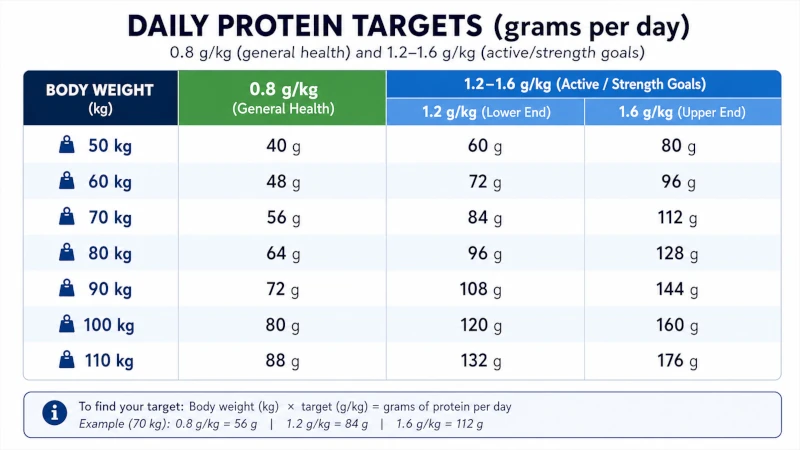
For decades the benchmark has been the Recommended Dietary Allowance: 0.8 grams of protein per kilogram of body weight per day [National Kidney Foundation, 2024]. For a 150-pound (about 68 kg) adult, that works out to roughly 55 grams — the minimum to keep a healthy body from running short, not a performance target [Harvard Health, 2023].
That figure went up in early 2026. The 2025–2030 Dietary Guidelines for Americans, released January 7, 2026, recommend 1.2 to 1.6 grams per kilogram per day — about 50 to 100% more than the old floor [USDA & HHS, 2026]. For that same 150-pound adult, the new range lands around 80 to 110 grams a day.
The increase is debated, and it’s worth saying so plainly. Nutrition researchers at Harvard and Stanford have noted that most Americans already eat more than enough protein, and that the evidence for pushing everyone toward the higher range isn’t settled [Harvard Nutrition Source, 2026]. The old RDA described a minimum; the new number leans toward an “optimal” intake for holding onto muscle, which matters more for some people than others. Treat the higher range as a target if you’re older, very active, pregnant, or losing weight — and don’t worry if you land closer to 0.8 on an ordinary day.
Two quick ways to find your own number:
- By weight: multiply your weight in kilograms by 0.8 (minimum) up to 1.2–1.6 (higher target). Pounds ÷ 2.2 = kilograms.
- By calories: aim for 10–35% of daily calories from protein [American Heart Association, 2024]. On a 2,000-calorie day, that’s about 50 to 175 grams.
People eating fully plant-based diets are often advised to sit a little above the minimum, because the body absorbs plant protein slightly less efficiently than animal protein [Healthline, 2026]. Eating a bit more, and varying your sources, covers that gap without any tracking.
The best protein-rich vegetarian foods
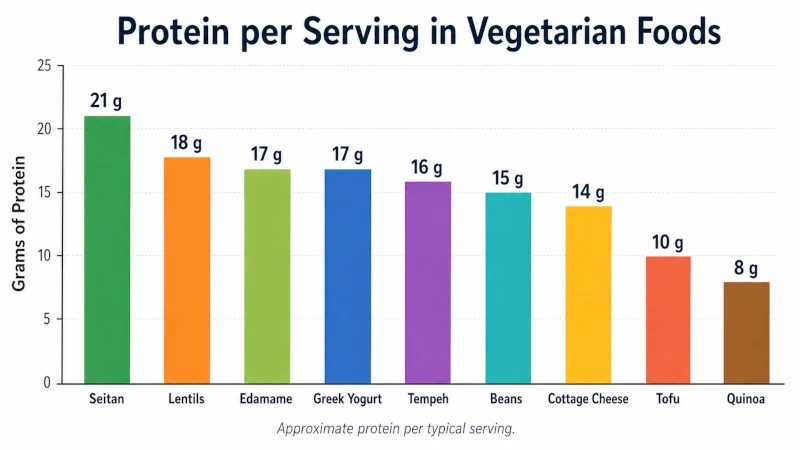
Here’s where the protein concentrates. Values are typical cooked-serving amounts from USDA-based food databases [USDA FoodData Central]; exact numbers vary a little by brand and preparation.
| Food | Typical serving | Protein |
| Seitan (wheat gluten) | 3 oz (85 g) | ~21 g |
| Lentils, cooked | 1 cup | 18 g |
| Tempeh | 3 oz (85 g) | ~17 g |
| Greek yogurt (lacto) | 3/4 cup | ~16 g |
| Tofu, firm | 1/2 cup | ~15 g |
| Black beans / chickpeas, cooked | 1 cup | ~15 g |
| Cottage cheese (lacto) | 1/2 cup | ~14 g |
| Hemp seeds | 3 tbsp | ~10 g |
| Edamame, shelled | 1/2 cup | ~9 g |
| Quinoa, cooked | 1 cup | ~8 g |
| Green peas, cooked | 1 cup | ~8 g |
| Pumpkin seeds | 1 oz | ~8 g |
| Milk / fortified soy milk | 1 cup | ~8 g |
| Egg (ovo) | 1 large | ~6 g |
Soy foods: the plant-based heavy hitters
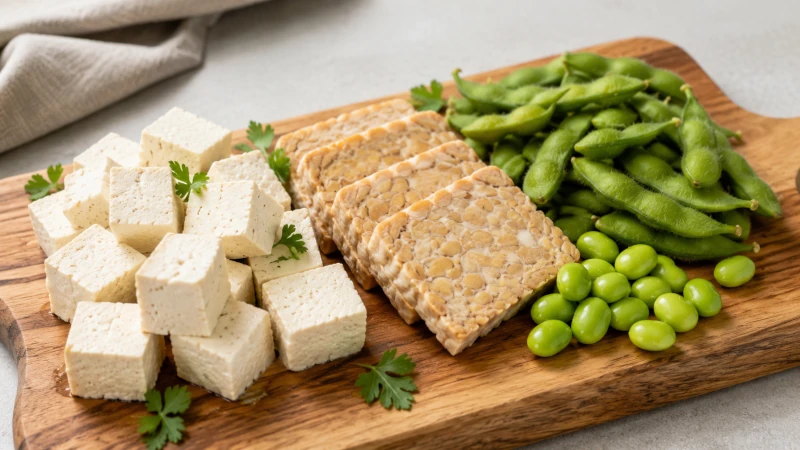
Tofu, tempeh, edamame, and soy milk all come from the soybean, one of the few plant foods that’s a complete protein — it supplies all nine essential amino acids in usable amounts [Cleveland Clinic, 2021]. Tempeh, made from fermented whole soybeans, brings around 17 grams per 3 ounces plus fiber and gut-friendly probiotics. Tofu is more neutral and takes on whatever you cook it with. Despite persistent online claims, soy foods are safe for the general population and are tied to heart benefits rather than harm.
Lentils, beans, and other legumes
These give you the most protein per dollar on the list. Cooked lentils deliver 18 grams a cup; chickpeas and black beans land around 15 [USDA FoodData Central]. They also bring fiber, iron, and folate, and the fiber feeds the beneficial bacteria in your gut.
Seitan and wheat-based proteins
Seitan — “wheat meat” — is essentially pure wheat gluten and the most protein-dense whole plant food going, at roughly 21 grams per 3 ounces with a chewy, meaty texture [Healthline, 2026]. Two catches: it’s gluten, so anyone with celiac disease or gluten sensitivity has to skip it, and it’s low in the amino acid lysine — easily covered by eating beans elsewhere in the day.
Grains, nuts, and seeds
Not primary protein sources, but they add up. Quinoa, amaranth, and buckwheat are unusual among grains in being complete proteins, at about 8 grams per cooked cup. Hemp seeds give roughly 10 grams per 3 tablespoons, pumpkin seeds about 8 per ounce, and nuts and nut butters 5 to 8 grams per serving [Healthline, 2026]. Sprinkled across meals, they quietly lift your daily total.
Eggs and dairy, if you eat them
Lacto-ovo vegetarians have the easiest time of all. A large egg has about 6 grams, Greek yogurt around 16 per three-quarter cup, cottage cheese about 14 per half cup, and a cup of milk roughly 8 — all complete proteins, all easy to stack into a day.
Complete vs. incomplete proteins (and the combining myth)
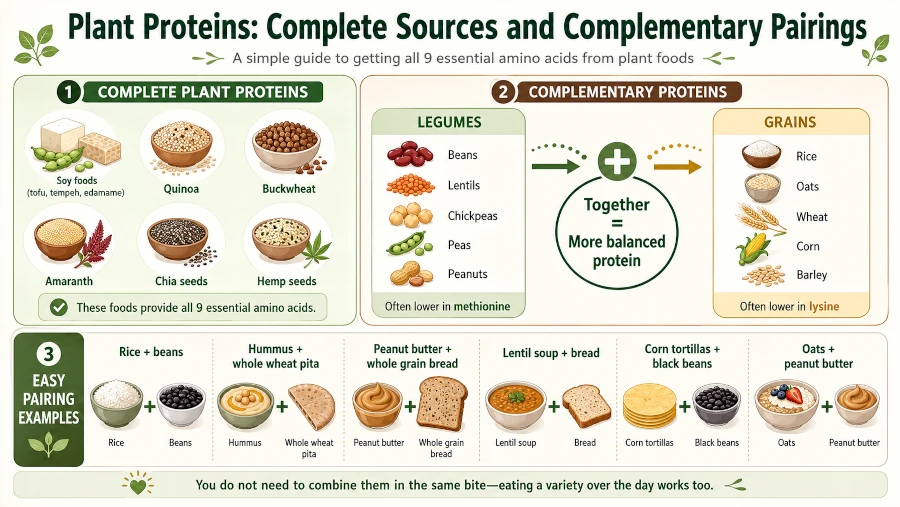
Proteins are chains built from about 20 amino acids. Nine of them are essential, meaning your body can’t make them and has to get them from food [MedlinePlus, 2024]; [StatPearls, 2024]. Some older textbooks list histidine as essential only for children — that’s outdated. It counts for adults too.
A “complete” protein contains all nine in good proportion. Animal foods and soy qualify. Most other plant proteins run low in one or two — beans are light on methionine, grains light on lysine — which is where the old advice to pair beans and rice at the same meal came from.
That advice is no longer considered necessary. Your body keeps a pool of amino acids and draws on it as needed, so as long as you eat a variety of plant proteins across the day, the gaps fill themselves [MedlinePlus, 2024]. Beans at lunch and rice at dinner work as well as the two on one plate. The only pattern that genuinely falls short is living on a single plant food.
Can you really get enough protein without meat?
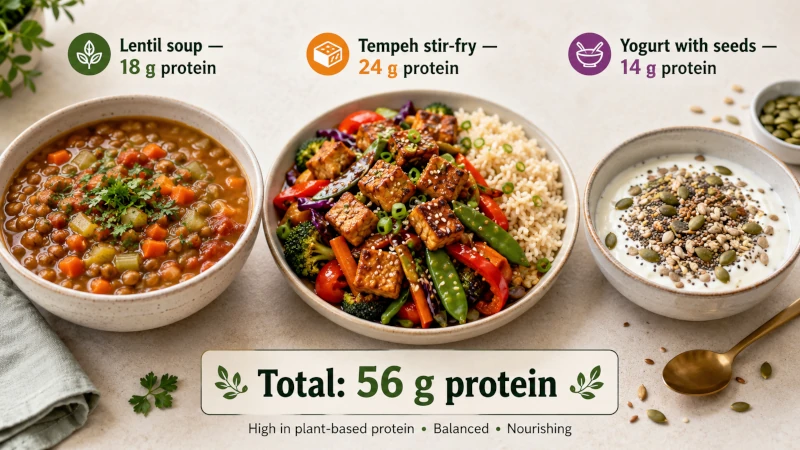
Yes — and it isn’t close. A day with lentil soup, a tempeh stir-fry, and a yogurt topped with hemp seeds clears 50 grams easily and can pass 100. When plant-based eaters do fall short, the problem usually isn’t that plants lack protein; it’s a planning gap. Surveys find vegans average a bit less protein than omnivores — closer to 70 versus 90 grams a day — and that gap closes once meals are built around the foods above.
The simplest fix is to anchor each meal to a protein source first — a scoop of lentils, a slab of tofu, a couple of eggs — then build the rest of the plate around it.
Is plant protein actually better for you?
There’s reasonable evidence that shifting some protein from animal to plant sources helps long-term health, though most of it is observational — so read it as a nudge, not a guarantee. A large dose-response meta-analysis found that getting an extra 3% of daily calories from plant protein was associated with about a 5% lower risk of death from any cause [Naghshi et al., BMJ, 2020].
Trials where people swapped animal protein for plant protein show modest drops in total and LDL (“bad”) cholesterol, and substituting plant for animal protein has been linked to lower cardiovascular mortality and type 2 diabetes risk — though researchers rate that evidence “limited-suggestive” rather than conclusive [Systematic review, 2023]. The likely reason isn’t magic in the beans; it’s what comes with them — fiber, unsaturated fats, less saturated fat — and what they replace. You don’t have to go fully plant-based to benefit. Trading a few servings a week is a reasonable, evidence-aligned move.
Safety, side effects, and who should take care
For most healthy people, eating more protein — plant or animal — is safe. The often-repeated idea that high protein damages the kidneys doesn’t hold up in healthy individuals: a meta-analysis of 28 studies found no harm to kidney function from higher protein intake in people with normal kidneys [McMaster University, 2018]. The kidneys simply increase filtration to clear the extra nitrogen, which is a normal adaptation, not injury. (The old article’s claim about protein causing “blood acidification” doesn’t reflect current understanding — the body tightly regulates blood pH — so it’s left out here.)
The cautions that do matter:
- Existing kidney disease. If you have chronic kidney disease or reduced kidney function, protein intake does need managing — work with your doctor or a renal dietitian on the right amount [CKD review, 2025]. The “no harm” finding applies to healthy kidneys, not damaged ones.
- Gout. Protein itself isn’t the main trigger; purine-rich foods, alcohol, and sugary drinks are. Most plant proteins, including legumes, are considered safe for people with gout. See our guide to foods that trigger gout for the specifics.
- Pregnancy and breastfeeding. Protein needs rise, so this is a time to aim toward the higher end and check in with a prenatal provider rather than restrict.
- Very restrictive plant-based diets. Protein is usually the easy part; vitamin B12, iron, iodine, calcium, and zinc take more attention, and heavily processed vegan foods can leave gaps [Healthline, 2026]. A registered dietitian can help you build a complete plan.
Protein deficiency is rare in well-fed countries, but it does happen — most often in older adults eating too little overall, people with serious illness, or very limited diets. The signs are nonspecific: muscle loss and weakness, swelling (edema), thinning hair, slow wound healing, and frequent infections. Symptoms like these are a reason to see a clinician rather than self-diagnose, since they overlap with many other conditions.
| Health disclaimer This article is for general education and information only and is not a substitute for professional medical advice, diagnosis, or treatment. Protein needs vary with age, health status, activity, and medical conditions. If you are pregnant or breastfeeding, have kidney disease or another chronic condition, or are planning a significant change to your diet, talk with your doctor or a registered dietitian before acting on anything here. Never disregard professional advice because of something you read in this article. |
Frequently Asked Questions
Which vegetarian food has the most protein?
By weight, seitan tops the list at about 21 grams per 3 ounces. Soy foods like tempeh (around 17 grams) come close and have the advantage of being complete proteins. Among legumes, cooked lentils lead at 18 grams per cup.
Can vegetarians get enough protein without supplements?
Yes. Whole foods cover it for nearly everyone. Protein powders are a convenience for people with high needs — competitive athletes, some older adults, or anyone struggling to eat enough — not a requirement for a healthy vegetarian diet.
Do I need to combine proteins at every meal?
No. The idea that you must pair foods like beans and rice at the same sitting is outdated. Eating a variety of plant proteins across the day is enough to cover all the essential amino acids.
Is soy safe to eat regularly?
For the general population, yes. Soy foods are complete proteins linked to heart benefits, and routine intake is considered safe. If you have a specific condition such as a hormone-sensitive cancer, ask your doctor about your individual situation.
How much protein do I need per day on a vegetarian diet?
The long-standing minimum is 0.8 grams per kilogram of body weight. Many people do well between 1.0 and 1.6 g/kg depending on age and activity, and U.S. guidance now points toward the higher end. Plant-based eaters often aim slightly above the minimum to account for digestibility.
Is plant protein as good as animal protein?
For meeting your needs, yes — especially with variety, since soy and quinoa are already complete. Some plant proteins are slightly less digestible and lower in one amino acid, both of which are covered by eating a bit more and mixing your sources.
References
- National Kidney Foundation. Protein in Our Diet: Variety and Moderation is the Key. 2024. View source
- Harvard Health Publishing. How much protein do you need every day? 2023. View source
- U.S. Departments of Agriculture and Health and Human Services. Dietary Guidelines for Americans, 2025–2030. Released January 7, 2026. View source
- MedlinePlus (U.S. National Library of Medicine). Dietary Guidelines for Americans 2025–2030. View source
- Harvard T.H. Chan School of Public Health, The Nutrition Source. Dietary Guidelines for Americans 2025–2030: protein and other changes. 2026. View source
- American Heart Association. Protein and Heart Health. 2024. View source
- MedlinePlus (U.S. National Library of Medicine). Amino acids. View source
- Lopez MJ, Mohiuddin SS. Biochemistry, Essential Amino Acids. StatPearls, NCBI Bookshelf. 2024. View source
- Cleveland Clinic. Amino Acids: Benefits & Food Sources. 2021. View source
- Healthline. The 18 Best Protein Sources for Vegans and Vegetarians. 2026. View source
- Naghshi S, et al. Dietary intake of total, animal, and plant proteins and risk of all cause, cardiovascular, and cancer mortality: systematic review and dose-response meta-analysis. BMJ. 2020. View source
- Animal versus plant-based protein and risk of cardiovascular disease and type 2 diabetes: a systematic review of RCTs and prospective cohort studies. 2023. View source
- McMaster University. Myth busted: a high-protein diet does not affect kidney function (meta-analysis of 28 studies). 2018. View source
- Low-protein diet for chronic kidney disease: evidence, controversies, and practical guidelines. 2025. View source
- U.S. Department of Agriculture. FoodData Central (protein values per serving). View source
