
Contents
- 1 What Your Morning and Evening Numbers Actually Mean
- 2 Morning vs Night: What Each Captures
- 3 Best time to check blood pressure: What most people get wrong
- 4 How to Do It Step-by-Step
- 5 Different Schedules for Different Needs
- 6 What Different Patterns Mean
- 7 Quick Checklist
- 8 What to Avoid
- 9 Why Averages Matter More Than Single Readings
- 10 Frequently Asked Questions
- 11 References
Most people treat blood pressure like a fixed number—something that should stay put if you’re healthy. It doesn’t work that way. Your pressure shifts with your nervous system, hormones, activity, and dozens of other variables. A 20-point swing between morning and evening isn’t a malfunction. It’s your body doing what bodies do.
The real question: which time gives you useful data? Morning measurements catch your cardiovascular system under strain—natural surges, medication gaps, overnight stress. Evening measurements show how your body recovered from the day. Most people need both for a week to see the pattern. Then you can pick one time and track it consistently. Single readings are noise. Weekly averages are signal.
Medical disclaimer: This article on the best time to check blood pressure is for educational purposes only and is not medical advice. If you have high blood pressure, heart disease, kidney disease, are pregnant, or take prescription medications, talk with a qualified clinician before changing treatment, diet, exercise, or supplements. Do not stop or adjust blood pressure medication without your prescriber.
What Your Morning and Evening Numbers Actually Mean
Morning blood pressure typically runs higher. Between 6 AM and noon, your body releases cortisol and adrenaline to wake you up. Blood vessels constrict. Heart rate climbs. This “morning surge” is normal—but exaggerated surges correlate with stroke risk in some studies [1].
Morning readings also reveal medication gaps. If you take blood pressure pills at night, the effect may be wearing off by morning. Your 7 AM reading shows your cardiovascular system at its most vulnerable.
Evening readings capture something different: the cumulative effect of your day. Stress from work. Sodium from lunch. Dehydration. Skipped exercise. Your evening number reflects how your body handled the last 12 hours—and whether your medication (if you take it in the morning) is still working.
Neither time is “more accurate.” They’re measuring different things.
Example: Maria takes her blood pressure every morning at 7 AM, right after waking up. Her average over seven days: 136/86. Her doctor adjusts her medication. Two weeks later, Maria adds evening checks at 8 PM. Evening average: 122/79. The morning-only data suggested poor control. The full picture showed her medication was working—just wearing off overnight. Her doctor switched her to a longer-acting formula instead of increasing the dose.
For a detailed guide on proper technique regardless of timing, see our how-to section.


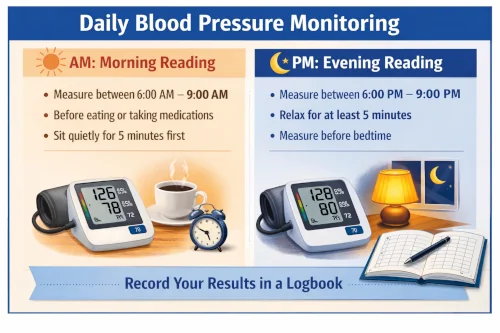
Morning vs Night: What Each Captures
| Time | What it reveals | Pros | Cons |
|---|---|---|---|
| Morning (within 1 hour of waking, before meds/coffee) | Natural surge, medication gaps, overnight recovery | Consistent conditions, shows baseline, catches high-risk window | Can be stressful, may overestimate all-day average |
| Evening (before bed, at least 1 hour after eating/exercise) | Daily accumulation, medication effectiveness, stress response | Reflects real-world conditions, often lower and less alarming | Variable (activity/diet affect it), easy to forget |
The American Heart Association recommends checking at both times for at least 3–7 days when starting home monitoring [2]. After that, many people settle into once-daily checks—morning is slightly more predictive of cardiovascular events in research, but evening consistency beats morning inconsistency.
Best time to check blood pressure: What most people get wrong
Mistake #1: Comparing today’s morning reading to yesterday’s evening reading. Your blood pressure at 7 AM will almost always be higher than at 9 PM. That’s not a problem—it’s physiology. Compare mornings to mornings. Evenings to evenings.
Mistake #2: Checking “whenever you remember.” Random timing introduces so many variables (recent meals, stress, movement, medications) that the data becomes useless. If you only measure when you “feel off,” you’re selecting for the worst readings.
Mistake #3: Obsessing over single readings. One morning spike after bad sleep doesn’t mean your treatment failed. One perfect evening reading doesn’t mean you’re cured. Your doctor needs patterns—usually defined as the average of at least 12 readings over 3–7 days [2].
Mistake #4: Measuring right after waking but before sitting still. Even 30 seconds of walking to the bathroom elevates your pressure. Sit quietly for 5 minutes before the first reading. Every time.
Mistake #5: Assuming lower is always better. If your evening readings consistently run 30+ points below your morning readings, that’s worth mentioning to your clinician. Excessive dipping at night sometimes signals underlying issues.
How to Do It Step-by-Step
Week 1: The Baseline Protocol
- Choose your times: Morning within 1 hour of waking (before medications, coffee, or breakfast). Evening 1–2 hours before bed (at least 1 hour after eating, drinking alcohol, or exercising).
- Prepare the same way every time: Empty bladder. Sit quietly for 5 minutes. Feet flat on floor. Back supported. Arm at heart level.
- Take two readings, 1–2 minutes apart. Record both. Average them. That’s your reading for that session.
- Do this twice daily for 3–7 days. More is better for accuracy, but 3 days (12 total readings) meets minimum clinical standards.
- Calculate separate averages: Average all morning readings. Average all evening readings. These two numbers matter more than any individual reading.
For more details on proper positioning and technique, see home BP monitoring.
After Week 1: Maintenance
Once you have baseline data, most people shift to:
- Daily checks at one time (usually morning) if blood pressure is controlled
- Weekly check-ins (one morning, one evening) to confirm stability
- Full 3-day protocols monthly or when changing medications
Your clinician may want something different. Ask.
The “It Depends” Moments
Before or after medication? Your doctor might want measurements before your morning dose (to see the trough level) or after (to confirm the medication is working). This isn’t medical consensus—it’s clinician preference. The critical thing is doing it the same way every time and telling your doctor which you chose.
What if I take blood pressure medication twice daily? Morning checks come before the morning dose. Evening checks can come before or after the evening dose, but stay consistent. Some doctors prefer “trough” timing (right before the next dose) to see if coverage lasts.
What about before vs after exercise? Always measure before. Exercise temporarily lowers blood pressure in most people—that’s good for your heart, bad for data accuracy. Wait at least 60 minutes after moderate activity before checking.
Different Schedules for Different Needs
| Protocol | When to use it | How it works |
|---|---|---|
| 3-Day (2x daily) | Starting monitoring, med changes, recent diagnosis | Check morning and evening for 3 consecutive days. Average each time separately. 12 total readings. |
| 7-Day (2x daily) | Suspected white-coat effect, borderline readings, validating home monitor | Check morning and evening for 7 consecutive days. Discard Day 1 readings. Average Days 2–7. 24 total readings (12 per time). |
| 1x Daily Maintenance | Controlled BP, stable meds, routine monitoring | Pick one time (usually morning). Check 3–4 days per week. Track weekly averages. |
For Shift Workers and Irregular Schedules
Clock time matters less than physiological time. Use “wake time” and “pre-sleep time” instead of morning and evening.
- Wake-time check: Within 1 hour of waking up, regardless of whether that’s 6 AM or 3 PM. Before medications or caffeine.
- Pre-sleep check: 1–2 hours before your normal sleep time, after your body has settled from the day.
If your schedule rotates weekly or monthly, note your shift pattern when recording. Your doctor can interpret the data if they know you measured at “wake +30 minutes” rather than “7 AM.”
For more on how sleep timing affects blood pressure, visit our sleep section.
What Different Patterns Mean
| Pattern | What it might indicate | What to do |
|---|---|---|
| Morning consistently 10–20 points higher | Normal diurnal variation | Nothing. This is expected. |
| Morning 30+ points higher | Exaggerated surge, medication wearing off | Discuss with clinician. May need evening dosing or different medication. |
| Evening consistently higher | Stress, sodium intake, “white-coat” anxiety, physical activity | Review daily habits. Check technique. Measure at true rest. |
| Both times elevated | Uncontrolled hypertension | Contact clinician. Bring your full data log. |
| Both times normal | Controlled BP | Continue monitoring as advised. |
| Large day-to-day swings (20+ points) | Inconsistent technique, stress, sleep issues, atrial fibrillation | Review technique. If consistent, discuss with clinician—may need continuous monitoring. |
These are patterns over 3–7 days, not single readings.
Quick Checklist
Use this before every measurement:
- Bladder empty
- Sat quietly for 5 minutes
- No caffeine, smoking, or exercise in past 30 minutes
- No food in past 60 minutes (for evening checks)
- Feet flat on floor, back supported
- Arm bare (no sleeve bunched under cuff)
- Cuff at heart level
- No talking during measurement
- Same time of day (within 30-minute window)
- Same arm every time
- Record both readings (take two, 1–2 minutes apart)
What to Avoid
Don’t check your blood pressure:
- Right after waking up (sit for 5 minutes first)
- Within 30 minutes of caffeine or nicotine
- Within 60 minutes of meals or alcohol
- Within 60 minutes of moderate exercise
- While bursting to use the bathroom
- While talking or watching TV
- In a cold room (vasoconstriction raises readings)
- On your lap or unsupported arm
And don’t:
- Compare different times of day
- React to single readings
- Check multiple times in a row because you “didn’t like” the first number (you’ll just stress yourself out and elevate it further)
Why Averages Matter More Than Single Readings
Blood pressure fluctuates beat-by-beat. Within a single hour, your systolic pressure might vary by 10–15 mmHg just from breathing patterns, small movements, or passing thoughts.
Clinical decisions are based on averages—typically 12 or more readings over 3–7 days. A single 150/95 doesn’t diagnose anything. An average of 150/95 over two weeks? That’s actionable data.
The practical rule: If you take seven morning readings over a week and six are 125–135/80–85 with one outlier at 158/92, ignore the outlier. Average the other six. Your blood pressure is controlled. The 158 reading was likely technique, stress, or a full bladder.
For context on how exercise affects blood pressure patterns, see our exercise section.
Frequently Asked Questions
- Do I need to check both morning and evening forever? No. After initial monitoring (1–2 weeks), most people with controlled blood pressure switch to once-daily checks or even weekly checks. Your clinician will tell you what they need.
- What if I forget a reading? Skip it. Don’t take extra readings to “make up” for missed ones. Resume your schedule the next day.
- Can I check during the day instead of morning and evening? Yes, if you’re consistent. Midday checks work fine—just do them at the same time daily, under the same conditions (rested, not right after eating or moving).
- My evening reading is always lower. Does that mean my blood pressure is fine? Not necessarily. If your morning average is elevated but evening is normal, you still have hypertension—it’s just masked in the evening. Bring both sets of data to your clinician.
- Should I take my medication before or after checking in the morning? Ask your doctor. Some want pre-dose readings (to see if the previous dose lasted). Others want post-dose (to confirm the medication works). Whichever you choose, do it the same way every time and document it.
- I take my BP pill at night. When should I measure? Morning measurements show your overnight coverage. Evening measurements (before your dose) show your daytime coverage. Both are useful during initial monitoring.
- What if I work night shifts? Measure at wake-time and pre-sleep-time, regardless of clock time. Note your schedule when recording so your clinician can interpret the data.
- How long should I wait after waking up? Within 1 hour of waking, but after sitting quietly for 5 minutes. So if you wake at 6 AM, you could measure anytime from 6:05 AM to 6:55 AM—just pick a time and stick with it.
- Can I check right before bed? Yes, as long as you’ve been sitting calmly and haven’t eaten, exercised, or had alcohol in the past hour. “Before bed” usually means 1–2 hours before sleep, not right as you’re climbing under the covers.
References
- [1] Kario K. Morning surge in blood pressure and cardiovascular risk: evidence and perspectives. Hypertension. 2010;56(5):765-773. https://www.ahajournals.org/doi/10.1161/HYPERTENSIONAHA.110.157149
- [2] Shimbo D, Artinian NT, Basile JN, et al. Self-measured blood pressure monitoring at home: a joint policy statement from the American Heart Association and American Medical Association. Circulation. 2020;142(4):e42-e63. https://www.ahajournals.org/doi/10.1161/CIR.0000000000000803