
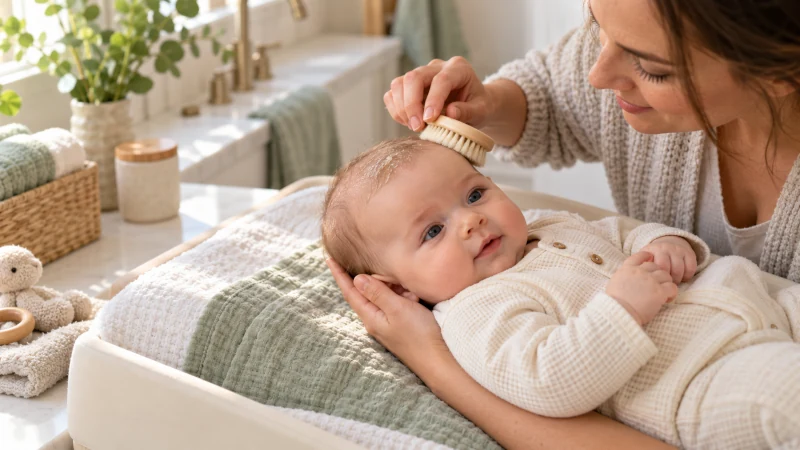
No essential oil has been tested as a treatment for cradle cap in babies, and the gentle routine pediatricians already recommend — soften the scales with a plain oil, wash, then brush — tends to do the job without one. If you’ve been reading about essential oils for cradle cap, that may not be the answer you expected. But cradle cap is harmless and usually clears on its own, so for most families the safest choice is to leave essential oils off a baby’s scalp, especially in the first few months [AAP, 2023] [NHS, 2025].
Tea tree, lavender, chamomile and cedarwood oils are all widely recommended online. Here’s what the research actually shows for each, why a baby’s skin is a poor place to experiment, and the routine that helps.
What cradle cap is, and why it usually clears on its own
Cradle cap is the scalp form of infantile seborrheic dermatitis: thick, yellowish, greasy or crusty scales, sometimes with redness underneath. It usually starts between three weeks and two months of age, and it is extremely common — about 70% of three-month-olds have it [AAP, 2023]. The same rash can show up on the face, behind the ears, in neck folds and in the diaper area.
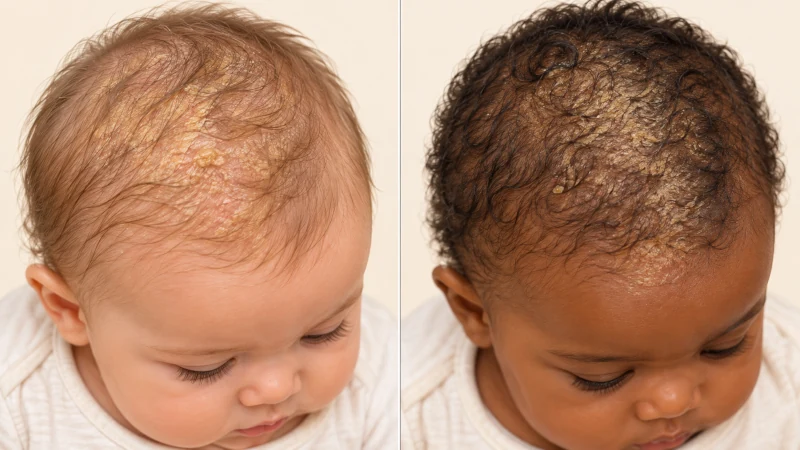
A few facts shape what “treatment” should look like:
- It isn’t caused by poor hygiene, an allergy or an infection, and it isn’t contagious [AAP, 2023].
- It is rarely itchy and usually doesn’t bother the baby at all [AAP, 2023] [NHS, 2025].
- Nobody knows the exact cause. The leading theories involve a reaction to Malassezia, a yeast that lives on everyone’s skin, and maternal hormones prompting the baby’s oil glands to overproduce [AAP, 2023].
- It usually fades within weeks or months and has cleared in most babies by their first birthday, though some toddlers keep a little flaking [AAP, 2023].
That last point matters more than it sounds. In the randomized trials of cradle cap treatments, babies tended to get better whatever they were given, including placebo [Victoire et al., 2019]. Any remedy will look like it “worked” if you start it during the weeks the rash was going to fade anyway.
If you’re not sure whether flaking is cradle cap, dandruff or something else, our guide to scalp psoriasis vs. dandruff and seborrheic dermatitis walks through how these conditions differ in older children and adults.
Essential oils for cradle cap? What the evidence shows
There is no clinical evidence that any essential oil treats cradle cap in babies.
The most thorough look at the question is a 2019 Cochrane review of treatments for infantile seborrheic dermatitis. It searched the medical literature through May 2018 and found only six small randomized trials, with 310 children in total. They tested oral biotin, two commercial creams and gels, hydrocortisone, a licorice-derived lotion and an antiseptic dye. None tested an essential oil, and the reviewers rated all of the evidence they found as very low certainty [Victoire et al., 2019]. They also pointed out that even the standard advice — oils to soften scales, shampooing, brushing — has never been tested in a trial. Our searches of more recent research did not turn up an infant trial of any essential oil for cradle cap either.
Here is how the four most-recommended oils stack up.
Tea tree oil
Tea tree oil is suggested because it has activity against Malassezia yeast. The best human evidence comes from adults and teenagers: in a randomized trial of 126 people aged 14 and older with dandruff, a 5% tea tree oil shampoo used daily for four weeks improved severity scores by 41%, compared with 11% for placebo [Satchell et al., 2002]. The trial was funded by a tea tree oil industry research body, and it tells us nothing about infants.
The concentration matters. A 5% shampoo is fifty times stronger than the 0.1% level that a standard essential-oil safety reference suggests for babies up to three months old [Tisserand & Young, 2014, via AromaWeb]. Tea tree is also one of the essential oils most often involved when children are poisoned, usually by swallowing it [VUMC, 2016].
Evidence grade: some support for adult dandruff; none for babies. Not a good choice for an infant’s scalp. For tea tree’s better-supported uses in adults, see our review of herbs for skin issues.
Lavender oil
Lavender has a calming, soothing reputation, but there are no trials of lavender oil for cradle cap. Poison specialists list lavender among the essential oils that can be harmful if a child swallows it [VUMC, 2016], and it sits at the center of an unresolved debate about hormone effects in children (covered under side effects below). Our evidence review of lavender benefits explains where lavender has real support in adults and where it doesn’t.
Evidence grade: insufficient — no studies in cradle cap.
Chamomile oil
Chamomile has a long traditional use for irritated skin, but there is no published trial of chamomile essential oil for cradle cap. It also belongs to the daisy family, the same family as ragweed, so people sensitive to those plants are more likely to react; our guide to German chamomile, including its allergy risks covers this in detail.
Evidence grade: traditional use only for this purpose.
Cedarwood oil
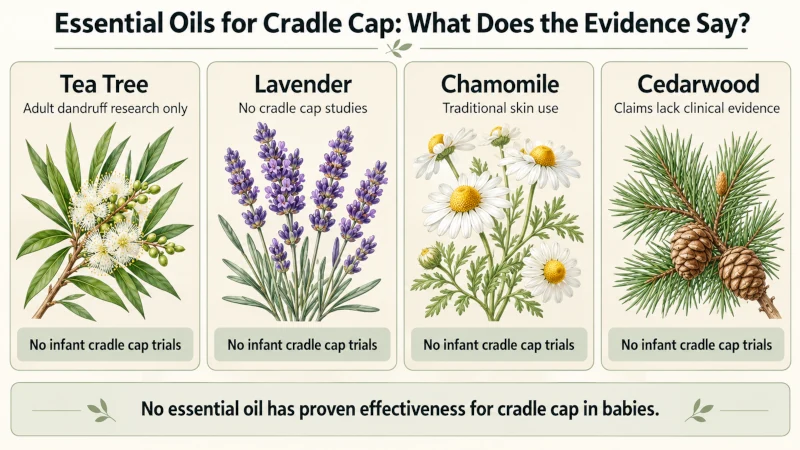
Cedarwood oil is promoted online as antifungal and anti-inflammatory for the scalp. We found no human trial of cedarwood oil for cradle cap or infant seborrheic dermatitis, and no infant safety data. Treat claims that it “reduces cradle cap severity” as unsupported.
Evidence grade: insufficient — no studies.
| Oil | Why it’s suggested | Trials in babies with cradle cap | Main concern for infants |
| Tea tree | Antifungal activity; one adult dandruff trial | None | Skin irritation; toxic if swallowed; common in child poisoning calls |
| Lavender | Calming, “soothing” reputation | None | Skin reaction; harmful if swallowed; hormone question unsettled |
| Chamomile | Traditional use for irritated skin | None | Allergy, especially with daisy/ragweed sensitivity |
| Cedarwood | Claimed antifungal effect | None | No efficacy or safety data in infants |
Why essential oils are a poor fit for a baby’s scalp

Set effectiveness aside for a moment. Several things still make essential oils a bad bargain for a condition that resolves on its own.
Babies absorb more through their skin. Poison specialists note that children’s thin skin readily absorbs essential oils, and that children have been poisoned by heavy or inappropriate use on the skin, not only by swallowing it [VUMC, 2016]. Children’s immature livers may also make them more sensitive to toxic effects [Poison Control, n.d.].
The skin under the scales may be irritated. Poison Control advises against using essential oils on damaged skin [Poison Control, n.d.], and picking or scrubbing at scales can easily break it.
Fragrance is on the “don’t” list. NHS guidance for cradle cap says not to use products containing fragrance or perfume [NHS, 2025]. Essential oils are concentrated plant fragrance.
Online recipes are stronger than they look. A common recipe — one to two drops of essential oil in an ounce of carrier oil — works out to roughly 0.17% to 0.33% [Worwood, 2016, via AromaWeb]. Essential Oil Safety by Tisserand and Young, a standard reference in aromatherapy, suggests 0.1% (0.2% at most) for babies up to three months and 0% for premature babies, and the authors say even those figures are cautious suggestions rather than research-based limits [Tisserand & Young, 2014, via AromaWeb]. So the “gentle” recipe can exceed the field’s own ceiling for young infants.
The bottle is a hazard in a home with a baby. The Tennessee Poison Center reported that essential oil exposures doubled between 2011 and 2015, with 80% involving children, and that less than half a teaspoon breathed into the lungs while choking can cause pneumonia [VUMC, 2016]. Poison Control suggests families with young children consider not keeping bottles of essential oils at all, or keep them locked up [Poison Control, n.d.].
You can’t be sure what’s in it. Essential oil products are not well regulated, so species, concentration and contaminants can be hard to verify [Poison Control, n.d.].
Put together, you’d be adding real — if mostly small — risks to treat a harmless rash that a plain oil and a soft brush already handle.
What actually helps: a gentle cradle cap routine
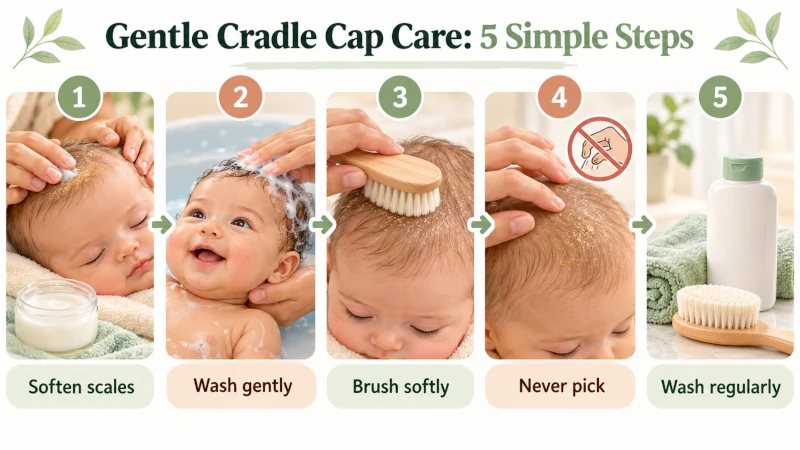
These steps haven’t been tested in large trials either [Victoire et al., 2019], but they are low-risk, they match American and UK pediatric guidance, and they work with the rash’s natural course instead of against your baby’s skin.
- Soften tough scales with a plain oil or emollient. Rub a little mineral oil, coconut oil or petroleum jelly into thick patches; the AAP suggests leaving it on overnight [AAP, 2023]. The NHS suggests a fragrance-free emollient (moisturizer) or coconut oil [NHS, 2025].
- Wash with a mild baby shampoo. Every other day suits most babies [AAP, 2023]. Skip soap, adult shampoos and anything fragranced [NHS, 2025]. Ask your pediatrician before trying a medicated shampoo, which can irritate a baby’s skin [AAP, 2023].
- Loosen the scales gently while shampooing. Use your fingertips, a soft baby brush or a baby comb [AAP, 2023] [NHS, 2025].
- Don’t pick or scratch. Picking raises the chance of infection [AAP, 2023] [NHS, 2025]. Some hair may come away with the scales; it grows back [AAP, 2023].
- Keep washing once it clears. Regular washing with a mild baby shampoo helps stop cradle cap coming back [AAP, 2023].
If the scales are still there after a few weeks of this, talk to your pediatrician. They may suggest an antifungal or hydrocortisone cream [AAP, 2023] — medicines with their own trade-offs, which is why that decision belongs with your baby’s doctor.
Which plain oil? Where the guidance differs
- Mineral oil, coconut oil or petroleum jelly: all three appear in AAP guidance [AAP, 2023]; the NHS lists emollients and coconut oil [NHS, 2025].
- Olive oil: advice conflicts. Some older guidance lists it, but the NHS now says not to use it because it may not be suitable for skin [NHS, 2025], and the Cochrane reviewers note a theoretical concern that it may encourage Malassezia growth — something no trial has tested [Victoire et al., 2019]. With good alternatives available, the cautious choice is to use something else.
- Peanut oil and other food oils: avoid peanut oil because of allergy risk [NHS, 2025]; the Cochrane authors raise the same concern about food oils on infant skin more broadly [Victoire et al., 2019].
If you’re still considering an essential oil
Some parents will still want to try one. If that’s you, raise it with your pediatrician first, and keep to these limits:
- Don’t use essential oils on premature babies or babies under three months. Tisserand and Young set the level for premature babies at 0%, and some aromatherapy educators advise no essential oils at all before age three [AromaWeb, n.d.].
- Never apply one undiluted, and never on broken, raw, oozing or inflamed skin [Tisserand Institute, n.d.] [Poison Control, n.d.].
- Keep it away from the eyes and mouth, and wash your own hands afterward [Tisserand Institute, n.d.].
- Use one oil, not a blend, so you can tell what caused a reaction. Stop and gently wash it off at the first sign of a rash [Poison Control, n.d.].
- Never add drops to bath water. Oils don’t mix with water, so undiluted droplets cling to skin and can irritate it [Tisserand Institute, n.d.].
- Avoid oils with known serious toxicity in children, including eucalyptus, camphor and wintergreen [Poison Control, n.d.] [VUMC, 2016].
- Lock bottles away after every use [Poison Control, n.d.] [Tisserand Institute, n.d.].
Keep in mind that the plain carrier oil is what softens the scales. The essential oil adds risk without a proven benefit.
Side effects and safety concerns
Skin irritation and allergy
A skin rash is the most common allergic reaction to essential oils [Poison Control, n.d.]. Once someone becomes allergic to a particular oil, they may need to avoid it for life [Tisserand Institute, n.d.] — a lasting cost for a baby who was only being treated for a temporary rash.
Poisoning
Swallowed essential oils can cause mouth and throat irritation and vomiting, and depending on the oil, effects on the nervous system ranging from agitation and seizures to severe drowsiness [VUMC, 2016]. If your child swallows any essential oil, or a product containing one, call Poison Control at 1-800-222-1222 right away [Poison Control, n.d.].
The hormone question
The evidence here is genuinely mixed. A 2007 report in the New England Journal of Medicine described three boys whose breast-tissue growth coincided with using products containing lavender and tea tree oils and resolved after the products were stopped; lab tests in the same report found estrogen-like and anti-androgen activity in both oils [Henley et al., 2007]. A later systematic review found no evidence linking tea tree oil to hormone disruption in children and little to none for lavender [Hawkins et al., 2020], and a parent-reported survey of 556 children aged 2 to 15 found no difference in hormone-related disorders between children who were and weren’t regularly exposed [Hawkins et al., 2021].
Both later studies came from a research group working in partnership with an aromatherapy association [NAHA, n.d.], and none of the research on either side looked at young babies. A fair reading: any risk appears low, but it hasn’t been settled for infants — one more reason not to apply these oils repeatedly to a baby’s scalp.
Medicines, pregnancy and breastfeeding
Essential oils may interact with medications [Poison Control, n.d.], so if your baby takes any medicine, check with your pharmacist or pediatrician first. The Tisserand Institute advises anyone who is pregnant, has a skin condition, has epilepsy or asthma, or takes prescribed medication to get medical advice before using pure essential oils [Tisserand Institute, n.d.]. If you’re breastfeeding, keep any essential-oil products off your breasts and chest so your baby can’t touch or swallow them.
Who should avoid essential oils entirely
- Premature babies and babies under three months
- Babies with broken, raw, oozing or infected skin
- Babies with eczema, very sensitive skin, or a family history of allergy to plants in the daisy family
- Babies taking any medicine, unless their doctor has approved it
- Any home where the bottle can’t be locked away
When to call your pediatrician
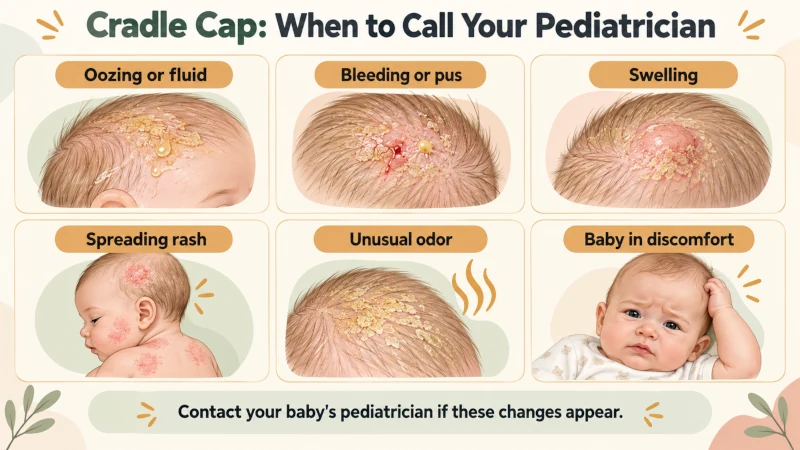
Self-care is enough for most cradle cap. Call your pediatrician if you notice any of these [AAP, 2023] [NHS, 2025]:
- Crusting that becomes weepy, oozes fluid or bleeds, or has pus bumps
- Skin that looks swollen, or a rash with an odor
- A rash spreading beyond the scalp, especially if it’s severe or covers much of the body
- A baby who seems to be in pain or uncomfortable
- No improvement after a few weeks of gentle home care
Bleeding, leaking fluid and swelling can be signs of infection or another condition, such as atopic eczema or scabies [NHS, 2025]. If your baby seems unwell or has a fever, call your pediatrician promptly rather than waiting.
Get help right away if:
- Your child swallows any essential oil or a product containing one — call Poison Control at 1-800-222-1222, even if they seem fine [Poison Control, n.d.].
- Your baby has trouble breathing, facial swelling, a seizure or unusual drowsiness — call 911. An allergic reaction that affects breathing is a medical emergency [Poison Control, n.d.].
| HEALTH DISCLAIMER: This article is for general education and is not a substitute for advice from your baby’s pediatrician or another qualified clinician. Cradle cap is usually harmless, but rashes in infants can have other causes, including eczema and infection. Essential oils can irritate skin, cause allergic reactions and be poisonous if swallowed. Talk with your pediatrician before using any essential oil, herbal product or medicated shampoo on your baby, and keep all essential oils locked away from children. If a child swallows an essential oil, call Poison Control at 1-800-222-1222. For trouble breathing or a seizure, call 911. |
Frequently Asked Questions
Is tea tree oil safe for cradle cap?
It isn’t a good choice for babies. The only scalp trial used a 5% shampoo in people aged 14 and older with dandruff, which says nothing about infant skin [Satchell et al., 2002]. Tea tree oil is also one of the essential oils most often involved in children’s poisonings [VUMC, 2016].
Can I put lavender oil on my baby’s scalp?
There is no evidence that lavender oil helps cradle cap, and it carries risks of skin reaction and harm if swallowed [VUMC, 2016]. A plain, fragrance-free oil softens the scales just as well without the added uncertainty.
What is the best oil for cradle cap?
A plain, fragrance-free one. The AAP lists mineral oil, coconut oil and petroleum jelly [AAP, 2023]; the NHS suggests an emollient or coconut oil and advises against olive oil and peanut oil [NHS, 2025].
How long does cradle cap last?
Usually weeks to months. Most babies are clear by their first birthday, though some toddlers keep a little flaking [AAP, 2023].
Should I use a medicated or dandruff shampoo?
Not without asking your pediatrician first. Medicated shampoos can irritate a baby’s skin [AAP, 2023], and adult shampoos should be avoided [NHS, 2025].
Is diffusing essential oils near my baby a safer option?
Diffusing won’t loosen scalp scales, so it doesn’t treat cradle cap. If you diffuse oils at home for other reasons, the Tisserand Institute suggests running a diffuser intermittently rather than all day, with some fresh air [Tisserand Institute, n.d.], and keeping devices and bottles out of children’s reach [Poison Control, n.d.].
References
- American Academy of Pediatrics. Stein S. What is cradle cap? HealthyChildren.org. View source
- NHS. Cradle cap. nhs.uk. View source
- Victoire A, Magin P, Coughlan J, van Driel ML. Interventions for infantile seborrhoeic dermatitis (including cradle cap). View source
- Satchell AC, Saurajen A, Bell C, Barnetson RS. Treatment of dandruff with 5% tea tree oil shampoo. View source
- Henley DV, Lipson N, Korach KS, Bloch CA. Prepubertal gynecomastia linked to lavender and tea tree oils. View source
- Hawkins J, et al. The relationship between lavender and tea tree essential oils and pediatric endocrine disorders: a systematic review of the literature. View source
- Hawkins J, Hires C, Dunne E, Keenan L. Prevalence of endocrine disorders among children exposed to lavender essential oil and tea tree essential oils. View source
- National Association for Holistic Aromatherapy. Lavender & tea tree oils as potential endocrine disruptors. View source
- National Capital Poison Center (Poison Control). Soloway RAG, Troutman WG. View source
- Vanderbilt University Medical Center. Tennessee Poison Center at Vanderbilt sees rise in children ingesting essential oils. View source
- Tisserand Institute. How to use essential oils safely. View source
- AromaWeb. Aromatherapy for children (reproducing dilution tables from Tisserand R, Young R. View source


