
If you know black mustard at all, it’s probably for its tiny, fiery seeds or for the mustard plaster a grandparent swore by for chest colds. Both come from the same chemistry. Crush a seed, add water, and the black mustard plant releases a sharp compound that warms, stings, and — left on skin too long — burns.
Here’s the short answer on health benefits. Black mustard is a useful spice and a genuine skin irritant, but there’s no good scientific evidence that it treats colds, arthritis, or pain [WebMD, n.d.]. Small trials show mustard footbaths make your feet feel warmer, and that’s about where the human research ends [Vagedes et al., 2018; Vagedes et al., 2021]. Burns from mustard plasters, on the other hand, are well documented [Yabanoglu et al., 2012; Tartar & Sharon, 2017]. If you still want to try a traditional use, the safety details here matter more than the folklore.
What the black mustard plant is
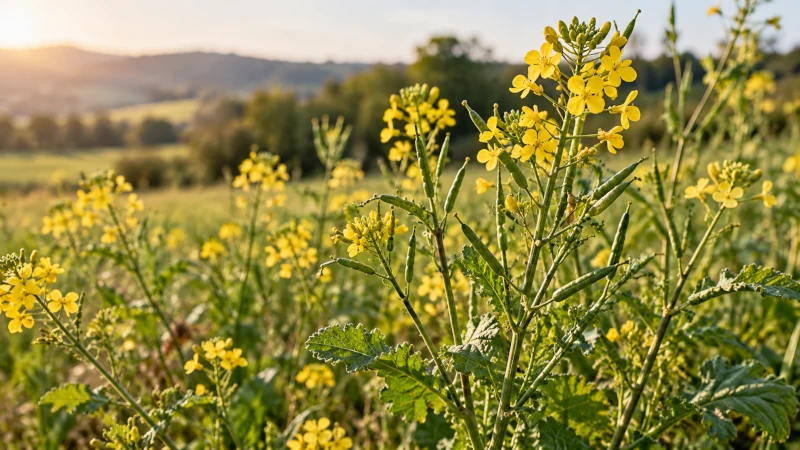
Black mustard (Brassica nigra) is an annual in the cabbage family, Brassicaceae [National Park Service, n.d.]. Older herbals call it Sinapis nigra, which is why that name still shows up on footbath products and in research papers. It’s native to Eurasia and now grows wild across much of the United States, mostly on roadsides, field edges, and other disturbed ground [EDDMapS, n.d.].
It’s taller than many people expect — roughly 2 to 8 feet — with clusters of small, four-petaled yellow flowers in summer and short pods of dark brown to black seeds that taste pungent [EDDMapS, n.d.]. The seeds are the part used as both spice and remedy.
Black, brown, and white mustard aren’t the same plant
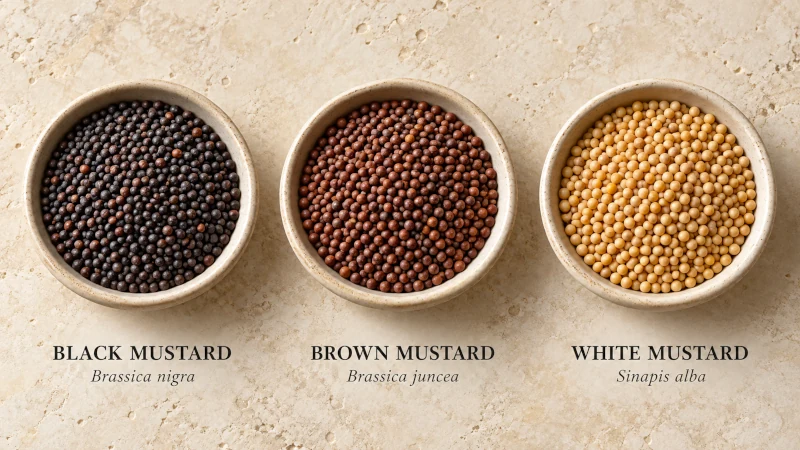
Most mustard seed comes from three different plants: black mustard, brown (Indian) mustard, and white mustard [Yabanoglu et al., 2012]. They get mixed up constantly. The previous version of this page even listed brown mustard, Brassica juncea, as a synonym for black mustard. It’s a separate species, although it shares black mustard’s main pungent compound [Mazumder et al., 2016].
| Common name | Scientific name | What to know |
| Black mustard | Brassica nigra (syn. Sinapis nigra) | Small, dark, very pungent seeds; the species behind traditional plasters and footbaths |
| Brown / Indian mustard | Brassica juncea | Separate species, also rich in sinigrin; seeds and oil widely used in South Asian cooking and Ayurveda |
| White / yellow mustard | Sinapis alba | Paler, milder seeds; commonly used for yellow table mustard |
Why black mustard seeds are so pungent
Whole, dry seeds are surprisingly tame. The heat appears only when a seed is crushed and gets wet. Black mustard seeds are rich in a compound called sinigrin. When the seed’s cells break, an enzyme called myrosinase converts sinigrin into allyl isothiocyanate — mustard oil, the same family of compounds behind the bite of wasabi and horseradish [Mazumder et al., 2016]. (The earlier version of this page called the enzyme “micronase”; the correct name is myrosinase.)
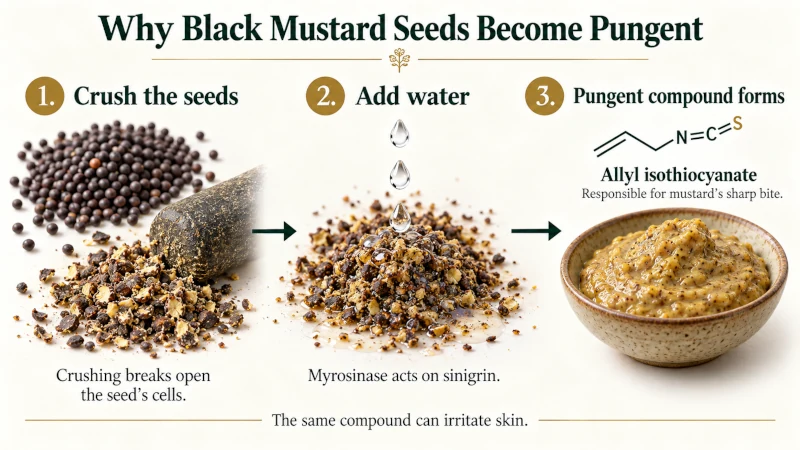
Mustard oil doesn’t heat skin the way a hot pack does. It switches on a pain-sensing channel on nerve endings called TRPA1. Researchers showed that mustard oil on the skin activates these nerves and produces pain, inflammation, and heightened sensitivity to heat and touch [Jordt et al., 2004]. That’s the warm, prickly feeling people describe from a plaster — and it’s why a plaster left on too long causes real injury, not just redness.
Black mustard plant uses: tradition vs. evidence
Mustard seed has a long folk-medicine résumé. It has been used as a stimulant, diuretic, and purgative and for problems from neuralgia to peritonitis, and mustard plasters are still used for rheumatism, arthritis, chest congestion, back pain, and sore muscles [Yabanoglu et al., 2012]. In Ayurveda, mustard seed and oil were used for joint pain, fever, coughs, and colds [Mazumder et al., 2016]. Like meadowsweet, another old remedy for rheumatic aches, black mustard earned its reputation through long use rather than testing.
Tradition tells you what people tried. It doesn’t tell you what worked. Here’s how each claim holds up.
Mustard plasters (sinapisms) for chest congestion and aches
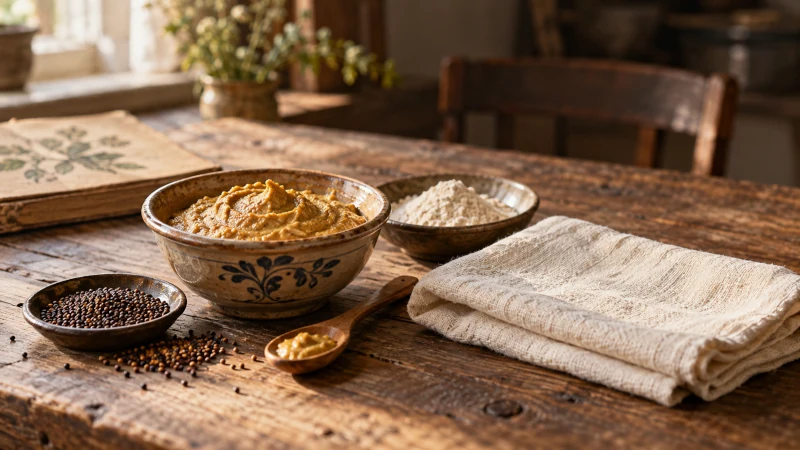
A mustard plaster, or sinapism, is a paste of mustard powder and flour spread on cloth and laid on the skin — usually the chest for congestion or a sore joint for pain. Traditional instructions cap it at 15 minutes [Yabanoglu et al., 2012].
The old explanation was “revulsion”: by drawing blood to the skin, the plaster supposedly relieved congestion in the lungs and deeper tissues. No clinical study supports that. What mustard oil reliably does is irritate sensory nerves [Jordt et al., 2004], which can make an area feel warm and may briefly distract from a deeper ache. WebMD’s natural-medicines monograph says black mustard contains chemicals that might reduce pain and that its oil might help lung congestion, yet it rates the evidence for colds, osteoarthritis, and pain as lacking [WebMD, n.d.].
The harms are better documented than the benefits. A 71-year-old woman had powdered mustard seed applied to her knee under a dressing to ease osteoarthritis pain; after about 24 hours she had a second-degree burn around the joint that took a month to heal [Yabanoglu et al., 2012]. In another case, a woman using a mustard plaster for chest congestion developed second-degree burns on her lower neck and chest [Tartar & Sharon, 2017]. Prolonged application can also damage nerves [Yabanoglu et al., 2012].
If a chest cold is what’s sending you to the spice cabinet, start with the herbs for colds and flu that have actually been studied instead. And a cough that’s getting worse needs a doctor, not a poultice.
Mustard footbaths for cold feet, colds, and headaches
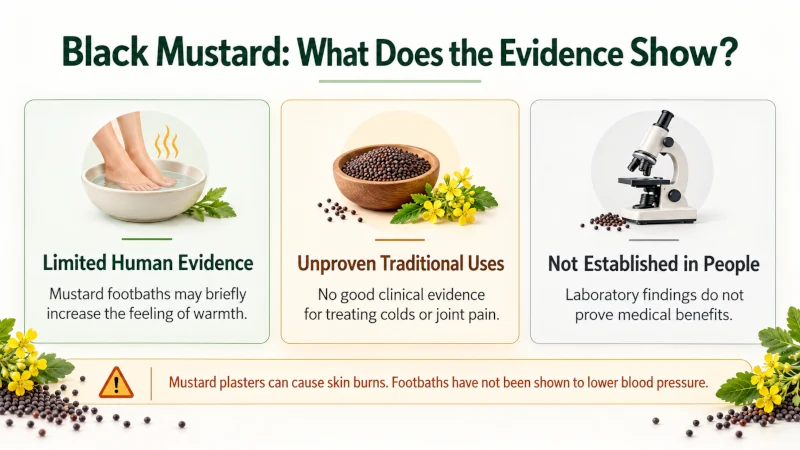
Footbaths are the gentler cousin of the plaster, and they’re the only black mustard use with controlled trials behind it. Small ones.
In a randomized crossover trial, 17 healthy young adults each took three footbaths: warm water alone, warm water with mustard, and warm water with ginger. Mustard and ginger both made the feet feel warmer than plain water right afterward, but only ginger’s effect lasted to the 10-minute follow-up. Measured skin temperature at the feet rose after all three, plain water included [Vagedes et al., 2018]. A pilot trial in 36 people, 23 of them cancer patients, found a similar pattern: mustard and ginger raised the feeling of warmth in the feet more than warm water did [Vagedes et al., 2021].
That is the whole evidence base. No published study we found shows that a mustard footbath relieves headaches, clears sinus congestion, or shortens a cold. The traditional idea — pulling blood down to the feet to “decongest” the head — has never been tested. If a warm footbath makes you feel better when you’re sick, the comfort is the benefit. For a cold itself, rest, fluids, and the basics in our guide to foods that help during a cold or flu have more going for them.
Blood pressure: an old claim with no support
The earlier version of this page said mustard footbaths lower high blood pressure by widening small arteries in the feet. We couldn’t find a single human study that measured blood pressure after a mustard footbath. The trials above measured warmth — and in the healthy-volunteer study, hand temperature actually dropped after the footbaths [Vagedes et al., 2018].
High blood pressure usually causes no symptoms, and it needs measuring and managing, not soaking. Our guides to foods that lower blood pressure and the herbs with real evidence for blood pressure cover what does move the numbers. Don’t swap a footbath for any of it, and never stop prescribed medication.
Lab research on sinigrin
You’ll see claims online that black mustard fights cancer, infection, or inflammation. These trace back to studies of sinigrin and mustard oil in cell cultures and animals. A 2016 review listed reported anticancer, antibacterial, antifungal, antioxidant, anti-inflammatory, and wound-healing activity, then cautioned that the information is very limited and more research is needed [Mazumder et al., 2016]. In many of those experiments, sinigrin did little on its own until myrosinase converted it [Mazumder et al., 2016]. None of this shows that eating mustard seed or taking a supplement prevents or treats disease in people.
The evidence at a glance
| Use | What supports it | Verdict |
| Plaster for chest congestion | Tradition; no clinical trials | Not supported; documented burn risk |
| Plaster or paste for joint or muscle pain | Tradition; plausible counterirritant effect | Not supported; documented burn risk |
| Footbath to warm cold feet | Two small randomized crossover trials | Limited: feet feel warmer for a short time |
| Footbath for headache, colds, sinusitis | Tradition only | Insufficient evidence |
| Footbath for high blood pressure | No studies found | Unsupported — don’t rely on it |
| Anticancer or antimicrobial effects | Cell and animal studies | Early-stage; not shown in people |
| Seasoning food | Long culinary use | Fine in food amounts unless you’re allergic |
Black mustard in the kitchen
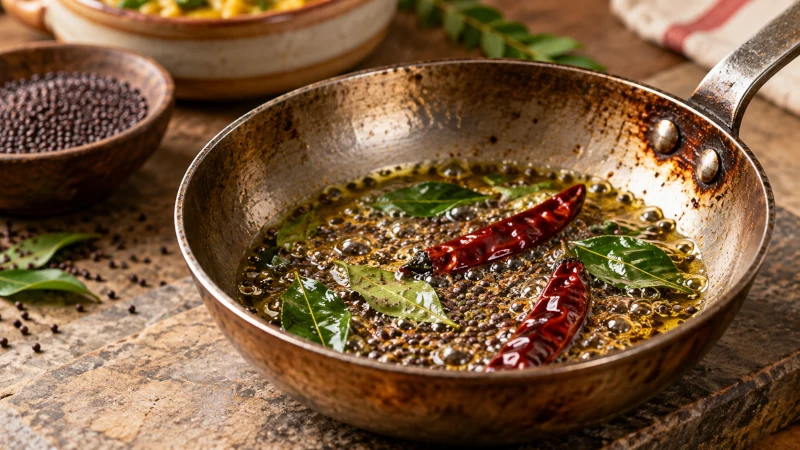
As a spice, black mustard is ordinary and uncomplicated. Its seeds are used to flavor condiments and food [WebMD, n.d.], and in cooking they’re often toasted whole in hot oil until they pop. In food amounts, the safety questions come from the medicinal and topical uses, not the seasoning — with one big exception: mustard allergy.
Black mustard side effects and who should avoid it
Skin burns and blistering
This is the main risk. Black mustard can cause blisters and skin damage, especially with long contact [WebMD, n.d.], and the case reports above show second-degree burns can happen [Yabanoglu et al., 2012; Tartar & Sharon, 2017]. Skin lesions may appear hours after the paste comes off [Yabanoglu et al., 2012], so “it felt fine at the time” doesn’t rule out damage.
Allergy
Mustard is a recognized food allergen. Health Canada lists it as a priority allergen that must be clearly labeled, and the only way to manage a mustard allergy is to avoid it completely [Health Canada, n.d.]. If you’re allergic to mustard, that includes plasters and footbaths, not just food.
Large amounts by mouth
Food amounts are fine for most people, but there isn’t reliable evidence that black mustard is safe as a medicine. Large amounts might cause throat damage, diarrhea, and breathing difficulties [WebMD, n.d.].
Pregnancy and breastfeeding
Medicinal amounts by mouth are likely unsafe during pregnancy, because black mustard contains chemicals that might cause a miscarriage. There isn’t enough information about breastfeeding; stick to food amounts in both cases [WebMD, n.d.].
Medication interactions and surgery
Black mustard might lower blood sugar, so taking it medicinally alongside diabetes medication could push blood sugar too low — monitor closely and talk to your prescriber. For the same reason, stop medicinal use at least two weeks before scheduled surgery [WebMD, n.d.]. The blood-sugar studies listed in that monograph were done in rats, so treat this as a sensible precaution rather than a proven human interaction.
Who should skip medicinal black mustard
- Anyone with a mustard allergy
- People who are pregnant (medicinal amounts by mouth)
- Children — there’s no safety information to guide plasters, pastes, or medicinal doses
- People with reduced feeling in their skin or feet, such as from diabetic neuropathy, who may not notice a burn developing
- Anyone with broken, irritated, or sunburned skin where it would be applied
- People taking diabetes medication, unless their prescriber agrees
- Anyone with surgery scheduled in the next two weeks
If you try a mustard footbath, keep it gentle
For healthy adults who want to try one, the research gives a sensible frame. In a dose-finding study, volunteers soaked their feet for 20 minutes in warm water at about 104°F (40°C) with 3 to 12 grams of mustard flour per liter [ClinicalTrials.gov, NCT04321720]. Start at the low end and don’t go longer.
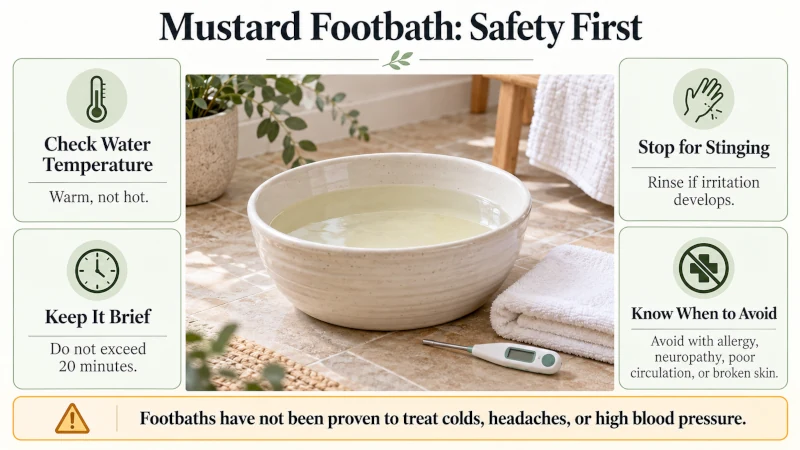
- Check the water with a thermometer or your hand first — warm, not hot.
- Stop right away if stinging or burning becomes more than mild warmth.
- Rinse and dry your feet afterward.
- Skip it if you have neuropathy, poor circulation, open cuts, or a mustard allergy.
We don’t give instructions for mustard plasters. The gap between “warm” and “burned” is narrow, and the published injuries happened to people following folk methods.
When to see a doctor
Get medical care if you notice any of the following:
- Blistering, open skin, or spreading redness after a plaster, paste, or footbath
- Hives, swelling, or vomiting after eating mustard — and call 911 for trouble breathing or swelling of the lips, tongue, or throat
- A chest cold with fever, shortness of breath, chest pain, or a cough that improves and then gets worse
- A sudden, severe headache, or a headache with fever and stiff neck, confusion, weakness, or vision changes — see these warning signs of serious headaches
- A very high blood pressure reading together with chest pain, shortness of breath, weakness, or vision changes — call 911
| HEALTH DISCLAIMER: This article is for general education and isn’t medical advice. Black mustard can burn the skin, trigger allergic reactions, and interact with diabetes medication, and it isn’t right for everyone — including people who are pregnant, have a mustard allergy, have reduced feeling in their skin, or are caring for a child. Talk with your doctor or pharmacist before using black mustard medicinally, especially if you take medication or have a health condition. If you think you’re having a medical emergency, call 911. |
Frequently Asked Questions
Is black mustard the same as the yellow mustard in a squeeze bottle?
No. Yellow table mustard is usually made from white mustard (Sinapis alba). Black mustard is a different plant with smaller, darker, more pungent seeds [Yabanoglu et al., 2012].
Can a mustard footbath lower blood pressure?
There’s no evidence it does. The footbath trials measured how warm people’s feet felt, not blood pressure [Vagedes et al., 2018; Vagedes et al., 2021]. Manage high blood pressure with your clinician, and don’t replace medication with a footbath.
Are mustard plasters safe?
They carry a real risk of burns. Traditional guidance limits them to 15 minutes, and published cases describe second-degree burns from mustard pastes and plasters [Yabanoglu et al., 2012; Tartar & Sharon, 2017]. For a chest cold or sore joint, safer options exist.
Is it safe to eat black mustard seeds?
In normal food amounts, yes, for most people. Avoid them completely if you have a mustard allergy [Health Canada, n.d.], and don’t take large medicinal amounts, which may cause throat irritation, diarrhea, or breathing problems [WebMD, n.d.].
Does black mustard help arthritis pain?
It has a long history as a counterirritant for aches, but there’s no good evidence it helps osteoarthritis [WebMD, n.d.]. One published burn case happened to a woman using mustard seed for knee arthritis [Yabanoglu et al., 2012].
Can I use black mustard while pregnant?
Seasoning food with it is fine. Medicinal amounts by mouth are considered likely unsafe in pregnancy [WebMD, n.d.], so skip mustard remedies and check with your prenatal care provider.
References
- Yabanoglu H, Akbulut S, Karakayali F. Phytocontact dermatitis due to mustard seed mimicking burn injury: report of a case. View source
- Tartar DM, Sharon VR. Second degree burn to mustard powder. View source
- Vagedes J, Helmert E, Kuderer S, Müller V, Voege P, Szőke H, Valentini J, Joos S. Effects of footbaths with mustard, ginger, or warm water only on objective and subjective warmth distribution in healthy subjects: a randomized controlled trial. View source
- Vagedes J, Kuderer S, Vagedes K, Hiller S, Beissner F, Szőke H, Joos S, Wolf U. Increasing warmth in oncological patients: a randomized controlled cross-over pilot trial examining the efficacy of mustard and ginger footbaths. View source
- ClinicalTrials.gov. Dose-response relationship of mustard flour footbaths in healthy volunteers. View source
- WebMD. Black Mustard — Uses, Side Effects, and More. Licensed from Therapeutic Research Center (Natural Medicines). View source
- Mazumder A, Dwivedi A, Du Plessis J. Sinigrin and its therapeutic benefits. Molecules. View source
- Jordt SE, Bautista DM, Chuang HH, McKemy DD, Zygmunt PM, Högestätt ED, Meng ID, Julius D. Mustard oils and cannabinoids excite sensory nerve fibres through the TRP channel ANKTM1. View source
- Health Canada. Mustard — a priority food allergen. Government of Canada. View source
- EDDMapS, University of Georgia Center for Invasive Species and Ecosystem Health. Black mustard (Brassica nigra). View source
- U.S. National Park Service, NPSpecies. Brassica nigra (L.) W.D.J. Koch — species profile. View source


