
If you have a bag of dried yellow flowers in front of you and you want to know what they actually do, here is the short version. European goldenrod is used to increase urine output and to ease minor urinary discomfort, and European regulators accept that use — but they accept it on the strength of centuries of consistent traditional use, not on clinical trials. [EMA European Union herbal monograph, 2008] Nearly every other claim you will read about goldenrod plant benefits traces back to a test tube, a rat, or folklore. Keeping those categories separate is the whole job of this page.
That is not a reason to dismiss the plant. Traditional-use approval in the EU is a real regulatory standard with defined doses, contraindications and warnings attached. It is simply a different, weaker kind of evidence than a randomised trial, and you deserve to know which one you are relying on.
What goldenrod actually is
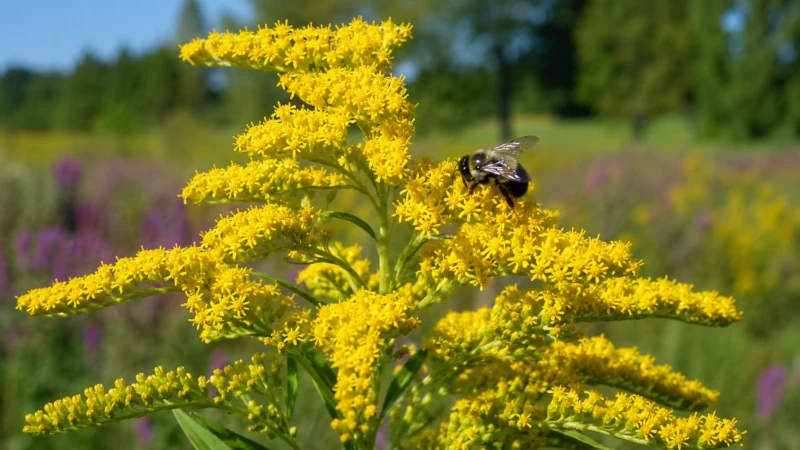
The medicinal species is Solidago virgaurea L., European goldenrod — a perennial in the daisy family (Asteraceae) with an erect stem reaching about a metre and bright yellow flower heads in late summer. The part used is the dried flowering aerial parts. [Fursenco et al., Biomolecules, 2020]
Species matters more than most labels admit. Canadian and giant goldenrod (S. canadensis and S. gigantea) are covered by a separate European Pharmacopoeia monograph, so a product sold simply as “goldenrod” may not be the plant the European research was done on. Check the botanical name on the label. [EMA HMPC assessment addendum, 2021]
Chemically, the aerial parts carry flavonoids derived from quercetin and kaempferol (rutin and hyperoside among them), oleanane-type triterpene saponins, the phenolic glycoside leiocarposide, caffeoylquinic acids and a monoterpene-rich essential oil. The European Pharmacopoeia treats flavonoids as the quality marker and requires between 0.5% and 1.5%, expressed as hyperoside. [Fursenco et al., Biomolecules, 2020] The older idea that coumarins drive the diuretic effect has not held up; only a single coumarin, umbelliferone, has been reported in the species at all.
Goldenrod plant benefits, graded by the evidence behind them
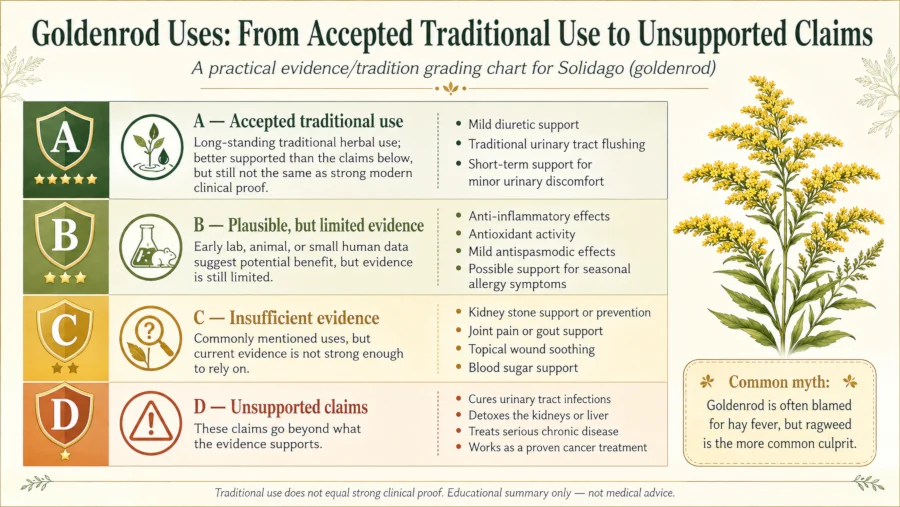
Increasing urine flow and easing minor urinary complaints — accepted traditional use
This is the one use with regulatory standing. The EU herbal monograph describes goldenrod as a traditional herbal medicinal product used to increase the amount of urine, as an adjuvant in the treatment of minor urinary complaints, in an indication based exclusively on long-standing use. [EMA European Union herbal monograph, 2008] The word “adjuvant” is doing real work there: alongside proper treatment, not instead of it.
The animal data are genuinely mixed rather than quietly supportive. One rat study reported that the flavonoid fraction raised urine output substantially; a later group found no increase in urine volume or electrolytes for the same fraction, while reporting furosemide-comparable effects for the hydroxycinnamic acid and saponin fractions instead. [Fursenco et al., Biomolecules, 2020] Different fractions, different labs, opposite conclusions. Goldenrod appears in most traditional listings of herbs used to support the urinary system, and that is a fair description of where it sits.
Bladder irritation and overactive bladder — promising, but the studies are weak
Two clinical reports exist, and both are open-label and uncontrolled. In the larger one, 512 patients with chronic recurrent overactive bladder took 424.8 mg of extract three times daily and 96% reported improvement; in a smaller study of 74 women with painful urination, 69% improved. [Fursenco et al., Biomolecules, 2020] No control group and no blinding means those numbers cannot separate the herb from natural resolution, regression to the mean, and expectation — which in bladder symptoms is a very large effect.
Laboratory work is more interesting than the trials: goldenrod extracts inhibit M2 and M3 muscarinic receptors and reduce bladder contraction in isolated tissue, which is the same broad mechanism as some prescription overactive-bladder drugs. There is also an unresolved tension here — a diuretic that increases urine production should not reduce urinary frequency. The reviewers who compiled this evidence concluded that as of their search, no randomised, controlled, double-blind study of the plant had been published. [Fursenco et al., Biomolecules, 2020] If you want the wider picture of which urinary conditions herbs are traditionally used for and which need a doctor, that comparison is worth reading alongside this.
Kidney stones — tradition plus a single animal study
Goldenrod’s stone reputation is old. Its urological use goes back at least to the physician Arnold von Villanova (1240–1311), and German folk medicine used it for urinary retention and stones. [Fursenco et al., Biomolecules, 2020] The modern evidence is one experiment: leiocarposide given orally to rats for six weeks significantly inhibited the growth of human-derived urinary calculi implanted into the bladder. [Fursenco et al., Biomolecules, 2020]
One rat study is a reason to fund more research, not a reason to treat a stone. Passing stones and preventing recurrence are managed on stone type and urine chemistry, and diet is the lever with real evidence behind it — see which foods actually raise kidney stone risk. Corn silk is another plant with a similar traditional urinary reputation and a similar evidence gap; the profile of Indian corn and its silk covers that one.
Anti-inflammatory, antioxidant and antibacterial activity — laboratory and animal only
These effects show up repeatedly in vitro, and repeatedly at modest strength. Extracts reduced paw swelling in rat models but less effectively than the reference anti-inflammatory drugs they were compared against. In a screen of 23 herbal products, goldenrod placed eleventh for antioxidant activity. Most antibacterial testing produced concentrations high enough that, judged against standard thresholds, the effect should be considered inactive. [Fursenco et al., Biomolecules, 2020] None of this has been tested in people.
Claims this plant does not support
A few widely repeated claims deserve to be named as unsupported, because they are the ones most likely to lead someone away from care that works:
- Weight loss. Anti-adipogenic effects have been seen in cell cultures and one mouse study. That is not a weight-loss treatment, and no human trial exists. [Fursenco et al., Biomolecules, 2020]
- “Cleansing the blood” of toxins. There is no measurable definition of this claim and no evidence for it. Increasing urine volume is not detoxification.
- Childhood diarrhoea. The monograph specifically states that use in children under 12 is not recommended, because there is not enough experience to judge it. Diarrhoea in a young child is a dehydration risk that needs a clinician, not a herbal syrup. [EMA European Union herbal monograph, 2008]
- Wound healing. Topical use on wounds and mouth ulcers is a real tradition across Europe, [Fursenco et al., Biomolecules, 2020] but no clinical evidence supports it, and open wounds are an infection risk.
How goldenrod is taken
The monograph sets out defined single doses for adults and adolescents. These are the reference amounts, and they are the figures a regulated product in Europe would be labelled with. [EMA European Union herbal monograph, 2008]
| Preparation | Single dose | Frequency |
| Comminuted herb, as an infusion | 2–4 oz | 2–4 times daily |
| Liquid extract (1:1, 25% ethanol) | 0.5–2 ml | 3 times daily |
| Tincture (1:2 – 1:5, 45% ethanol) | 0.5–2 ml | 3 times daily |
| Dry extract (4:1 – 10:1) | 300–600 mg | 3 times daily |
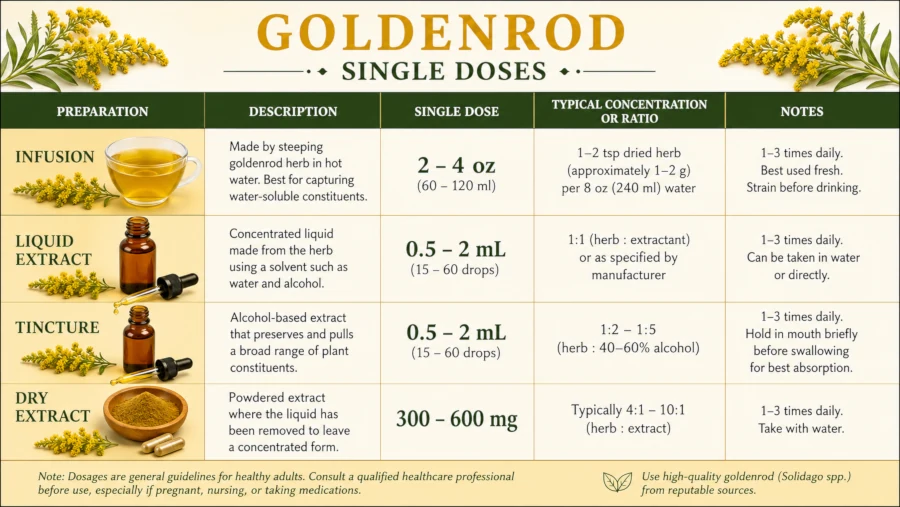
Traditional use runs for two to four weeks. If symptoms persist while you are taking it, that is the point to see a doctor or pharmacist rather than extend the course. Drink enough fluid alongside it — the entire rationale of the herb is flushing the urinary tract, which does not work while you are dehydrated. [EMA European Union herbal monograph, 2008]
Does goldenrod cause hay fever?
No — and this is one of the tidiest myths in herbal medicine to dismantle. Goldenrod is insect-pollinated, and its pollen grains are too heavy and sticky to travel on the wind. The late-summer culprit is ragweed, which blooms at the same time, is wind-pollinated, and releases millions of tiny airborne grains from flowers too dull to notice. [University of Illinois Extension, 2022] Goldenrod gets the blame because it is the plant you can see.
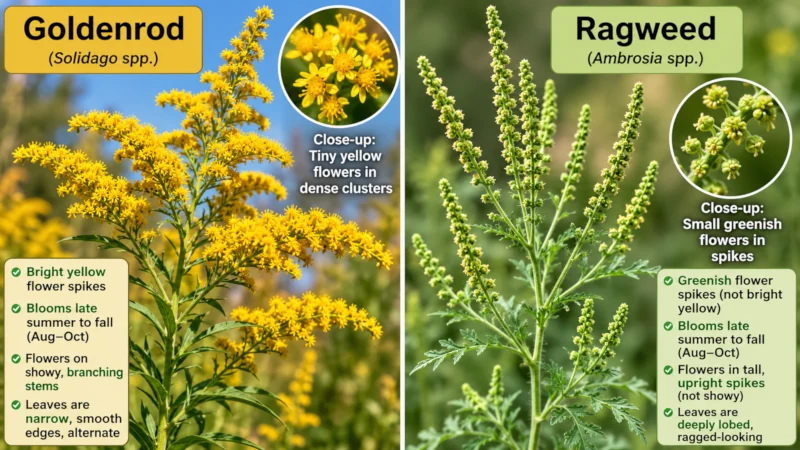
Handling the plant directly is a different matter. Skin contact can cause reactions in sensitised people, which is a safety issue rather than a pollen-allergy one.
Safety, side effects, and who should avoid goldenrod
The monograph lists hypersensitivity reactions and gastrointestinal upset as the known undesirable effects, with the frequency not known. [EMA European Union herbal monograph, 2008] When European regulators reviewed the pharmacovigilance data in 2021, the EudraVigilance database held 28 reports of suspected adverse reactions, including two of rash and two of diarrhoea, and the committee concluded there were no new safety concerns. [EMA HMPC assessment addendum, 2021] That is a reassuring signal, though under-reporting for herbal products is substantial and the absence of reports is not the same as the presence of safety data.

Allergy is the main risk
Goldenrod is contraindicated in anyone hypersensitive to plants in the Asteraceae (Compositae) family — the group that includes ragweed, chamomile, echinacea, daisies and marigolds. [EMA European Union herbal monograph, 2008] Contact dermatitis from topical use is documented. There is also evidence of cross-sensitisation between goldenrod and natural rubber latex, identified immunologically in three occupational cases; the authors of that work concluded the clinical significance for people with latex allergy still needs defining, so treat it as an open question rather than a settled warning. [EMA HMPC assessment addendum, 2021]
Who should not take it
- Anyone with an Asteraceae allergy, and anyone who has reacted to goldenrod before.
- Anyone advised to restrict fluid intake — the monograph names severe cardiac or renal disease specifically. A diuretic herb is the wrong direction for those conditions. [EMA European Union herbal monograph, 2008]
- Children under 12, where use is not recommended due to a lack of experience.
- During pregnancy and breastfeeding, where use is not recommended because the safety data do not exist.
- Anyone taking prescription diuretics — concomitant treatment with synthetic diuretics is specifically not recommended. [EMA European Union herbal monograph, 2008]
Medication interactions
The monograph records no reported interactions. [EMA European Union herbal monograph, 2008] Read that carefully: it means none have been documented, not that none exist. Anything that alters fluid and electrolyte balance warrants a conversation with your prescriber if you take lithium, blood pressure medication, or diuretics. Tinctures and liquid extracts also contain ethanol, which matters for anyone avoiding alcohol.
Red flags: when to stop and get medical care
Urinary symptoms are one of the areas where self-treatment causes the most avoidable harm, because a bladder infection that spreads upward becomes serious quickly. Stop and seek care the same day if you have:
- Fever or chills alongside urinary symptoms
- Pain in your back, side or groin
- Nausea or vomiting
- Cloudy, dark, bloody or foul-smelling urine
- Frequent, painful urination that is getting worse rather than better
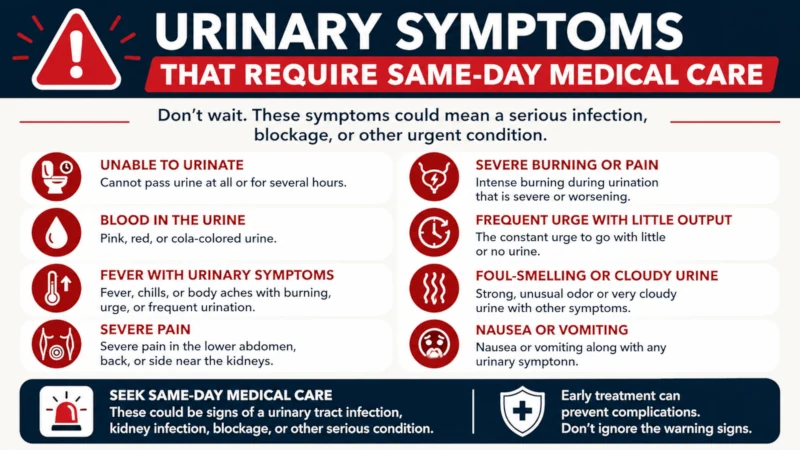
Those are the symptoms of a kidney infection, and most kidney infections begin as untreated bladder infections. [NIDDK guidance on kidney infection, 2024] Confusion, rapid breathing or heart rate, shortness of breath or severe pain alongside a fever can signal sepsis and are an emergency — go to hospital, do not wait. [NIDDK guidance on kidney infection, 2024]
The monograph also flags fever, painful urination, spasms or blood in the urine appearing while you are taking goldenrod as a reason to consult a healthcare professional. [EMA European Union herbal monograph, 2008] Separately, anyone who is pregnant, has recurrent infections, has a urinary catheter, kidney disease, diabetes or a suppressed immune system should treat urinary symptoms as a medical matter from the start rather than a self-care one.
| HEALTH DISCLAIMER: This article is general education, not medical advice, and it is not a substitute for diagnosis or treatment by a qualified clinician. Herbal preparations can interact with prescription medicines and are not appropriate for every person or every condition. Talk to your doctor or pharmacist before taking goldenrod if you are pregnant or breastfeeding, take any regular medication, or have heart, kidney, liver or bladder disease. Urinary symptoms that come with fever, back or side pain, or blood in the urine need medical assessment rather than a herbal tea. |
Frequently Asked Questions
Is goldenrod safe to take every day?
Traditional use is described as a course of two to four weeks rather than an indefinite daily habit, and if symptoms persist during that time the advice is to consult a clinician. [EMA European Union herbal monograph, 2008] There is no long-term safety data to support open-ended use.
Can goldenrod treat a urinary tract infection?
No. Its accepted use is as an adjuvant for minor urinary complaints — support alongside proper treatment. A confirmed bacterial infection usually needs antibiotics, and delaying that risks the infection reaching the kidneys. [EMA European Union herbal monograph, 2008] [NIDDK guidance on kidney infection, 2024]
Will goldenrod dissolve or pass a kidney stone?
There is no human evidence that it does. The relevant finding is a single rat study in which a goldenrod constituent slowed the growth of implanted calculi. [Fursenco et al., Biomolecules, 2020] Stone management should be guided by your stone type and a urologist.
Is goldenrod tea the same as a goldenrod supplement?
Not in strength or in what is extracted. An infusion of the dried herb, an ethanolic tincture and a concentrated dry extract have different dose ranges precisely because they deliver different amounts of active constituents. Match the dose to the preparation you actually have, and check that the label names Solidago virgaurea. [EMA European Union herbal monograph, 2008]
Should I avoid goldenrod if I get seasonal allergies?
Seasonal hay fever on its own is not a reason to avoid it, because goldenrod pollen is not what is in the air. [University of Illinois Extension, 2022] A diagnosed allergy to plants in the daisy family is a different matter, and that is a genuine contraindication. [EMA European Union herbal monograph, 2008]
References
- European Medicines Agency, Committee on Herbal Medicinal Products. Community herbal monograph on Solidago virgaurea L., herba (EMEA/HMPC/285758/2007). 2008. → View source
- European Medicines Agency, Committee on Herbal Medicinal Products. Addendum to Assessment report on Solidago virgaurea L., herba (EMA/HMPC/637909/2018). 2021. → View source
- European Medicines Agency. Solidaginis virgaureae herba — herbal medicinal product overview. → View source
- Fursenco C, Calalb T, Uncu L, Dinu M, Ancuceanu R. Solidago virgaurea L.: A Review of Its Ethnomedicinal Uses, Phytochemistry, and Pharmacological Activities. Biomolecules. 2020;10(12):1619. DOI: 10.3390/biom10121619. PMID 33266185. → View source
- National Institute of Diabetes and Digestive and Kidney Diseases (NIDDK). Symptoms & Causes of Kidney Infection (Pyelonephritis). Reviewed October 2024. → View source
- Swihart E. University of Illinois Extension, Good Growing. Autumn allergies: don’t blame goldenrod. October 2022. → View source
