
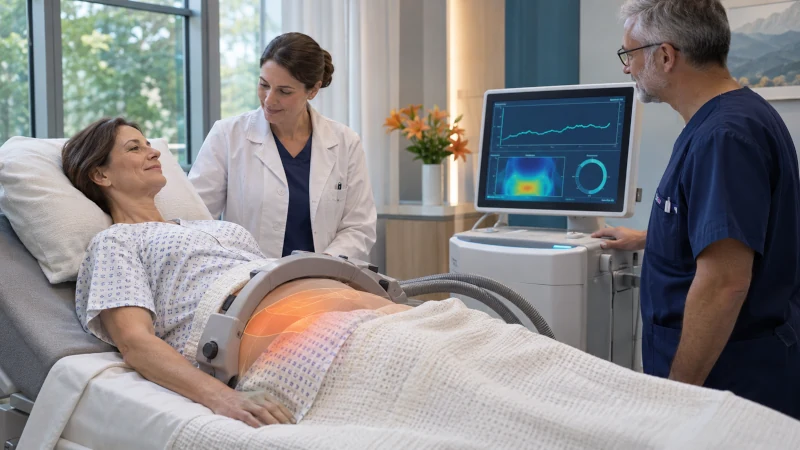
Heat can make some cancers easier to kill. Hyperthermia cancer treatment uses carefully controlled heat to damage tumors directly or, far more often, to make radiation and chemotherapy work better. It has solid trial results in a handful of specific cancers. It is not a stand-alone cure, it isn’t widely available, and it has very little in common with the saunas and “heat sessions” sometimes sold under the same name.
If you’ve been offered heat therapy, or found it online, four questions get you most of the way: which cancer, what kind of heat, combined with what, and delivered by whom.
What hyperthermia cancer treatment actually is
In cancer care, hyperthermia means heating body tissue to damage and kill cancer cells. It also goes by thermal therapy, thermotherapy, and thermal ablation. The National Cancer Institute describes tissue temperatures as high as 113°F (45°C) and notes that most healthy tissue isn’t damaged if it stays under 111°F [NCI, 2025].
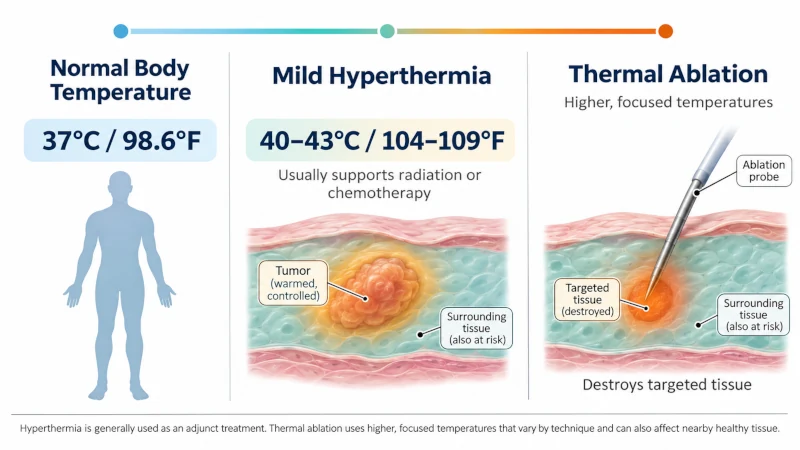
Those names cover two different jobs. Mild hyperthermia — typically 40–43°C (104–109°F) for about an hour — usually isn’t meant to destroy a tumor by itself; it makes the tumor more vulnerable to radiation or chemotherapy given alongside it [Crezee, 2021]. Thermal ablation uses hotter, tightly focused heat to destroy a small tumor outright. Radiofrequency ablation (RFA), which the American Cancer Society calls probably the most common type of hyperthermia, belongs here [ACS, 2025].
The major cancer organizations are cautious about the mild form. The NCI says hyperthermia is almost always used with other treatments, isn’t widely available, and that it isn’t clear whether it helps people live longer [NCI, 2025]. The American Cancer Society describes it as largely experimental at this time [ACS, 2025]. Those are general statements. For a few cancers, the trial results are considerably stronger, as you’ll see below.
How heat helps radiation and chemotherapy
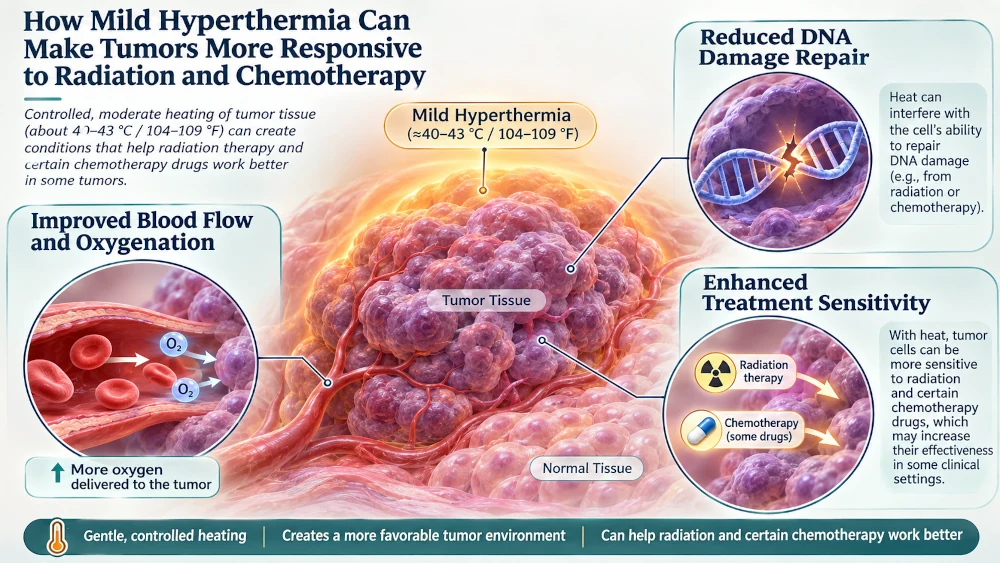
Heat does several things at once, and researchers still debate which matters most. Mild heat improves blood flow and oxygen in parts of a tumor, and oxygen-rich cells are easier for radiation to kill. It also blocks the repair of sub-lethal damage, so cells hit by radiation are less able to bounce back [Zagar, 2010]. Heat also changes the tumor’s surroundings, strengthens the effect of certain chemotherapy drugs, and triggers heat shock proteins, which may help the immune system recognize tumor cells; much of that immune evidence still comes from laboratory work [Hildebrandt, 2002].
The hard part is engineering. The whole tumor has to get hot enough while the healthy tissue next to it doesn’t get too hot. That’s why treatment teams place small probes with thermometers in or near the tumor, sometimes guided by CT scans, and why uneven “hot spots” are the main cause of burns [NCI, 2025].
The main types of hyperthermia
Hyperthermia is grouped by how much of the body is heated [NCI, 2025]:
| Type | What it treats | How heat is delivered |
| Local — external | Tumors on or just below the skin | Applicators placed on the skin surface |
| Local — intraluminal (endocavitary) | Tumors in or near body cavities, such as the esophagus or rectum | A probe placed inside the cavity |
| Local — interstitial (includes RFA) | Deeper tumors | Probes inserted into the tumor under anesthesia; reaches higher temperatures |
| Regional — deep tissue | Cancers such as cervical or bladder cancer | External devices focus energy on the area |
| Regional — perfusion | Cancers of an arm or leg (such as melanoma), some liver or lung cancers | Blood is removed, heated, and returned to the limb or organ, often with chemotherapy |
| Regional — peritoneal perfusion / HIPEC | Cancer in the lining of the abdomen | Heated drugs circulated through the abdomen during surgery (106–108°F) |
| Whole-body | Cancer that has spread throughout the body | Heated chamber, hot water bath, or heated blankets; 107–108°F for short periods |
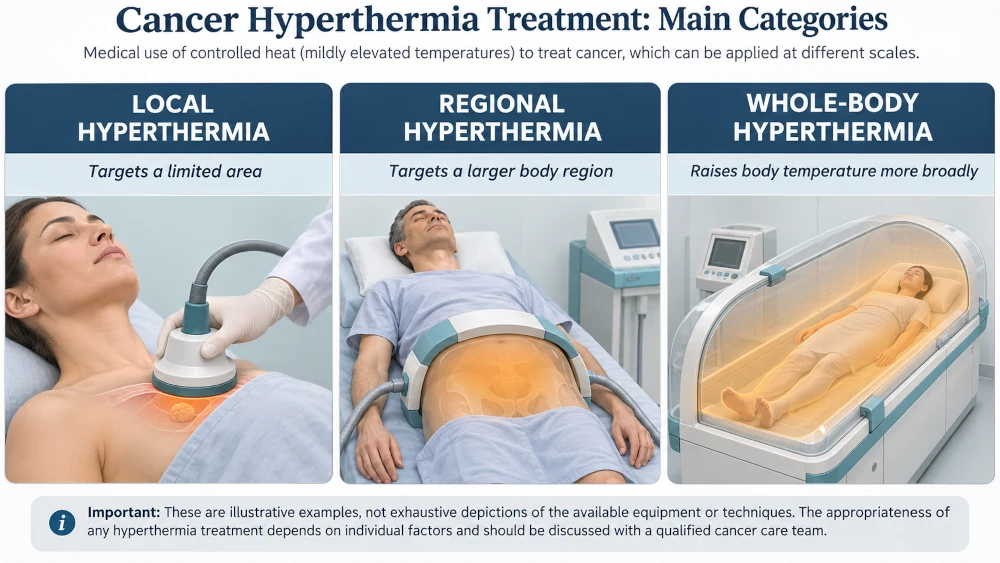
Several of these are far from non-invasive. Interstitial treatment means probes placed under anesthesia, and heated abdominal chemotherapy happens during major surgery [NCI, 2025]. Whole-body hyperthermia is the least proven of the group; research is still underway to see whether it helps chemotherapy work better for cancer that has spread [ACS, 2025].
Where the evidence is strongest
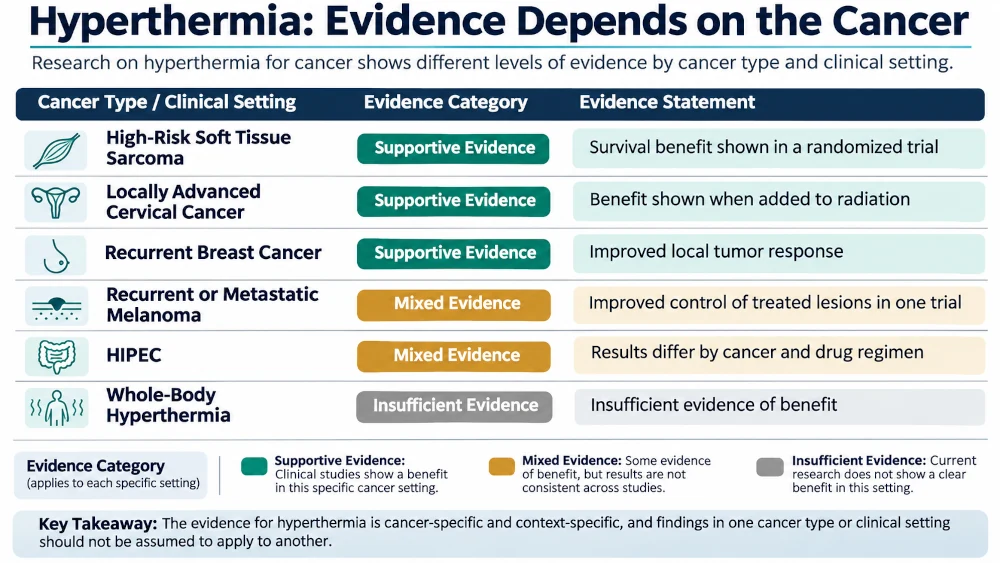
Hyperthermia’s track record rests on a modest number of randomized trials, mostly run at European specialist centers. A 2020 review of heating technology lists where it is in routine clinical use: locally advanced cervical cancer in patients who can’t have chemotherapy, recurrent breast cancer, non-muscle-invasive bladder cancer, and soft tissue sarcoma [Kok, 2020].
Cervical cancer
The best-known trial, run by the Dutch Deep Hyperthermia Group, randomly assigned 358 people with locally advanced bladder, cervical, or rectal cancer to radiation alone or radiation plus hyperthermia. Complete responses rose from 39% to 55% overall. Cervical cancer showed the clearest gain: an 83% complete response rate with heat versus 57% without, and three-year survival of 51% versus 27%. In bladder cancer, an early advantage disappeared during follow-up [van der Zee, 2000].
A Cochrane review of six randomized trials concluded that adding heat to radiation may give a clinically meaningful improvement for locally advanced cervical cancer, particularly stage IIIB, without a clear increase in severe side effects. It also said more data are needed before recommending it for every patient [Lutgens, 2010].
One detail matters for patients today. Those trials mostly compared heat-plus-radiation with radiation alone, while most patients now get radiation combined with chemotherapy. That’s why the U.S. Food and Drug Administration’s 2011 humanitarian device exemption for the BSD-2000 hyperthermia system is narrow: it covers use with radiation for cervical cancer patients who would normally get chemoradiation but can’t have chemotherapy. That pathway rests on safety and “probable benefit,” which is a lower bar than full approval [FDA, 2011].
High-risk soft tissue sarcoma
In the EORTC 62961-ESHO 95 trial, 329 eligible adults with large, high-grade sarcomas got chemotherapy before surgery, with or without regional hyperthermia, at nine centers. After a median follow-up of 11.3 years, the heated group had better local control and longer survival: 62.7% were alive at five years versus 51.3%, and 52.6% versus 42.7% at ten years. The authors concluded that adding regional hyperthermia may be warranted for patients who are candidates for pre-surgery chemotherapy [Issels, 2018].
That’s strong evidence for one setting. It doesn’t mean heat helps every sarcoma, or helps without the chemotherapy and surgery it was paired with.
Breast cancer that comes back on the chest wall
Five randomized trials, pooled into one analysis of 306 people with advanced primary or recurrent breast cancer, found that heat plus radiation produced more complete responses than radiation alone, although not every individual trial showed an advantage [Vernon, 1996]. In the pooled data, complete response was 59% with heat versus 41% without [Zagar, 2010].
That is local control of a visible recurrence, which matters a great deal for comfort and quality of life. None of these trials tested heat on its own, and none involved early-stage breast cancer.
Melanoma
In a European trial of 134 recurrent or metastatic melanoma lesions in 70 patients, two-year local control was 46% with radiation plus heat versus 28% with radiation alone, and heat did not significantly increase radiation skin reactions [Overgaard, 1995]. Once more, the benefit was controlling individual tumors.
Heated chemotherapy in the abdomen (HIPEC): mixed results
HIPEC — heated chemotherapy washed through the abdomen at the end of surgery — shows why each cancer has to be judged on its own trials. In stage III ovarian cancer, a Dutch trial of 245 women found that adding cisplatin HIPEC to surgery after initial chemotherapy extended median recurrence-free survival from 10.7 to 14.2 months and median overall survival from 33.9 to 45.7 months, with similar rates of serious side effects (27% vs 25%) [van Driel, 2018].
In colorectal cancer that had spread to the abdominal lining, the French PRODIGE 7 trial of 265 patients found no survival gain from oxaliplatin HIPEC: median survival was about 41 months in both groups [Quénet, 2021], and late complications after surgery were more common with HIPEC [ASCO Post, 2021]. “HIPEC works” is too broad a statement. It depends on the cancer, the drug, and the patient.
Evidence at a glance
| Cancer / setting | Heat combined with | Best evidence | Result | Strength |
| Locally advanced cervical cancer | Radiation | RCTs + Cochrane review | Better local control and survival vs radiation alone | Moderate; clearest when chemo isn’t possible |
| High-risk soft tissue sarcoma | Pre-surgery chemo | One large phase 3 RCT | Longer survival at 5 and 10 years | Strong for this setting |
| Recurrent breast cancer (chest wall) | Radiation | 5 pooled RCTs | More complete responses | Moderate (local control) |
| Recurrent/metastatic melanoma | Radiation | One RCT | Better 2-year local control | Limited to moderate |
| Stage III ovarian cancer (HIPEC) | Interval surgery | One RCT | Longer recurrence-free and overall survival | Promising |
| Colorectal cancer in the abdomen (oxaliplatin HIPEC) | Surgery | One RCT | No survival benefit | Negative for this regimen |
| Whole-body hyperthermia | Chemo | Early studies | Unproven | Insufficient |
What hyperthermia can’t do
It doesn’t replace standard treatment. In almost all of the evidence above, heat was an add-on to radiation, chemotherapy, or surgery [NCI, 2025].
It doesn’t spare healthy tissue automatically. Very high temperatures injure normal cells too, which is why the American Cancer Society says it should be done by doctors skilled in using it [ACS, 2025].
It isn’t proven for most cancers. The NCI lists more than a dozen advanced cancers hyperthermia has been used for, from appendix to rectal cancer [NCI, 2025], but “has been used for” and “has been shown to help” are different claims. Ask which trial applies to your diagnosis.
Thermal ablation is a different story. RFA and similar techniques are routine for destroying small tumors in organs such as the liver, kidney, and lung [Kok, 2020]. That’s a precise local procedure, not a general anti-cancer heat treatment.
Side effects and risks
Side effects depend on the type of heat and where it’s aimed. Most don’t last long, but some can be serious [ACS, 2025].
- Local hyperthermia: pain at the site, burns or blistering, infection, bleeding, blood clots, swelling, and damage to nearby skin, muscles, or nerves [ACS, 2025].
- Perfusion: swelling, blood clots, bleeding, and damage to normal tissue; most of these improve after treatment [NCI, 2025].
- Regional and whole-body hyperthermia: nausea, vomiting, and diarrhea; less commonly, serious heart and blood vessel problems [NCI, 2025].
- The treatments it’s paired with: radiation and chemotherapy side effects still happen, sometimes at the same time [ACS, 2025].
Who may not be a good candidate
Your treatment team decides who qualifies, but a few issues come up often. A pacemaker, or metal implants larger than surgical clips near the treatment area, are generally considered contraindications because metal can create intense, localized hot spots [Trujillo-Romero, 2015]. Heart and blood vessel problems weigh more heavily for regional and whole-body treatment, which can strain those systems [ACS, 2025]. The brain is especially sensitive to heat, even at the lower temperatures used in whole-body treatment [ACS, 2025].
If you’re pregnant or breastfeeding, tell your team before anything is scheduled; cancer treatment during pregnancy is planned case by case with specialist input.
Tell your team about every supplement and herbal product you take, too. Some matter more than you’d expect — ginger, for example, may raise bleeding risk, which is relevant before surgery-based treatments such as HIPEC. Our guide to ginger’s evidence and safety covers what is and isn’t known.
Is a sauna or hot bath the same thing?
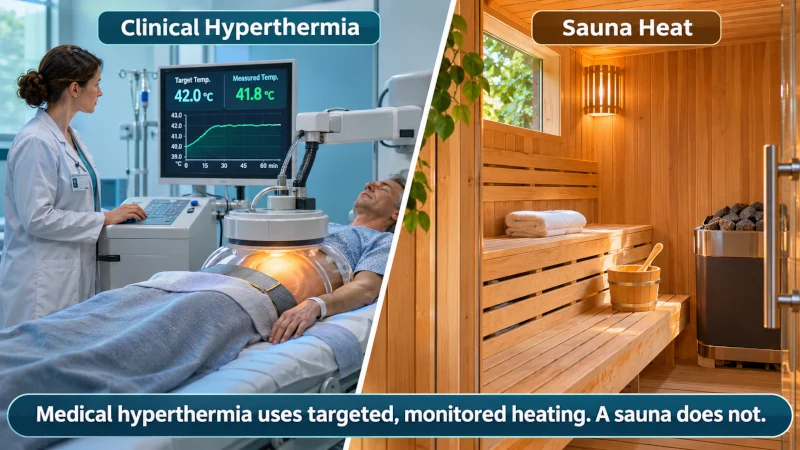
No. Clinical hyperthermia uses special equipment, temperature probes, and careful timing around radiation or chemotherapy, delivered by a trained team [NCI, 2025]. None of the trials above tested saunas, hot tubs, infrared beds, or heating pads, and home heat can’t be aimed at a tumor or held at a measured temperature inside it. If you want to use a sauna or hot tub during treatment, check with your oncology team first, particularly if you feel weak, dizzy, or dehydrated.
Finding legitimate treatment: questions to ask
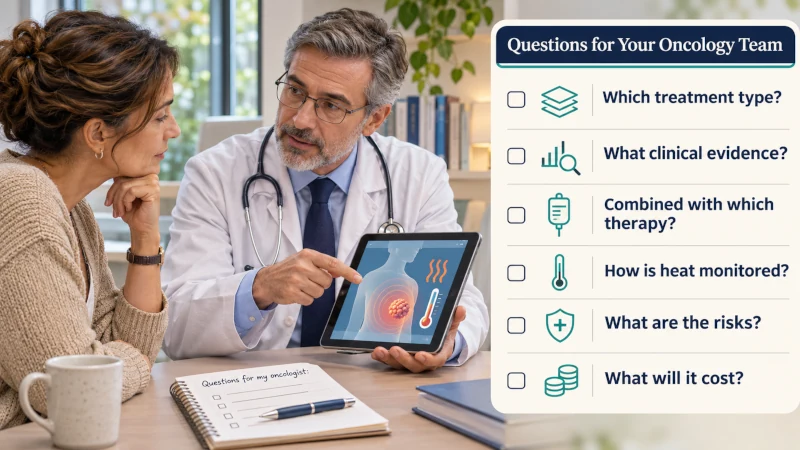
Because it needs special equipment and skilled staff, only a small number of hospitals and cancer centers offer hyperthermia [NCI, 2025]. The safest route in is through your own oncologist, a referral to an academic cancer center, or a clinical trial your team can help you find. Before you agree to treatment, ask:
- What type of hyperthermia is this, and what will it be combined with?
- Which randomized trials support it for my cancer type and stage?
- Will it replace any part of my standard treatment? (If the answer is yes, get a second opinion.)
- How will you measure the temperature in and around the tumor?
- What side effects should I watch for, and who do I call if they happen?
- Is this part of a clinical trial, what will it cost, and will my insurance cover it?
Be wary of any clinic that offers heat instead of surgery, radiation, or chemotherapy, promises a cure, or asks for large upfront payments for whole-body sessions.
Heat won’t change the basics that help you get through treatment. Eating enough matters more during cancer care than cutting out sugar — see what the evidence says about sugar and cancer — and no food can treat cancer on its own, as our evidence-based guide to foods and cancer explains.
When to call your care team right away
Contact your team the same day, or get urgent care, if you notice any of these after a hyperthermia session:
- A burn or blister that is spreading, very painful, or oozing
- Fever, chills, or redness, warmth, or pus at a probe or incision site
- Swelling, pain, or warmth in one arm or leg, which can signal a blood clot
- Vomiting or diarrhea that keeps you from holding down fluids
- Confusion, fainting, or severe dizziness
Call 911 for chest pain, a racing or irregular heartbeat, trouble breathing, or sudden weakness on one side of the body.
| HEALTH DISCLAIMER: This article explains how hyperthermia is used in cancer care and what research has found. It is for general education, is not medical advice, and can’t tell you whether hyperthermia fits your situation. Decisions about cancer treatment should be made with an oncologist who knows your diagnosis, stage, and overall health. If you have symptoms that worry you during or after treatment, contact your care team or emergency services. |
FREQUENTLY ASKED QUESTIONS
Is hyperthermia FDA approved for cancer?
Approval applies to specific devices for specific uses. For example, the FDA granted the BSD-2000 hyperthermia system a humanitarian device exemption in 2011 for use with radiation in cervical cancer patients who can’t have chemotherapy [FDA, 2011]. That is a narrow indication, not a general approval of heat therapy for cancer.
What temperature does hyperthermia use?
Mild hyperthermia usually targets about 40–43°C (104–109°F) for roughly an hour [Crezee, 2021]. The NCI describes temperatures up to 113°F (45°C) in tissue; ablation uses higher, focused heat to destroy small tumors [NCI, 2025].
Can hyperthermia cure cancer by itself?
Thermal ablation such as RFA can destroy some small tumors without surgery [ACS, 2025]. Mild hyperthermia isn’t used that way; in the trials that showed benefit, it was added to radiation, chemotherapy, or surgery.
Does hyperthermia hurt?
It can. Hot spots may cause discomfort, pain, burns, or blisters, and placing temperature probes involves numbing the area first [NCI, 2025]. Tell the team right away if you feel burning during a session.
Is HIPEC the same as hyperthermia?
HIPEC is one form of regional hyperthermia: heated chemotherapy circulated through the abdomen during surgery. Its results vary by cancer — it improved survival in one ovarian cancer trial [van Driel, 2018] but not in a colorectal trial using oxaliplatin [Quénet, 2021].
References
- American Cancer Society. Hyperthermia to treat cancer. View source
- ASCO Post. Hyperthermic intraperitoneal chemotherapy plus cytoreductive surgery for colorectal cancer metastases does not improve overall survival. View source
- Crezee, J., Franken, N. A. P., & Oei, A. L. Hyperthermia-based anti-cancer treatments. View source
- Hildebrandt, B., Wust, P., Ahlers, O., Dieing, A., Sreenivasa, G., Kerner, T., Felix, R., & Riess, H. The cellular and molecular basis of hyperthermia. Critical Reviews in Oncology/Hematology, 43(1), 33–56. View source
- Issels, R. D., Lindner, L. H., Verweij, J., et al. (2018). Effect of neoadjuvant chemotherapy plus regional hyperthermia on long-term outcomes among patients with localized high-risk soft tissue sarcoma: The EORTC 62961-ESHO 95 randomized clinical trial. View source
- Kok, H. P., Cressman, E. N. K., Ceelen, W., et al. Heating technology for malignant tumors: International Journal of Hyperthermia, View source
- Lutgens, L., van der Zee, J., De Ruysscher, D. K. M., Lambin, P., & Platt, J. Combined use of hyperthermia and (chemo)radiation therapy for treating locally advanced cervix carcinoma. View source
- National Cancer Institute. Hyperthermia to treat cancer. View source
- Overgaard, J., González González, D., Hulshof, M. C. C. M., et al. Randomised trial of hyperthermia as adjuvant to radiotherapy for recurrent or metastatic malignant melanoma. View source
- Quénet, F., Elias, D., Roca, L., et al. Cytoreductive surgery plus hyperthermic intraperitoneal chemotherapy versus cytoreductive surgery alone for colorectal peritoneal metastases (PRODIGE 7). View source
- Trujillo-Romero, C. J., Paulides, M. M., Drizdal, T., & van Rhoon, G. C. Impact of silicone and metal port-a-cath implants on superficial hyperthermia treatment quality. View source
- U.S. Food and Drug Administration. Humanitarian Device Exemption H090002: BSD-2000 Hyperthermia System. View source
- van der Zee, J., González González, D., van Rhoon, G. C., et al. Comparison of radiotherapy alone with radiotherapy plus hyperthermia in locally advanced pelvic tumours: A prospective, randomised, multicentre trial. View source
- van Driel, W. J., Koole, S. N., Sikorska, K., et al. Hyperthermic intraperitoneal chemotherapy in ovarian cancer. New England Journal of Medicine, 378(3), 230–240. View source
- Vernon, C. C., Hand, J. W., Field, S. B., et al. Radiotherapy with or without hyperthermia in the treatment of superficial localized breast cancer: Results from five randomized controlled trials. International Journal of Radiation Oncology, View source
- Zagar, T. M., Oleson, J. R., Vujaskovic, Z., et al. Hyperthermia combined with radiation therapy for superficial breast cancer and chest wall recurrence: A review of the randomised data. View source


