
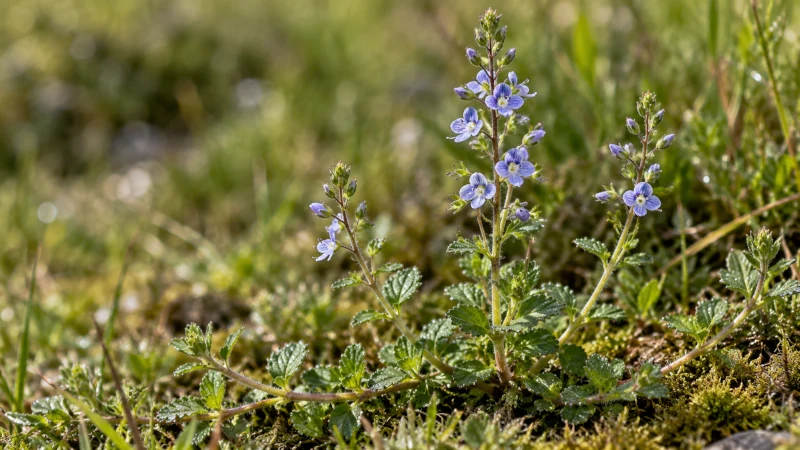
The speedwell plant (Veronica officinalis) is a small, creeping European herb with spikes of pale lilac-blue flowers and a long career as a folk remedy. People have brewed it for coughs, sluggish digestion, and irritated skin for centuries, and in parts of Europe it was simply drunk as an everyday stand-in for imported tea [Raclariu et al., 2017].
Here is what science adds so far: not much. Speedwell extracts show antioxidant and anti-inflammatory activity in lab dishes and animals, but no clinical trial has tested speedwell tea for any illness in people [Salehi et al., 2019]. Germany’s Commission E reviewed the herb and declined to approve it for any use, citing a lack of data on whether it works, while expecting no particular risks [Altmeyers, 2025]. So speedwell is a reasonable occasional tea for most healthy adults and a poor choice as a treatment for anything.
What the speedwell plant is
Speedwell is a hairy perennial that spreads along the ground on a creeping rootstock and sends up short, upright spikes of small, pale purple-blue flowers, usually from June to August [Altmeyers, 2025]. Botanists now place it in the plantain family, Plantaginaceae; older herbals file it under the figwort family, Scrophulariaceae [Kew POWO, 2026].
Its native range runs from the Atlantic islands of Macaronesia across Europe to western Siberia and northern Iran. It has also naturalized across much of Canada and the northern and eastern United States, and in Chile and South Africa [Kew POWO, 2026]. In shops you may see it sold as veronica, gypsy weed, or thé d’Europe, “European tea” [RxList, 2026]. Herbal products use the dried, flowering above-ground parts [Altmeyers, 2025].
Speedwell at a glance
| Botanical name | Veronica officinalis L. |
| Family | Plantaginaceae (plantain family) |
| Other names | Common speedwell, heath speedwell, gypsy weed, veronica, thé d’Europe |
| Part used | Dried flowering above-ground parts |
| Notable compounds | Iridoid glycosides (aucubin, catalpol and related esters), flavonoids, phenolic acids |
| Regulatory status | Germany’s Commission E issued a negative monograph: not approved for any use |
| Proven benefits in people | None established |
| Main practical risk | Products that contain a different Veronica species than the label says |
One name, several plants
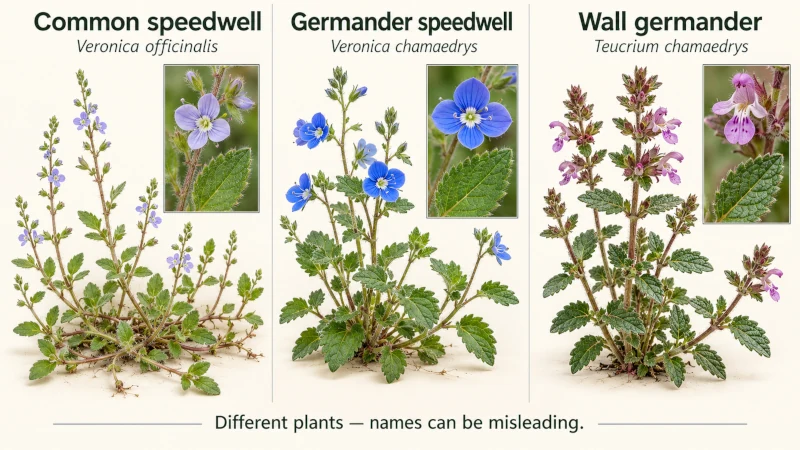
Veronica is a big genus, with more than 200 species, and several of them are called speedwell [Salehi et al., 2019]. The one most often confused with the medicinal species is germander speedwell (V. chamaedrys), which regularly turns up in its place in commercial products (more on that below).
Germander speedwell is not the same plant as germander (Teucrium chamaedrys), an unrelated mint-family herb and a well-documented cause of liver injury. If a label or recipe just says “germander,” read our guide to the germander plant and its liver risks before going anywhere near the teapot.
Traditional uses of speedwell

Speedwell’s folk résumé is long and fairly consistent across Europe. Researchers who compiled its uses country by country found it taken for coughs, asthma, pharyngitis, and tonsillitis in Bulgaria; for bronchitis, rheumatic complaints, skin diseases, and wounds in Montenegro; for coughs, catarrh, kidney and lung complaints, and wound healing in Romania; and simply as a pleasant everyday tea in Italy and Sweden [Raclariu et al., 2017]. German herbal references describe the same pattern: respiratory, digestive, rheumatic, and bladder and kidney complaints, plus a gargle for an inflamed mouth and throat [Altmeyers, 2025].
Modern chemistry confirms the plant contains iridoid glycosides such as aucubin and catalpol, along with flavonoids and phenolic acids [Raclariu et al., 2017] [Mocan et al., 2015]. Interesting chemistry is not the same as a proven effect, though, and that gap is the whole story of this plant.
What the research actually shows
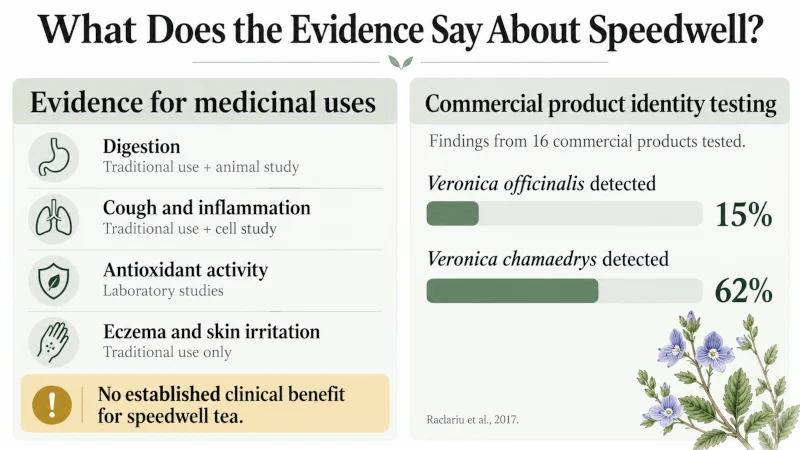
Every study below was done in cells, in test tubes, or in rats, with one exception: a small cosmetic cream trial. None tested the tea people actually drink.
| Claim | What the evidence is | Grade |
| Aids digestion and appetite | Folk use; one 1985 rat study on stomach ulcers [Scarlat et al., 1985] | Traditional + animal only |
| Eases coughs, bronchitis, sore throat | Folk use; one human cell-culture study [Gründemann et al., 2013] | Traditional + lab only |
| Prevents asthma attacks | No studies found | Insufficient — do not use for asthma |
| Relieves migraine | No studies found | Insufficient |
| Diuretic or “blood purifying” | Folk claim only [RxList, 2026] | Insufficient |
| Soothes eczema and itching (on the skin) | Folk use; no human trials | Traditional only |
| Reduces wrinkles (2% extract cream) | One small, company-funded trial in 21 women [Lee et al., 2015] | Limited |
| Antioxidant and antibacterial | Test-tube studies [Mocan et al., 2015] | Lab only |
Digestion and the stomach lining
The best-known experiment is old and small. In 1985, Romanian researchers gave speedwell extracts to rats with drug-induced stomach ulcers; the extracts reduced ulcer formation, and in a second model they appeared to speed repair of the stomach lining [Scarlat et al., 1985]. The finding fits the plant’s folk reputation. Nobody has followed it up in people.
If your appetite is poor or you feel heavy after meals, a cup of speedwell is unlikely to hurt, but don’t expect much from it. Our guide to herbs for stomach issues that actually have evidence covers the few options with human data, such as peppermint oil for IBS and ginger for nausea.
Coughs and airway inflammation
A 2013 study tested a standardized speedwell extract on human lung-lining cells grown in a dish. The extract reduced eotaxin, a chemical signal that draws inflammatory cells into the airways, and lowered prostaglandin E2 by damping the COX-2 pathway. It did little to calm mast cells, the cells that drive allergic reactions [Gründemann et al., 2013]. That offers a plausible mechanism for the folk use in coughs and catarrh. It doesn’t show that a cup of speedwell changes a cough.
Asthma needs a direct word: no study shows speedwell prevents asthma attacks, and no herb replaces a controller or rescue inhaler. For an ordinary cough, honey and certain thyme preparations have better support. Our evidence-rated guide to herbs for the lungs walks through them.
Antioxidant and antibacterial activity
Speedwell extracts score well on standard antioxidant tests, and in one study they slowed the growth of Staphylococcus aureus and Listeria bacteria in the lab [Mocan et al., 2015]. The concentrations needed were high, several milligrams of extract per milliliter, and good test-tube antioxidant scores rarely translate into measurable benefits in the body. A 2019 review of the whole Veronica genus reached the same verdict: the activity is real in the lab, and studies in humans are still needed [Salehi et al., 2019].
Skin
Washing eczema or itchy skin with speedwell is one of its oldest uses, yet no clinical trial has tested it for eczema, itching, or dermatitis. The nearest thing to human skin data is a cosmetic study.
Twenty-one women aged 45 to 65 applied a cream containing 2% speedwell extract to the crow’s-feet area on one side of the face and an identical cream without the extract on the other, twice a day. At 28 days there was no difference. At 56 days the speedwell side showed 18% less wrinkle area and 16% shorter wrinkles than the placebo side [Lee et al., 2015]. The trial was small, only partly blinded, and funded by the company that makes the cream. And wrinkles are not eczema.
If you’re dealing with a rash, our guide to herbs for skin issues and what the evidence supports separates the few plants with real data from the rest, and explains why steady moisturizing and trigger control do more for eczema than any herb.
Claims with no evidence behind them
Some speedwell claims repeated online have no studies at all. We found no research supporting speedwell for migraines, for preventing asthma attacks, as a diuretic, or for “purifying the blood.” Natural Medicines, the clinical database many pharmacists use, rates the evidence as insufficient for every use it lists, from loss of appetite and gout to skin problems and sore throat [RxList, 2026].
The bigger problem: what is in the bag may not be speedwell

Even if speedwell worked, you’d need to know you were drinking it. When researchers DNA-tested 16 commercial V. officinalis products, they found the labeled species in only 15% of them and germander speedwell in 62% [Raclariu et al., 2017]. The authors point out why that matters: if a product contains plants that aren’t on the label, any reaction to it can’t be traced to what you thought you took.
If you buy speedwell, choose a supplier that names the botanical species (Veronica officinalis) and can show identity testing. Skip wild-harvesting unless you can identify the plant with certainty.
How speedwell is traditionally prepared
No dose of speedwell has been tested or established for any purpose [RxList, 2026], so we don’t give one here. Traditional preparations are simple:
- Tea (infusion): dried flowering herb steeped in just-boiled water, covered for several minutes, then strained.
- Gargle: the cooled tea, used for a sore mouth or throat.
- Compress or wash: cooled tea applied with a clean cloth to intact, itchy skin.
Treat it like any herbal tea: an occasional cup, not a daily medicinal routine. Before using it on your skin, test a small patch first and keep it off broken, weeping, or infected skin.
Brooklime and water speedwell
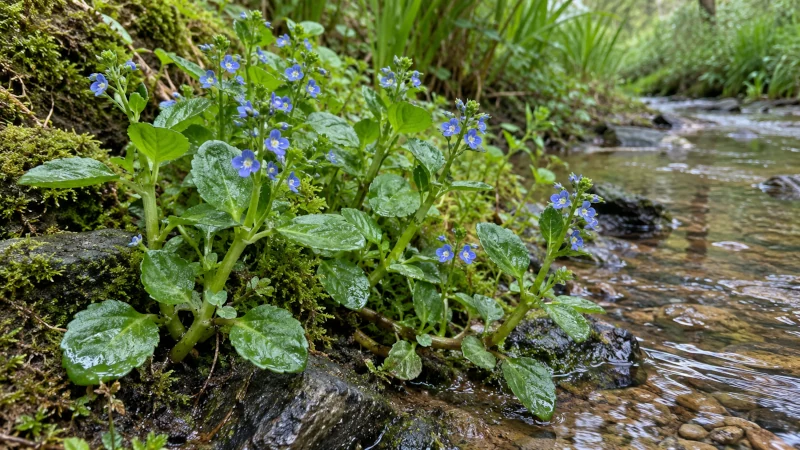
Two wetland relatives are often mixed up with speedwell and with each other. Brooklime is Veronica beccabunga, a fleshy, glossy-leaved plant of stream edges; water speedwell is a different species, V. anagallis-aquatica [Salehi et al., 2019]. Brooklime’s leaves are edible but very bitter, and like watercress they were traditionally eaten in salads across northern Europe [Wildlife Trusts].
If you forage brooklime, cook it. Watercress and other freshwater plants can carry the larvae of Fasciola, a liver fluke that infects people who eat them raw, and the CDC advises against eating raw watercress and other freshwater plants, especially from areas where livestock graze [CDC, 2024].
Speedwell safety: side effects, interactions, and who should avoid it
Speedwell appears to be low-risk in food amounts. Taken as a medicine, Natural Medicines rates it possibly safe, but notes that its possible side effects are unknown and that there isn’t enough information to judge whether it is safe on the skin [RxList, 2026]. Commission E also expected no specific risks [Altmeyers, 2025]. For a herb this lightly studied, “no known risks” mostly means nobody has looked closely.
Side effects
No side effects are well documented. Stop using it if you notice stomach upset, a rash, or any reaction you can’t explain, and tell your doctor or pharmacist what you took.
Medication interactions
No drug interactions have been documented, which reflects a lack of research rather than proof of safety. If you take prescription medicine, mention speedwell to your pharmacist before drinking it regularly.
Pregnancy and breastfeeding
Not enough is known about speedwell during pregnancy or breastfeeding, and the standard advice is to avoid it [RxList, 2026].
Who should skip speedwell
- Anyone pregnant or breastfeeding.
- Children, since there is no safety information for them.
- People with asthma or another lung condition who might use it in place of prescribed treatment.
- Anyone thinking of applying it to broken, weeping, or infected skin.
- People with a long-term illness or several prescriptions, unless a pharmacist has checked it first.
When to see a doctor instead of brewing tea
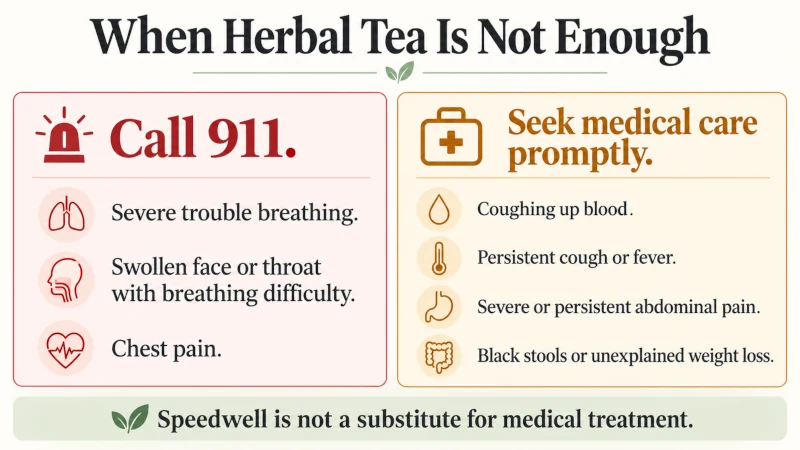
Call 911 if a cough comes with shortness of breath or trouble breathing, or with hives and a swollen face or throat [MedlinePlus, 2025].
Contact your provider promptly if a cough lasts longer than 10 to 14 days, brings up blood, comes with fever or thick yellow-green phlegm, makes a high-pitched sound when you breathe in, or comes with unexplained weight loss or night sweats [MedlinePlus, 2025].
See a doctor right away if indigestion comes with chest, jaw, neck, or arm pain; trouble or pain swallowing; frequent or bloody vomiting; severe, constant belly pain; black, tarry stools; yellowing of the skin or eyes; or weight loss you can’t explain [NIDDK, 2025].
For skin, get it checked if a rash is spreading, the skin is hot, swollen, or painful, you have a fever, or eczema isn’t controlled with regular moisturizing.
| HEALTH DISCLAIMER: This article is for general education only. It is not medical advice and does not replace diagnosis or treatment from a qualified healthcare professional. Speedwell has not been shown to treat any medical condition, and its safety has not been well studied. Talk to your doctor or pharmacist before using speedwell or any herbal product, especially if you are pregnant or breastfeeding, giving it to a child, taking prescription medicine, or living with a long-term condition such as asthma. If you have trouble breathing, chest pain, are coughing or vomiting blood, or have black stools, seek medical care right away or call 911. |
Frequently Asked Questions
Is speedwell tea safe to drink?
For most healthy adults, an occasional cup appears to be low-risk; speedwell is rated likely safe in food amounts, though its possible side effects as a medicine are unknown [RxList, 2026]. Avoid it if you are pregnant or breastfeeding, and buy from a supplier that verifies the species, since many products contain a different plant.
What is the speedwell plant used for?
Traditionally for coughs, catarrh, digestive complaints, kidney and bladder problems, and as a wash for itchy skin [Raclariu et al., 2017]. None of these uses has been confirmed in human trials, and Germany’s Commission E did not approve speedwell for any of them [Altmeyers, 2025].
Is speedwell the same as germander?
No. Germander speedwell (Veronica chamaedrys) is a close relative of common speedwell and a frequent substitute in products. Germander (Teucrium chamaedrys) is an unrelated mint-family herb linked to serious liver injury, and it should not be taken as a tea or supplement.
Can speedwell help asthma or bronchitis?
There is no evidence it does. The only relevant research is a cell-culture study [Gründemann et al., 2013]. Never use speedwell in place of asthma medication, and see a provider for a cough that lasts more than 10 to 14 days or comes with fever or trouble breathing [MedlinePlus, 2025].
Is brooklime edible?
Yes, though it is very bitter; brooklime was traditionally eaten like watercress [Wildlife Trusts]. Cook it rather than eating it raw, because raw freshwater plants can transmit a liver fluke [CDC, 2024].
References
- Altmeyers Encyclopedia, Department of Phytotherapy. “Speedwell.” View source
- Royal Botanic Gardens, Kew. “Veronica officinalis L.” Plants of the World Online. View source
- Salehi B, Shetty MS, Kumar NVA, et al. “Veronica plants—drifting from farm to traditional healing, food application, and phytopharmacology.” Molecules. View source
- Raclariu AC, Mocan A, Popa MO, et al. “Veronica officinalis product authentication using DNA metabarcoding and HPLC-MS reveals widespread adulteration with Veronica chamaedrys.” Frontiers in Pharmacology. View source
- Scarlat M, Sandor V, Tămaş M, Cuparencu B. “Experimental anti-ulcer activity of Veronica officinalis L. extracts.” Journal of Ethnopharmacology. View source
- Gründemann C, Garcia-Käufer M, Sauer B, et al. “Traditionally used Veronica officinalis inhibits proinflammatory mediators via the NF-κB signalling pathway in a human lung cell line.” Journal of Ethnopharmacology. View source
- Mocan A, Vodnar DC, Vlase L, Crișan O, Gheldiu AM, Crișan G. “Phytochemical characterization of Veronica officinalis L., V. teucrium L. and V. orchidea Crantz from Romania and their antioxidant and antimicrobial properties.” International Journal of Molecular Sciences. View source
- Lee HY, Ghimeray AK, Yim JH, Chang MS. “Antioxidant, collagen synthesis activity in vitro and clinical test on anti-wrinkle activity of formulated cream containing Veronica officinalis extract.” View source
- RxList. “Veronica” (effectiveness and safety ratings from Natural Medicines Comprehensive Database). Accessed October 2026. View source
- The Wildlife Trusts. “Brooklime.” View source
- Centers for Disease Control and Prevention. “About Fasciola.” View source
- MedlinePlus Medical Encyclopedia. “Cough.” U.S. National Library of Medicine; View source
- National Institute of Diabetes and Digestive and Kidney Diseases. “Symptoms & Causes of Indigestion.” View source


