Iceland moss earns its reputation in one narrow place. Steeped in water, it releases a slippery gel that coats a raw throat and takes the edge off the tickle that keeps a dry cough going. European regulators accept exactly two traditional uses for it: soothing irritation of the mouth and throat with an associated dry cough, and stimulating a temporarily poor appetite (EU herbal monograph on Cetraria islandica, 2015).
The honest list of Iceland moss health benefits is short, but the two items on it are real, low-risk, and easy to try at home. The bigger claims attached to this lichen — tuberculosis, asthma, morning sickness — have no human evidence behind them, and acting on a couple of them can cost you.
It isn’t a moss
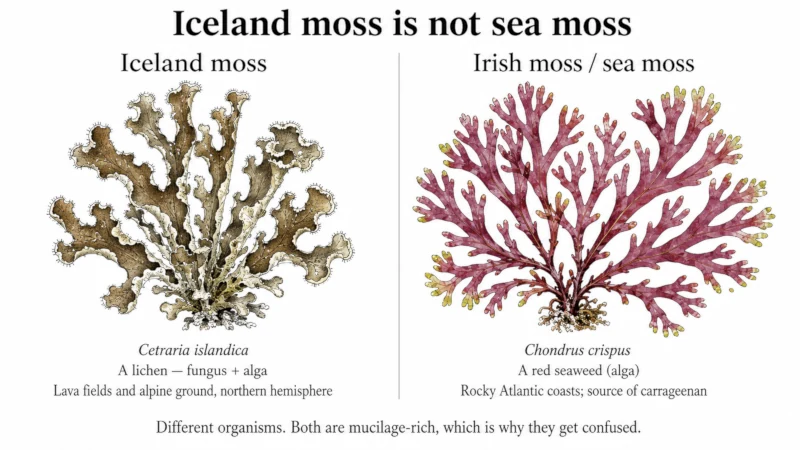
Iceland moss is a lichen: a fungus and an alga living as one organism. It grows in a branched, curling tuft two to four inches high, brown to grayish-white, on lava fields, alpine slopes and acidic ground across the northern hemisphere (Britannica, Iceland moss). The whole dried body of the lichen — the thallus — is the part used.
Northern Europeans ate it long before they medicated with it. Soaked, dried and ground, it went into breads, soups and jellies during lean years, and it is still a staple food for reindeer and caribou (Britannica, Iceland moss). That food history matters: it’s the main reason a bitter, unglamorous lichen has a documented safety record at all.
Why it soothes: mucilage, not medicine
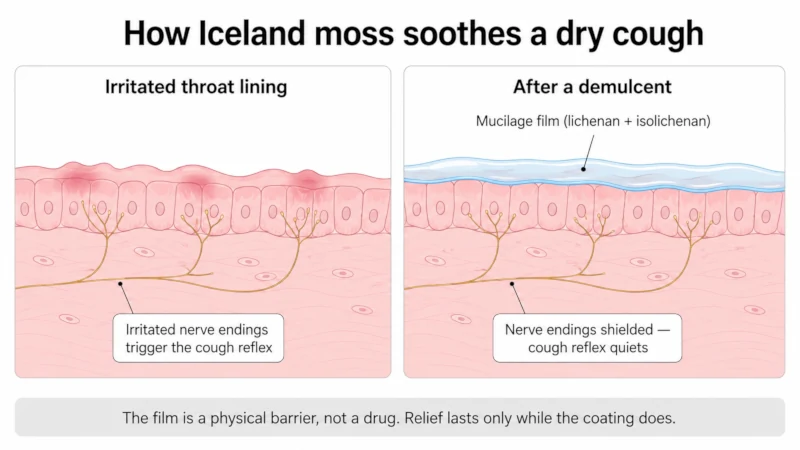
A quarter to half of the dried thallus is polysaccharide — mainly lichenan, which dissolves in hot water, and isolichenan, which dissolves in cold (EMA assessment report on Cetraria islandica, 2015). In water these form mucilage, a viscous gel that settles over the lining of the mouth and throat as a physical film.
Nothing pharmacological happens. The gel is a barrier. It sits on inflamed tissue, dulls the sensation that triggers the cough reflex, and buys the tissue time to heal on its own. That is the same mechanism behind marshmallow root’s demulcent action and behind why honey helps a scratchy throat. It also explains the limits: the relief lasts as long as the coating does, which is minutes to an hour, so you take it repeatedly through the day rather than once.
The lichen also carries bitter compounds — fumarprotocetraric acid at roughly 2.6 to 11.5 percent, plus smaller amounts of protocetraric and protolichesterinic acids. Bitterness on the tongue is the traditional basis for its second accepted use, appetite stimulation (EMA assessment report, 2015).
One correction worth making, because it appears almost everywhere Iceland moss is written about: usnic acid is not what this lichen does. Analyses of Cetraria islandica find usnic acid in traces at best — around 0.04 percent — and in some samples not at all (EMA assessment report, 2015). Claims that Iceland moss works as an antibiotic because of its usnic acid content are borrowing chemistry from other lichens.
Iceland moss health benefits, graded honestly
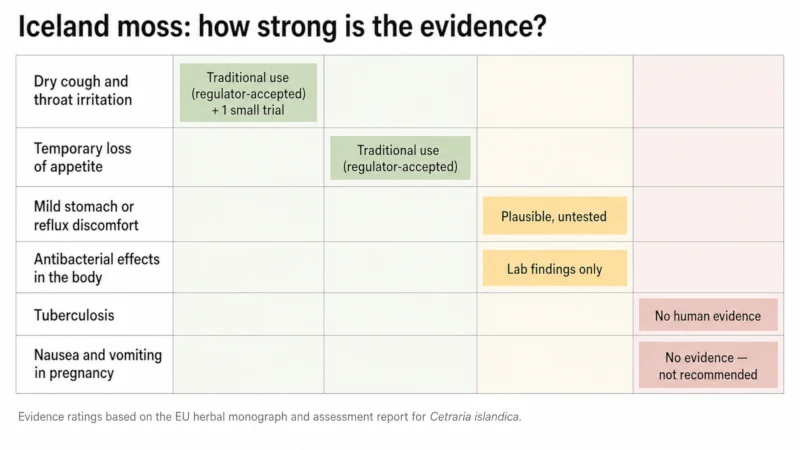
| Use | Evidence level | What that means |
| Dry cough, irritated mouth or throat | Traditional use, accepted by regulators; one small human trial | Reasonable to try for short-term symptom relief |
| Temporary loss of appetite | Traditional use, accepted by regulators | Plausible, based on bitterness; no controlled trials |
| Soothing mild stomach or reflux discomfort | Plausible by mechanism, essentially untested | Low risk, unproven |
| Antibacterial effects in the body | Lab findings only | Do not treat an infection with it |
| Tuberculosis | No human evidence | Requires prescription antibiotics; see below |
| Nausea and vomiting in pregnancy | No evidence, and not recommended in pregnancy | Avoid |
Dry cough and throat irritation — the strongest case, and it’s still modest
The European Medicines Agency’s herbal committee approved Iceland moss preparations as a demulcent for mouth and throat irritation and associated dry cough. Approval rests on traditional use — at least 30 years of documented safe use, 15 of them in the EU — rather than on clinical trials (EMA public summary on Iceland moss, 2017). That is a real regulatory standard, but it is a lower bar than “proven effective.”
The human data behind it amount to very little. The main study, published in 1997, gave Iceland moss pastilles to 63 adults recovering from nasal surgery — a group with predictably dry, irritated throat tissue — at three different doses over five days. All three groups improved, including the lowest dose. There was no placebo group, which is a serious limitation for a symptom as suggestible as throat discomfort (EMA assessment report, 2015).
When the agency revisited the file in 2021, it found no new efficacy or safety studies at all and left the monograph unchanged (EMA addendum to the assessment report, 2022). US consumer databases are blunter, rating the evidence for every use as insufficient (WebMD, Iceland moss).
So: worth trying for a scratchy, dry, unproductive cough. Not worth expecting much from beyond that. If you want to compare it against the other herbs used for coughs and congestion, it sits in the same tier as mullein — traditionally supported, thinly studied, and safe enough that trying it costs you little.
Appetite
The second accepted indication is temporary loss of appetite in adults. Bitter herbs taken shortly before a meal are a long-standing European practice, and Iceland moss is genuinely bitter. There are no controlled trials showing it increases food intake (EMA public summary on Iceland moss, 2017). Note the word temporary. Appetite loss that persists, or comes with weight loss, is a symptom to have looked at rather than a symptom to self-treat.
Antibacterial activity — real in a dish, unproven in a person
Ethanolic extracts of Iceland moss inhibit some gram-positive bacteria and do nothing against gram-negative ones. Protolichesterinic acid, one of its lichen acids, shows activity against Mycobacterium aurum and against Helicobacter pylori in laboratory testing (EMA assessment report, 2015).
That is a laboratory result, not a treatment. A compound that kills bacteria in a dish has to survive digestion, reach the infected tissue at a high enough concentration, and do it without harming you — and no study has shown Iceland moss doing any of that. Treat these findings as a reason for researchers to keep looking, not as a reason to skip an antibiotic.
Tuberculosis: this one matters
Iceland moss is still described in older herbals as a supporting remedy for pulmonary tuberculosis, on the strength of that Mycobacterium lab activity. There is no human evidence for it, and the stakes are unusually high.
Active TB disease is treated with a combination of prescription antibiotics — regimens such as isoniazid, rifampin, rifapentine, pyrazinamide, ethambutol or moxifloxacin — for four, six or nine months depending on the plan. The CDC is direct that doses must not be missed and treatment must not be stopped early, because incompletely treated TB can persist and develop drug resistance (CDC, Treatment for TB Disease). Untreated active TB is a life-threatening and transmissible illness. If you have been diagnosed with TB, or you have a cough lasting weeks with fever, night sweats or weight loss, that belongs with a doctor immediately, not with a lichen tea.
Nausea and vomiting in pregnancy: don’t
A recurring claim holds that Iceland moss stops persistent vomiting in pregnancy. No study supports it, and the regulatory position runs the other way: safety in pregnancy and breastfeeding has not been established, and in the absence of data, use is not recommended (EU herbal monograph on Cetraria islandica, 2015). US consumer safety guidance goes further and calls it possibly unsafe in pregnancy and breastfeeding, specifically because dried lichen can carry lead (WebMD, Iceland moss).
There are approaches for morning sickness with actual evidence behind them, including small frequent meals, bland foods, taking prenatal vitamins at night with food, acupressure wristbands, and vitamin B6 or a prescription doxylamine–B6 combination if diet changes aren’t enough. Call your doctor if you vomit blood or coffee-ground material, lose more than two pounds a week, or can’t keep fluids down (MedlinePlus, Morning sickness).
How Iceland moss is actually used
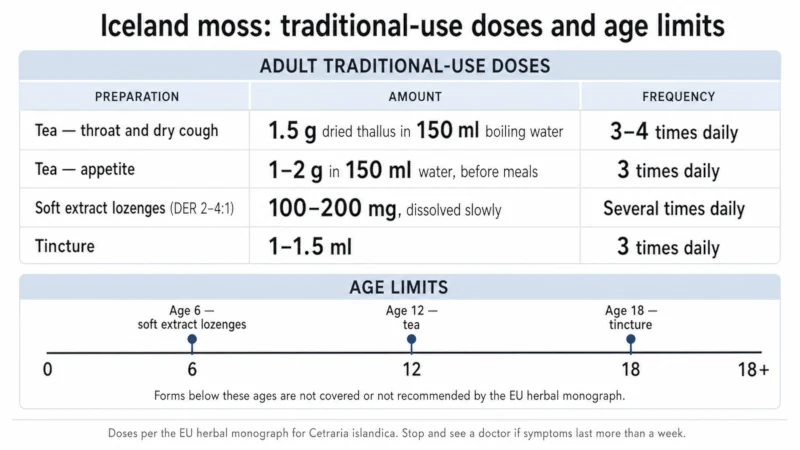
Dosing below reflects the amounts European regulators list for traditional preparations (EU herbal monograph on Cetraria islandica, 2015). Products sold in the US are dietary supplements and are not reviewed by the FDA for effectiveness before sale, so label strengths vary. Read yours.
| Preparation | Adult amount | How often |
| Tea, for throat and dry cough | 1.5 g dried thallus in 150 ml boiling water | 3–4 times daily |
| Tea, for appetite | 1–2 g in 150 ml water, before meals | 3 times daily |
| Soft extract lozenges (DER 2–4:1) | 100–200 mg, dissolved slowly in the mouth | Several times daily |
| Tincture | 1–1.5 ml | 3 times daily |
For children aged 6 to 12, only the oromucosal soft extracts are covered, at 100 mg (DER 2–4:1) or 80 mg (DER 0.4–0.8:1) four to six times daily. Tea preparations are not recommended under 12, and tincture is not established under 18.
Two practical notes. Let a lozenge dissolve rather than chewing it — the point is contact time against the tissue, and swallowing it quickly wastes the coating. And if the tea’s bitterness is unpleasant, a first short boil with the water discarded before the real steep will cut it, though you lose some mucilage along with the bitter compounds. Honey helps too, and has better evidence behind it than the lichen does — a Cochrane review of six trials in 899 children found honey probably reduces cough frequency and severity better than no treatment or placebo, at moderate certainty (Cochrane review of honey for acute cough in children, 2018).
Stop and see a doctor if symptoms last longer than a week (EU herbal monograph on Cetraria islandica, 2015).
Side effects, interactions and who should skip it
Side effects. European regulators list none as known, and when they reviewed nine years of European pharmacovigilance reports they could link only four to Iceland moss — hypersensitivity reactions, vomiting, cough and diarrhea — and concluded causality could not be established from so few cases (EMA addendum, 2022). Sources disagree here: US consumer guidance says Iceland moss can irritate the digestive tract lining and advises avoiding it with stomach or intestinal ulcers, a caution the European monograph does not carry (WebMD, Iceland moss). If you have an active ulcer, the cautious reading is the safer one.
The interaction that catches people. Mucilage coats more than your throat. It can slow the absorption of medicines taken at the same time, so leave half an hour to an hour between Iceland moss and any other oral medication (EU herbal monograph on Cetraria islandica, 2015). This is easy to overlook and matters most with medications where the dose has to land precisely — thyroid hormone, seizure medications, anticoagulants. Tell your doctor and pharmacist what supplements you take, and mention them before any surgery (NIH Office of Dietary Supplements, 2023).
Lead and other contaminants. Lichens have no roots and no waxy cuticle; they absorb what falls on them from the air, including heavy metals and radionuclides. Finnish samples have shown lead at 30 mg/kg, well above the 10 ppm limit the European Pharmacopoeia sets for Iceland moss, and post-Chernobyl radionuclide accumulation has been documented (EMA assessment report, 2015). This is the single best reason not to use Iceland moss long-term or in large amounts, and the reason US guidance flags it in pregnancy and breastfeeding (WebMD, Iceland moss). Buy from a supplier that tests for heavy metals and will show you the certificate. Don’t harvest it near roads or industry.
A note on usnic acid. Concentrated usnic acid, sold in some weight-loss supplements, has caused severe acute hepatitis and, in a few cases, liver failure requiring transplant; the FDA acted against one such product. That literature concerns usnic acid extracted mostly from Usnea lichens, and it does not describe Cetraria islandica (LiverTox: Usnic Acid, NIDDK). Given how little usnic acid Iceland moss contains, ordinary tea and lozenges are a different situation. Concentrated lichen-acid extracts sold for fat loss are not, and are worth avoiding.
Who should avoid Iceland moss: anyone pregnant or breastfeeding; children under 6 for any form, under 12 for teas, under 18 for tinctures; anyone with a known hypersensitivity to it; anyone with an active stomach or intestinal ulcer; and anyone using it as a substitute for treatment of a diagnosed infection or lung disease. If you have asthma, COPD or another chronic lung condition, a demulcent does nothing for the underlying airway problem — keep taking what you were prescribed, and treat dietary and herbal measures as an addition, never a replacement.
When a cough needs a doctor, not a lozenge
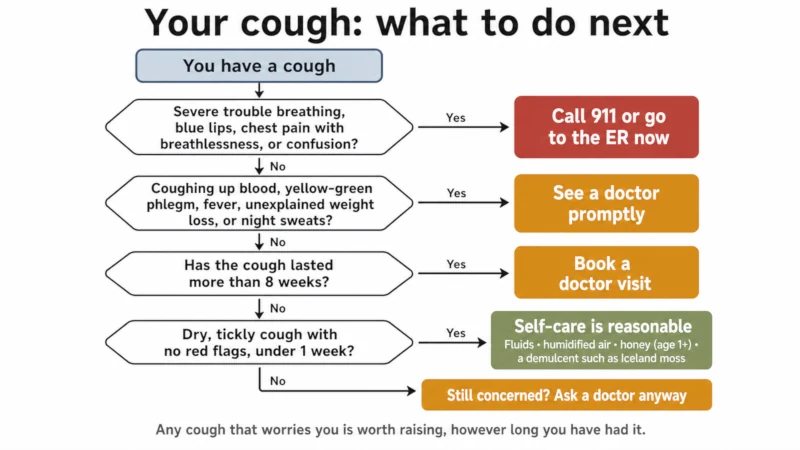
Most acute coughs clear on their own within about three weeks. Any cough lasting more than eight weeks should be discussed with a doctor, and any cough that worries you is worth raising regardless of how long you’ve had it (American Lung Association, Cough).
Seek medical care promptly for:
- coughing up blood, or yellow-green phlegm
- shortness of breath or difficulty breathing
- chest pain
- fever, or fever with headache and drowsiness
- confusion
- unexplained weight loss or night sweats alongside a persistent cough
Call 911 or go to an emergency room for severe difficulty breathing, blue lips, chest pain with breathlessness, or confusion.
Two more limits. Iceland moss is for a dry cough — a chesty, productive cough that’s bringing up mucus is a different problem, and worth reading about alongside what to eat when you’re sick with bronchitis. And for children, the FDA advises against cough and cold products containing decongestants or antihistamines under age 2, with manufacturers labeling most such products “do not use” under 4; for young children with colds, cool-mist humidifiers, saline drops and fluids are the recommended approach (FDA, Use Caution When Giving Cough and Cold Products to Kids, 2018).
Honey is the better-evidenced option for children over 1 (Cochrane review of honey for acute cough in children, 2018) — but never under 12 months, because honey can cause infant botulism (CDC, Foods and Drinks to Avoid or Limit). If your child has a persistent cough, ask their pediatrician before adding an herbal product. Broader remedies for the ears, nose and throat may give you gentler options.
| HEALTH DISCLAIMER: This article is for general education and is not medical advice. It is not a substitute for diagnosis or treatment from a qualified professional. Herbal products can interact with prescription medicines and are not appropriate for everyone. If you are pregnant, breastfeeding, taking any medication, managing a chronic condition, or considering an herbal remedy for a child, talk to your doctor or pharmacist first. Never delay or stop prescribed treatment — including antibiotics or inhalers — in favor of an herbal preparation. If you are having trouble breathing, coughing up blood, or feel severely unwell, seek emergency care. |
Frequently Asked Questions
Is Iceland moss the same as sea moss or Irish moss?
No. Iceland moss is a lichen — a fungus-and-alga partnership that grows on rock and soil in cold northern regions (Britannica, Iceland moss). Irish moss, usually sold as sea moss, is Chondrus crispus, a red seaweed harvested from Atlantic coastlines and used mainly as a source of carrageenan (Britannica, Irish moss). Different organisms, different chemistry, different uses. Both are mucilage-rich, which is probably why they get confused.
How long can I take it?
Short stretches only. If your symptoms haven’t improved after a week, stop and see a doctor rather than continuing (EU herbal monograph on Cetraria islandica, 2015). Long-term or high-dose use is also where the lead accumulation concern becomes real (WebMD, Iceland moss).
Will it help a chesty cough that brings up mucus?
Probably not much. Iceland moss coats and soothes; it isn’t an expectorant in any demonstrated sense, and the accepted traditional use is specifically for dry cough and throat irritation (EU herbal monograph on Cetraria islandica, 2015). Fluids, warm drinks and humidified air do more for a productive cough.
Can my kids take it?
Only in specific forms and ages. Oromucosal soft extracts are covered from age 6; teas are not recommended under 12, and tinctures are not established under 18 (EU herbal monograph on Cetraria islandica, 2015). For a young child with a cold, the FDA points to humidifiers, saline drops and fluids rather than medicated products (FDA, 2018). Ask your pediatrician first.
Does it interact with my medications?
The mucilage can delay absorption of other oral medicines, so separate them by half an hour to an hour (EU herbal monograph on Cetraria islandica, 2015). No specific drug interactions are documented beyond that (WebMD, Iceland moss), but “none documented” is not the same as “none exist” for a product this lightly studied. Tell your pharmacist what you’re taking (NIH Office of Dietary Supplements, 2023).
How do I know I’m buying a clean product?
Look for a supplier that publishes third-party testing for heavy metals, particularly lead, and will provide a certificate of analysis for the batch. Because lichens absorb airborne contaminants, sourcing matters more here than with most herbs (EMA assessment report, 2015).
References
- European Medicines Agency. European Union herbal monograph on Cetraria islandica (L.) Acharius s.l., thallus (EMA/HMPC/678891/2013). Committee on Herbal Medicinal Products, 2015. View source
- European Medicines Agency. Assessment report on Cetraria islandica (L.) Acharius s.l., thallus (EMA/HMPC/36866/2014). 2015. View source
- European Medicines Agency. Iceland moss — summary for the public (EMA/812331/2016). 2017. View source
- European Medicines Agency. Addendum to assessment report on Cetraria islandica (EMA/HMPC/502105/2021). 2022. View source
- WebMD. Iceland Moss — Uses, Side Effects, and More. WebMD Vitamins & Supplements. View source
- NIDDK. LiverTox: Clinical and Research Information on Drug-Induced Liver Injury — Usnic Acid. NCBI Bookshelf. View source
- NIH Office of Dietary Supplements. Dietary Supplements: What You Need to Know. Updated January 4, 2023. View source
- American Lung Association. Cough — Warning Signs of Lung Disease. View source
- Centers for Disease Control and Prevention. Treatment for Tuberculosis. View source
- MedlinePlus Medical Encyclopedia. Morning sickness. U.S. National Library of Medicine. View source
- U.S. Food and Drug Administration. Use Caution When Giving Cough and Cold Products to Kids. Updated February 8, 2018. View source
- Oduwole O, Udoh EE, Oyo-Ita A, Meremikwu MM. Honey for acute cough in children. Cochrane Database of Systematic Reviews, 2018, CD007094. View source
- CDC. Foods and Drinks to Avoid or Limit — Infant and Toddler Nutrition. Reviewed April 14, 2026. View source
- Encyclopaedia Britannica. Iceland moss. View source
- Encyclopaedia Britannica. Irish moss. View source
