
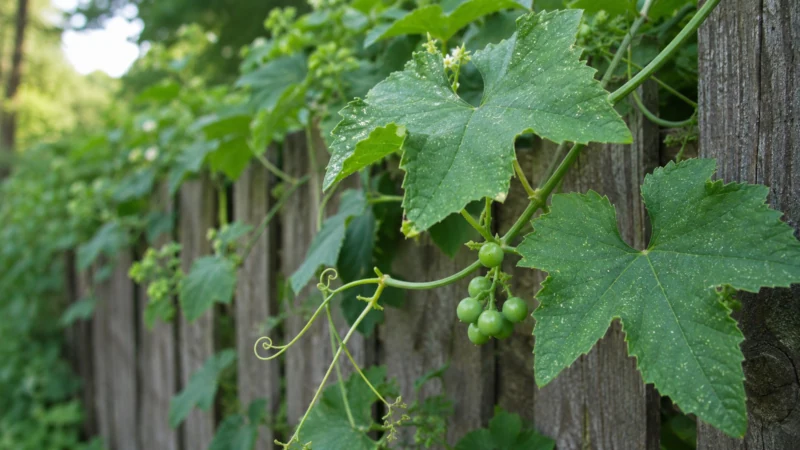
If you came here looking for the flower that flavors beer, pause before you touch anything. The name “wild hops plant” gets attached to two completely unrelated vines, and one of them can kill a child. Across the western United States, wild hops is a folk name for bryony (Bryonia), a fast-climbing weed in the cucumber family whose roots and berries are seriously poisonous [Washington State Noxious Weed Control Board]. True hops (Humulus lupulus) is a different plant in a different family. Sorting out which one is in front of you is the single most useful thing this page can do for you.
The short version: if the vine has grape-like berries, it is not hops, and you should not eat it, brew with it, or let children near it.
Three plants collide under this one common name, and the differences matter.
White bryony (Bryonia alba) is the plant most Americans mean. It was brought to the United States as a medicinal plant, escaped cultivation, and is now a declared noxious weed in Oregon, Washington, and Idaho, with established populations in several Utah counties [Utah State University Extension, 2025]. Its folk names include wild hops, wild vine, English mandrake, and devil’s turnip [Kujawska & Svanberg, 2019]. Its berries ripen from green to black.
Red bryony (Bryonia dioica) is the closely related European species, and the one older herbals usually describe. Its berries turn red rather than black. Both species belong to the Cucurbitaceae — the squash and cucumber family — and both are toxic [Kujawska & Svanberg, 2019].
True hops (Humulus lupulus) is in the Cannabaceae family. It is a climbing vine with heart-shaped dark green leaves that produces papery cones, not berries, and those cones carry the bitter resin used in brewing [NIH LiverTox, 2018]. If you are looking at fruit that resembles a small grape, you are not looking at hops.
How to identify wild hops (bryony) in the field
Bryony is a perennial vine that regrows each spring from a fleshy yellow tuber. Established plants can send out vines 12 to 40 feet long in a single season, and growth of roughly six inches a day has been recorded [Utah State University Extension, 2025] [Montana State University Extension, 2019]. Where there is nothing to climb, it sprawls into dense mats that smother whatever is underneath.
- Leaves: simple, triangular, alternate, with three to five palmate lobes and broad teeth. Both surfaces carry small white glands or dots.
- Tendrils: long, curling, and unbranched, coming off the leaf axils.
- Flowers: greenish-white to pale yellow, up to about half an inch across, and shaped like a small cucumber blossom.
- Berries: roughly half an inch across, each holding three to six seeds. White bryony berries turn from light green to black; red bryony berries turn red.
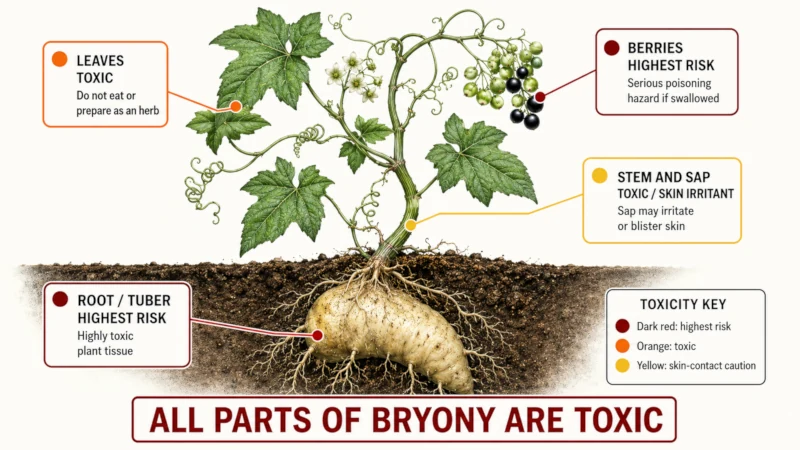
- Root: a thick, fleshy, pale yellow tuber that on a well-established plant can reach the size of a football.
That description comes from state weed authorities rather than folklore [Washington State Noxious Weed Control Board] [Utah State University Extension, 2025].
The look-alike problem
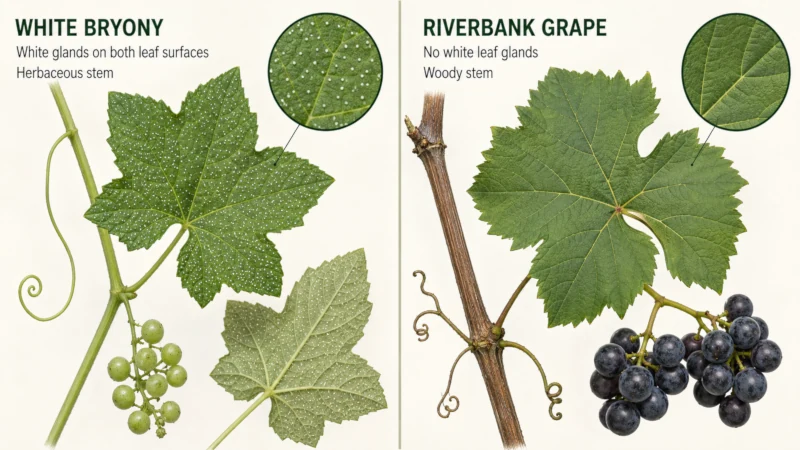
The reason this plant sends people to the emergency room is that it reads, at a glance, as wild grape. Montana State University Extension flags the resemblance to riverbank grape (Vitis riparia) specifically, and notes two tells that hold up: bryony leaves carry small white glands on both surfaces, and bryony has no woody stem [Montana State University Extension, 2019]. Fruits and foliage are also mistaken for wild cucumber [Utah State University Extension, 2025].
| Feature | Bryony (“wild hops”) | Wild grape | True hops |
| Family | Cucurbitaceae | Vitaceae | Cannabaceae |
| Fruit | Berry, ~½ in., green to black or red | Berry, purple-black clusters | Papery green cone, no berry |
| Stem | Herbaceous, dies back each year | Woody, persists year to year | Herbaceous, rough bristles |
| Leaf surface | Small white glands on both sides | No white glands | No white glands |
| Safe to eat? | No — roots and berries can be fatal | Yes | Cones used in brewing |
Sources: [Montana State University Extension, 2019] [Utah State University Extension, 2025] [NIH LiverTox, 2018].
Why bryony is poisonous
The toxicity comes from cucurbitacins — bitter triterpenes found across the squash family, concentrated here to a degree that ordinary cucumbers and melons never reach. They are severe gastrointestinal irritants and drastic purgatives [Kujawska & Svanberg, 2019]. Every part of the plant is toxic, but the roots and the berries carry the highest risk [Washington State Noxious Weed Control Board] [Utah State University Extension, 2025].
One detail worth knowing if you are reading older herbal texts: cucurbitacin content is not constant. Fresh roots dug in summer are reported to contain the highly toxic cucurbitacin I, while roots dried after autumn or spring harvest contain mostly a less toxic derivative [Kujawska & Svanberg, 2019]. That is a chemical footnote, not a safety margin — it does not make any part of the plant safe to prepare at home.
How much is dangerous — and how firm that number really is
You will see a figure repeated across extension bulletins: as few as 40 berries can be fatal to an adult, and human fatality has been reported at fewer than 40 [Utah State University Extension, 2025] [Montana State University Extension, 2019]. A 2019 review traces that estimate back to older toxicology literature, which put the lethal dose at roughly 15 berries for a child and 40 for an adult [Kujawska & Svanberg, 2019].
Treat those as order-of-magnitude estimates from case reports, not as a threshold. They come from historical poisoning literature rather than controlled study, and body weight, ripeness, and how much was actually swallowed all move the number. The practical takeaway is the opposite of reassuring precision: a handful of berries is a medical emergency for a small child, and there is no safe amount to sample.
What to do if someone swallows part of the plant
| Call 911 immediately if the person collapses, has a seizure, has trouble breathing, or cannot be woken up. Otherwise, get expert help right away — free and confidential, 24 hours a day: Poison Control: 1-800-222-1222 · or use the webPOISONCONTROL online tool at poison.org Do not induce vomiting. Ipecac syrup is no longer recommended [National Capital Poison Center]. |
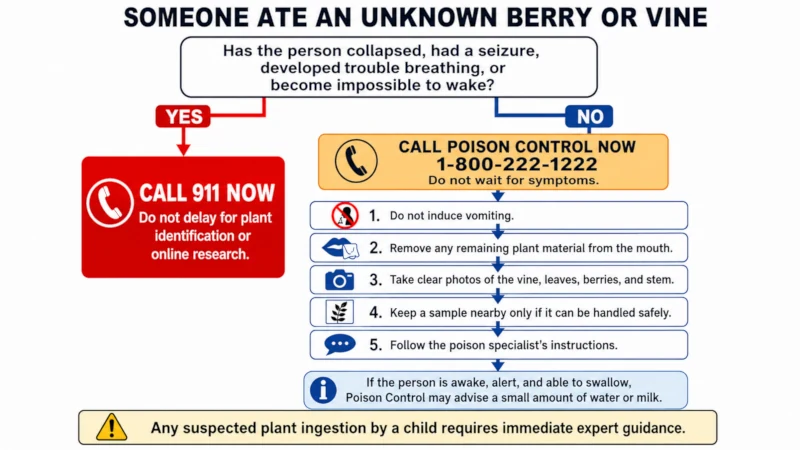
A few things make that call more useful. Have the plant name or a photo ready — poison specialists depend on accurate identification, and they often cannot identify a plant over the phone from a description alone [National Capital Poison Center]. Remove any remaining plant material from the person’s mouth. If the swallowed material was irritating and the person is alert and able to swallow, a small amount of water or milk is reasonable while you get help [National Capital Poison Center].
Symptoms that mean you need care now
Cucurbitacin poisoning is a gastrointestinal event first. Expect burning in the mouth and throat, nausea, vomiting, cramping abdominal pain, and violent watery diarrhea. In severe poisoning, the danger shifts from the gut to fluid loss and, in the worst reported cases, to collapse and respiratory failure [Kujawska & Svanberg, 2019].
- Any known or suspected ingestion by a child, at any amount
- Repeated vomiting or diarrhea that will not stop
- Blood in vomit, stool, or urine
- Dizziness, confusion, weakness, or fainting
- Signs of dehydration: very dark urine, no urination, dry mouth, sunken eyes
- Seizure, trouble breathing, or unresponsiveness — call 911
Handling the plant: skin contact counts
The sap blisters skin. Both Utah State and Montana State extension services tell people to wear gloves, long sleeves, and protective clothing when handling bryony, and that advice is not decorative [Utah State University Extension, 2025] [Montana State University Extension, 2019]. Fresh root sap is the worst offender.
If sap gets on skin, remove contaminated clothing and rinse the area with plenty of room-temperature running water for at least 15 minutes, then call Poison Control for guidance. Persistent blistering, deep burns, or spreading redness needs a clinician [National Capital Poison Center]. Wash your hands before touching your eyes.
What bryony was used for — and why the use stopped
Bryony has a real medicinal history, and it is worth understanding rather than dismissing. The root appeared in the official pharmacopoeias of Germany, Denmark, Sweden, and Poland; in Sweden it was listed until 1817. It was used as a purgative and laxative, applied to bruises and sores, and had a long reputation against gout and stitches in the side [Kujawska & Svanberg, 2019]. Its knobby root was also sold, fraudulently, as mandrake by peddlers who carved it into human shapes.
It fell out of use for a reason that has not changed: the plant is too toxic and the effects too violent to control. A 2019 historical review concludes that declining interest in bryony as a medicinal plant stems from its toxicity, and that gentler, more effective plants displaced it [Kujawska & Svanberg, 2019]. Ironically, the medicinal reputation is exactly why it reached North America in the first place [Utah State University Extension, 2025].
Where does the evidence stand today? The pharmacological activities attributed to bryony — anti-inflammatory, antirheumatic, expectorant — rest on laboratory and animal work, not on controlled trials in people [Kujawska & Svanberg, 2019]. There is no clinical evidence base supporting bryony root as a treatment for any condition, and the toxicity is not in dispute. This is the same pattern that plays out with other plants whose folk reputation outran their safety record — the sassafras tree is a useful comparison, and so is poison hemlock.
Homeopathic Bryonia is a separate question
Homeopathic preparations labeled Bryonia (often sold as 6C, 30C, or 200C) are made from the plant but diluted to the point that, at higher potencies, no molecules of the original substance are expected to remain [NCCIH, 2021]. That resolves the poisoning question and raises a different one.
The National Center for Complementary and Integrative Health states plainly that there is little evidence to support homeopathy as an effective treatment for any specific health condition, citing a 2015 Australian government assessment of 57 systematic reviews covering 176 studies that found no reliable evidence of effectiveness [NCCIH, 2021]. NCCIH also notes a genuine safety caveat: some products sold as homeopathic are not highly diluted and can contain substantial amounts of active ingredient, with side effects and drug interactions to match. No homeopathic product is FDA-approved [NCCIH, 2021]. The core guidance is to not use homeopathy in place of proven care or as a reason to delay seeing a clinician.
If you actually wanted hops
True hops is a legitimate herbal ingredient with a modest evidence base. Extracts have long been used as a sedative for anxiety, tension, and difficulty sleeping, usually combined with valerian. The honest summary from the NIH is that despite wide use, hops has not been proven effective as either a sedative or a hypnotic [NIH LiverTox, 2018]. Reported side effects are few — drowsiness, dizziness, and hypersensitivity reactions — and hops has not been convincingly linked to liver injury [NIH LiverTox, 2018].
That is a modest claim, and it is the accurate one. If you are buying a hops supplement, check that the label names Humulus lupulus. If you are foraging, you are looking for papery cones on a bristly vine, not berries on a smooth one.
If bryony is growing on your property
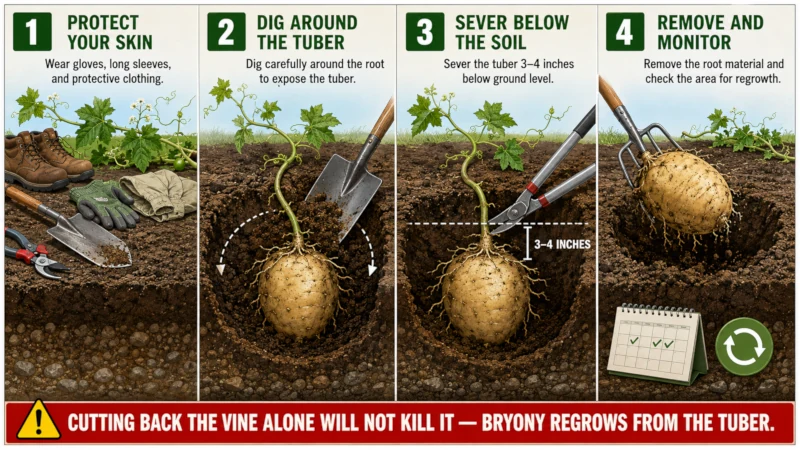
Cutting the vine back does not work — it resprouts from the root [Washington State Noxious Weed Control Board]. Removal means getting the tuber.
- Dig and sever the tuber 3 to 4 inches below the soil surface. Fall, after the leaves die back, is the most effective timing, though it can be done any time [Utah State University Extension, 2025].
- Pull seedlings before they establish; young plants come out far more easily than a football-sized tuber.
- Wear gloves and long sleeves, and keep the cut root away from bare skin.
- Expect to repeat. Seeds stay viable for years and plants regenerate from roots and tubers, so plan on monitoring the same spot across several seasons [Utah State University Extension, 2025].
- Glyphosate is the post-emergent herbicide registered for control, and it is non-selective — it kills desirable plants it touches. Herbicide use near ditches, streams, and riverbanks is tightly restricted, so read the label for the site you are treating [Utah State University Extension, 2025].
- Where bryony is a listed noxious weed, your county weed board can tell you what control is required and what help is available [Washington State Noxious Weed Control Board].
Birds are the main way it spreads: they eat the berries and deposit seed under fence lines, trees, and power lines, which is why new plants tend to appear beneath perches [Utah State University Extension, 2025].
Who needs to be most careful
Children top the list. The berries look like grapes, the reported lethal dose is lower for a child, and small children explore by mouth [Montana State University Extension, 2019] [Kujawska & Svanberg, 2019]. If bryony is growing where children play, removal is not a landscaping preference.
Pregnant and breastfeeding women should avoid every part of the plant and any preparation made from it. There is no modern safety data, and nineteenth-century sources record its use as an abortifacient on the strength of its effect on the uterus [Kujawska & Svanberg, 2019] — a history that argues for complete avoidance, not cautious use.
Pets and livestock are also at risk. Washington State classifies bryony as toxic to both humans and livestock, and cases of livestock poisoning are documented [Washington State Noxious Weed Control Board]. If a pet has eaten any part of the plant, call your veterinarian or an animal poison line rather than waiting for symptoms.
Anyone taking prescription medication, managing a chronic illness, or considering any herbal product containing bryony should talk with a clinician or pharmacist first. Because the plant acts as a drastic purgative, it also carries a specific hazard for anyone whose medication depends on normal absorption or whose condition makes fluid loss risky.
Related plants people confuse with it
Two more vines regularly get tangled into the same conversation. Black bryony (Dioscorea communis, formerly Tamus communis) is not a true bryony at all — it belongs to the yam family, has heart-shaped leaves and bright red berries, and is likewise poisonous when taken internally. Sarsaparilla (Smilax aspera) is the one older texts contrast bryony against; it has thorny stems and heart-shaped leaves, and although its root has a long medicinal history, its berries are still advised against.
The practical rule cuts through all of it: an unfamiliar climbing vine with berries is not something to taste-test. Identify it first, from a state extension service or a local expert, before it goes anywhere near your mouth.
| HEALTH DISCLAIMER: This article is for general education and information only. It is not medical advice and is not a substitute for diagnosis or treatment from a qualified healthcare professional. Bryony is a poisonous plant, and nothing here should be read as instructions for preparing or taking it. If you suspect a poisoning, call Poison Control at 1-800-222-1222 or use the webPOISONCONTROL online tool; call 911 if the person collapses, has a seizure, has trouble breathing, or cannot be woken. If you are pregnant, breastfeeding, caring for a young child, taking prescription medication, or managing a chronic condition, talk to your doctor before using any herb, supplement, or natural remedy. |
Frequently Asked Questions
Is the wild hops plant the same as the hops used in beer?
No. Brewing hops is Humulus lupulus, which produces papery cones. The plant commonly called wild hops in the western United States is bryony (Bryonia), a poisonous vine in the cucumber family that produces berries [Washington State Noxious Weed Control Board] [NIH LiverTox, 2018].
How many bryony berries are dangerous?
Extension sources report that as few as 40 berries can be fatal to an adult, and older toxicology literature puts the figure near 15 berries for a child [Utah State University Extension, 2025] [Kujawska & Svanberg, 2019]. These are estimates from case reports rather than measured thresholds. Any ingestion warrants a call to Poison Control.
My child ate a berry off a vine in the yard. What now?
Call Poison Control at 1-800-222-1222 or use the webPOISONCONTROL tool right away — do not wait for symptoms, and do not make the child vomit [National Capital Poison Center]. Take a photo of the vine, leaves, and berries, since accurate identification changes the advice you get [National Capital Poison Center]. If the child collapses, seizes, cannot breathe, or cannot be woken, call 911.
Can you touch wild hops safely?
Brief contact with leaves is unlikely to cause harm, but the sap can blister skin, so gloves and long sleeves are recommended whenever you handle or dig the plant [Utah State University Extension, 2025]. Rinse any sap off with running water for at least 15 minutes.
Does homeopathic Bryonia 30C contain the actual plant?
At that dilution, no molecules of the original substance are expected to remain [NCCIH, 2021]. NCCIH also reports that there is little evidence supporting homeopathy as an effective treatment for any specific condition, and that some products labeled homeopathic are not highly diluted and can contain meaningful amounts of active ingredient [NCCIH, 2021]. Bring the product to your clinician if you are using one.
How do I tell bryony from wild grape?
Look at the leaf surface and the stem. Bryony leaves carry small white glands on both sides and its stem is herbaceous, dying back each year. Riverbank grape has no white glands and develops a woody stem [Montana State University Extension, 2019]. If you are not certain, do not eat the fruit.
References
- Beddes T, Caron M, Hadfield J, Ransom C. White Bryony (Bryonia alba). Utah State University Extension, peer-reviewed fact sheet. November 2025. → View source
- Mangold J. White Bryony — Monthly Weed Post, September 2019. Montana State University Extension, Invasive Plants Program. → View source
- Washington State Noxious Weed Control Board. White Bryony (Bryonia alba) — Class B noxious weed profile. → View source
- Kujawska M, Svanberg I. From medicinal plant to noxious weed: Bryonia alba L. (Cucurbitaceae) in northern and eastern Europe. Journal of Ethnobiology and Ethnomedicine. 2019;15:22. DOI 10.1186/s13002-019-0303-6. → View source
- National Capital Poison Center. First Aid: Act Fast! — poison first-aid guidelines. → View source
- National Capital Poison Center. Poisonous and Non-Poisonous Plants: An Illustrated List. → View source
- National Center for Complementary and Integrative Health (NCCIH). Homeopathy: What You Need To Know. Last updated April 2021. → View source
- LiverTox: Clinical and Research Information on Drug-Induced Liver Injury. Hops. National Institute of Diabetes and Digestive and Kidney Diseases. Updated March 30, 2018. Bookshelf ID NBK548872. → View source
