
Most of what circulates about the stinking weed plant is inherited folklore rather than tested medicine. And the effect that has been documented most consistently in humans is not a benefit — it is harm. Senna occidentalis, better known as coffee senna, has been tied to outbreaks of sudden liver failure in children who ate its seeds, and to the death of an adult who brewed its leaves for two weeks [LiverTox, NIDDK, 2020].
So the honest summary of stinking weed benefits is this: the plant does contain biologically active compounds, traditional healers across Latin America, West Africa, and South Asia have used it for generations, and neither of those facts makes it safe to drink. This page covers what the plant is, what tradition claims, what laboratory work has and has not shown, and where the hard safety lines fall.
What stinking weed actually is
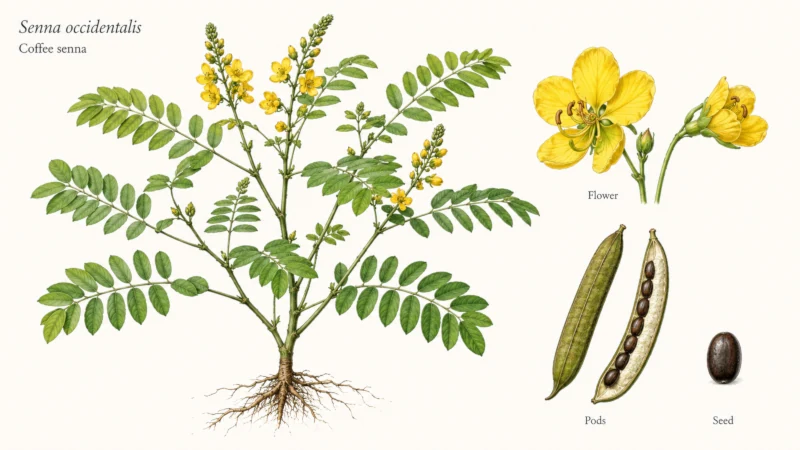
The accepted botanical name is Senna occidentalis (L.) Link, in the pea family (Fabaceae). You will still see the older name Cassia occidentalis almost everywhere in the medical literature, so the two refer to the same plant. Common names include coffee senna, stinkweed, styptic weed and septicweed; casse fétide in French, brusca in Spanish.
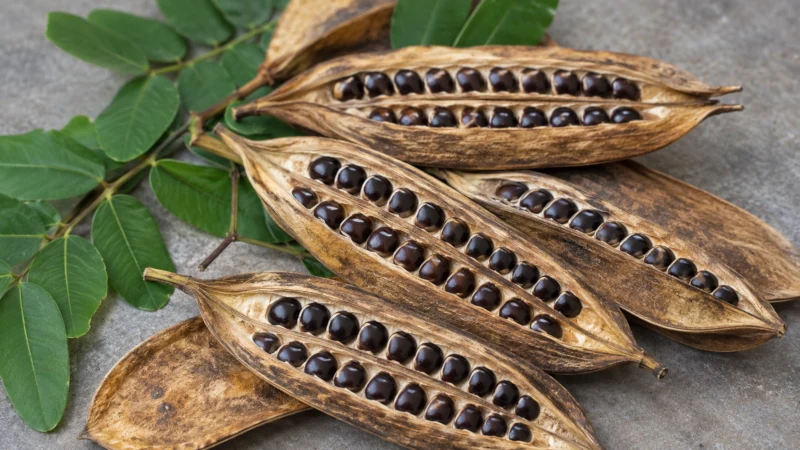
It is native to tropical and subtropical America — Mexico and the Caribbean down through Colombia, Venezuela, Brazil and northern Argentina — and has since naturalised across Africa, South and Southeast Asia, Australia and the southern United States [Plants of the World Online, Kew]. It grows as an annual or short-lived subshrub, roughly one to two metres tall, with pinnate leaves, yellow flowers, and flattened pods up to about 12 cm holding two rows of dark seeds. Crush the leaves and the smell explains the name.
Kew’s own species record lists the plant’s documented uses as medicine, food — and poison [Plants of the World Online, Kew]. That third entry is not an afterthought.
It is not the senna in your pharmacy
This confusion causes real harm, so it is worth being blunt about. The senna sold as an over-the-counter laxative comes from Senna alexandrina — the plant older texts call Cassia angustifolia or Cassia acutifolia. That species has a long regulatory history, standardised sennosides, and a well-characterised short-term safety profile.
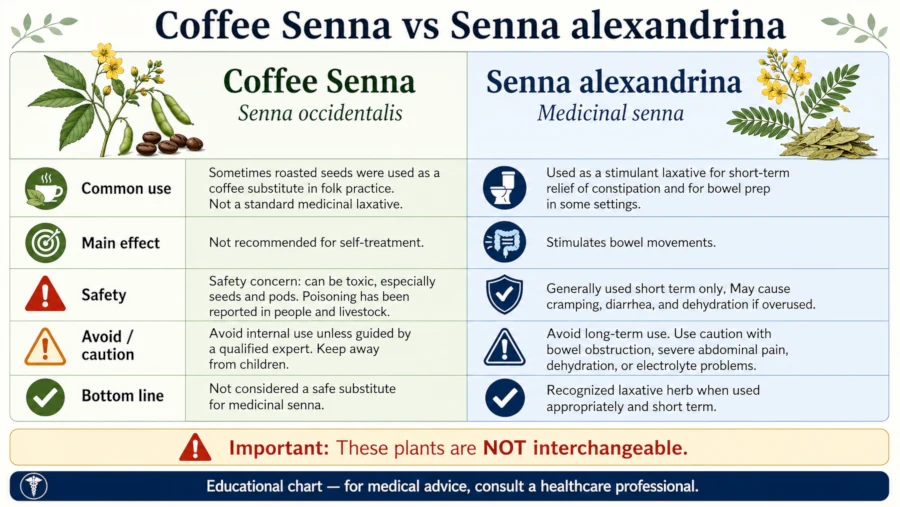
Coffee senna is a different species that merely shares the genus. The NIH’s drug-induced liver injury database, LiverTox, discusses the two separately and states plainly that whether coffee senna’s liver injury shares a mechanism with ordinary laxative senna is unknown [LiverTox, NIDDK, 2020]. Several unrelated plants carry the “senna” label — bladder senna is another — and dosing advice written for one of them does not transfer to the others.
What tradition claims, and how the evidence grades
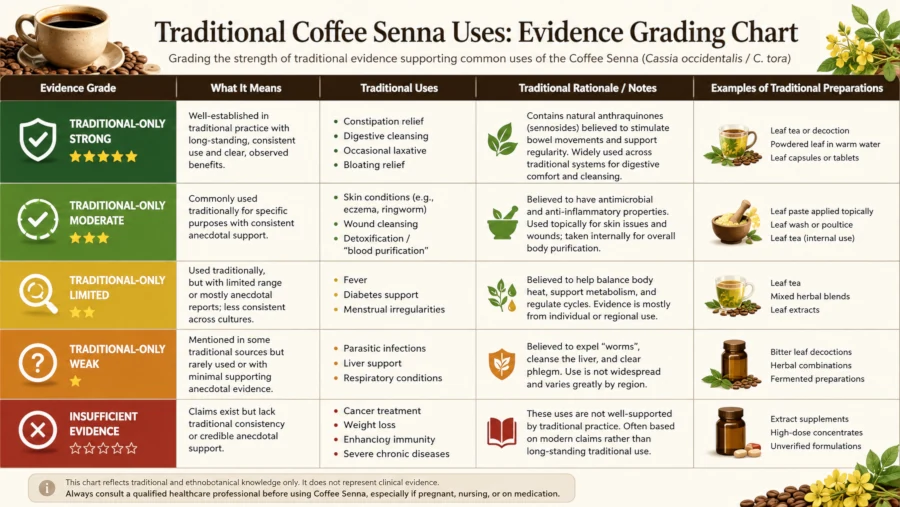
Traditional use is worth recording accurately. It is not, on its own, evidence of benefit or of safety. Here is the honest ledger.
| Traditional use | What actually supports it | Evidence grade |
| Toasted seeds brewed as a coffee substitute | Widely and reliably documented as an ethnobotanical practice across Latin America. It is a description of what people do, not a health claim. | Well documented as custom; not a benefit claim |
| Root decoction for painful periods (dysmenorrhea) | Folk practice only. No human clinical trials identified. | Traditional only |
| Leaf poultices for swelling, bruises, boils and sprains | Folk practice only. Topical use has not been trialled in humans. | Traditional only |
| Seeds for prostate problems | No supporting human or preclinical evidence was located for this specific use. | Insufficient evidence |
| Antibacterial, antifungal, antidiabetic, anti-inflammatory, anticancer activity | Reported in laboratory and animal studies summarised in a pharmacological review of the species. | Preclinical only (lab / animal) |
For the last row, a 2010 review in Fitoterapia catalogued the reported activities and the compounds isolated from the plant — anthraquinones including emodin, aloe-emodin and chrysophanol, plus flavonoids such as apigenin [Yadav et al., 2010]. Every one of those findings comes from cell cultures or animal models. None has been tested in a controlled human trial.
That same review lists hepatoprotective activity — liver-protecting — among the reported effects. Human case reports describe the opposite. Both findings are real at their own level of evidence, and the contradiction is genuine rather than something to be smoothed over: an isolated compound at a controlled dose in a rodent behaves nothing like a handful of raw seeds eaten by a four-year-old. When preclinical signals and human case reports point in opposite directions, the human data is the one that governs a decision about what to put in your body.
The safety record is the story
Acute liver, muscle and brain injury in children
For years, districts of western Uttar Pradesh in India saw recurring seasonal outbreaks of a devastating illness in young children, typically between September and November. Children developed sudden vomiting, agitation and abnormal behaviour, then slid into stupor and coma. Blood tests showed sharply raised liver enzymes, low blood sugar and clotting failure. Doctors named the syndrome hepatomyoencephalopathy, because liver, skeletal muscle and brain were all struck at once. In the case series LiverTox summarises, 76% of the children died, usually within 72 hours [LiverTox, NIDDK, 2020].
The cause was not identified for years, partly because the presentation mimics viral encephalitis. A case-control study conducted in Bijnor district in 2005 compared 18 affected children with 54 age-matched controls. Parents of 8 of the 18 cases (44.4%) gave a definite history of the child eating beans of the Cassia occidentalis weed shortly before falling ill, against 3 of 54 controls (5.6%) — an odds ratio of 12.9 (95% CI 2.6–88.8, P<0.001). A history of pica was the only other significantly associated factor, at an odds ratio of 5.20. The authors concluded that eating the beans probably caused the outbreaks [Vashishtha et al., Indian J Med Res, 2007].
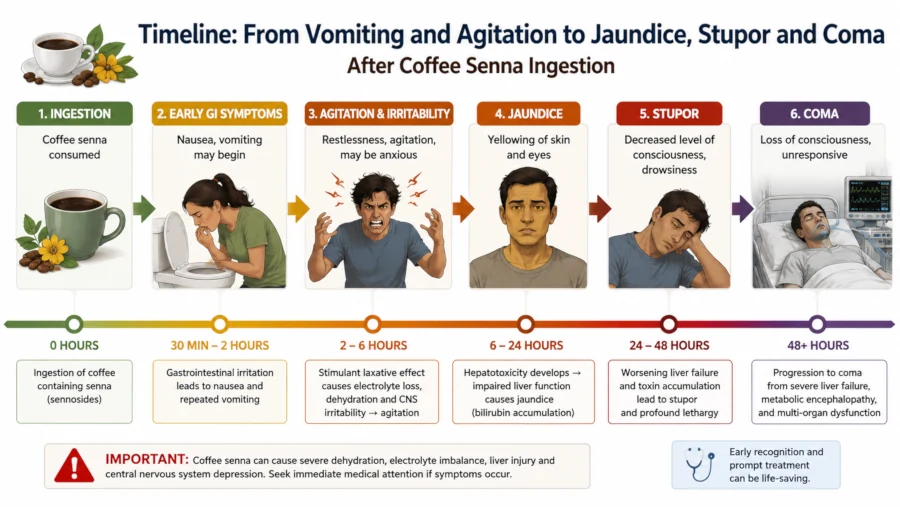
A case-control study of this size establishes probable cause rather than proof, and the researchers said so themselves. But the association is strong, it is consistent with decades of documented poisoning in cattle and goats, and it is consistent with what happens in animals given seed extracts in the laboratory.
An adult death after two weeks of leaf tea
The children’s outbreaks involved raw seeds eaten straight off the plant, which is easy to file away as something that happens to toddlers rather than to careful adults. One published case makes that reassurance harder to hold.
A 75-year-old woman self-medicated with Senna occidentalis leaves for two weeks to treat knee osteoarthritis. She developed nausea, vomiting, diarrhoea and a low fever, was sent home from a local hospital with near-normal bloodwork, and returned two days later confused, deeply jaundiced and swollen. Her bilirubin had reached 12.9 mg/dL, her INR 2.68, her ammonia 127 µmol/L. She progressed to coma and unremitting seizures and died five days after first presenting. Autopsy examination of the liver showed massive necrosis [Ish et al., ACG Case Reports Journal, 2019]; [LiverTox, NIDDK, 2020].
Two weeks of herbal tea, in an adult, for a sore knee. That is the number worth carrying away from this page. A single case report cannot tell you how often this happens — it may well be rare — but it does establish that the dose and duration required are not extreme.
What the toxin is
The specific compound responsible has not been conclusively identified. Anthraquinone derivatives are the leading suspects: LiverTox attributes senna-related liver injury generally to these compounds and notes that most cases involve excessive doses, which points toward direct toxicity rather than an unpredictable individual reaction [LiverTox, NIDDK, 2020]. Practically, this matters in one way: if the damage is dose-related and direct rather than idiosyncratic, then “I’ll just take a little” is a weaker defence than people assume, and there is no established threshold below which the plant is known to be safe.
Side effects, interactions and who must avoid it
Reported effects in poisoning cases include vomiting, diarrhoea, abdominal pain, agitation and abnormal behaviour, muscle injury, low blood sugar, jaundice, clotting abnormalities, seizures and coma [LiverTox, NIDDK, 2020]; [Vashishtha et al., 2007]. Because anthraquinones in the wider senna group act as bowel stimulants, cramping, loose stools and fluid or electrolyte loss are also plausible at lower exposures.
Medication interactions have not been formally studied for this species, so what follows is precautionary reasoning rather than tested fact. Anything that can injure the liver deserves particular care alongside paracetamol/acetaminophen, methotrexate, isoniazid, azole antifungals, statins, or heavy alcohol use. Anything with a purgative effect can shift potassium, which matters if you take digoxin, prescription diuretics, or corticosteroids. Anything affecting clotting deserves care alongside warfarin or other anticoagulants — this plant’s poisoning cases feature clotting failure prominently. Tell a pharmacist before combining any herbal preparation with prescription medicine.
Do not use coffee senna internally if you are in any of these groups:
- Children — no exception, no dose. The published deaths are overwhelmingly in children under ten.
- Pregnant or breastfeeding. There is no safety data, and the wider senna group has documented effects on the uterus and bowel. Avoid entirely.
- Anyone with liver disease, hepatitis, or raised liver enzymes.
- Anyone taking regular prescription medication, particularly the drug classes listed above.
- Anyone with kidney disease, inflammatory bowel disease, or undiagnosed abdominal pain.
For everyone else, the realistic position is that there is no established therapeutic dose, no quality control over wild-harvested plant material, no human efficacy data for any indication, and a documented pattern of severe liver injury. Older herbals give confident-sounding decoction and infusion quantities. Those figures predate the case literature and this page does not repeat them.
If it grows near you
Coffee senna is a roadside and pasture weed across much of the tropics and the southern United States, and the pods are exactly the kind of thing a child picks up. Pica — the urge to eat non-food items — was itself an independent risk factor in the outbreak study [Vashishtha et al., 2007]. Some practical steps:
- Pull or cut the plants where small children play, and clear fallen pods rather than leaving them on the ground.
- Teach children the general rule: no eating beans, berries or seeds found outdoors, however much they look like food.
- Keep livestock and pets away from stands of it; poisoning in cattle and goats is long established.
- If you deliberately grow it as an ornamental, remove the pods before they mature.
Red flags: when to get help immediately
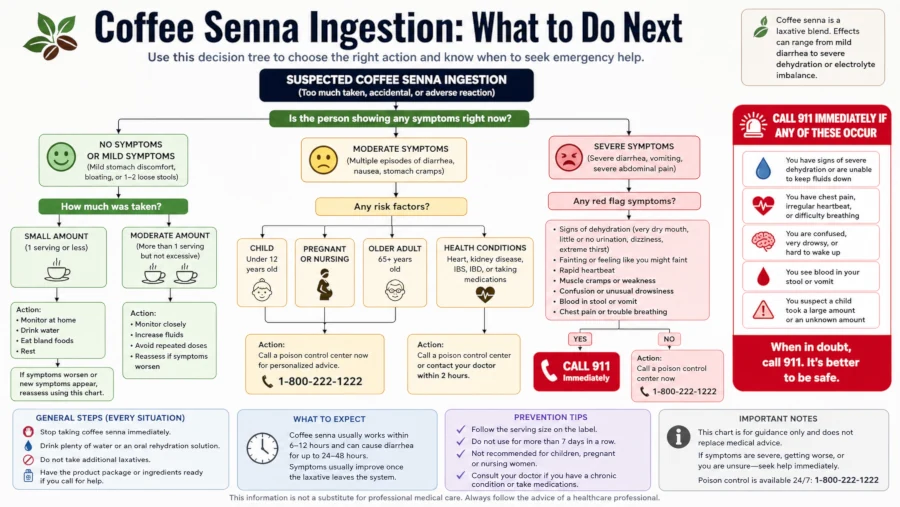
If someone — especially a child — has swallowed any part of this plant, do not wait to see how things develop. Get advice straight away. In the United States, the National Capital Poison Center offers free, confidential help through its webPOISONCONTROL online tool, and poison centres can be reached at 1-800-222-1222 [Poison Control, National Capital Poison Center].
Call 911 immediately if the person collapses, has a seizure, has trouble breathing, or cannot be woken [Poison Control].
Seek urgent medical care for any of the following after a suspected ingestion:
- Repeated vomiting, particularly alongside agitation, confusion, unusual or violent behaviour, or drowsiness
- Yellowing of the skin or the whites of the eyes, or dark urine
- Muscle pain or weakness, or urine the colour of cola
- Unusual bruising or bleeding
- Any seizure, or a child who becomes unusually difficult to rouse
One point to raise with the clinician: this syndrome was repeatedly mistaken for viral encephalitis before its cause was identified. If there is any chance the plant was eaten, say so explicitly and by name. It changes what the medical team looks for.
What about the coffee substitute?
Roasting the seeds and brewing them like coffee is a genuine and long-standing tradition in parts of Latin America, and it is fair to say that this practice has not produced the outbreak pattern seen with raw seed ingestion. But two things are worth being straight about. No study establishes that roasting reliably destroys or deactivates the toxic constituents.
And LiverTox’s account of the Indian outbreaks notes that where the plant had been used to prepare tea, the quantities involved were minimal — which is a comment on exposure levels, not a clearance for regular consumption [LiverTox, NIDDK, 2020]. The adult death described earlier followed two weeks of leaf preparation, not raw seeds. Absence of documented harm from a traditional practice is not the same as evidence of safety, and the margin here is too thin to build a habit on.
Realistic expectations
If you came here hoping to find that stinking weed is an overlooked remedy for period pain, swelling or prostate trouble, the evidence does not support that. What exists is centuries of traditional use, a body of promising-but-untested laboratory chemistry, and a documented human toxicity record serious enough that a national liver-injury database maintains an entry on it.
If the traditional uses are what drew you here, those underlying problems all have better-studied options — and painful periods, persistent swelling and urinary symptoms are all worth a diagnosis rather than a home remedy. Our overview of common rue covers a similar case of an old menstrual remedy whose safety record outweighs its evidence.
| Health Disclaimer: This article is for general education only and is not medical advice. Coffee senna (Senna occidentalis) has a documented record of severe liver, muscle and neurological injury in humans, and nothing here should be read as a recommendation to prepare, take or give it. Do not use it during pregnancy or breastfeeding, and never give it to a child. Talk with a doctor or pharmacist before using any herbal product, especially if you take prescription medication, have a liver or kidney condition, or care for children. If you think someone has swallowed part of this plant, contact Poison Control or seek urgent medical care immediately; call 911 if they collapse, have a seizure, have trouble breathing, or cannot be woken. |
Frequently Asked Questions
Is stinking weed the same as the senna in laxatives?
No. Over-the-counter senna comes from Senna alexandrina (older names Cassia angustifolia and Cassia acutifolia). Stinking weed is Senna occidentalis, a different species with a very different safety record. Dosing information written for laxative senna does not apply to it [LiverTox, NIDDK, 2020].
Is stinking weed tea safe to drink?
There is no established safe dose. A published case describes a 75-year-old woman who died of acute liver failure after two weeks of self-medicating with the leaves [Ish et al., 2019]. Wild plant material also varies enormously in strength. On the current evidence, no.
Why are children at particular risk?
The documented outbreaks almost all involved young children eating the beans directly from the plant, and pica was an independent risk factor. In one case-control study the odds of illness were about 13 times higher in children with a definite history of eating the beans [Vashishtha et al., 2007]. Children are also smaller, so a given quantity of plant material is a much larger exposure.
Does roasting the seeds make them safe?
Roasting seeds as a coffee substitute is traditional in parts of Latin America, but no study has established that it reliably destroys the toxic constituents. Treat it as an unquantified risk rather than a proven detoxification step.
What should I do if my child ate seeds from this plant?
Get advice immediately rather than waiting for symptoms. Use the webPOISONCONTROL tool or call a poison centre at 1-800-222-1222; call 911 if the child collapses, seizes, has trouble breathing, or cannot be woken [Poison Control]. Tell the medical team the plant by name — the illness can be mistaken for viral encephalitis.
Do the lab studies showing anti-inflammatory effects count for anything?
They are a legitimate reason for researchers to keep studying the plant’s isolated compounds. They are not a reason to consume the whole plant. Preclinical activity has never been the same thing as a safe, effective human treatment [Yadav et al., 2010].
References
- LiverTox: Clinical and Research Information on Drug-Induced Liver Injury — “Senna.” National Institute of Diabetes and Digestive and Kidney Diseases (NIDDK), NIH. Updated 1 April 2020. Bookshelf ID NBK547922. → View source
- Vashishtha VM, Kumar A, John TJ, Nayak NC. “Cassia occidentalis poisoning as the probable cause of hepatomyoencephalopathy in children in western Uttar Pradesh.” Indian Journal of Medical Research. 2007;125(6):756–762. PMID 17704552. → View source
- Ish P, Rathi S, Singh H, Anuradha S. “Senna occidentalis Poisoning: An Uncommon Cause of Liver Failure.” ACG Case Reports Journal. 2019;6(4):e00035. PMID 31616727; PMCID PMC6658039; DOI 10.14309/crj.0000000000000035. → View source
- Plants of the World Online. “Senna occidentalis (L.) Link.” Royal Botanic Gardens, Kew. Accessed 19 July 2026. → View source
- Yadav JP, Arya V, Yadav S, Panghal M, Kumar S, Dhankhar S. “Cassia occidentalis L.: a review on its ethnobotany, phytochemical and pharmacological profile.” Fitoterapia. 2010;81(4):223–230. PMID 19796670; DOI 10.1016/j.fitote.2009.09.008. → View source
- Poison Control / National Capital Poison Center. “Get Poison Control help online now.” Accessed 19 July 2026. → View source
