
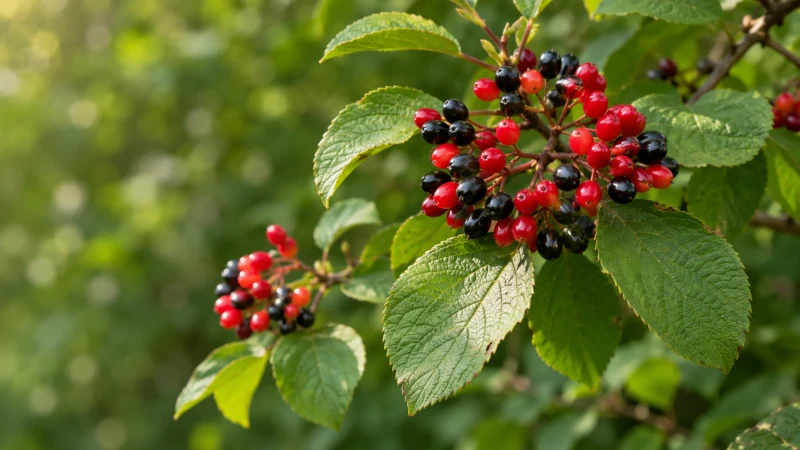
The wayfaring tree has an old reputation as a mouth-and-throat astringent, but no one has tested it in people. The research that exists is a handful of lab studies on its leaves and fruit, plus a folk record of astringent use. There’s also a real disagreement about how harmful the berries are to eat. If you’re wondering whether to turn the shrub in your hedge into a gargle, the honest answer is that better-tested options exist. Here’s what the wayfaring tree is, what’s in it, and where the evidence runs out.
The wayfaring tree at a glance
| Feature | Details |
| Scientific name | Viburnum lantana L. [POWO, n.d.] |
| Family | Viburnaceae in recent literature; older references place it in Adoxaceae or Caprifoliaceae [Effatparvar et al., 2025] [PFAF, n.d.] |
| Size | Deciduous shrub or small tree, usually 4–5 m (13–16 ft) [The Wildlife Trusts, n.d.] [PFAF, n.d.] |
| Native range | Europe to Iran and northwest Africa; introduced in parts of North America [POWO, n.d.] |
| Habitat | Woodland edges, hedgerows, scrub and downland, especially on chalky soils [The Wildlife Trusts, n.d.] [PFAF, n.d.] |
| Traditional use | Astringent, recorded in Italian folk practice [USDA ARS, n.d.] |
| Human clinical trials | None found |
How to recognize it
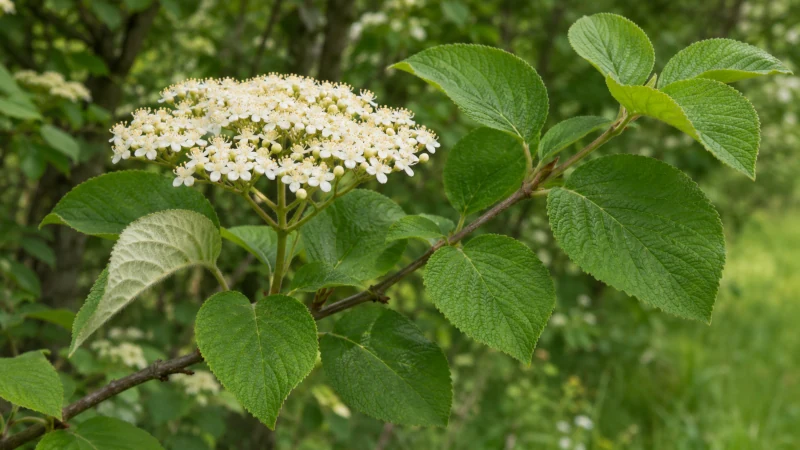
The easiest giveaway arrives in late summer. The berries ripen unevenly, so a single cluster often holds red fruit and black fruit side by side. They start red and turn black when ripe [The Wildlife Trusts, n.d.]. Ripening begins in August, and the fruit tends to hang on the shrub through winter [Konarska & Domaciuk, 2018].
The rest of the year, look for broad, oval leaves with dense, soft hairs on the underside, and flat-topped clusters of creamy-white flowers in May and June [The Wildlife Trusts, n.d.]. Birds and small mammals eat the berries and spread the seeds.
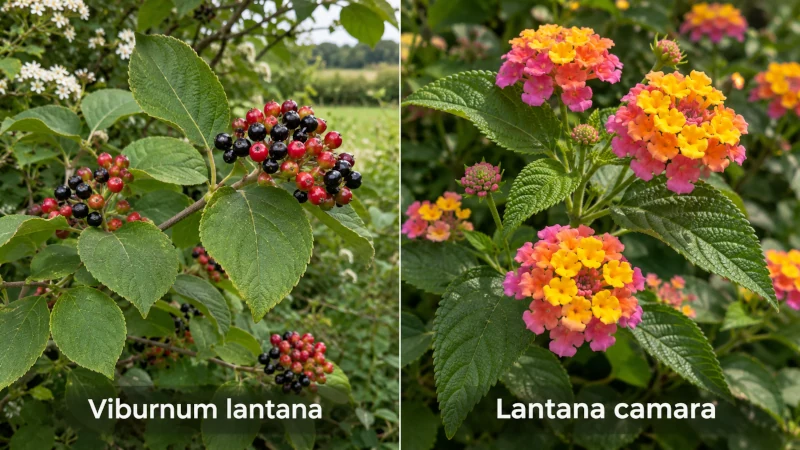
One naming trap: the wayfaring tree has nothing to do with lantana (Lantana camara), an unrelated garden plant. If you’re reading about a plant’s safety, check which one the source means.
What’s in the leaves and berries
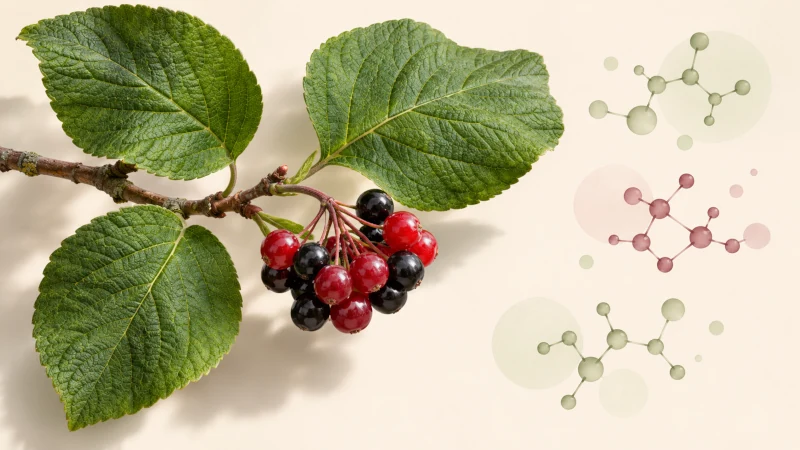
Under a microscope, the fruit holds tannins, flavonoids, anthocyanins, carotenoids, saponins and pectins, with the highest concentrations in the skin [Konarska & Domaciuk, 2018]. The same researchers note that tannins, low pH and a poor taste make Viburnum fruit unappealing to animals. That chemistry explains the sharp, mouth-drying taste people describe.
The leaves look like the richest part of the plant. In a 2025 lab comparison with its relative guelder rose (Viburnum opulus), wayfaring tree leaves had the highest total polyphenol content of any part tested, and chlorogenic acid was the main compound in both species [Effatparvar et al., 2025].
Traditional use: a puckering astringent
The folk record is short. The USDA’s ethnobotany database lists one documented use for Viburnum lantana: as an astringent in Italian tradition, citing a 1957 herbal codex [USDA ARS, n.d.]. Herbal books built on that idea, recommending rinses and gargles for inflamed gums and sore throats.
The reasoning makes sense on paper. Tannin-rich plants leave that dry, tightened feeling on the inside of your mouth, which is why astringents have long been used in rinses. Bistort, another tannin-heavy European astringent, has a similar history. But a plausible mechanism isn’t proof that a remedy helps. Even Plants For A Future, a large database that generally takes folk uses seriously, lists no known medicinal uses for this species and gives it a medicinal rating of zero out of five [PFAF, n.d.].
What the research on the wayfaring tree actually shows
All the studies we found were done in test tubes. That’s an early step, useful for spotting compounds worth a closer look, and very far from showing a benefit in people.
| Claim | What has been studied | Strength of evidence |
| Antioxidant activity | Extracts of branches, leaves and fruit scavenged free radicals in chemical assays. Wayfaring tree extracts outperformed guelder rose in one study [Erdogan-Orhan et al., 2011], and the leaf extract was the strongest in another [Effatparvar et al., 2025]. | Lab only |
| Blood-sugar enzymes | Leaf, branch and fruit extracts blocked the carbohydrate-digesting enzyme α-glucosidase more strongly than the drug acarbose in a test tube. The leaf extract was strongest [Effatparvar et al., 2025]. | Lab only; no animal or human data |
| Gum inflammation, sore throat, pharyngitis | Folk astringent use only [USDA ARS, n.d.]. | Traditional; no studies found |
| Antiseptic or antibacterial | No study on this species that we could access and confirm. | Insufficient |
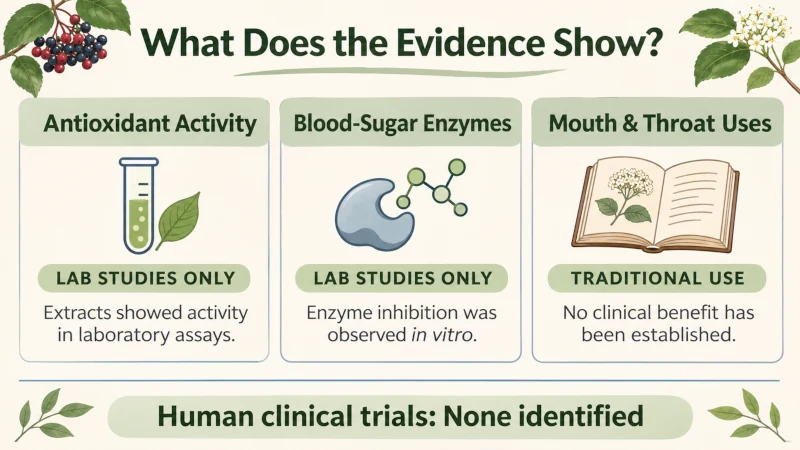
The blood-sugar result is the kind that gets overstated. Beating acarbose in a dish means a compound is worth studying. It does not mean the leaves lower blood sugar when you swallow them, and it is no reason to change diabetes treatment.
The wayfaring tree isn’t unusual here. New Jersey tea (Ceanothus americanus) is another shrub with a folk reputation for sore throats and similarly thin evidence.
Are wayfaring tree berries poisonous?
Reputable sources disagree, so it’s worth seeing both sides.
Plants For A Future calls the fruit very low or zero in toxicity. It says the berries cause only mild upsets when eaten unripe or in quantity, and that large amounts can cause vomiting and diarrhea. It describes the fruit as a famine food, eaten only when nothing else is available [PFAF, n.d.].
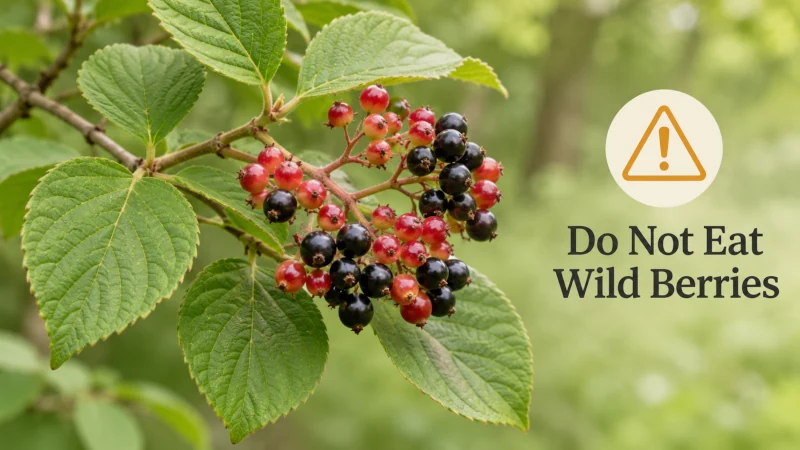
The Wildlife Trusts, a UK conservation federation, takes a firmer line. It calls the berries poisonous to humans, says they cause vomiting, and describes them as “very poisonous” [The Wildlife Trusts, n.d.].
Both agree on one point: eating the berries can make you vomit. Serious poisoning doesn’t appear in either source, but there’s also no benefit to eating them, so treat them as inedible. Keep an eye on children, who may be drawn to the glossy red and black fruit. If a child swallows some berries, call your local poison control center (in the UK, NHS 111) for advice, and get emergency help if they have trouble breathing or seem very unwell.
Should you make a wayfaring tree gargle?
Older herbal books give recipes for a wayfaring tree decoction made from ripe berries and leaves. We don’t recommend making one. No preparation has a tested dose or safety record, and a gargle is easy to swallow by accident, especially for a child. Identifying a wild shrub correctly is another place things go wrong. The foxglove story shows how badly homemade plant remedies can go, and while the wayfaring tree is nowhere near that dangerous, the same logic applies: a plant that hasn’t been tested isn’t automatically gentle.

If your mouth or throat is what brought you here, these steps have better support.
Better-tested options for a sore throat
- Gargle with warm salt water and spit it out (adults only, not children) [NHS, n.d.-a].
- Drink plenty of fluids, eat cool or soft foods, rest, and avoid smoky places.
- Ask a pharmacist about pain relief, medicated lozenges or anesthetic sprays. Check the leaflet first if you’re pregnant.
- Don’t expect antibiotics. Most sore throats don’t need them.
Better-tested options for sore or bleeding gums
- Bleeding, swollen gums are usually caused by plaque, so removing it is the treatment that matters [NHS, n.d.-b].
- Brush with fluoride toothpaste at least twice a day, and spit rather than rinse.
- Clean between your teeth every day with floss or interdental brushes.
- Don’t smoke, and keep up regular dental checkups.
A rinse can feel soothing, but none replaces plaque removal. For other plants with a stronger evidence base, browse our herb guides.
Who should avoid it
No safety studies exist for using the wayfaring tree as a remedy. That means there’s no evidence of harm, but also no evidence of safety. Plant products can cause real harm and can interact with medicines [NCCIH, 2019]. Skip it entirely if any of these apply:
- Pregnancy or breastfeeding. There’s no data. Many herbal products have never been tested in pregnant or nursing women [NCCIH, 2019].
- Children. They’re the most likely to swallow a gargle or eat the berries, and the NHS advises against salt-water gargles for children too.
- Diabetes medication. The lab results on blood-sugar enzymes raise a theoretical question about stacking effects. No one has studied it.
- Any regular medication. No interaction studies exist. Tell your doctor or pharmacist about any herbal product you use [NCCIH, 2019].
- A sensitive stomach or digestive condition. Vomiting and diarrhea are the one effect all sources agree on.
When to see a doctor or dentist
Self-care is fine for an ordinary sore throat or mildly sore gums. Get help when things don’t follow that pattern.
Call 911/999 or go to the emergency room now if you or your child [NHS, n.d.-a]:
- have trouble breathing or can’t swallow
- are drooling because swallowing is too hard
- make a high-pitched sound when breathing in (stridor)
- have severe symptoms that are getting worse quickly
Get an urgent appointment for a very high temperature or shivering, signs of dehydration, or a weakened immune system. See a doctor if a sore throat hasn’t improved after a week, keeps coming back, or comes with a lump in your neck or a mouth ulcer lasting more than three weeks [NHS, n.d.-a].
See a dentist urgently if gum problems come with very sore, swollen gums, loose teeth, ulcers or red patches in the mouth, or a lump in the mouth or on the lip [NHS, n.d.-b].
| HEALTH DISCLAIMER: This article is for general education and isn’t a substitute for advice, diagnosis or treatment from a qualified health professional. The wayfaring tree has not been tested as a treatment in people. Talk to your doctor, dentist or pharmacist before using any herbal remedy, especially if you are pregnant or breastfeeding, giving it to a child, or taking medication. If you think someone has been poisoned, contact your local poison control center or emergency services. |
Frequently Asked Questions
Can you eat wayfaring tree berries?
It’s not a good idea. Sources disagree on how toxic they are, but they agree the berries can cause vomiting, and one calls them very poisonous [The Wildlife Trusts, n.d.] [PFAF, n.d.]. There’s nothing to gain from eating them.
Why does the wayfaring tree have red and black berries at the same time?
The berries ripen unevenly. Each one starts red and turns black when ripe, so a single cluster often shows both colors from late summer onward [The Wildlife Trusts, n.d.].
Does the wayfaring tree help gingivitis?
There’s no evidence it does. Its use for gums is traditional, based on its astringent taste. Gingivitis is caused by plaque, and the treatment that works is brushing, cleaning between your teeth, and seeing a dentist [NHS, n.d.-b].
Is the wayfaring tree the same as lantana?
No. The wayfaring tree is Viburnum lantana. Garden lantana (Lantana camara) is an unrelated plant. Check the Latin name before trusting any safety advice.
Yes. Cramp bark, or guelder rose, is Viburnum opulus, in the same genus. The two are often studied together, but their chemistry differs, so findings for one don’t automatically apply to the other [Konarska & Domaciuk, 2018].
References
- Effatparvar Z, Aydın B, Yuca H, et al. Comparative study of antidiabetic and antioxidant properties of Viburnum opulus L. and Viburnum lantana L. View source
- Erdogan-Orhan I, Altun ML, Sever-Yilmaz B, Saltan G. View source
- Konarska A, Domaciuk M. Differences in the fruit structure and the location and content of bioactive substances in Viburnum opulus and Viburnum lantana fruits. View source
- National Center for Complementary and Integrative Health. Using dietary supplements wisely. View source
- NHS. Sore throat. View source
- NHS. Gum disease. View source
- Plants For A Future. Viburnum lantana – L. View source
- Royal Botanic Gardens, Kew. Viburnum lantana L. Plants of the World Online. View source
- The Wildlife Trusts. Wayfaring-tree. View source
- USDA Agricultural Research Service. Ethnobotanical plant: Viburnum lantana. Dr. Duke’s Phytochemical and Ethnobotanical Databases. View source


