
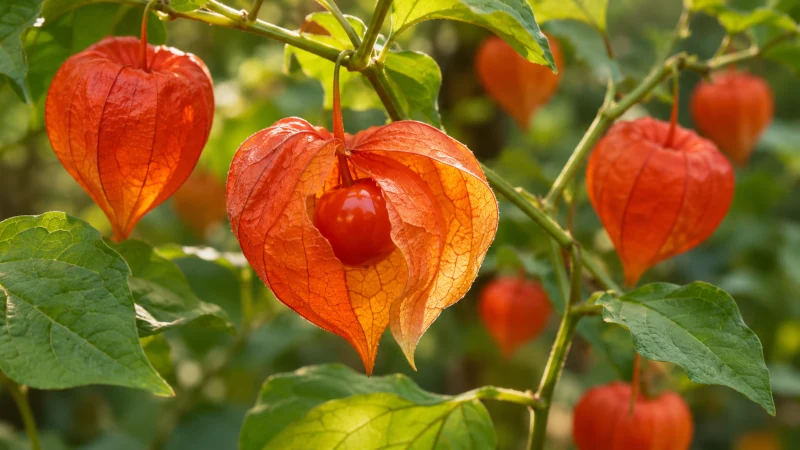
Ripe winter cherry berries are edible and carry a fair amount of vitamin C, but the rest of the plant is poisonous, and the traditional claims about gout and kidney stones have never been tested in people. That is the short version. The winter cherry plant, Physalis alkekengi, is the “Chinese lantern” many gardeners grow for its papery orange husks, and the small berry inside is where any benefit lies.
Before going further, check which plant you actually have. The name “winter cherry” is also used for a completely different herb sold in capsules.
Which “winter cherry” do you have?
Three plants get mixed up under this name, and they are not interchangeable. The NIH Office of Dietary Supplements lists “winter cherry” as another name for ashwagandha, Withania somnifera — a root extract sold for stress and sleep [NIH ODS, n.d.]. If your bottle says Withania, you want our guide to what the evidence says about ashwagandha instead.
| Common name | Latin name | What people use | Covered here? |
| Winter cherry, Chinese lantern, bladder cherry | Physalis alkekengi | Ripe berries; in Chinese medicine, the dried husk and fruit | Yes |
| Ashwagandha, Indian ginseng (also “winter cherry”) | Withania somnifera | Root or leaf extract in capsules, powders | No |
| Golden berry, cape gooseberry | Physalis peruviana | Fresh fruit from the grocery store | No — a related species |
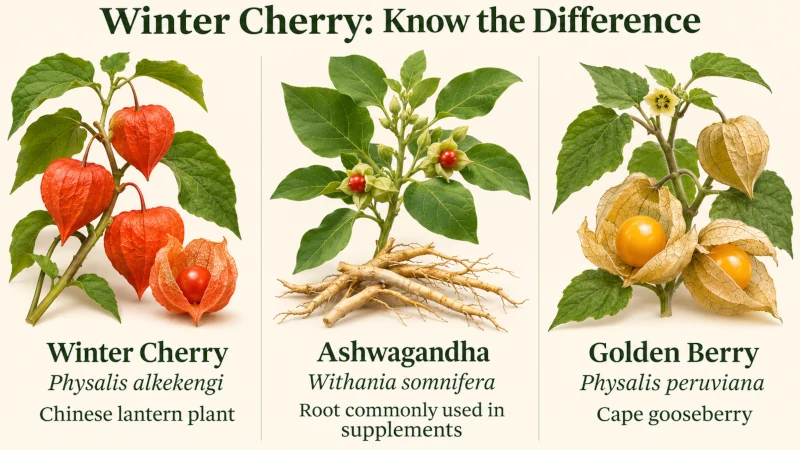
Golden berries are close cousins and look similar, which is why some websites blend the two. Researchers who measured both treat them as separate species with different chemistry [Yari et al., 2025].
What the winter cherry plant looks like and where it grows
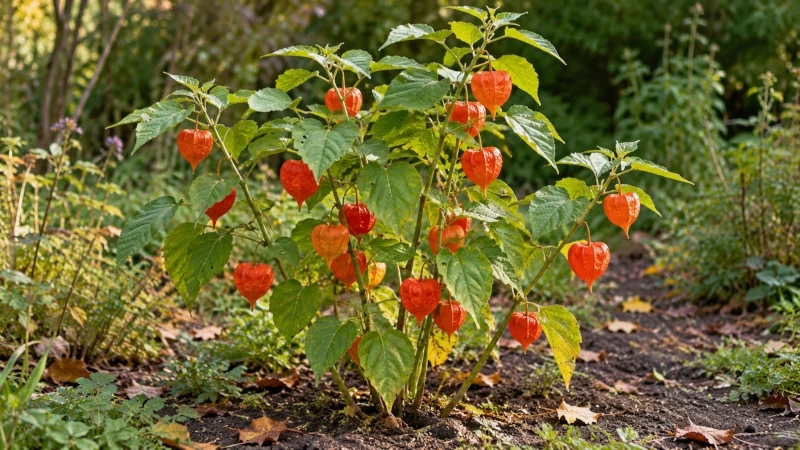
Winter cherry is a perennial in the nightshade family, the same family as tomatoes and potatoes. It grows about 40 to 60 cm tall [Popova et al., 2022]. After the small cream flowers fade, the calyx — the green leafy cup behind the flower — swells into a papery lantern that turns orange-red in late summer and encloses a single round berry. The genus name comes from the Greek word for bladder, after that inflated husk [NC State Extension, n.d.].
Most of the roughly 100 Physalis species come from Central and South America. Winter cherry is the exception: it is native to Europe and Asia [Popova et al., 2022]. In gardens it is hardy across USDA zones 3 to 9 [NC State Extension, n.d.].
What’s in the berries
Ripe winter cherry fruit contains vitamins A and C, phenolic antioxidants, plant sterols, minerals, and pectin [Popova et al., 2022]. Its orange color comes from carotenoids, which a Bulgarian analysis measured at roughly 19 to 23 micrograms per gram of fresh fruit [Popova et al., 2022].
Vitamin C is the headline nutrient. An Iranian study that tested fruit from several growing sites found 45 to 85 mg of vitamin C per 100 g in cultivated winter cherry and about 68 mg in wild fruit. Golden berries grown for comparison had about 57 mg [Yari et al., 2025]. The spread is wide because soil, climate, and cultivation changed the numbers a lot, so claims that winter cherry reliably beats a specific citrus fruit go further than the data. For perspective on where that puts it, see our list of the best food sources of vitamin C.
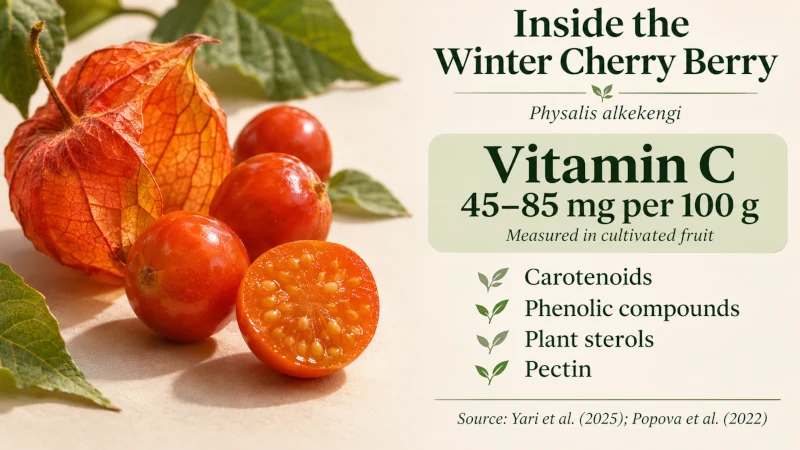
Researchers have also identified more than a hundred compounds in the plant, with steroid-like molecules called physalins drawing the most attention [Li et al., 2018].
Winter cherry for gout, uric acid, and kidney stones: what the evidence shows
Traditional use
European herbal tradition treated the berries as a diuretic and as “uricosuric” — something that helps the kidneys clear uric acid, the compound that forms crystals in gout and some kidney stones. In Chinese medicine, the dried husk and fruit (sold as Jin Deng Long) have a long history of use for cough, sore throat, painful urination, eczema, and jaundice, usually as part of multi-herb formulas [Li et al., 2018].
Lab and animal research
Extracts and isolated compounds from the plant have shown anti-inflammatory, antimicrobial, antioxidant, and diuretic effects in cell and animal studies [Li et al., 2018]. A 2023 review of this research describes it as mostly animal and cell work, notes that the conclusions are still limited, and calls for confirmation before any clinical use [Liu et al., 2023]. One study it cites linked part of the diuretic effect to the fruit’s potassium and magnesium content [Liu et al., 2023].
We could not find a single study, in animals or people, testing whether winter cherry lowers uric acid or dissolves stones.
Human research
There are no clinical trials. RxList rates the evidence for arthritis, gout, and use as a diuretic in kidney and bladder conditions as insufficient, and says there is not enough information to know how the plant works [RxList, n.d.].
Evidence at a glance
| Claim | Best evidence available | What that means for you |
| Source of vitamin C | Direct measurements of the fruit | Reasonable as part of a varied diet |
| Anti-inflammatory | Cell and animal studies of extracts and physalins | Early-stage; not shown in people |
| Diuretic (“water pill” effect) | Traditional use plus animal studies | Unproven in humans |
| Lowers uric acid / helps gout | Traditional use only | Insufficient — no plant-specific studies found |
| Dissolves or prevents kidney stones | Traditional use only | Insufficient — don’t rely on it |
If you are dealing with gout or stones, approaches with real human data will serve you better. Our guide to gout-friendly foods that help keep uric acid in check is a good place to start. For stones, the right diet depends on the stone type — see which foods raise kidney stone risk and why stone type matters and what research says about lemon and kidney stones. Our roundup of herbal remedies for the urinary system covers herbs that have actually been tested in people.
How to eat winter cherry safely
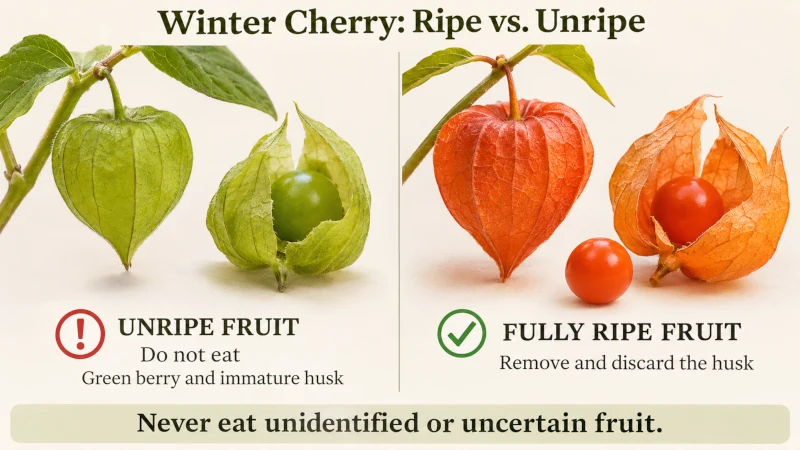
Treat winter cherry as a food, not a medicine. Only fully ripe berries are edible; the husk should be removed and the fruit eaten on its own [Popova et al., 2022]. Ripe fruit can be eaten fresh or cooked into jelly, jam, preserves, sauces, or pies [NC State Extension, n.d.].
There is no established medicinal dose [RxList, n.d.]. Older herbal books list daily berry counts and decoction strengths, but none of those amounts has been tested for safety or effect, so we don’t repeat them here. A handful of ripe berries as fruit is a very different thing from drinking a concentrated brew for weeks.
A few practical points:
- Ripe means the husk has turned fully orange-red and papery and the berry inside is soft and evenly colored. If you are not sure, don’t eat it.
- Never eat green berries, leaves, stems, or flowers.
Winter cherry plant safety: toxicity, side effects, and who should avoid it
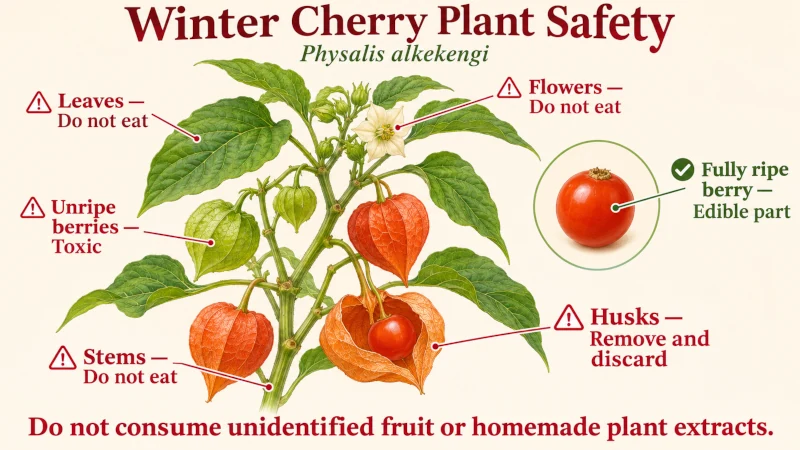
The poisonous parts
All parts of the plant except the ripe fruit are toxic. The unripe fruit and leaves contain solanine and related alkaloids. Reported symptoms include headache, stomach pain, vomiting, diarrhea, lowered body temperature, and dilated pupils, and severe poisoning can be fatal [NC State Extension, n.d.].
The husk is where sources disagree. Food-focused sources say to discard it [Popova et al., 2022], while Chinese medicine uses the dried husk as a prescribed remedy [Li et al., 2018]. Those are different contexts: a practitioner-prepared, dosed herb versus a husk eaten from the garden. Don’t make your own husk tea.
Even for the ripe fruit, there is not enough information to know whether it is safe as a remedy or what side effects it might cause [RxList, n.d.]. One mouse study reported damage to heart tissue after the animals were given a water extract of the plant [Mokhatab et al., 2021]. A single animal study proves little, but it is one more reason not to take concentrated extracts.
Pregnancy, fertility, and breastfeeding
This is the clearest safety signal. In a rat study, injections of a water extract of the fruit stopped the females’ reproductive cycles, lowered progesterone by 44%, and cut the number of pups born by 96%. The cycles returned once the extract was stopped [Vessal et al., 1991]. Rats given injected extract are not pregnant people eating berries, but the effect was large enough to take seriously.
RxList advises avoiding winter cherry during pregnancy and breastfeeding because there is not enough safety data [RxList, n.d.]. If you are pregnant, trying to conceive, or breastfeeding, skip it as a remedy.
Medication interactions
No interaction studies exist, and RxList does not list any [RxList, n.d.]. That is an absence of research, not proof of safety. Because the plant’s traditional use centers on increasing urine flow, ask a pharmacist before using it as a remedy if you take prescription diuretics, blood-pressure medicines, or medicines for gout or kidney stones.
Who should avoid winter cherry
- Anyone who is pregnant, trying to conceive, or breastfeeding.
- Young children. Plant the lanterns where small hands can’t reach the green fruit, and teach kids not to eat them.
- People with kidney disease, or those taking diuretics, unless a clinician has said it is fine.
- Anyone using it to replace prescribed treatment for gout or stones.
- Anyone who can’t confidently tell ripe fruit from unripe.
When to see a doctor
Gout and kidney stones both need a proper diagnosis, and neither should be managed with an untested herb alone.
See a health professional right away for sharp pain in your back, side, lower abdomen, or groin; pink, red, or brown urine; pain when urinating; a constant urge to urinate; or being unable to pass more than a little urine. Fever and chills can also accompany a stone [NIDDK, n.d.].
For a suddenly painful, swollen joint, get urgent help if the pain is getting worse, you have a very high temperature or feel hot, cold, or shivery, or you feel sick or can’t eat. Those signs can mean an infection inside the joint [NHS, n.d.]. If you have been prescribed uric acid-lowering medicine, keep taking it regularly even when you feel fine [NHS, n.d.].
If someone may have eaten unripe berries, leaves, or other parts of the plant, call Poison Help at 1-800-222-1222 in the US [HRSA Poison Help, n.d.] or your local emergency number.
| HEALTH DISCLAIMER: This article is for general education. It is not medical advice and does not replace diagnosis or treatment from a qualified health professional. Winter cherry has no established medicinal dose and has not been tested for safety or effectiveness in people. Do not use it in place of prescribed treatment for gout, kidney stones, or any other condition. If you are pregnant, trying to conceive, breastfeeding, take prescription medicines, or have kidney disease, talk with your doctor or pharmacist before using any herbal product. If someone may have eaten unripe fruit, leaves, or other parts of the plant, call Poison Help at 1-800-222-1222 (US) or your local emergency number. |
Frequently Asked Questions
Is winter cherry the same as ashwagandha?
No, although both are sold under the name. Ashwagandha is Withania somnifera, a root used in supplements [NIH ODS, n.d.]. The winter cherry plant in this article is Physalis alkekengi, the Chinese lantern. Check the Latin name on any product label.
Can you eat winter cherry berries?
Yes, if they are fully ripe and the husk is removed. Unripe berries and every other part of the plant are poisonous [NC State Extension, n.d.; Popova et al., 2022].
Does winter cherry help with gout?
It has a traditional reputation for clearing uric acid, but no human studies support it, and RxList rates the evidence as insufficient [RxList, n.d.]. Don’t swap it for prescribed gout treatment.
Is winter cherry the same as golden berry?
They are related but different species. Golden berry is Physalis peruviana; winter cherry is Physalis alkekengi. Their vitamin C and antioxidant content differ [Yari et al., 2025].
What should I do if a child eats a Chinese lantern berry or leaf?
Call Poison Help at 1-800-222-1222 in the US right away, even if the child seems fine [HRSA Poison Help, n.d.]. Have the plant or a photo of it with you when you call.
References
- Li AL, Chen BJ, Li GH, Zhou MX, Li YR, Ren DM, Lou HX, Wang XN, Shen T. Physalis alkekengi L. var. franchetii (Mast.) View source
- Liu Y, Wang X, Li C, Yu D, Tian B, Li W, Sun Z. Research progress on the chemical components and pharmacological effects of Physalis alkekengi L. var. View source
- Mokhatab M, Torabzadeh P, Farhadi M. Adult female BALB/c mice heart and aorta tissue under the influence of aqueous extract of Physalis alkekengi. View source
- National Institute of Diabetes and Digestive and Kidney Diseases (NIDDK). Symptoms & Causes of Kidney Stones. View source
- NC State Extension Gardener Plant Toolbox. Physalis. View source
- NHS. Gout. View source
- NIH Office of Dietary Supplements. Ashwagandha. View source
- Health Resources and Services Administration (HRSA). Poison Help. View source
- Popova V, Mazova N, Ivanova T, Petkova N, Stoyanova M, Stoyanova A, et al. Phytonutrient composition of two phenotypes of Physalis alkekengi L. fruit. View source
- RxList. Winter Cherry: Health Benefits, Side Effects, Uses, Dose & Precautions. View source
- Vessal M, Mehrani HA, Omrani GH. Effects of an aqueous extract of Physalis alkekengi fruit on estrus cycle, reproduction and uterine creatine kinase BB-isozyme in rats. J Ethnopharmacol. View source
- Yari P, Alirezalu A, Khalili S. A comparative study of chemical composition, phenolic compound profile and antioxidant activity of wild grown, field and greenhouse cultivated Physalis (P. alkekengi and P. View source


