
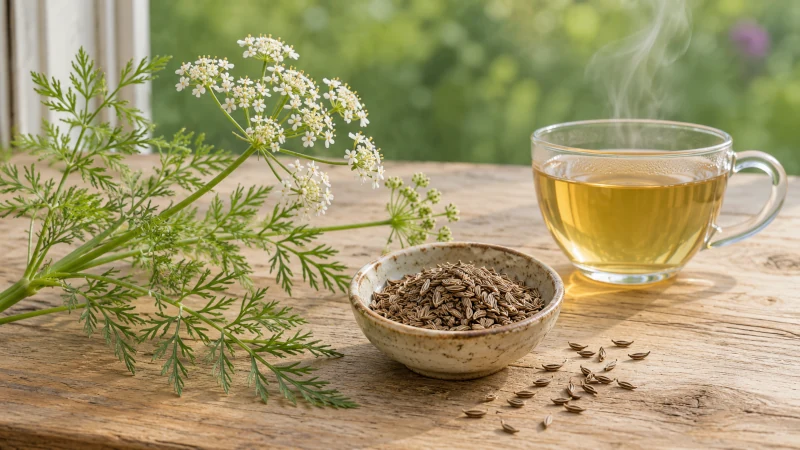
If you’re reaching for caraway seeds because of gas or bloating, you’re following a very old habit, and this one has some modern support. In Europe, the caraway plant (Carum carvi) is officially recognized as a traditional remedy for bloating and flatulence. Capsules that combine caraway oil with peppermint oil have also done well in short clinical trials for indigestion [EMA, 2015; Li et al., 2019]. The evidence doesn’t make caraway a cure-all, though, and it is not something to give a baby. Below: what the seeds can realistically do, how to use them, and when to leave them alone.
Caraway at a glance
| Quick fact | Detail |
| Botanical name | Carum carvi L. |
| Plant family | Apiaceae (parsley/carrot family) |
| Part used | Dried fruits, usually called seeds |
| Main aromatic compounds | d-carvone and d-limonene |
| Best-supported use | Peppermint + caraway oil capsules for functional dyspepsia (low-quality evidence, short-term) |
| Traditional use | Bloating and flatulence (EU-recognized traditional use) |
| Not recommended for | Children under 12 (tea), anyone under 18 (oral oil), pregnancy and breastfeeding (medicinal doses), Apiaceae allergy, liver or gallbladder disease |
Sources: [Britannica, n.d.; EMA, 2015; EMA, n.d.-b; Li et al., 2019]
What the caraway plant is
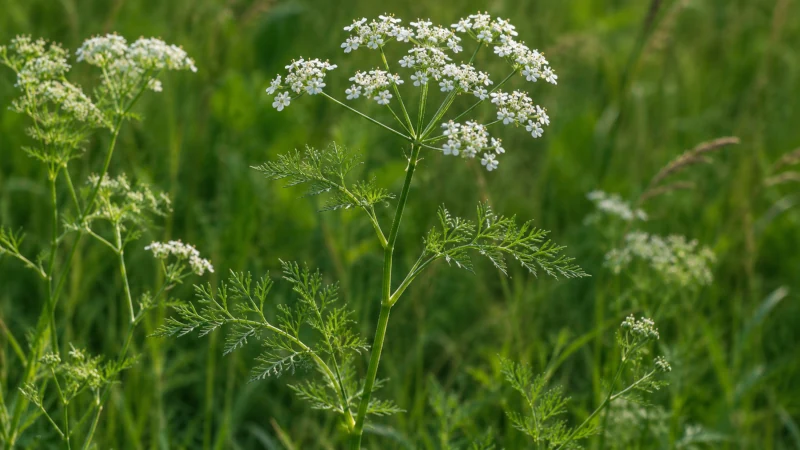
Caraway is a biennial herb in the Apiaceae family. That puts it alongside fennel, anise, dill and celery. It is native to Europe and western Asia and has been grown since ancient times. The plant has finely divided, feathery leaves and small white flowers in flat-topped clusters called umbels [Britannica, n.d.].
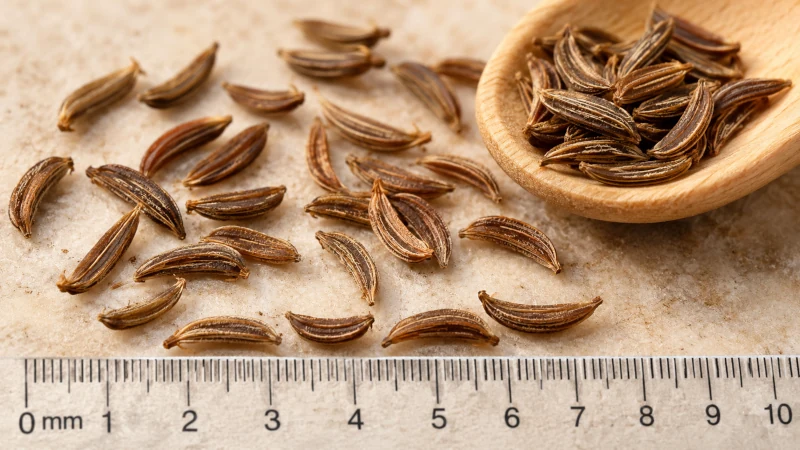
The “seeds” are botanically the plant’s dried fruits. Each one is a small brown crescent about 5 mm long, with five ridges running along its back. About 5% of the fruit is essential oil, mostly d-carvone and d-limonene [Britannica, n.d.]. Carvone gives caraway its warm, faintly licorice-like bite, the flavor you know from rye bread. Cooks also use it in sauerkraut, coleslaw, cheese and meat dishes, and the oil flavors liqueurs such as aquavit and kümmel [Britannica, n.d.].
Caraway for gas and bloating: what the evidence shows
Traditional use: recognized, not proven
The European Medicines Agency’s herbal committee lists caraway fruit as a traditional herbal medicine for “symptomatic relief of digestive disorders such as bloating and flatulence” [EMA, 2015]. Traditional use has a specific meaning there. The herb is accepted because it has been used safely this way for at least 30 years, at least 15 of them in the EU. It is not accepted because clinical trials proved it works [EMA, n.d.-a]. Caraway oil has the same traditional-use status [EMA, n.d.-b].
So caraway’s reputation as a carminative, an herb that helps you pass gas, rests on long, low-risk use rather than demonstrated effect. Lab work points the same way. In samples of human intestine removed during surgery, both caraway oil and peppermint oil relaxed the gut muscle [Madisch et al., 2023]. A muscle sample in a lab dish is not a person with symptoms, though, and nobody has run good trials of plain caraway tea.
Caraway oil plus peppermint oil for indigestion
Caraway’s strongest human data come from trials where it was paired with peppermint oil, not used alone. The condition studied was functional dyspepsia: recurring upper-stomach pain, fullness or early fullness when tests find no structural cause.
A 2019 meta-analysis pooled five randomized, placebo-controlled trials with 578 adults. After four weeks, 56% of people taking peppermint–caraway oil capsules rated themselves much or very much improved, compared with 26% on placebo. For upper-abdominal pain, 83% improved versus 52%. That works out to about one extra person helped for every three treated. Side effects were no more common than with placebo, and the most frequent were nausea and belching [Li et al., 2019].
Keep two caveats in mind. The authors graded the evidence as low quality because the trials were small, short and used inconsistent diagnostic criteria, so nobody knows how well the capsules work beyond a month [Li et al., 2019]. A 2023 review reached similarly positive conclusions, but some of its co-authors work for the company that makes the leading product, Menthacarin [Madisch et al., 2023]. The trials also used standardized capsules, typically 90 mg peppermint oil and 50 mg caraway oil [Li et al., 2019]. Their results don’t tell you what a cup of caraway tea will do.
Warm caraway-oil compresses and IBS
In a small German crossover trial, 48 adults with irritable bowel syndrome each tried three abdominal compresses for three weeks apiece: hot with caraway oil, hot with olive oil, and unheated with olive oil. Symptoms improved more with the caraway compress than with the cold one. Against the hot olive-oil compress, the difference wasn’t statistically significant, which suggests the heat did much of the work. Participants still rated the caraway version as the most helpful [Lauche et al., 2015]. A warm caraway-oil compress is a reasonable comfort measure for IBS. It isn’t evidence that caraway treats IBS.
Weight loss and other claims
One randomized, triple-blind trial gave 70 physically active women with overweight or obesity either 30 mL a day of a caraway extract or a placebo for 90 days. The caraway group lost more weight and body fat [Kazemipoor et al., 2013]. That’s one small study of one specific extract. It doesn’t mean caraway sprinkled on food will change your weight.
Claims you may read about caraway calming gut inflammation come mainly from animal research. One example is a mouse study of inflammatory bowel disease [Hill, 2019]. Treat these as early-stage findings.
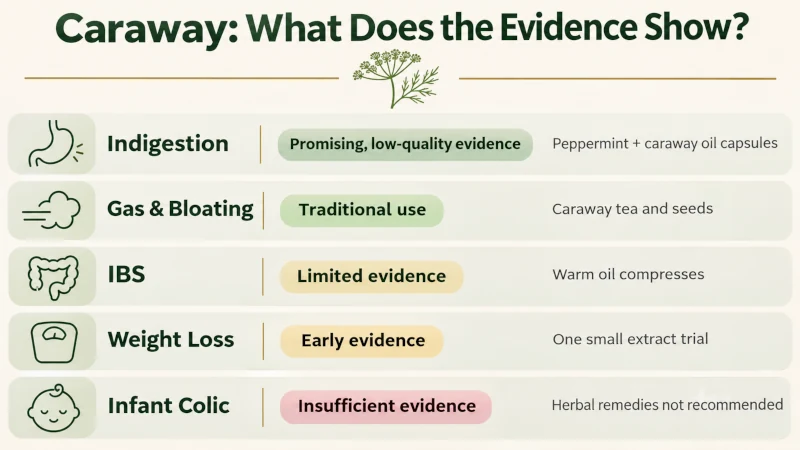
Evidence summary
| Use | What has been studied | Strength of evidence |
| Gas and bloating (seeds, tea) | Long traditional use; recognized by the EMA | Traditional; no good trials of tea |
| Functional dyspepsia | Peppermint + caraway oil capsules; 5 RCTs, 578 adults | Promising but low quality; short-term only |
| Irritable bowel syndrome | Hot caraway-oil compress; 1 small trial | Limited; heat may explain the effect |
| Weight loss | Caraway extract; 1 RCT in 70 women | Early; single study |
| Breast milk supply | 1 tiny uncontrolled study; 1 poor-quality mixed-herb tea trial | Insufficient |
| Infant colic | No valid trials | Insufficient; not recommended |
| Inflammation | Mainly animal and lab studies | Early-stage |
Sources: [EMA, 2015; Li et al., 2019; Lauche et al., 2015; Kazemipoor et al., 2013; LactMed, 2025; NHS, n.d.-a; Hill, 2019]
How to use the caraway plant’s seeds
Caraway tea
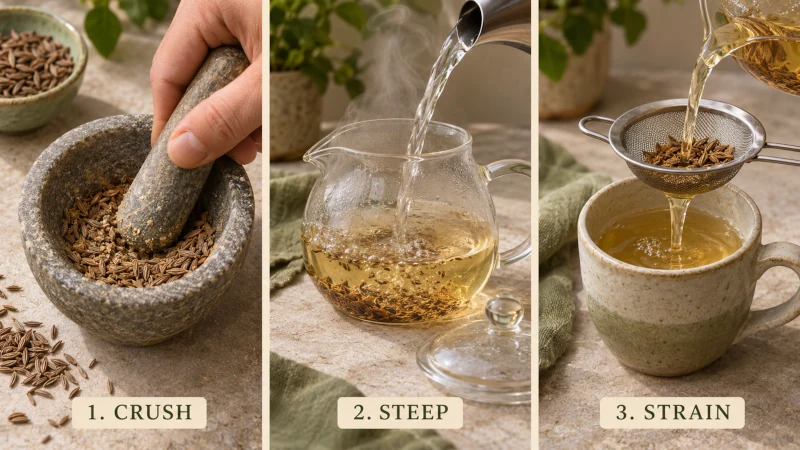
The EU monograph’s traditional dose for adults and teenagers over 12 is 0.5 to 2 g of crushed caraway fruit in 150 ml of boiling water (about two-thirds of a cup), taken one to three times a day [EMA, 2015]. A teaspoon of caraway seeds weighs roughly 2 g [WebMD, n.d.], so half a teaspoon to one teaspoon per cup is in range.
- Crush the seeds lightly in a mortar, or press them under the flat of a knife.
- Pour boiling water over them, cover the cup, and let it steep for a few minutes.
- Strain and drink. After meals is a sensible time if gas tends to follow eating.
If your symptoms last more than two weeks, or get worse, see a doctor [EMA, 2015].
Caraway in cooking
Cooking amounts are a different matter from medicinal doses, and caraway is generally recognized as safe as a food by the U.S. FDA [LactMed, 2025]. Rye bread, cabbage, roasted root vegetables and pots of beans all suit it. Adding caraway to foods that tend to cause gas is a pleasant way to use it where the trouble usually starts, though no trials have tested that particular habit.

Caraway oil and capsules
Caraway essential oil is highly concentrated. The EMA does not recommend oral caraway oil products for anyone under 18 [EMA, n.d.-b]. If you want to try the peppermint–caraway combination studied for indigestion, buy a product made to be swallowed and follow its label. Don’t drip essential oil into water. Products for use on the skin are considered usable at all ages under the EMA assessment [EMA, n.d.-b], and a warm compress is the gentlest way to use the oil.
Caraway for babies and breastfeeding
Some herbal sources recommend caraway for colicky or gassy babies, sometimes as drops of essential oil or as caraway boiled into the baby’s milk. Don’t do this. The EMA does not recommend caraway fruit preparations for children under 12 because there isn’t enough data to show they are safe [EMA, 2015]. It doesn’t recommend oral caraway oil for anyone under 18 [EMA, n.d.-b]. The NHS says herbal supplements for colic are not recommended and that there’s no evidence they help [NHS, n.d.-a].
For a crying, windy baby, health visitors suggest holding the baby upright during feeds, burping after feeds, gentle rocking, and a warm bath. Call emergency services if your baby has a weak, high-pitched or unusual cry. See a doctor if nothing helps, if your baby isn’t gaining weight as expected, or if you’re struggling to cope [NHS, n.d.-a].
Caraway is also promoted for boosting breast milk. LactMed, the U.S. National Library of Medicine’s lactation database, found no scientifically valid trials supporting this. One old study of five mothers found no effect on milk volume, and a trial of a mixed herbal tea containing caraway was rated poor quality. Small amounts of carvone do pass into breast milk [LactMed, 2025].
The two main sources lean slightly differently. LactMed describes caraway as usually well tolerated and generally recognized as safe as a food [LactMed, 2025]. The EMA does not recommend medicinal caraway during pregnancy or breastfeeding because there isn’t enough safety data [EMA, 2015]. A practical reading is that caraway in food is fine, and medicinal teas and supplements are best skipped while pregnant or nursing. If milk supply is the worry, see a lactation consultant first. LactMed stresses that herbs should never replace a proper feeding assessment [LactMed, 2025].
Side effects and who should avoid caraway
Side effects are uncommon and usually mild. In the peppermint–caraway trials, nausea and belching were the most frequent [Li et al., 2019]. LactMed lists heartburn, belching, gas and nausea [LactMed, 2025]. The EMA monograph lists no known side effects for caraway tea [EMA, 2015].
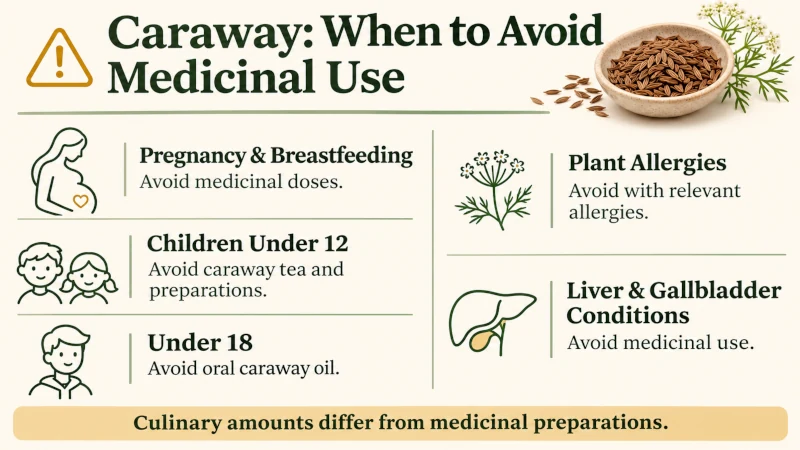
Skip medicinal caraway (teas, extracts, oils) if you:
- are allergic to plants in the Apiaceae family, such as fennel, anise, celery, coriander or dill, or to mugwort or birch [EMA, 2015]
- have liver disease, gallstones, cholangitis (bile-duct inflammation) or another biliary disorder, or achlorhydria (little or no stomach acid) [EMA, 2015]
- are pregnant or breastfeeding [EMA, 2015]
- are giving it to a child under 12 (tea) or anyone under 18 (oral oil) [EMA, 2015; EMA, n.d.-b]
Medication interactions. The EMA reports no known interactions [EMA, 2015]. WebMD suggests people with diabetes be cautious with caraway oil, extract or large amounts because caraway may lower blood sugar [WebMD, n.d.]. That caution isn’t backed by clear human data. Still, if you take medicine for diabetes, or any regular medication, tell your doctor or pharmacist before using caraway as a remedy.
Caraway isn’t the only digestive herb with a long history. Our guide to herbs for the digestive system compares it with others.
When gas or bloating needs a doctor
Gas and bloating are usually harmless. Book a doctor’s appointment if you feel bloated regularly, or if it continues after you’ve changed your diet. Do the same if your gas symptoms change suddenly, or if gas or bloating comes with weight loss you can’t explain, blood in your stool, ongoing diarrhea or constipation, or abdominal pain [NHS, n.d.-b; NIDDK, n.d.].
Call 911 (or your local emergency number) or go to an emergency department if stomach pain:
- comes on suddenly and is severe
- comes with vomiting blood, or vomit that is green or looks like coffee grounds
- comes with heavy rectal bleeding or black, sticky stools
- means you can’t pass stool or gas at all, or can’t urinate
- comes with difficulty breathing [NHS, n.d.-c]
| HEALTH DISCLAIMER: This article is for general education and isn’t a substitute for advice, diagnosis or treatment from a qualified health professional. Herbal remedies can cause allergic reactions and may not suit people with certain conditions. Talk to your doctor or pharmacist before using caraway as a remedy if you are pregnant or breastfeeding, have liver or gallbladder disease, take regular medication, or want to use it for a child. Don’t give caraway oil or caraway preparations to infants. |
Frequently Asked Questions
What part of the caraway plant is used for digestion?
The dried fruits, which most people call seeds. They contain the essential oil, mainly carvone and limonene, that gives caraway its flavor and its traditional use for gas [Britannica, n.d.; EMA, 2015].
How much caraway tea can I drink a day?
The EU traditional-use dose for adults and teenagers over 12 is 0.5–2 g of crushed seeds (about half to one teaspoon) in 150 ml of boiling water, up to three times a day. See a doctor if symptoms last more than two weeks [EMA, 2015; WebMD, n.d.].
Can I give caraway water to my baby for gas?
No. The EMA doesn’t recommend caraway preparations for children under 12, and the NHS says herbal colic remedies aren’t recommended and haven’t been shown to help [EMA, 2015; NHS, n.d.-a]. Ask your pediatrician or health visitor about soothing techniques instead.
Is caraway safe during pregnancy?
Caraway as a spice in food is generally recognized as safe [LactMed, 2025]. Medicinal doses (teas, extracts, oil capsules) aren’t recommended in pregnancy because there isn’t enough safety data [EMA, 2015].
Does caraway interact with medications?
The EMA reports no known interactions [EMA, 2015]. WebMD advises caution for people with diabetes because caraway may lower blood sugar [WebMD, n.d.]. Check with your pharmacist if you take regular medication.
References
- European Medicines Agency, HMPC. European Union herbal monograph on Carum carvi L., fructus. View source
- European Medicines Agency. Carvi fructus – herbal medicinal product (summary page). View source
- European Medicines Agency. Carvi aetheroleum – herbal medicinal product (summary page). View source
- Li J, Lv L, Zhang J, Xu L, Zeng E, Zhang Z, Wang F, Tang X. View source
- Madisch A, Frieling T, Zimmermann A, Hollenz M, Labenz J, Stracke B, Miehlke S. View source
- Lauche R, Janzen A, Lüdtke R, Cramer H, Dobos G, Langhorst J. View source
- Kazemipoor M, Radzi CW, Hajifaraji M, Haerian BS, Mosaddegh MH, Cordell GA. View source
- Drugs and Lactation Database (LactMed). Caraway. National Institute of Child Health and Human Development; View source
- Encyclopaedia Britannica. Caraway. View source
- NHS. Colic. View source
- NHS. Bloating. View source
- NHS. Stomach ache. View source
- National Institute of Diabetes and Digestive and Kidney Diseases. Symptoms & causes of gas in the digestive tract. View source
- WebMD. Caraway. View source
- Hill A. Everything you need to know about caraway. Healthline. Dec 6, 2019. View source


