
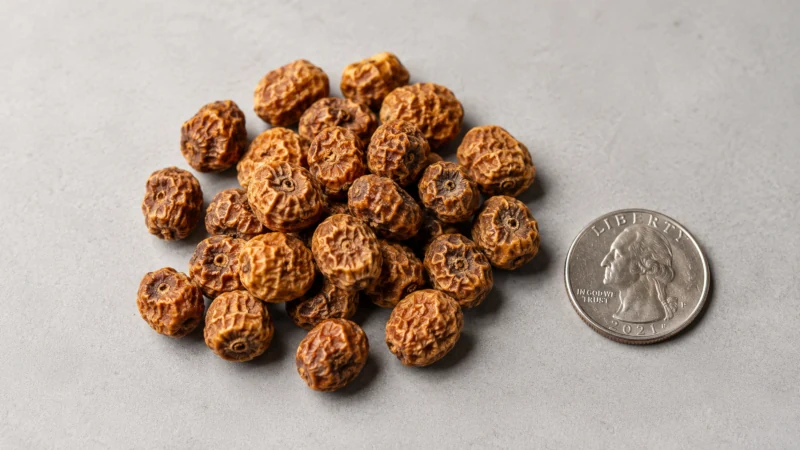
Tiger nuts are not nuts. They are small tubers — the swollen root tips of a sedge called Cyperus esculentus — and that single fact explains most of what makes them worth eating. They carry an unusual amount of fiber for their size, a fat profile closer to olive oil than to almonds, and a sweet, chewy bite that becomes the Spanish drink horchata de chufa. Most of the tiger nut health benefits you will find listed online are real in the narrow sense that somebody measured something. Usually that something was measured in a test tube or a rat. Here is what holds up, what does not, and how to eat them without spending your afternoon regretting it.
What you are actually eating
Cyperus esculentus grows across Africa, Asia, and southern Europe. It is farmed most intensively around Valencia, Spain, where the tubers are the base of horchata de chufa; in North America, the same plant shows up in lawns and cornfields under the name yellow nutsedge [Knazicka et al., Foods, 2026]. The tubers run one to two centimeters across, wrinkle when dried, and taste sweet enough that ancient Egyptians roasted them as a confection [Yu et al., Foods, 2022].
Composition swings hard with variety, soil, and storage, which is why published nutrition figures for tiger nuts rarely agree with each other. Analyses put them at roughly 400 to 414 calories per 100 grams, with about 47% carbohydrate, 20–38% fat, 6–10% protein, and 8–9% dietary fiber [Knazicka et al., Foods, 2026]. Treat any single number you see as a midpoint, not a fact.
| Component | Reported range (per 100 g) | Why it varies |
| Calories | 400–414 kcal | Fat content drives this |
| Fat | 20–38% | Variety and growing region |
| Carbohydrate | ≈47% (starch 14–37%) | Storage converts starch to sugars |
| Dietary fiber | 8–9% | Black cultivars run higher |
| Protein | 6.1–9.7% | Low, and limited in methionine |
| Dominant fatty acid | Oleic acid, 56–85% | Same acid that dominates olive oil |
Ranges from Knazicka et al., Foods, 2026 and Yu et al., Foods, 2022.
For a serving you would actually eat, a one-ounce portion — about a quarter cup, or 50-odd raw tubers — comes to roughly 120 calories, 19 g carbohydrate, 7 g fat, 10 g fiber, and 1–2 g protein [Cleveland Clinic, 2023]. Nine of those 19 grams of carbohydrate are sugar, which is why they taste like candy.
Tiger nut health benefits, ranked by how good the evidence is
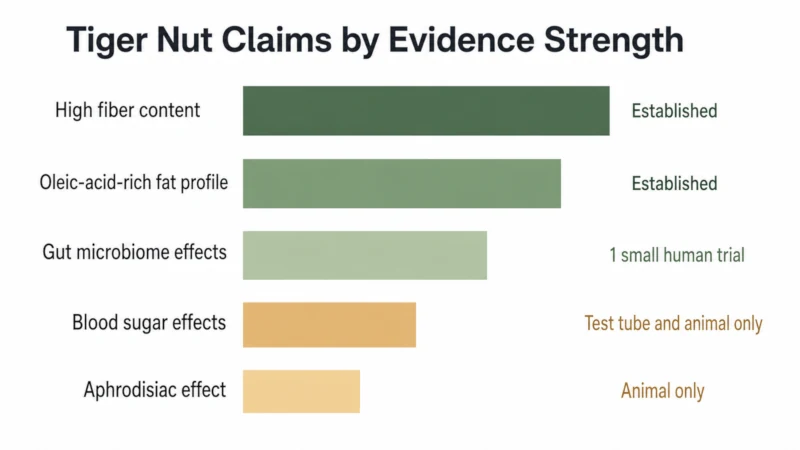
Fiber and digestion — the strongest case
Ten grams of fiber in an ounce of food is genuinely uncommon. The FDA Daily Value for fiber is 28 grams [FDA, Daily Value reference guide], so a single small handful covers over a third of it. Most Americans fall well short of that target, and closing the gap is one of the few dietary moves with broad agreement behind it.
Most of the fiber in tiger nuts is insoluble — it passes through undigested, adds bulk, and moves things along [Cleveland Clinic, 2023]. They also contain resistant starch, which behaves like a prebiotic and feeds gut bacteria rather than feeding you. If you are already working on this, the same logic applies to the rest of your plate: see our guide to increasing fiber intake from everyday foods.
The human evidence is thinner than the enthusiasm suggests. The one published human trial gave 31 healthy adults 300 mL of unsweetened, unprocessed horchata daily for three days. Across the group as a whole, the researchers found no clear change in gut microbial profile; shifts only appeared when volunteers were sorted into subgroups by their starting microbiome [Selma-Royo et al., Nutrients, 2022]. That is a small, short, uncontrolled study with a null main result and an interesting secondary one. It is a reason to be curious, not a reason to buy in bulk.
A fat profile that really does resemble olive oil
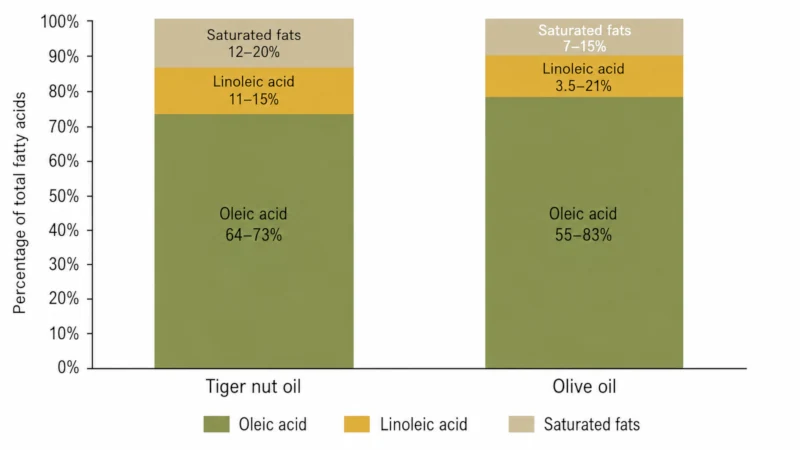
This is the part that is well measured. Oleic acid — the monounsaturated fat that dominates olive oil — makes up 56–85% of the fat in tiger nut tubers, with palmitic, linoleic, and stearic acids trailing behind [Knazicka et al., Foods, 2026]. Tiger nut oil runs 64–73% oleic acid against olive oil’s 55–83%.
Researchers who calculated standard lipid quality indices found tiger nut samples sitting almost exactly where olive oil sits: an atherogenicity index of 0.159–0.173 versus 0.16 for olive oil, and a hypocholesterolemic-to-hypercholesterolemic ratio of 5.8–6.2 versus 6.10 [Knazicka et al., Foods, 2026]. Worth being precise about what that means: those indices are computed from the fat composition itself. They predict a favorable profile. They are not measurements of anyone’s cholesterol. No published human trial has tested whether eating tiger nuts changes blood lipids, and the supporting feeding studies were done in rats [Yu et al., Foods, 2022].
One practical note from the same analysis: unpeeled tubers had substantially higher antioxidant activity and phenolic content than peeled ones, because the skin is where those compounds live [Knazicka et al., Foods, 2026]. Buy them whole and skin-on.
Blood sugar — early, indirect, and mostly in glassware
Aqueous tiger nut extracts inhibit alpha-amylase and alpha-glucosidase, the enzymes that break starch down into absorbable sugar, in laboratory assays [Yu et al., Foods, 2022]. That is the same broad mechanism some diabetes drugs use, which is where the headlines come from. But an extract in a cuvette is not a snack in a stomach, and the fiber-slows-sugar-absorption argument, while reasonable, has not been tested with tiger nuts in people. Anyone managing diabetes should treat tiger nuts as food, not as a tool, and keep taking their prescribed medication.
Kitchen uses that need no health claim at all
Tiger nut flour is starchy and behaves well in gluten-free baking, and tiger nut milk gives people avoiding dairy, gluten, or tree nuts another option [Cleveland Clinic, 2023]. These are the least glamorous benefits and the most reliable ones. If you are drinking horchata as a milk substitute, know that it is not a nutritional swap for dairy — it carries less protein and far less calcium, so you will want other calcium sources in the diet.
Claims that outrun their evidence
The aphrodisiac reputation. Tiger nuts contain quercetin, and rat studies have reported increased testosterone and sexual activity after high-dose feeding [Yu et al., Foods, 2022]. No human study has tested this. The review that catalogs those animal findings says plainly that human confirmation is still needed.
The digestive-enzyme claim. You will see it written that the amylase and lipase in tiger nuts help you digest your food. Those enzymes are the tuber’s own storage machinery, and their activity rises and falls with how the tubers were stored [Yu et al., Foods, 2022]. No evidence shows they survive your stomach or do anything for your digestion. The fiber is doing the work here, not the enzymes.
Antimicrobial and immune effects. Tiger nut extracts inhibit bacteria in test-tube studies [Healthline, 2022]. Nothing follows from that about whether eating them affects infection risk.
How to eat them
Dried tiger nuts are hard. Soaking them for several hours to overnight softens them into something chewy and pleasant; you can also roast them, or grind them into flour. Start with a small handful. Ten grams of fiber arriving unannounced is enough to produce noticeable gas and bloating, especially if your usual fiber intake is low [Cleveland Clinic, 2023].
Horchata de chufa, made sensibly

This makes about one liter:
- Soak 150 g of tiger nuts in water for 24 hours, then drain.
- Blend the soaked tubers into a smooth paste.
- Stir the paste into one liter of fresh water and let it steep for an hour.
- Press and strain through a fine cloth. A little cinnamon suits it well.
- Refrigerate and drink within a couple of days.
Traditional recipes allow up to 150 grams of sugar per liter. Do the arithmetic before you follow that: at that rate, one 200 mL glass carries about 30 g of added sugar — roughly 60% of the FDA’s 50-gram Daily Value for added sugars in a single drink [FDA, added sugars guidance, 2021]. Tiger nuts are already about 9 g of sugar per ounce on their own. Sweeten lightly or not at all, and you keep the fiber without the sugar load.
On food safety: freshly made horchata carries a high microbial load from the raw tubers and spoils quickly, which is why commercial producers pasteurize it [Yu et al., Foods, 2022]. Refrigerate homemade horchata immediately, keep it a couple of days at most, and skip the homemade version if you are pregnant or immunocompromised.
Safety, side effects, and who should be careful
Common and expected
- Gas, bloating, and cramping. The predictable result of a large fiber dose. Increase portions gradually; soaking, roasting, or germinating the tubers helps [Cleveland Clinic, 2023].
- Sugar load from sweetened horchata. Commercial horchata is often heavily sweetened. Check the label.
Allergy — rare, but documented and occasionally severe
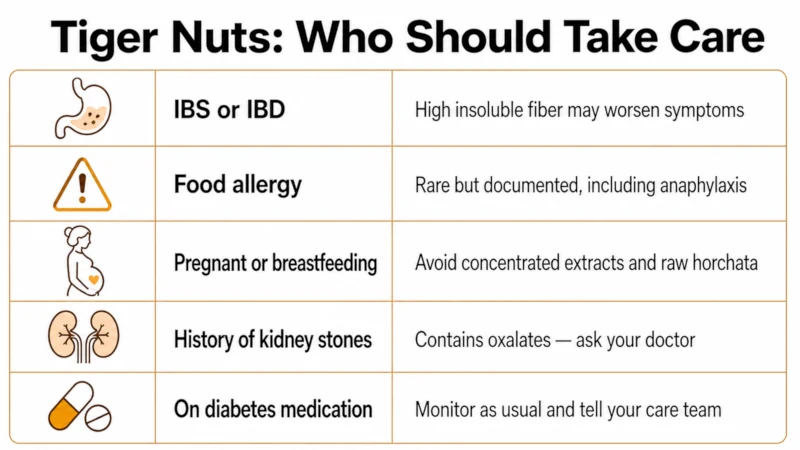
Tiger nuts are not tree nuts, so they are a reasonable option for many people with nut allergies. That does not make them universally safe. IgE-mediated tiger nut allergy has been reported repeatedly in the medical literature, including oral allergy symptoms, hives, angioedema, and anaphylaxis [Galindo Bonilla et al., Allergy, 2002]; a 2024 case report describes anaphylaxis triggered by tiger nut milk [Annals of Allergy, Asthma & Immunology, 2024]. Cross-reactivity with pollen has also been described, so people with pollen-food allergy syndrome may react [González-de-Olano et al., J Investig Allergol Clin Immunol, 2013]. Separately, a horchata factory worker handling tiger nut dust developed hypersensitivity pneumonitis [J Allergy Clin Immunol, 1999] — an occupational exposure, not an eating risk, but worth knowing if you process them in quantity.
Mold toxins
Tiger nuts are dried tubers, and like other dried commodities they can carry aflatoxins and ochratoxin A. A year-long survey of tiger nuts and horchata sold in Valencia found detectable contamination in 32 of 238 samples, with two tiger nut samples exceeding regulatory limits [Rubert et al., Food Chemistry, 2011]. Most samples were clean, but buy from suppliers with visible quality control, store the tubers dry, and throw out anything musty, discolored, or shriveled beyond the usual wrinkles.
What the evidence does not flag
A 2026 analysis calculated dietary exposure to trace elements from tiger nut tubers and found every target hazard quotient well below the threshold of concern, meaning routine consumption does not raise a heavy-metal problem [Knazicka et al., Foods, 2026].
Who should be cautious
- Anyone with IBS, IBD, or a sensitive gut. The insoluble fiber load can aggravate symptoms. Start very small, or skip them.
- People who are pregnant or breastfeeding. Tiger nuts as a food are ordinary food. Concentrated tiger nut oils, extracts, and supplements have not been studied in pregnancy, so there is no safety data to rely on — ask your doctor before using those, and avoid unpasteurized homemade horchata.
- People with a history of calcium-oxalate kidney stones. Tiger nuts contain oxalates, but reported amounts vary so widely between studies that no reliable per-serving figure exists. Raise it with your doctor or a registered dietitian rather than guessing.
- People taking diabetes medication. No drug interaction has been documented. The theoretical concern is additive blood-sugar lowering from a very high-fiber food. Monitor as you normally would and mention the change to your doctor or pharmacist.
- Young children. Dried, unsoaked tubers are hard and small. Soak them thoroughly or grind them.
When to talk to a doctor
Call 911 or get to an emergency room if eating tiger nuts or drinking horchata is followed by swelling of the lips, tongue, or throat, trouble breathing or swallowing, widespread hives, dizziness, or faintness. Those are signs of a severe allergic reaction and they can progress quickly.
Make a regular appointment with your doctor if you notice:
- Diarrhea or constipation that persists beyond two weeks
- Blood in your stool, or black, tarry stools
- Ongoing abdominal pain, or unintentional weight loss
- Blood sugar readings that shift noticeably after a diet change, if you are diabetic
And a plain one: no food replaces prescribed medication. If you are on a statin, a blood pressure drug, or a diabetes medication, tiger nuts are something you add alongside treatment, not something you swap it for.
| HEALTH DISCLAIMER: This article is for general education and information. It is not medical advice, and it is not a substitute for diagnosis or treatment from a qualified professional. Tiger nuts are a food, and nothing here is intended to diagnose, treat, cure, or prevent any disease. If you are pregnant or breastfeeding, manage a chronic condition, take prescription medication, or have a history of food allergy, talk with your doctor before making a meaningful change to your diet. Never stop or adjust a prescribed medication on the basis of an article. |
Frequently Asked Questions
Are tiger nuts safe if I have a nut allergy?
Botanically they are tubers, not nuts, so they do not contain tree nut or peanut proteins and are widely used in nut-free products. That said, allergy to tiger nuts themselves has been documented, including anaphylaxis [Galindo Bonilla et al., Allergy, 2002], and packaged products can be processed on shared equipment. Check labels, and if your allergies are severe, clear it with your allergist first.
How many tiger nuts should I eat in a day?
There is no established therapeutic dose, because no human trial has established one. A practical starting point is a small handful — under an ounce — which already delivers a third of the daily fiber target. Build up slowly if your gut tolerates it.
Is horchata healthier than cow’s milk?
Neither, exactly. Horchata brings fiber and monounsaturated fat that milk does not. Milk brings far more protein and calcium than horchata does. If you are replacing dairy, plan for calcium from other foods, and watch the added sugar in commercial versions.
Do tiger nuts actually lower cholesterol?
Not proven. Their fat composition looks like olive oil’s, and calculated lipid quality indices come out favorably [Knazicka et al., Foods, 2026], but no human trial has measured cholesterol before and after eating them. The rat feeding studies that report improved lipid profiles are a starting point, not an answer.
Raw, roasted, or soaked — does it matter?
Somewhat. Roasting raises antioxidant content and makes them easier to eat; soaking softens them and reduces some antinutrients [Cleveland Clinic, 2023]. Leaving the skin on preserves the phenolic compounds concentrated there [Knazicka et al., Foods, 2026]. Pick whichever you will actually eat.
References
- Knazicka, Z., et al. (2026). Biological Properties, Mineral Composition, and Health-Promoting Potential of Tiger Nut Tubers (Cyperus esculentus L.) as a Novel and Underutilized Food Source. Foods, 15(2), 191. DOI: 10.3390/foods15020191. View source
- Yu, Y., Lu, X., Zhang, T., Zhao, C., Guan, S., Pu, Y., & Gao, F. (2022). Tiger Nut (Cyperus esculentus L.): Nutrition, Processing, Function and Applications. Foods, 11(4), 601. DOI: 10.3390/foods11040601. View source
- Selma-Royo, M., García-Mantrana, I., Collado, M. C., & Perez-Martínez, G. (2022). Intake of Natural, Unprocessed Tiger Nuts (Cyperus esculentus L.) Drink Significantly Favors Intestinal Beneficial Bacteria in a Short Period of Time. Nutrients, 14(9), 1709. DOI: 10.3390/nu14091709. View source
- Rubert, J., Sebastià, N., Soriano, J. M., Soler, C., & Mañes, J. (2011). One-year monitoring of aflatoxins and ochratoxin A in tiger-nuts and their beverages. Food Chemistry, 127(2), 822–826. PMID: 23140741. View source
- Galindo Bonilla, P. A., et al. (2002). Allergy to tiger nut. Allergy, 57(11), 1083–1084. Wiley Online Library. View source
- González-de-Olano, D., et al. (2013). Pollen-Food Syndrome Involving Allergy to Tiger Nut. Journal of Investigational Allergology and Clinical Immunology, 23(3), 197–198. View source
- Annals of Allergy, Asthma & Immunology (2024). Anaphylaxis to tiger nut milk (case report). View source
- Hypersensitivity pneumonitis in a worker exposed to tiger nut dust (1999). Journal of Allergy and Clinical Immunology. View source
- Cleveland Clinic (2023). 9 Health Benefits of Tiger Nuts. Cleveland Clinic Health Essentials, March 22, 2023. View source
- Healthline (2022). 6 Emerging Health Benefits of Tiger Nuts. Reviewed by Amy Richter, MS, RD; updated January 6, 2022. View source
- U.S. Food and Drug Administration. Daily Value on the Nutrition and Supplement Facts Labels. View source
- U.S. Food and Drug Administration (2021). Interactive Nutrition Facts Label: Total and Added Sugars. View source
