
Most claims about yellow dock benefits come from tradition and laboratory dishes, not from clinical trials in people — a gap worth knowing before you buy the tea or capsules. [Drugs.com, 2025] The root of this common weed (Rumex crispus) is sold with a long list of promises, but the honest version is narrower: it works mainly as a gentle stimulant laxative and a bitter digestive tonic, it carries a modest amount of iron and vitamin C, and almost everything else attributed to it rests on weak or early-stage evidence.
It also has real safety limits that the marketing rarely mentions, including good reasons to avoid it during pregnancy and a genuine risk of allergic reactions. This guide sorts what the root may do from what it is claimed to do, and flags the cautions worth taking seriously.
What is yellow dock?

Yellow dock is a perennial herb in the buckwheat family (Polygonaceae), also called curly dock, curled dock, or sour dock. It is native to Europe and now grows throughout the United States, often treated as a roadside weed. The yellow taproot is the part used for tea, tinctures, and capsules; the young leaf stalks are sometimes eaten as a cooked green. [Drugs.com, 2025]
Three groups of compounds explain most of what the root does. It contains anthraquinone glycosides (such as emodin and chrysophanol) — the same family of stimulant-laxative chemicals found in senna — along with astringent tannins, some oxalates, and minerals including iron and calcium. [Idris et al., 2019] That single fact about anthraquinones accounts for the root’s most reliable effect on the body.
What the evidence says about yellow dock benefits
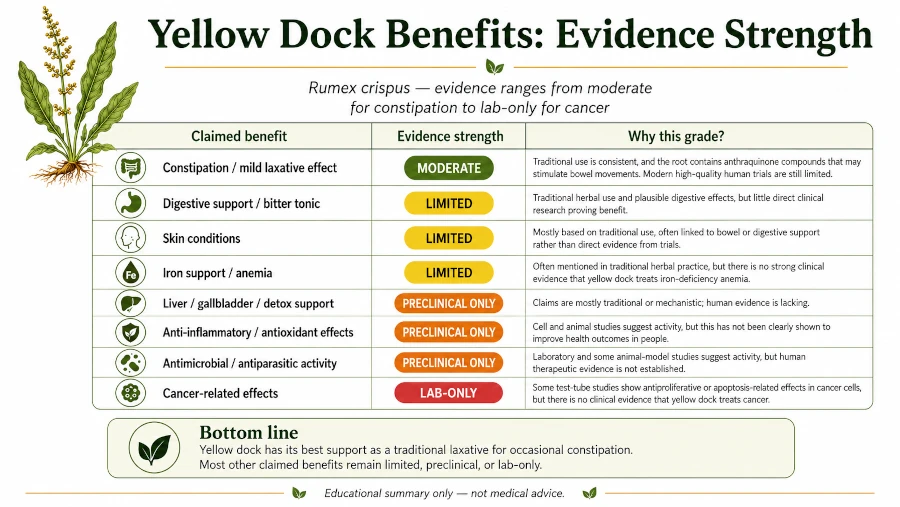
Start with the headline finding: there are no published human clinical trials showing that yellow dock treats any condition. [Drugs.com, 2025] [EBSCO, 2024] That does not make it useless, but it means the right question is not “what does it cure” — it is “how strong is the evidence for each use.” The table below sorts the common claims that way.
| Common claim | Evidence | What that means |
| Relieves constipation | Moderate | Contains stimulant-laxative anthraquinones; supported by tradition and pharmacology, not modern trials. |
| Stimulates digestion / bile | Limited | Bitter taste plausibly prompts digestive secretions; little direct human evidence. |
| Builds iron / treats anemia | Limited | Iron-rich by weight, but a normal dose delivers very little; not a dependable anemia fix. |
| “Detoxifies” liver / clears skin | Weak | Traditional “alterative” use only; no clinical evidence the root detoxifies organs. |
| Fights cancer / infection | Lab only | Antioxidant and anticancer signals seen in test tubes; no human trials. Do not use to treat disease. |
A gentle laxative (its best-supported use)
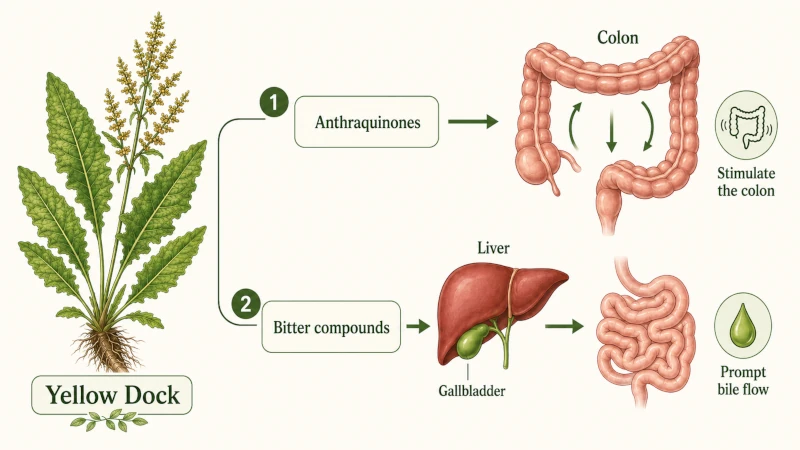
The clearest thing yellow dock does is loosen the bowels. Its anthraquinones stimulate the colon, much like other herbal stimulant laxatives. Traditional preparations use 2 to 4 grams of dried root in a tea, and the standard caution is to keep this short-term — no longer than about 8 to 10 days. [Drugs.com, 2025] Like any stimulant laxative, it is not meant for daily, long-term use, which can lead to dependence and electrolyte loss. If constipation is your main concern, it sits alongside other herbs traditionally used for constipation, and the same rule applies to all of them: treat the cause, not just the symptom.
A digestive bitter
Yellow dock tastes sharply bitter, and bitters have long been used to prompt saliva, stomach acid, and bile before a meal. The mechanism is plausible and the traditional use is consistent, but human data are thin, so treat “stimulates digestion” as a reasonable traditional use rather than a proven one. It belongs in the same broad category as other herbs that support digestion.
Iron and “blood building”
Yellow dock root is genuinely iron-rich by concentration — one laboratory analysis measured roughly 33 mg of iron per 100 g of dried root. [Idris et al., 2019] The catch is the dose. A typical 2 to 4 gram serving delivers only about 0.7 to 1.3 mg of iron, a small fraction of the 8 to 18 mg adults need each day. The root also contains tannins and oxalates that can blunt iron absorption. So while it is reasonable to call yellow dock “iron-containing,” it is not a dependable treatment for iron-deficiency anemia on its own.
If iron is your goal, iron-rich foods and a tested supplement are far more reliable, and a blood test should come first. Other plants in this space, such as stinging nettle, are also commonly used; iron needs come up often among the herbs used in women’s health, since menstruation is a frequent cause of low iron. Anemia is worth diagnosing and treating properly, not self-managing with tea.
“Detox,” skin, and blood cleansing
In older herbal texts, yellow dock is an “alterative” — a blood cleanser thought to clear skin problems by improving digestion and “detoxifying” the body. This is the weakest part of the evidence. There is no clinical research showing the root detoxifies the liver or kidneys, and in healthy people those organs already handle that job without herbal help. Any skin benefit is traditional and unproven.
Antioxidant, antimicrobial, and anticancer claims
Test-tube studies show that yellow dock extracts have antioxidant activity, and one in-vitro screen found that root extracts were toxic to human leukemia cells. [Drugs.com, 2025] These findings are interesting for researchers, but activity in a dish does not translate to a benefit in people. There is no clinical evidence that yellow dock prevents or treats cancer or infection, and it should never be used in place of medical treatment for either.
How people use yellow dock
Yellow dock root comes as a dried-root tea or decoction (the dense root is usually simmered rather than steeped), a liquid tincture, and capsules. Traditional dosing is 2 to 4 grams of dried root in a tea up to three times a day, for no more than 8 to 10 days at a stretch. [Drugs.com, 2025] Raw or undercooked leaves should not be eaten. Because supplements are not standardized, the amount of active compounds varies between brands and batches, and the FDA does not verify that a product contains what its label claims. [WebMD, 2026]
Safety, side effects, and who should avoid yellow dock
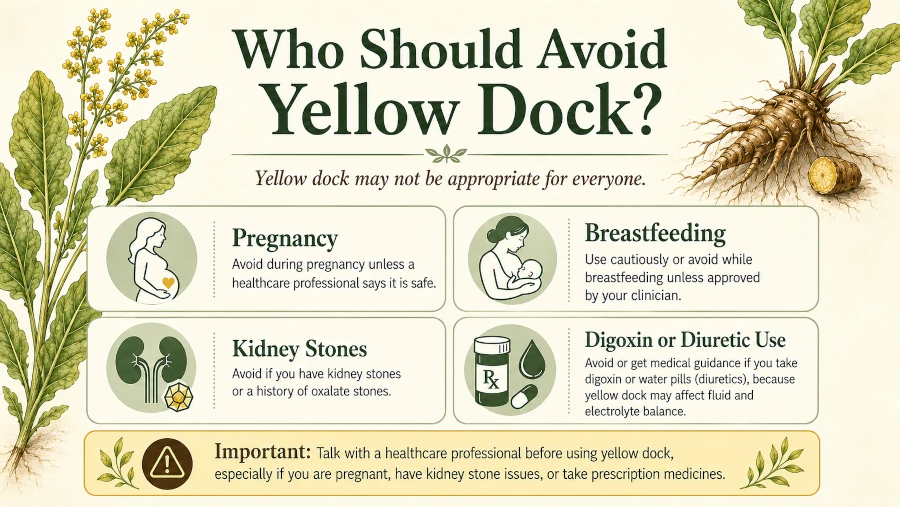
Most of yellow dock’s risks trace back to two things: the stimulant-laxative anthraquinones and the oxalates. Both are manageable for many healthy adults in small, short-term amounts — but they create clear reasons for some people to skip it entirely.
Common side effects
The usual complaints are digestive: loose stools, diarrhea, cramping, nausea, and upset stomach. Overuse can pull potassium and other electrolytes too low, which is one reason the short-term limit matters. [WebMD, 2026] [RxList, 2021]
The raw-leaf and oxalate risk
Raw, uncooked yellow dock leaves are high in oxalates, which can burn the mouth and throat, raise the risk of kidney stones, and in large amounts cause serious poisoning. Cooking the leaves lowers the oxalate level. Most teas and supplements use the root, which contains far less. [WebMD, 2026] [Idris et al., 2019] Anyone who has had kidney stones should be especially cautious.
Allergic reactions — an important correction
This is the claim worth setting straight. Some websites say yellow dock can ease swelling of the face, lips, or tongue and relieve difficulty breathing. Those are not benefits — they are warning signs of a severe allergic reaction, and yellow dock can cause them rather than treat them. [WebMD, 2026] People who are allergic to ragweed are more likely to react to it. [RxList, 2021] If you develop facial, lip, or tongue swelling, hives, wheezing, or trouble breathing after taking it, stop and seek emergency care right away.

Medication interactions
Because it acts as a stimulant laxative, yellow dock can lower potassium, and low potassium raises the danger of two drug groups in particular: digoxin (a heart medication) and diuretics (“water pills”). Both are rated major interactions — combinations to avoid. [RxList, 2021] It can also add to the effect of other stimulant laxatives and may affect blood clotting, so people on blood thinners should check with a clinician first.
Pregnancy and breastfeeding
Despite some claims that it is a safe herb for this stage of life, authoritative sources advise against oral yellow dock during pregnancy and breastfeeding. Its stimulant-laxative action is not wanted in pregnancy, and the anthraquinones can pass into breast milk and affect a nursing infant’s bowels. [Drugs.com, 2025] [RxList, 2021] If you are pregnant and dealing with constipation or low iron, those are worth raising with your clinician, alongside foods that support a healthy pregnancy, rather than reaching for this root.
Who should avoid yellow dock
- People who are pregnant or breastfeeding
- Anyone with kidney disease or a history of kidney stones
- People with a bowel obstruction, stomach or intestinal ulcers, or inflammatory bowel disease
- Anyone taking digoxin, diuretics, blood thinners, or other stimulant laxatives
- People allergic to ragweed (cross-reactivity is possible)
- Infants and young children
Sources: [WebMD, 2026]; [Drugs.com, 2025]; [RxList, 2021]
Realistic expectations
Used sensibly, yellow dock is a short-term bowel stimulant and a traditional bitter — not a cure-all. There is no good evidence that it drives weight loss, “boosts” the immune system, slows aging, or treats cancer, diabetes, or chronic disease. When a single common weed is marketed as helping with all of those at once, that breadth is a reason for skepticism, not excitement. Modest, short-term, and specific is the honest way to think about it.
When to talk to a healthcare professional
Skip the self-treatment and see a clinician if you notice any of the following:
- Constipation lasting more than a week or two, or with severe pain
- Black, tarry, or bloody stools
- Unexplained weight loss or persistent fatigue
- Suspected anemia — get a blood test before treating iron
- Pregnancy, breastfeeding, or any chronic condition or regular medication
Constipation and low iron are common and usually treatable, but they can also signal something that needs proper evaluation. An herb is not a substitute for that.
| Health Disclaimer: This article is for general education only and is not medical advice, a diagnosis, or a treatment plan. Yellow dock is a dietary supplement, not a tested medicine, and the U.S. Food and Drug Administration does not review supplements for safety or effectiveness before sale. Do not use it to treat, cure, or replace care for any health condition. If you are pregnant or breastfeeding, take prescription medicine, or have a kidney, liver, digestive, or bleeding condition, talk with a qualified healthcare professional before using yellow dock or any herbal product. If you have signs of a severe allergic reaction — swelling of the face, lips, or tongue, hives, wheezing, or trouble breathing — stop and seek emergency care. |
Frequently Asked Questions
Is it safe to take yellow dock every day?
No. It is a stimulant laxative meant for short-term use — generally no more than about 8 to 10 days. Daily use can lead to dependence and low potassium. [Drugs.com, 2025]
Does yellow dock actually raise iron levels?
It contains iron, but a normal dose delivers only about a milligram, and its tannins and oxalates can reduce absorption. It is not a reliable treatment for iron-deficiency anemia. [Idris et al., 2019]
Can I use it while pregnant or breastfeeding?
Best avoided. Authoritative sources advise against oral yellow dock in pregnancy and breastfeeding because of its laxative action and because its compounds can pass into breast milk. [Drugs.com, 2025] [RxList, 2021]
Does yellow dock treat allergies?
No. It can actually cause allergic reactions, especially in people allergic to ragweed. Facial or tongue swelling and breathing trouble are emergency signs, not effects to seek out. [WebMD, 2026] [RxList, 2021]
Is it proven to detox the liver or fight cancer?
No. Any liver or anticancer signals come from laboratory studies, not human trials, and it should never replace medical care. [Drugs.com, 2025]
References
- Drugs.com. Yellow Dock — Professional Monograph (Review of Natural Products). Updated 2025. → View source
- WebMD. Yellow Dock: Uses, Side Effects, Warnings & Dosing. Medically reviewed, 2026. → View source
- RxList. Yellow Dock: Health Benefits, Side Effects, Interactions, Dose & Precautions. 2021. → View source
- Idris OA, Wintola OA, Afolayan AJ. Comparison of the proximate composition, vitamins, anti-nutrients and GC-MS analysis of the essential oil of the root and leaf of Rumex crispus L. Plants. 2019;8(3):51. → View source
- EBSCO Research Starters. Yellow Dock’s Therapeutic Uses. Complementary and Alternative Medicine. → View source
