
Fish oil has one benefit that strong research agrees on — it lowers triglycerides — and a longer list of maybes that tend to get oversold. If you are deciding whether to take it, that gap is most of the story. This guide sorts the real benefits of fish oil from the hopeful ones, grades each by how good the human evidence is, and covers the doses, side effects, and drug interactions worth knowing before you open a bottle.

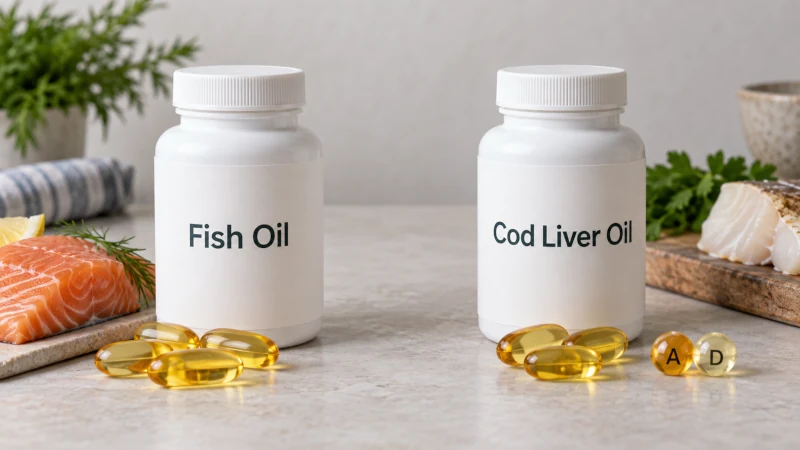
Two ground rules first. Fish oil supplies two long-chain omega-3 fatty acids, EPA and DHA, the forms your body actually uses; a plant omega-3 called ALA (in flaxseed, chia, walnuts, and canola oil) converts to them at a rate usually under 15%, so oily fish and fish oil are the practical sources [NIH ODS, 2026]. And fish oil is not the same product as cod liver oil — that one carries vitamins A and D, which changes its safety profile, as covered below [NCCIH, 2024].
Benefits of fish oil: lower triglycerides
This is where the evidence is genuinely solid. A 2020 Cochrane-level review of 23 trials in about 44,000 people found EPA and DHA cut triglycerides by roughly 15% [NCCIH, 2024]. A 2023 dose-response meta-analysis pooling 90 randomized trials and 72,598 participants found the drop grows with dose, with the clearest effect above about 2 grams a day and in people who start with high blood fats or excess weight [Wang et al., 2023]. For very high triglycerides, the American Heart Association concludes that 4 grams a day of prescription-strength omega-3s lowers levels meaningfully [NIH ODS, 2026].
Two practical caveats. Prescription omega-3 drugs are tested and dosed differently from over-the-counter capsules, so supplement results may not match them [NCCIH, 2024]. And diet does a lot of the same work: our guide to lowering triglycerides naturally walks through the changes — less added sugar, less alcohol, more oily fish, regular exercise — that move the number, often without a prescription.

Cholesterol: the old claim was backwards
For years fish oil was sold as a way to lower cholesterol. It is not. It does not reliably lower total or LDL (“bad”) cholesterol, and at some doses it can nudge LDL modestly upward — the 2023 meta-analysis mapped a J-shaped curve for LDL and HDL rather than a straight line down [Wang et al., 2023]. If your goal is a better cholesterol panel, fish oil is the wrong lever; if you are tracking your numbers, see how at-home cholesterol testing fits alongside a lab panel.
Heart disease: genuinely mixed
Here the honest answer is “it depends who you are.” Eating one to two servings of fish a week is linked with lower heart risk, and that is the form major bodies endorse [NIH ODS, 2026]. Supplements are a different question. For healthy, lower-risk adults, large trials such as VITAL and ASCEND did not show that a 1-gram daily capsule prevents major cardiovascular events, and a 2020 review of 86 trials found little or no effect on overall deaths, strokes, or total cardiovascular events — only a slight reduction in cardiovascular death and coronary events [NCCIH, 2024].

The strongest positive signal came from REDUCE-IT, where 4 grams a day of a prescription EPA product cut cardiovascular events by about 25% — but that was a high dose of a drug, in higher-risk people already on statins, and a separate high-dose trial (STRENGTH) using a different formulation found no benefit [NIH ODS, 2026].
The AHA’s position reflects this split: it suggests about 1 gram a day of EPA plus DHA for people who already have coronary heart disease — preferably from oily fish, with supplements only under a doctor’s direction — and does not recommend supplements for people without high cardiovascular risk [NIH ODS, 2026]. So: do not treat a supplement as heart-disease insurance if you are healthy; the real case is for people with established heart disease or very high triglycerides, guided by a clinician.
Blood pressure: small and inconsistent
Omega-3s can produce modest blood-pressure reductions, mostly at higher doses, but the trials are mixed and the effect is small next to the basics [NIH ODS, 2026]. If lowering your numbers is the aim, the changes with the largest, most consistent payoff — less sodium, more potassium from food, weight loss, and regular activity — are laid out in our guide to natural approaches to high blood pressure.
Rheumatoid arthritis: a reasonable add-on

This is the most credible of the anti-inflammatory uses. Reviews suggest fish oil can modestly ease joint pain, swelling, and morning stiffness for some people with rheumatoid arthritis, and can let some reduce their use of anti-inflammatory painkillers — though the effect on symptoms is not consistent across every trial [NCCIH, 2024]. Doses studied are commonly around 2 to 3 grams of combined EPA and DHA per day, and benefits build slowly, taking up to about three months to show. It is an addition to treatment, not a replacement — never stop prescribed medication to “try fish oil instead.” Our rheumatoid arthritis diet guide puts this in the context of an overall eating pattern.
The maybes, and the claims that don’t hold up
A lot of older fish-oil content lists conditions as settled benefits when the research doesn’t support that. Here is the honest grading, drawn from the federal reviews [NIH ODS, 2026] [NCCIH, 2024].
| Use | What the evidence shows |
| Lowering triglycerides | Strong — consistent, dose-dependent reduction (~15% on average) |
| Rheumatoid arthritis symptoms | Moderate — helpful add-on for some; effects take months |
| Heart disease (existing CHD / high TG) | Mixed — possible benefit under medical guidance, esp. high dose |
| Heart disease (healthy adults) | Weak — supplements not shown to prevent events |
| Blood pressure | Limited — small, inconsistent effect |
| Menstrual pain (dysmenorrhea) | Limited — a few small trials; not established |
| Migraine | Early — emerging trials, not yet conclusive |
| Inflammatory bowel disease (incl. ulcerative colitis) | Not supported — reviews find no clear benefit |
| Asthma, psoriasis | Insufficient — evidence too weak to claim benefit |
| Cancer prevention | No consistent benefit; a large trial found none |
| Cognition / Alzheimer’s disease | No benefit in healthy adults or established AD |
| Dry eye disease | No consistent benefit in the largest trial |
| Depression | Uncertain; any effect is small |
Two corrections worth calling out, because they appear on many older pages. Fish oil is not an established treatment for ulcerative colitis or other inflammatory bowel disease — reviews do not support it [NIH ODS, 2026]. And while menstrual pain is sometimes listed as a fish-oil benefit, mainstream clinical guidance for painful periods centers on anti-inflammatory medication, hormonal options, heat, and exercise rather than fish oil [Cleveland Clinic, 2023]; the omega-3 evidence there is limited and preliminary.
Side effects, safety, and who should be careful
For most people fish oil is well tolerated, and side effects are usually mild: a fishy aftertaste or burps, bad breath, body odor, heartburn, nausea, loose stools, or headache [NCCIH, 2024]. The issues worth real attention are these:

- Bleeding risk. At higher doses omega-3s can lengthen bleeding time. If you take warfarin, a direct oral anticoagulant, aspirin, or another antiplatelet drug, talk to your doctor first; most research suggests 3–6 g/day does not significantly change INR, but monitoring is still advised, and you should tell your surgeon before any procedure [NIH ODS, 2026].
- Atrial fibrillation. Two large trials found that 4 g/day slightly raised the risk of atrial fibrillation in people with, or at high risk of, cardiovascular disease — a reason not to self-prescribe very high doses [NIH ODS, 2026].
- Mercury — a common myth. Fish oil supplements have not been found to contain methylmercury, because it is removed during processing and purification. The mercury concern applies to eating certain large predatory fish, not to the capsules [NIH ODS, 2026].
- Vitamin A — only with cod liver oil. Standard fish oil does not contain meaningful vitamin A. Cod liver oil (a fish liver oil) contains vitamins A and D, which can be harmful in excess — a specific reason to avoid cod liver oil in pregnancy. Don’t confuse the two products [NCCIH, 2024].
- Dose ceiling. Keep supplemental EPA plus DHA at or below about 3 g/day unless a doctor directs otherwise. The FDA has judged up to 5 g/day safe but advises that supplement labels not recommend more than 2 g/day; high-dose prescription products are a medical decision [NIH ODS, 2026].
- Pregnancy and breastfeeding. DHA matters for fetal development, and omega-3s are linked with a lower risk of preterm birth. Aim for 8–12 oz a week of lower-mercury seafood, avoid cod liver oil (vitamin A), and clear any supplement with your provider [NCCIH, 2024].
Who should be most cautious, or check with a clinician before starting: anyone on blood thinners or antiplatelet drugs, anyone facing surgery, people considering high doses who have or are at risk of atrial fibrillation, people with a fish or shellfish allergy, and anyone who is pregnant or breastfeeding.
How to choose and use it
- Food first. Two servings a week of oily fish — salmon, sardines, mackerel, herring, anchovies — covers most people and brings nutrients a capsule can’t.
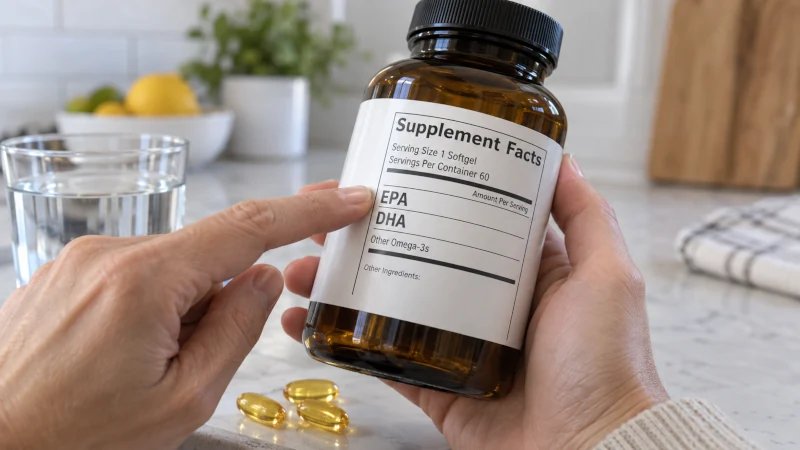
- Read the real numbers. A ‘1,000 mg fish oil’ softgel often contains only about 180 mg EPA and 120 mg DHA. Products vary widely, so check the EPA + DHA total on the label, not the ‘fish oil’ figure [NIH ODS, 2026].
- Set expectations. The strongest reason to take it is high triglycerides; it’s a reasonable add-on for rheumatoid arthritis; it is not a heart-disease shield for healthy people, and it is not a cure for anything.
- Take it with food to reduce fishy burps, and store it somewhere cool to limit oxidation.
When to talk to a healthcare professional
- Before starting fish oil if you take a blood thinner or antiplatelet drug, are due for surgery, are pregnant or breastfeeding, or have a fish/shellfish allergy.
- If you have very high triglycerides (especially 500 mg/dL or above), which needs medical treatment, not just a supplement.
- Before using fish oil for a diagnosed condition such as rheumatoid arthritis or heart disease — as an addition to, not a replacement for, prescribed care.
- Seek urgent care for red-flag symptoms unrelated to the supplement itself — chest pain or pressure, sudden shortness of breath, one-sided weakness, or trouble speaking are emergencies; call 911.
| HEALTH DISCLAIMER: This article is for general education and is not medical advice, diagnosis, or treatment. Fish oil and other omega-3 supplements can interact with medications and are not appropriate for everyone. Talk with your doctor, pharmacist, or a registered dietitian before starting a supplement or changing your diet — especially if you take blood thinners or other prescription drugs, are scheduled for surgery, are pregnant or breastfeeding, or have a chronic condition. Never stop or change a prescribed medication on your own. If you have chest pain, sudden shortness of breath, one-sided weakness, or trouble speaking, call 911. |
Frequently Asked Questions
What is the main benefit of fish oil?
Lowering triglycerides. That is the one effect with strong, consistent trial evidence — roughly a 15% reduction on average, more at higher doses and higher starting levels. Most other advertised benefits are weaker or unproven.
Does fish oil prevent heart attacks?
For healthy, lower-risk people, supplements have not been shown to prevent heart attacks or strokes. There is a better case for people who already have heart disease or very high triglycerides, and a high-dose prescription product reduced events in one high-risk trial — but that is a medical decision, not a reason for the general public to self-dose.
How much fish oil should I take?
For general health, two servings of oily fish a week is the food-first target. If you supplement, check the EPA + DHA total on the label and keep it at or below about 3 g/day unless your doctor directs otherwise. Very high or prescription doses should be supervised.
Is there mercury in fish oil?
Supplements have not been found to contain methylmercury — it is removed during processing. The mercury concern is about eating certain large fish, which matters most in pregnancy; choosing lower-mercury seafood addresses it.
Can I take fish oil with blood thinners?
Ask your doctor first. Omega-3s can lengthen bleeding time at higher doses, and although most research suggests moderate doses don’t significantly change INR, monitoring is sensible — and you should tell your surgeon before any procedure.
Is cod liver oil the same as fish oil?
No. Cod liver oil also contains vitamins A and D, which can be harmful in excess, so it is not interchangeable with regular fish oil — and it should be avoided in pregnancy because of its vitamin A content.
References
- National Institutes of Health, Office of Dietary Supplements. Omega-3 Fatty Acids — Health Professional Fact Sheet. Updated 2026. → View source
- National Center for Complementary and Integrative Health (NCCIH). Omega-3 Supplements: What You Need To Know. Last updated November 2024. → View source
- Wang T, Zhang X, Zhou N, et al. Association Between Omega-3 Fatty Acid Intake and Dyslipidemia: A Continuous Dose-Response Meta-Analysis of Randomized Controlled Trials. J Am Heart Assoc. 2023;12(11):e029512. doi:10.1161/JAHA.123.029512. → View source (DOI) PubMed
- Cleveland Clinic. Dysmenorrhea (Menstrual Cramps). Reviewed May 22, 2023. Cited for menstrual-pain management context, not as support for a fish-oil benefit. → View source


