
If you’re weighing up the Saunders Cervical Traction Device, here’s the honest short version: it’s a well-made home unit that gently stretches your neck, and for some people it takes the edge off nerve-related or muscular neck pain for a while. What it isn’t is a cure. The research behind cervical traction is modest and mixed — good evidence for short-term relief, thin evidence for lasting change — and the device isn’t safe for everyone. So the real question isn’t “is it a miracle,” it’s “is it a reasonable thing for me to try, and how do I use it without making things worse.”
This guide walks through what the Saunders Cervical Traction Device is, what the science actually supports, how to use it safely, and the situations where you should skip the device and see a doctor instead.
What the Saunders Cervical Traction Device actually is
It’s a home version of the neck traction physical therapists have used in clinics for decades. You lie on your back, rest the base of your skull in a padded cradle, and use a small hand pump to apply a measured pulling force to your neck while a gauge shows exactly how much. The device is made by Enovis (the Chattanooga/DJO brand), which has produced clinical traction equipment for years [Enovis, Saunders Cervical Traction].
How it’s built and how you use it
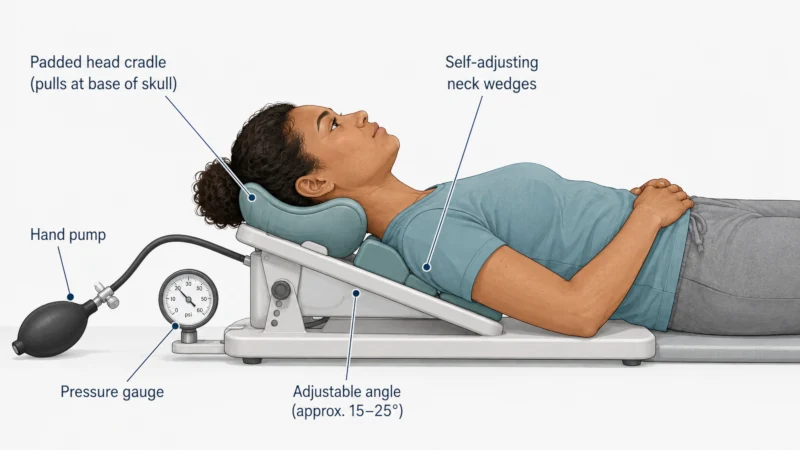
A few design details matter. The unit applies its pull at the occiput — the base of your skull — rather than under your chin. That’s deliberate: chin-strap traction presses on the jaw joint (the TMJ), and pulling from the occiput while you’re lying down avoids that pressure and lets your neck muscles relax [Enovis, Saunders Cervical Traction]; [StatPearls cervical traction review, 2023].
Self-adjusting neck wedges size it to your neck, and the frame offers a few fixed angles. The hand pump lets you raise the force gradually and read it on the gauge, up to roughly 50 pounds at the top of its range — though most home use sits well below that. It weighs about nine pounds and packs into a carry case, which is a large part of its appeal.
How it’s supposed to work
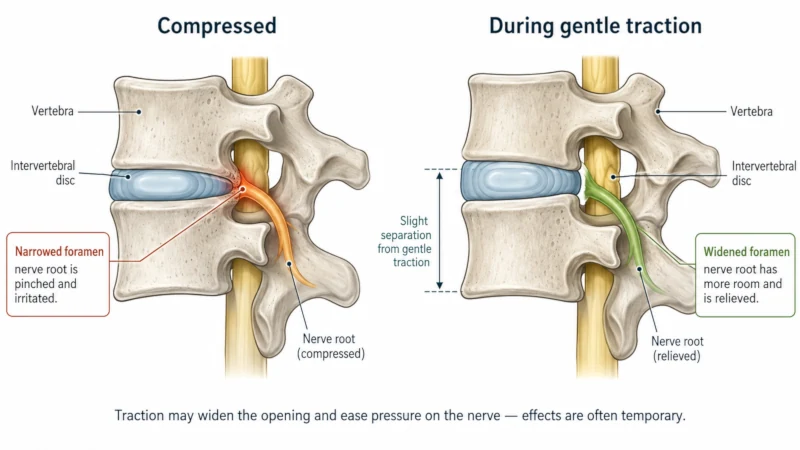
The theory is straightforward even if the biology isn’t fully settled. Traction gently separates the neck vertebrae, which widens the small openings where nerve roots exit the spine and can ease pressure on a compressed or irritated nerve. A second, simpler explanation is that the pull relaxes tight neck muscles. Researchers are candid that there’s no single confirmed mechanism, and both effects may play a part [StatPearls cervical traction review, 2023].
Does the Saunders Cervical Traction Device actually work?
This is where honesty matters more than enthusiasm, because the evidence lands in the middle — not useless, not a breakthrough.
Where the evidence is strongest
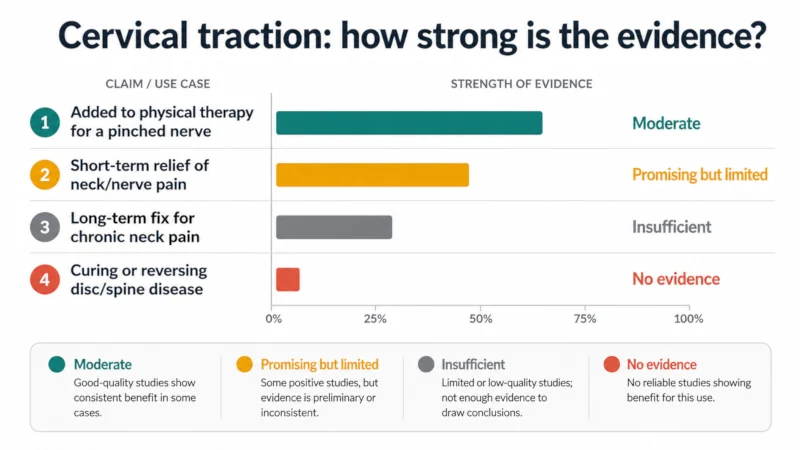
The best case for cervical traction is as an add-on to an active treatment program. A 2018 meta-analysis in Physical Therapy found moderate-quality evidence that adding traction to a physical therapy routine reduced pain in people with cervical radiculopathy, both right after treatment and at a six-month follow-up [Romeo et al., Physical Therapy, 2018]. Many people also get genuine, if temporary, relief — clinical reviews consistently note that traction can ease symptoms in the short term [StatPearls cervical traction review, 2023].
Where it’s weak or mixed
The caveats are just as real. A 2020 meta-analysis of traction for cervical nerve-root pain found that the improvement, while statistically measurable, was too small to be clinically meaningful for most patients [Colombo et al., 2020]. And for chronic, longer-standing neck pain, most studies are small and low in quality, with no good evidence that traction changes anything over the long run [StatPearls cervical traction review, 2023].
Put those together and a fair summary looks like this:
| Use of the device | What the evidence supports |
| Added to a PT/exercise program for a pinched nerve (radiculopathy) | Moderate — modest short- and medium-term pain reduction |
| Short-term relief of nerve or muscular neck pain | Promising but limited — real for some, often temporary |
| A stand-alone long-term fix for chronic neck pain | Insufficient — little quality evidence of lasting benefit |
| Curing, reversing, or preventing disc or spine disease | No — not supported; avoid any source claiming this |
The practical takeaway: think of the device as a tool that may buy you comfort and make it easier to do the movement and strengthening work that actually drives recovery — not as the recovery itself.
Who it may help — and the conditions it’s used for
Cervical traction is used for several neck problems: a pinched nerve (cervical radiculopathy), degenerative disc disease, cervical spondylosis (age-related “wear-and-tear” arthritis of the neck), foraminal narrowing, and plain muscular tightness [StatPearls cervical traction review, 2023]. Cervical radiculopathy — that radiating pain, tingling, or weakness running from the neck into the shoulder or arm — is the classic reason people try it, and reassuringly, most cases settle with conservative care like activity, medication, and physical therapy without ever needing surgery [AAOS OrthoInfo, cervical radiculopathy]; [Cleveland Clinic, 2025].
If your neck pain is desk-and-posture related muscle strain, traction may relax things, but it’s competing with free measures — movement breaks, workstation changes, exercise. Traction earns its place most clearly when a nerve root is genuinely being pinched. For the bigger picture on non-drug approaches to nagging neck and back pain, our overview of natural approaches to musculoskeletal disorders and the broader musculoskeletal health section are good companions to this page.
How to use it safely
The single most useful step happens before you buy: talk to a doctor or physical therapist about whether traction suits your specific neck problem, and ideally get the force, angle, and session length matched to you. Cervical traction has real contraindications (below), and a professional can rule them out.
When you do use it, the general principles are simple. Set the device on a firm, flat surface and lie down with the base of your skull in the cradle. Adjust the neck wedges so it’s snug but comfortable. Pump slowly, watching the gauge, and start low — build force gradually over sessions rather than chasing a big stretch on day one. Keep sessions short and follow the schedule your therapist or the product manual gives you rather than a number you read online. Ease the pressure off gently at the end.
Stop immediately and release the traction if you feel increasing pain, new or worsening numbness or tingling, arm or hand weakness, or dizziness. Those aren’t “push through it” sensations — they can signal that a nerve or the spinal cord is being irritated rather than relieved [StatPearls cervical traction review, 2023]. More is not better; overdoing traction can leave you sorer than when you started.
Side effects, risks, and who should not use it
Common side effects
Most people who tolerate traction get, at worst, temporary neck soreness, a mild headache, or brief lightheadedness after a session. Because the Saunders design pulls from the occiput rather than the chin, jaw discomfort is less of an issue than with older halter-style units [Enovis, Saunders Cervical Traction]. Side effects that build or persist are a reason to stop and check in with a professional.
Who should avoid it
Traction isn’t right for every neck. Clinical references list a range of conditions where cervical traction is a probable or relative contraindication — meaning you should not use it without a clinician’s specific clearance. These include [StatPearls cervical traction review, 2023]:
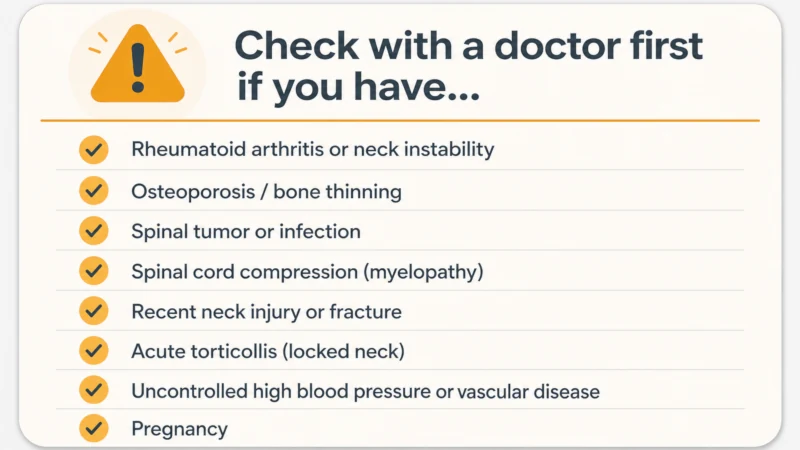
- Rheumatoid arthritis or any condition causing instability of the neck ligaments
- Osteoporosis or significant bone thinning
- A spinal tumor, or a bone or spinal infection
- Myelopathy (compression of the spinal cord itself)
- A recent neck fracture, dislocation, or acute injury
- Acute torticollis (a sudden, severely stiff or locked neck)
- Uncontrolled high blood pressure, or vascular problems such as vertebral or carotid artery disease
- Pregnancy
If any of these apply to you, the device is not a “try it and see” purchase — it’s a “clear it with your doctor first” one.
Pregnancy and breastfeeding
Pregnancy is listed among the situations where cervical traction is a probable contraindication [StatPearls cervical traction review, 2023]. If you’re pregnant or recently postpartum and dealing with neck pain, skip home traction unless a doctor or physical therapist who knows your history specifically recommends and supervises it, and ask them about safer options for relief in the meantime.
Red flags: when neck pain needs a doctor, not a device
Some neck symptoms mean it’s time to stop self-treating and get assessed — a traction device is the wrong response to any of these. Seek prompt medical care, and call 911 for sudden, severe, or rapidly worsening symptoms:
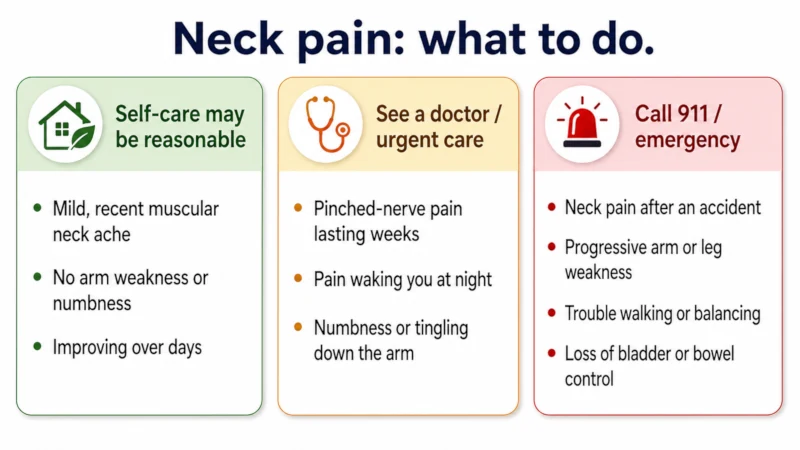
- Neck pain right after a car crash, fall, or other significant injury
- Progressive weakness, numbness, or clumsiness in an arm or hand
- Trouble with balance or walking, or a “heavy-legged” feeling — possible signs of spinal cord involvement
- Loss of bladder or bowel control
- Severe neck pain or stiffness with fever
- A pinched-nerve pattern that keeps worsening, wakes you at night, or hasn’t improved after a few weeks of sensible care
For persistent, non-emergency neck pain, a primary care doctor, an urgent care clinic, or a physical therapist is the right next stop. If you’re managing long-running pain and want to understand the non-drug options that pair well with (or instead of) a device, our guide to chronic pain management covers physical therapy, heat and cold, and related approaches.
Is it really “FDA-approved,” and is it worth it?
You’ll see “FDA-approved” attached to home traction units a lot, and it’s not quite accurate. In FDA terms, approval is the strict process reserved for the highest-risk devices, like pacemakers. Lower-risk devices such as home cervical traction units are either cleared through a lighter review or are exempt from that step altogether — most low-risk (Class I) devices are exempt from FDA premarket clearance [FDA, medical device exemptions]. So the accurate way to say it is that the Saunders is a legitimate, regulated medical device from an established maker — not that it carries FDA “approval.”
Is it worth it? For the right person — someone with a nerve-related neck problem, cleared by a clinician, using it as one part of an active plan — a home unit can be a reasonable, convenient alternative to repeated clinic traction, and it can make daily rehab more comfortable. For someone hoping a device alone will erase chronic neck pain, the evidence just doesn’t promise that. Buy it for what it is: a tool that may help you feel better in the short term while you do the real work of recovery.
| Health Disclaimer This article is for general education and information only. It is not medical advice and is not a substitute for diagnosis or treatment from a qualified healthcare professional. Cervical traction has real contraindications and isn’t suitable for everyone. If you have a neck condition, are pregnant, take medication, or have any of the conditions listed above, talk to a doctor or physical therapist before using the Saunders Cervical Traction Device or any traction device. If you have severe, worsening, or sudden neurological symptoms — arm or leg weakness, loss of coordination, loss of bladder or bowel control, or neck pain after an injury — seek urgent medical care or call 911. Never push through pain, numbness, or dizziness during traction. |
Frequently Asked Questions
Does the Saunders Cervical Traction Device really work for neck pain?
For some people, yes — usually as short-term relief, and most convincingly when it’s added to a physical therapy or exercise program for a pinched nerve. A 2018 meta-analysis found moderate evidence that adding traction to PT reduced radiculopathy pain [Romeo et al., 2018]. But the effect is modest, and for chronic neck pain the long-term evidence is limited [Colombo et al., 2020]; [StatPearls, 2023]. It’s a helper, not a cure.
How long should I use it in each session?
Follow the schedule your physical therapist or the product manual gives you rather than a fixed number from the internet, and build up gradually from a low force. Stop the session if pain, numbness, tingling, or dizziness increases [StatPearls, 2023].
Who should not use cervical traction?
Anyone with rheumatoid arthritis or neck instability, osteoporosis, a spinal tumor or infection, spinal cord compression (myelopathy), a recent neck injury or fracture, uncontrolled high blood pressure or certain vascular conditions, acute torticollis, or who is pregnant — unless a clinician specifically clears it [StatPearls, 2023].
Is the Saunders Cervical Traction Device FDA-approved?
Not in the strict sense. Home traction units are lower-risk devices that are FDA-cleared or exempt rather than FDA-“approved,” a term reserved for high-risk devices [FDA, medical device exemptions]. It is a legitimate regulated device from an established manufacturer.
When should I see a doctor instead of using a traction device?
Right away for red flags — arm or leg weakness, trouble walking or balancing, loss of bladder or bowel control, or neck pain after an accident. And book a visit if a pinched-nerve pattern keeps worsening or hasn’t eased after a few weeks [AAOS OrthoInfo, cervical radiculopathy].
Can it fix a herniated disc or reverse arthritis in my neck?
No. There’s no good evidence that traction cures, reverses, or prevents disc or spine disease. It may relieve symptoms while the underlying problem is managed with a broader plan [StatPearls, 2023].
References
- Abi-Aad KR, Derian A. Cervical Traction. StatPearls Publishing; updated 2023. PMID 29262157. View source
- Romeo A, Vanti C, Boldrini V, et al. Cervical Radiculopathy: Effectiveness of Adding Traction to Physical Therapy. Physical Therapy. 2018;98(4):231–242. PMID 29315428. View source
- Colombo C, et al. Traction Therapy for Cervical Radicular Syndrome is Statistically Significant but not Clinically Relevant for Pain Relief. 2020. PMC7690405. View source
- American Academy of Orthopaedic Surgeons, OrthoInfo. Cervical Radiculopathy (Pinched Nerve). View source
- Cleveland Clinic. Cervical Radiculopathy (Pinched Nerve). 2025. View source
- U.S. Food and Drug Administration. Medical Device Exemptions 510(k) and GMP Requirements. View source
- Enovis / Chattanooga (DJO). Saunders Cervical Traction. View source
