
The vanilla plant is a climbing orchid, Vanilla planifolia, and the dark “beans” in your spice jar are its cured seed pods. People have credited vanilla with everything from settling the stomach to lifting the mood. Here is the honest version: in the amounts you cook with, vanilla is a flavor, not a treatment. Its main aroma compound, vanillin, does interesting things in lab and animal studies, and a few small hospital trials have tested its scent on premature babies. The most useful health facts about the vanilla plant are practical ones — how to spot fake “vanilla,” who may react to it, and why extract belongs in the cake and not in a glass.
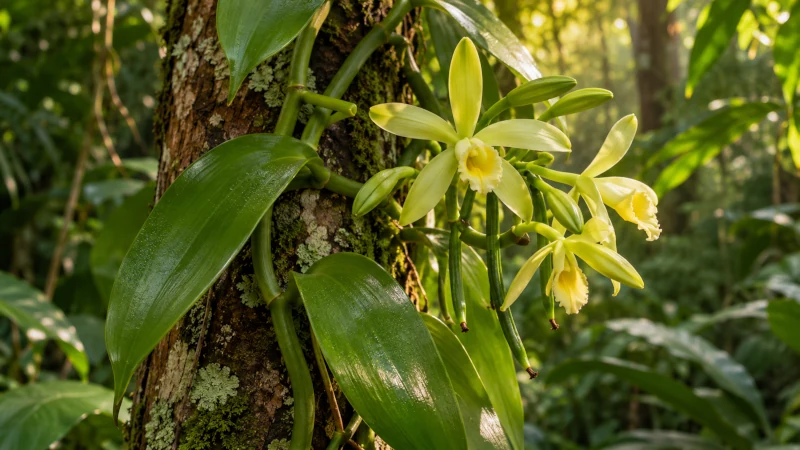
The vanilla plant at a glance
| Feature | Details |
| Scientific name | Vanilla planifolia (older synonym: Vanilla fragrans) [POWO, n.d.] |
| Plant family | Orchidaceae — vanilla is an orchid that grows as a vine [Kew, n.d.] |
| Native range | Tropical forests of Mexico, Central America, and northern South America [Kew, n.d.] |
| Status in the wild | Endangered; wild plants are rare because of habitat loss and overharvesting [Kew, n.d.] |
| Part used | The fruit pods, cured until dark and fragrant; roughly 12–24 cm long [Thermo Fisher, n.d.] |
| Key flavor compound | Vanillin, which develops during curing [Kew, n.d.; Thermo Fisher, n.d.] |
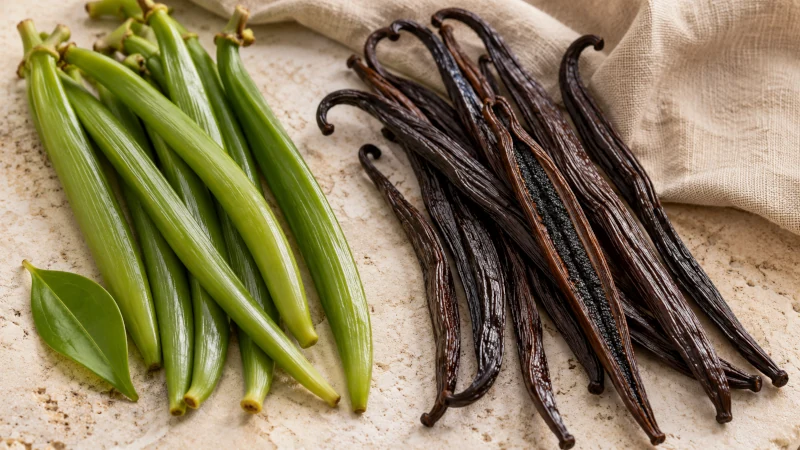
Green, freshly picked pods don’t have the aroma you know. Vanilla’s flavor is released only after the pods are dried and cured by steaming and fermentation [Kew, n.d.], and by the end of that process vanillin can show up as fine white crystals on the bean [Thermo Fisher, n.d.].
From Aztec cocoa to hand-pollinated vines
Aztec people in Mexico were the first known to use vanilla, as a flavoring for cocoa [Kew, n.d.]. When the plant was carried to other tropical regions, growers hit a wall: the vines flowered but set no fruit. In its native range, vanilla relies on an insect pollinator — Kew names the Melipona bee — that doesn’t live where the plant was introduced [Kew, n.d.].
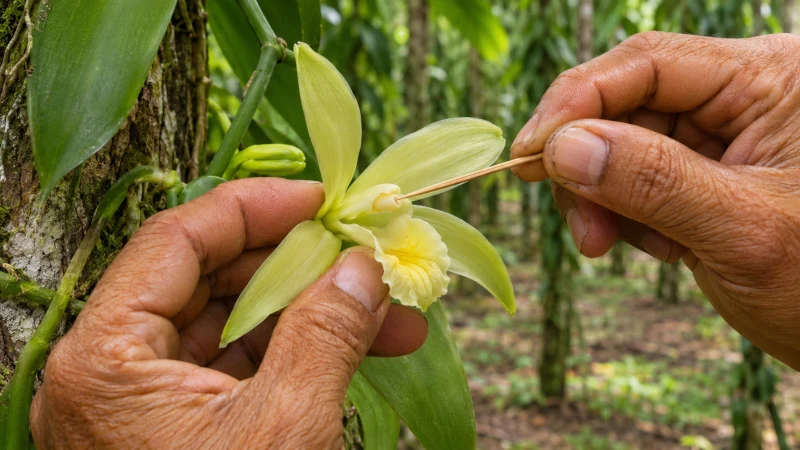
Belgian botanist Charles Morren published a hand-pollination method in 1837, but it was too slow to make vanilla farming pay [Wikipedia, n.d.]. The breakthrough came in 1841 on the island of Réunion, where Edmond Albius, an enslaved boy of about 12, worked out a fast way to pollinate each flower by hand [Kew, n.d.; Wikipedia, n.d.]. Outside its native range, vanilla is still pollinated this way, one flower at a time, and each blossom is open for only about eight hours [Kew, n.d.]. Add a labor-intensive curing process [Thermo Fisher, n.d.] and you have the reason real vanilla costs what it does.
Vanilla plant health benefits: what the evidence shows
Most vanilla health claims rest on vanillin research done in test tubes and animals. That work is real, but it can’t tell you what a teaspoon of extract does in a person. Here is how the main claims stack up.
| Claim | What the research actually is | Strength of evidence |
| Aids digestion; mild stimulant; aphrodisiac | Traditional use; Kew notes these uses need further research [Kew, n.d.] | Traditional only — no good human trials |
| Antioxidant and anti-inflammatory | Lab and animal studies of vanillin and its breakdown products [Bezerra-Filho et al., 2019] | Early-stage — no human outcome data |
| Antimicrobial | Vanillin has antimicrobial properties [Kew, n.d.] | Lab property; relevant to food, not to treating infection |
| Scent reduces breathing pauses in premature babies | Two small hospital trials with conflicting results [Edraki et al., 2013; Yaghoubi et al., 2017] | Limited and mixed; hospital use only |
| Helps cut added sugar | Blind taste tests: vanilla made milk taste sweeter [Penn State, 2019] | Promising for taste; no health-outcome data |
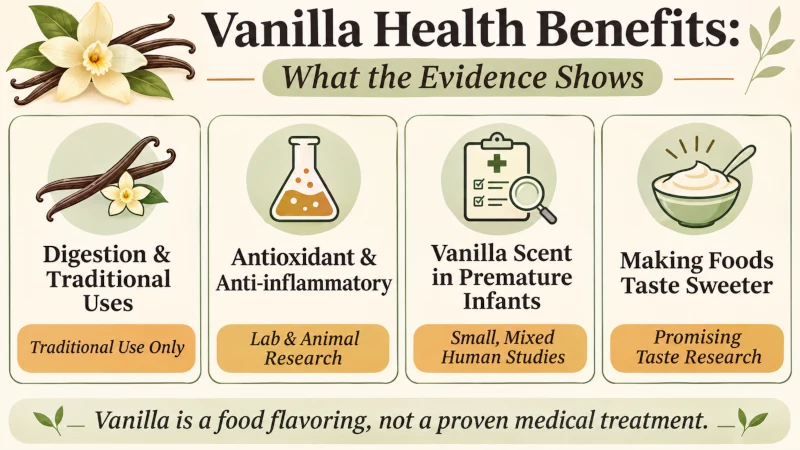
We grade evidence the same way across our herb guides, so you can compare vanilla with other plants on equal terms.
Traditional digestive and “tonic” uses
Herbal traditions have long described vanilla as a digestive aid and gentle stimulant, and sometimes as an aphrodisiac or fever remedy. Kew’s botanists list these uses but say they need further research [Kew, n.d.]. We found no clinical trials testing vanilla for digestion in people. If you’re curious about plants with a similar folk reputation, our look at roselle, another plant traditionally used to support digestion is a useful comparison. For digestive symptoms that keep coming back, start with our digestive health guides rather than the spice rack.
Vanillin in the lab
Vanillin and its breakdown products, vanillic acid and vanillyl alcohol, show anti-inflammatory and antioxidant activity in laboratory research. A 2019 review argued they deserve further study as anti-inflammatory agents [Bezerra-Filho et al., 2019]. That’s a reason for scientists to keep looking. It isn’t a reason to take vanilla for inflammation: lab experiments use concentrated compounds, the amount of vanillin in a recipe is small, and human trials measuring health outcomes are missing.
Vanilla scent and premature babies
This is the one area with human trials, and it’s narrow. In a 2013 randomized trial of 36 premature infants in Iran, a vanillin solution placed in the incubator was linked to fewer breathing pauses (apnea) over five days compared with routine care [Edraki et al., 2013]. The trial was small, and some figures in the paper don’t match between its text and tables. A 2017 trial of 40 premature infants reported in its abstract no significant difference in apnea attacks between groups, although its discussion describes a benefit [Yaghoubi et al., 2017].
Read together, the results are mixed. These were supervised studies in neonatal intensive care units, not home remedies. Breathing pauses in a baby are an emergency for the medical team. Scent research in adults is a separate question; our review of lavender’s evidence shows what a stronger aromatherapy evidence base looks like.
Using vanilla to cut added sugar
This may be vanilla’s most practical benefit. In blind taste tests at Penn State, people rated vanilla-flavored milk as sweeter than its sugar content could explain, and the researchers estimated added sugar could be cut by 20 to 50 percent without people noticing [Penn State, 2019]. That finding is about perceived sweetness, not weight or blood sugar. Still, it’s a useful kitchen move: a little vanilla in oatmeal, yogurt, or coffee can make less sugar taste like enough.
How to use vanilla in your kitchen
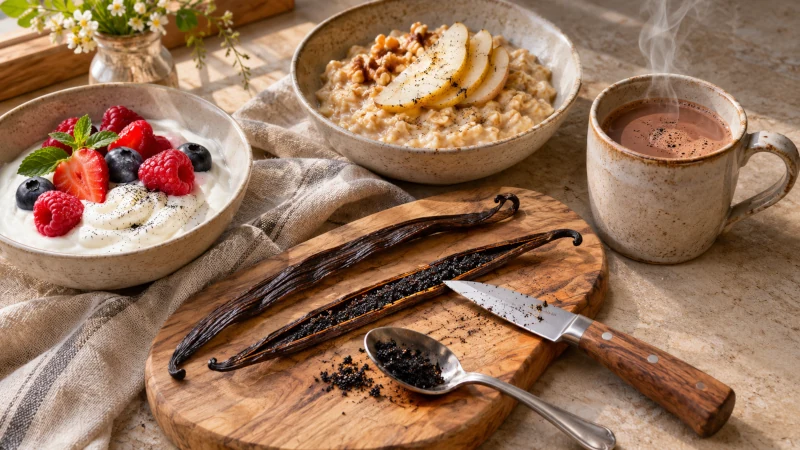
The classic advice is to let the flavor infuse into whatever you’re making. A few ways to do that:
- Whole beans: split the pod lengthwise, scrape the seeds into custard, cream, or batter, and steep the empty pod in warm milk or cream before removing it.
- Extract: stir it into batters or add it toward the end of cooking. A little goes a long way.
- Vanilla sugar: bury a used, dried pod in a jar of sugar and give it a week or two.
- Hot drinks: a piece of pod in hot cocoa revives the Aztec pairing.
Real vanilla, imitation vanilla, and the coumarin problem
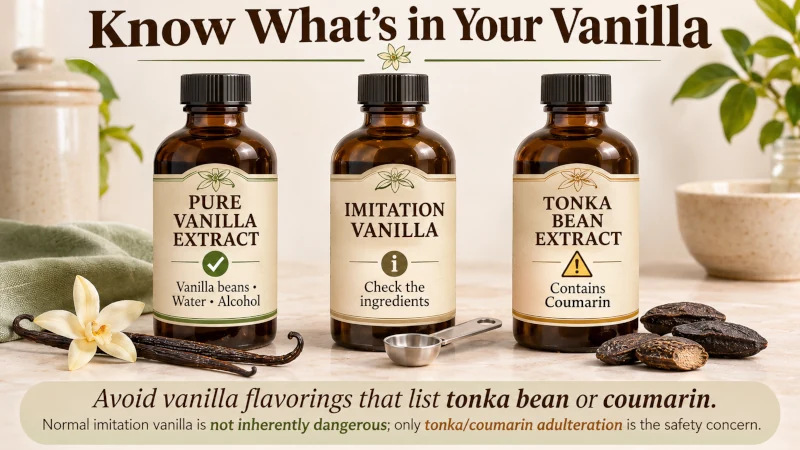
In the United States, “vanilla extract” has a legal definition: vanilla bean flavor dissolved in water and alcohol, with at least 35 percent alcohol by volume [eCFR, 21 CFR 169.175]. Vanilla-style flavors that don’t meet the standard must be labeled “imitation” [FDA, 2008]. Kew notes that much of the “vanilla essence” sold today is made from wood pulp or coal tar [Kew, n.d.]. Imitation vanilla is a difference in flavor and price, not a safety issue.
The real safety concern is coumarin. Some cheap “Mexican vanilla” is made with extract of tonka beans, an unrelated plant that contains coumarin [FDA, 2008]. Food with added coumarin, including tonka bean extract, has been treated as adulterated in the US under an order dating to 1954 [eCFR, 21 CFR 189.130]. The FDA notes coumarin is related to warfarin, a blood-thinning drug, which makes it especially risky for people on blood thinners [FDA, 2008].
Quick buying checks:
- Skip any product that lists tonka bean or coumarin, or that has no ingredient list or a vague one [FDA, 2008].
- Be cautious with very cheap, large bottles bought while traveling or from informal sellers.
- Real vanilla made in Mexico and legally imported shouldn’t contain coumarin [FDA, 2008] — the issue is the counterfeit, not the country.
Spices are full of look-alikes; our guide to Ceylon cinnamon’s health benefits explains why the species on the label matters there too.
Safety: allergies, alcohol, and who should be careful
Allergies and skin reactions
Vanilla allergy is uncommon, and when it happens it’s usually a delayed skin reaction rather than an immediate one [Thermo Fisher, n.d.]. Reported cases include lip dermatitis from a vanilla lip balm, a facial rash from a hair lotion containing vanilla, and contact dermatitis in people who grow or process vanilla or work as bakers [Thermo Fisher, n.d.]. If you’re allergic to balsam of Peru, a common fragrance allergen, vanilla may bother you too; Allergy UK lists it as a cross-reacting substance [Allergy UK, n.d.].
Pregnancy and breastfeeding
Vanilla used as a flavoring in food is part of most people’s normal diet. The question during pregnancy is the alcohol: pure extract is at least 35 percent alcohol [eCFR, 21 CFR 169.175], and the CDC says there’s no known safe amount of alcohol during pregnancy [CDC, n.d.]. The amount in a slice of cake is small, but if you’re avoiding alcohol completely, whole beans or vanilla powder are easy swaps — check the label, since some vanilla pastes contain alcohol. We found no research on vanilla specifically during breastfeeding; the same alcohol-free swaps work if you prefer to avoid extract.
Medications
We didn’t find documented interactions between real vanilla in normal food amounts and medicines. Two situations deserve care: coumarin-containing “vanilla” if you take a blood thinner such as warfarin [FDA, 2008], and alcohol-based extract if you take a medicine that requires avoiding alcohol. Your pharmacist can tell you whether that applies to you.
Children
Keep vanilla extract out of reach. At 35 percent alcohol or more [eCFR, 21 CFR 169.175], a child drinking it from the bottle is a poisoning risk, not a flavor mishap. In the US, call Poison Control at 1-800-222-1222 [Poison Control, n.d.].
Who should avoid or limit vanilla
- Anyone with a known vanilla or vanillin allergy.
- People with balsam of Peru allergy — especially with vanilla-scented skin and lip products. A dermatologist can advise.
- Anyone avoiding all alcohol (pregnancy, recovery, certain medicines) should choose alcohol-free forms over extract.
- Anyone taking a blood thinner should avoid unlabeled or tonka-based “vanilla.”
When to see a doctor or get urgent care
- Get emergency care for swelling of the lips, tongue, or throat, trouble breathing, or widespread hives after eating or using a product.
- See a doctor for a rash on the lips, face, or hands that keeps returning. Fragrance allergies are usually diagnosed with patch testing by a dermatologist [Allergy UK, n.d.].
- Call your doctor if you take warfarin or another blood thinner, have used vanilla of uncertain origin, and notice unusual bruising or bleeding.
- Call Poison Control if a child swallows vanilla extract.
HEALTH DISCLAIMER: This article is for general education and isn’t a substitute for advice, diagnosis, or treatment from a qualified healthcare professional. Vanilla is a food flavoring, not a proven treatment for any condition. If you are pregnant, breastfeeding, taking medication, or managing a health condition, talk with your doctor or pharmacist before using any herb or natural remedy for health purposes.
Frequently Asked Questions
Is the vanilla plant good for digestion?
Is Mexican vanilla safe?
Real vanilla made in Mexico and legally imported should be fine. The risk is counterfeit “vanilla” made from tonka beans, which contains coumarin; avoid products that list tonka or have no clear ingredient list [FDA, 2008].
What’s the difference between pure and imitation vanilla?
Pure vanilla extract must be made from vanilla beans and contain at least 35% alcohol in the US [eCFR, 21 CFR 169.175]. Imitation vanilla usually uses vanillin made from other sources [Kew, n.d.]. It tastes simpler, but it isn’t unsafe.
Can I eat foods made with vanilla extract while pregnant?
The CDC says no amount of alcohol is known to be safe in pregnancy [CDC, n.d.]. The extract in a serving of baked goods is small; if you want zero alcohol, use whole beans or vanilla powder instead, and ask your clinician if you’re unsure.
Why is real vanilla so expensive?
Outside its native range, every flower has to be pollinated by hand during a window of about eight hours [Kew, n.d.], and the pods then go through a labor-intensive curing process [Thermo Fisher, n.d.].
References
- Allergy UK. Balsam of Peru. View source
- Bezerra-Filho CSM, et al. Therapeutical potential of vanillin and its main metabolites to regulate the inflammatory response and oxidative stress. View source
- Centers for Disease Control and Prevention. About alcohol use during pregnancy. View source
- Edraki M, Pourpulad H, Kargar M, Pishva N, Zare N, Montaseri H. View source
- Electronic Code of Federal Regulations. Vanilla extract. View source
- Electronic Code of Federal Regulations. Coumarin. View source
- U.S. Food and Drug Administration. Mexican “vanilla” with coumarin: no bargain. View source
- Penn State News. Vanilla makes milk beverages seem sweeter. View source
- Poison Control (National Capital Poison Center). poison.org. View source
- Plants of the World Online, Royal Botanic Gardens, Kew. Vanilla fragrans Ames (synonym of Vanilla planifolia). View source
- Royal Botanic Gardens, Kew. Vanilla (Vanilla planifolia). View source
- Thermo Fisher Scientific. Allergen Encyclopedia: f234 Vanilla. View source
- Wikipedia. Edmond Albius. View source
- Yaghoubi S, Salmani N, Dehghani K, DavoodiZadehJolgeh H. View source


