You’ve probably heard that carrots help you see in the dark. That part is mostly a myth. But the nutrient behind the myth, vitamin A, is doing real work in your body every day, and it’s worth knowing what carrots actually do — and don’t do — for your health.
Carrots are one of the best plant sources of provitamin A, the raw material your body converts into the vitamin A it needs for your eyes, your immune system, and your skin. That’s the real health benefit of carrots. It’s not a cure for acne, a treatment for kidney stones, or a way to quit smoking, whatever older folk-health writing claims — and we’ll get into why those specific claims don’t hold up.
What’s Actually in a Carrot
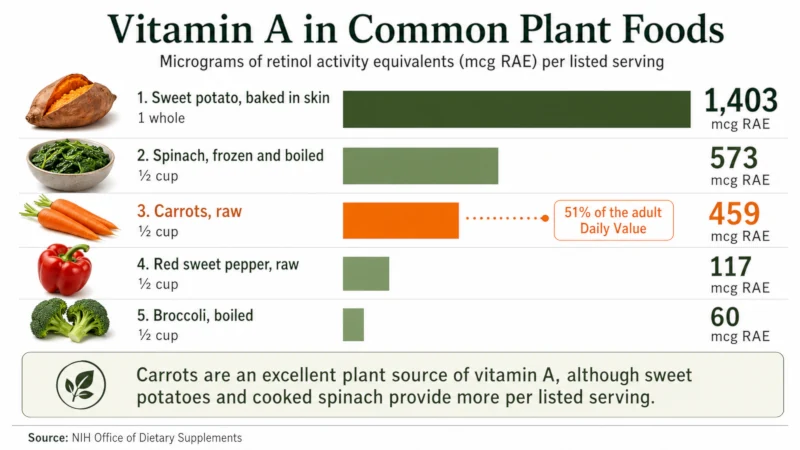
One medium raw carrot has roughly 25 calories and about 6 grams of carbohydrate, most of it fiber and natural sugar. The standout nutrient is vitamin A: a half-cup of raw carrots supplies about 459 mcg RAE (retinol activity equivalents), or 51% of an adult’s Daily Value, almost entirely as beta-carotene rather than the “preformed” vitamin A found in liver or fish oil [NIH ODS, 2025]. Carrots also contribute some potassium and vitamin K1, though leafy greens and bananas beat them on both.
That beta-carotene distinction matters more than it sounds. Your body converts beta-carotene into vitamin A only as needed, which is the reason carrots are one of the few “vitamin A” foods you genuinely can’t overdose on. Liver, fish oil, and vitamin A supplements are a different story — see the food sources of vitamin A for a fuller comparison, and the safety section below for why that distinction is worth remembering.
The Real Benefit: Vitamin A
Vitamin A supports vision, immune function, reproduction, and the normal maintenance of your heart, lungs, and skin [NIH ODS, 2025]. Getting enough of it — from carrots or anywhere else — matters in a few concrete ways.
Your Eyes
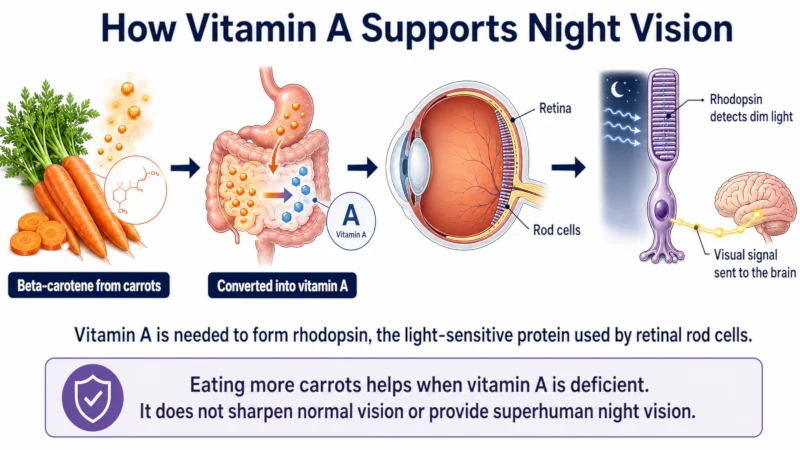
Vitamin A is a building block of rhodopsin, the light-sensitive pigment your retina uses to detect dim light. A genuine vitamin A deficiency causes night blindness and, if it continues, a more serious condition called xerophthalmia that can damage the cornea [Harvard T.H. Chan, 2024; NIH ODS, 2025]. If you eat a typical U.S. diet, though, you’re very unlikely to be deficient — frank vitamin A deficiency is rare in this country, according to NIH data [NIH ODS, 2025]. For more, our eye and vision section covers related conditions and when they need attention.
Your Immune System and Skin
Vitamin A helps maintain the mucous membranes in your eyes, gut, and airways that form your body’s first line of defense, and deficiency raises both the risk and severity of infections, including respiratory illness and diarrhea [NIH ODS, 2025]. It also supports normal skin cell turnover, which is why deficiency shows up partly as dry, rough skin. That’s a real mechanism, but a narrow one — it doesn’t mean eating more carrots will clear acne or give skin a special glow, and no current evidence supports that stronger claim.
The “Carrots Help You See in the Dark” Myth
Harvard’s Nutrition Source calls this one only a semi-myth. Beta-carotene, carrots’ main nutrient, is genuinely a precursor to vitamin A and does help your eyes adjust in dim conditions [Harvard T.H. Chan, 2024]. But that only matters if you’re deficient to begin with. If your vitamin A levels are already normal, eating more carrots won’t sharpen your eyesight, correct nearsightedness, or let you see better than anyone else in the dark — it can only correct a deficiency that’s actually there.
Can Carrots Turn Your Skin Orange? (Yes — And It’s Harmless)
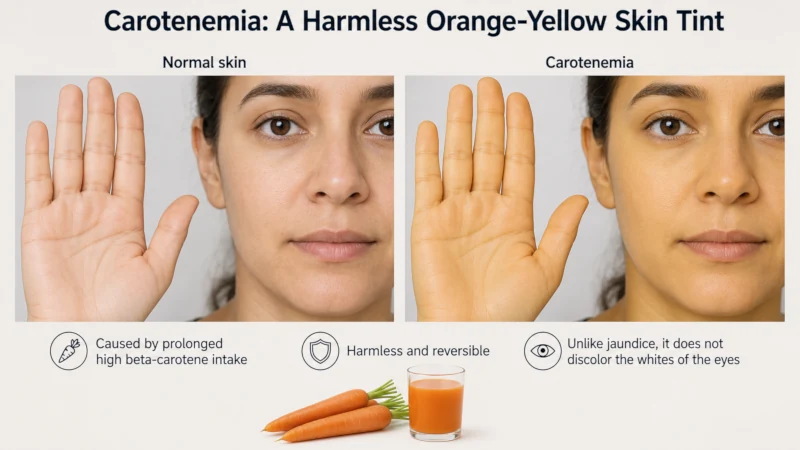
Unlike the night-vision claim, this one checks out. Eating a lot of beta-carotene-rich food can cause carotenemia, a yellow-orange tint most visible on the palms, soles, and around the nose.
Cleveland Clinic dermatologist Melissa Piliang, MD, puts the threshold at roughly 20 to 50 milligrams of beta-carotene a day for a few weeks — for reference, one medium carrot has about 4 mg, so it typically takes something like ten carrots a day, sustained, or a habit of concentrated carrot juice, to get there [Cleveland Clinic, 2026]. It’s harmless, fades once intake drops, and — unlike jaundice — doesn’t affect the whites of the eyes. Young children eating a lot of pureed carrots and squash are actually the group most likely to develop it [Cleveland Clinic, 2026].
Where the Evidence Gets Thinner
A lot of older health writing credits carrots with easing digestion, fighting intestinal parasites, dissolving kidney and gallstones, treating hyperthyroidism, and helping people quit smoking. Some of this traces back to real but narrow mechanisms — carrots do contain fiber, and vitamin A does support mucous membrane health — stretched well past what the evidence actually supports. We looked for current, credible sources behind each of these specific claims and didn’t find them, so they’re not repeated here.
One claim is worth correcting directly rather than just dropping. High-dose beta-carotene supplements are not the same as beta-carotene from carrots, and they are not a safe substitute for quitting smoking. In two large clinical trials, high-dose beta-carotene supplements actually increased lung cancer risk in smokers and in people with asbestos exposure [NIH ODS, 2025; Harvard T.H. Chan, 2024]. If you smoke, food is the safer source of beta-carotene — supplements aren’t recommended for this purpose, and quitting itself, with medical support, is what actually lowers lung cancer risk.
Carrots’ fiber does play a real, modest role in digestion, and grated or cooked carrot has long been used as a home remedy for mild diarrhea. If diarrhea — yours or a child’s — lasts more than a couple of days, comes with blood, high fever, or signs of dehydration, that calls for oral rehydration and medical attention, not a home food remedy. Our guide to the causes of diarrhea covers when self-care is and isn’t enough.
Who Should Be Careful With Carrots
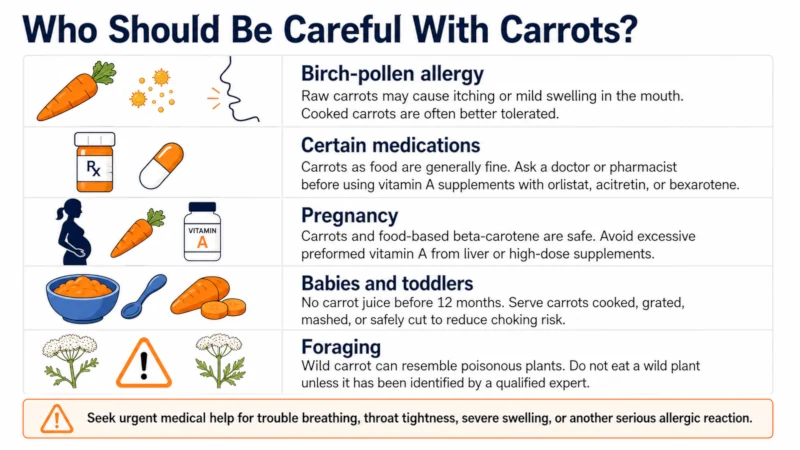
Carrots are safe for most people in ordinary amounts. A few groups should pay closer attention.
Oral Allergy Syndrome
If you have a birch pollen allergy, raw carrots are one of the more common trigger foods for oral allergy syndrome (also called pollen-food allergy syndrome) — itching or mild swelling in the mouth and throat shortly after eating. Cooking usually breaks down the allergen, so many people who react to raw carrots can eat cooked ones without trouble. Reactions are usually mild and confined to the mouth, but symptoms beyond that — throat tightness, trouble swallowing, hives, or difficulty breathing — are a reason to see an allergist and discuss whether you should carry an epinephrine auto-injector [ACAAI, 2022].
Medication Interactions
Vitamin A can interact with a few medications. Orlistat, a weight-loss drug, reduces absorption of vitamin A and beta-carotene, so people taking it are often advised to also take a multivitamin. Two prescription drugs derived from vitamin A — acitretin for psoriasis and bexarotene for certain lymphomas — can push vitamin A to dangerously high levels if combined with a vitamin A supplement. None of this applies to eating carrots as food, but it’s worth mentioning to your doctor or pharmacist if you’re on these medications and considering any vitamin A supplement [NIH ODS, 2025].
Pregnancy
Carrots and their beta-carotene are a normal, healthy part of a pregnancy diet. The real caution is specific to preformed vitamin A — the retinol form found in liver, some fish oils, and high-dose supplements — which can cause birth defects at high intakes. Beta-carotene from food isn’t linked to that risk [NIH ODS, 2025]. If you’re pregnant or might become pregnant, it’s the supplement aisle worth being careful in, not the produce aisle.
Feeding Carrots to Babies
Carrots are a normal first food once a baby starts solids, generally around 6 months. Two specific points are worth knowing. First, the American Academy of Pediatrics recommends no fruit juice at all — including carrot juice — before 12 months of age, since it offers no advantage over whole food, breast milk, or formula at that stage [AAP/HealthyChildren.org, 2022].
Second, home-prepared vegetable purees from carrots, along with a handful of other vegetables like beets and spinach, carry a small, well-documented nitrate risk for infants younger than about three months, tied to a rare condition called methemoglobinemia; this is longstanding AAP guidance and matters far more with contaminated well water than with an ordinary carrot puree introduced at the usual age for starting solids [AAP, summarized in American Family Physician, 2005]. Separately, raw carrot rounds and sticks are a well-known choking hazard for babies and toddlers — grate or cook carrots, or cut them into thin sticks rather than coins, until a child can safely chew harder raw foods.
Foraging Wild Carrot
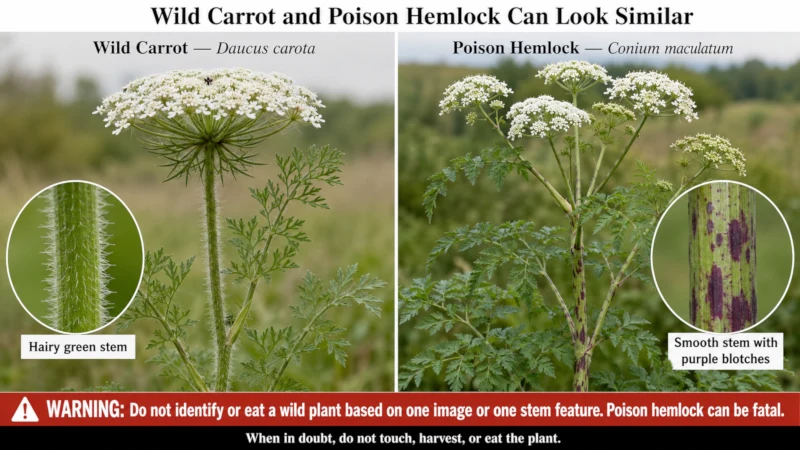
Wild carrot (Daucus carota, also called Queen Anne’s Lace) is the ancestor of the cultivated carrot, and its root is technically edible. It’s also easy to confuse with poison hemlock, one of the most toxic plants in North America, which grows in the same fields and roadside ditches. Cornell Cooperative Extension’s weed identification program notes the two look alike enough that misidentification is a real, recurring hazard, and even touching wild carrot’s sap can irritate skin in sensitive people [Cornell Cooperative Extension]. Unless you’re trained in plant identification, this is one to leave alone — the carrot in your produce aisle carries none of that risk.
How to Get the Most Vitamin A From Your Carrots
Because vitamin A and beta-carotene are fat-soluble, eating carrots with a bit of fat — olive oil in a slaw, hummus, or a pat of butter on roasted carrots — improves how much your body actually absorbs. Cooking helps too: lightly cooked carrots make beta-carotene more available than raw ones do, which runs against the common assumption that raw vegetables are always the more nutritious choice [NIH ODS, 2025].
Recommended Daily Vitamin A Intake
| Life Stage | RDA (mcg RAE/day) | Notes |
| Children 1–3 years | 300 | |
| Children 4–8 years | 400 | |
| Children 9–13 years | 600 | |
| Men 14+ years | 900 | |
| Women 14+ years | 700 | |
| Pregnancy (19–50) | 770 | Beta-carotene from food is fine; avoid high-dose preformed vitamin A |
| Breastfeeding (19–50) | 1,300 |
Source: NIH Office of Dietary Supplements, 2025.
| Health Disclaimer: This article is for general education and isn’t a substitute for medical advice, diagnosis, or treatment. Carrots are a normal, healthy food for most people, but individual needs vary — especially during pregnancy, in infancy, and for anyone with a diagnosed allergy, absorption disorder, or condition affecting vitamin A metabolism. Talk with a doctor, registered dietitian, or your child’s pediatrician before making significant dietary changes or starting any supplement, and seek medical care for any symptoms that concern you. |
Frequently Asked Questions
Do carrots really improve your eyesight?
They can correct vision problems caused by an actual vitamin A deficiency, including night blindness. If your vitamin A levels are normal, eating more carrots won’t sharpen your vision beyond normal or replace glasses.
Can eating too many carrots be dangerous?
Not in the way people usually worry about. The most that happens is carotenemia — a harmless orange-yellow skin tint that fades once you cut back. You can’t reach toxic vitamin A levels from eating vegetables; that risk comes from preformed vitamin A in supplements, fish liver oil, and liver itself.
How much vitamin A is in a carrot?
A half-cup of raw carrots has about 459 mcg RAE of vitamin A, roughly half an adult’s daily need, almost entirely as beta-carotene.
Is carrot juice okay for babies?
Not before 12 months. The American Academy of Pediatrics recommends no juice of any kind, including carrot juice, for infants under a year, since it offers no advantage over whole food or breast milk/formula at that stage.
Can carrots help you quit smoking?
No good evidence supports that, and it’s worth actively correcting: high-dose beta-carotene supplements have been shown to increase lung cancer risk specifically in smokers. Quitting itself, with medical support, is what actually lowers that risk.
Are carrots safe during pregnancy?
Yes. The beta-carotene in carrots isn’t linked to the birth-defect risk associated with high-dose preformed vitamin A supplements, which is the form worth being cautious about in pregnancy.
References
- National Institutes of Health, Office of Dietary Supplements. Vitamin A and Carotenoids — Fact Sheet for Consumers. Updated March 10, 2025. View source
- National Institutes of Health, Office of Dietary Supplements. Vitamin A and Carotenoids — Fact Sheet for Health Professionals. Updated March 10, 2025. View source
- Harvard T.H. Chan School of Public Health. The Nutrition Source: Vitamin A. Reviewed 2023, updated Nov. 2024. View source
- Cleveland Clinic. Can Eating Too Many Carrots Turn Your Skin Orange? Health Essentials. View source
- American College of Allergy, Asthma & Immunology. Pollen Food Allergy Syndrome. 2019, updated 2022. View source
- American Academy of Pediatrics, HealthyChildren.org. Where We Stand: Fruit Juice for Children. 2022. View source
- Preboth M. AAP Clinical Report on Infant Methemoglobinemia. American Family Physician. 2005;72(12):2558. View source
- Cornell Cooperative Extension, Cornell Weed Identification. Wild Carrot. View source
