
Foods that lower blood pressure work less by magic and more by arithmetic: they shift the balance of sodium, potassium and other nutrients your blood vessels react to every day. No single food drops your numbers on its own. What moves the needle is a pattern — more vegetables, fruit, beans, whole grains and unsalted nuts, and far less packaged and restaurant food.
The best-studied version of that pattern even has a name. The DASH eating plan (Dietary Approaches to Stop Hypertension) was built specifically to lower blood pressure, and in studies it reduces systolic pressure by about 5 to 6 mm Hg, often within a few weeks [NHLBI, 2025]. That is a real, useful change — on the scale of what a single blood-pressure pill can do — yet it comes from food most people already recognize.
Here is what the evidence actually supports, where it is thin, and who needs to be careful before loading up on “heart-healthy” foods. If you take blood-pressure medication, treat this as information to discuss with your clinician, not a reason to change anything on your own.
The short version
Eat more whole plants and less salt. In practice that means building meals around vegetables, fruit, beans and lentils, whole grains, unsalted nuts and seeds, with some fish, poultry and low-fat or unsweetened dairy. Cut back on cured and processed meats, salty snacks, canned soups and most takeout. Potassium-rich foods help your body let go of sodium, while keeping sodium itself in check lowers the pressure pushing against your artery walls [AHA, 2024]. Most of the benefit comes from the overall diet, not from any one “superfood.”
What counts as high blood pressure
Blood pressure is written as two numbers — systolic (the higher number, when the heart beats) over diastolic (the lower number, when it rests). Current categories from the American Heart Association are:
- Normal: below 120/80 mm Hg
- Elevated: 120–129 systolic and below 80 diastolic
- Stage 1 high blood pressure: 130–139 systolic or 80–89 diastolic
- Stage 2 high blood pressure: 140 or higher systolic, or 90 or higher diastolic
A reading above 180/120 mm Hg is a hypertensive crisis and needs urgent attention [AHA, 2024]. High blood pressure usually causes no symptoms, which is why it is sometimes called the silent problem — the damage to arteries and organs builds quietly over years.
How food actually changes your blood pressure
Three mechanisms do most of the work, and they explain why the foods below show up again and again.
The sodium–potassium balance
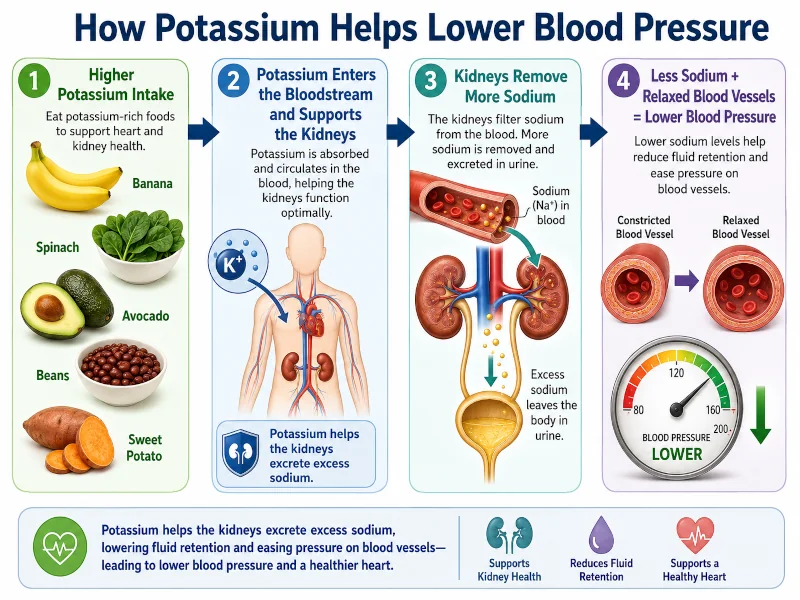
Sodium makes your body hold onto water, which raises the volume of blood your vessels have to carry. Potassium does roughly the opposite: it helps your kidneys flush sodium out and helps blood-vessel walls relax. People who eat little potassium have a higher risk of high blood pressure, especially when their diet is also high in salt [NIH ODS, 2024]. Most of us get the ratio backwards — too much sodium from packaged food, too little potassium from plants. The AHA suggests aiming for 3,500 to 5,000 mg of potassium a day, ideally from food rather than pills [AHA, 2024]. You can see where it shows up most in this potassium-rich foods chart.
Nitric oxide and vessel relaxation
Some vegetables — beets and leafy greens in particular — are rich in natural nitrate. Your body converts it to nitric oxide, a molecule that signals blood vessels to widen. Wider vessels mean lower pressure. This is the pathway behind much of the interest in beet juice.
Weight, fiber and the rest of the diet
Plant-heavy eating tends to be higher in fiber and lower in calories, which supports a healthier weight — and losing excess weight is one of the most reliable ways to bring pressure down. Fiber also feeds gut bacteria that produce compounds linked to lower pressure. None of these effects is dramatic alone. Stacked together over months, they add up.
Where the evidence for foods that lower blood pressure is strongest
If you change only a few things, change these. The common thread is potassium, magnesium and fiber from whole plants, with little added salt.
Leafy greens and other potassium-rich vegetables
Spinach, Swiss chard, kale, beet greens, broccoli and cabbage combine potassium, magnesium and (in the case of greens) dietary nitrate. A daily salad or a cooked vegetable side — seasoned with herbs, lemon or vinegar rather than salt — is one of the simplest swaps you can make. One caution: if you take warfarin, greens are also high in vitamin K, so keep your intake steady rather than wildly up and down, and tell your clinician (more on that in the safety section).
Beans, lentils and other legumes
Cooked from dry, legumes are almost sodium-free and pack potassium, magnesium, calcium and soluble fiber into one cheap package. Canned versions work too — just drain and rinse to wash off some of the added salt. Using beans in place of cured or processed meat does double duty: more of the helpful nutrients, far less sodium.
Fruit, especially the potassium-heavy kind
Bananas get the headlines (about 420 mg of potassium each), but apricots, prunes, oranges, melon, kiwi and avocado all deliver. A piece of fruit in place of a salty or sugary snack is a small change that points in the right direction. Eating fruit whole, rather than as juice, keeps the fiber and slows the sugar.
Low-fat or unsweetened dairy
Plain yogurt and milk are core parts of the DASH pattern, supplying calcium and potassium. If you do not eat dairy, you can reach the same minerals through legumes, nuts, seeds and leafy greens.
Beets and nitrate-rich vegetables
Beetroot juice is the most-studied form. A pooled analysis of randomized trials found it lowered systolic pressure modestly, with bigger drops at higher doses (about 4.8 mm Hg at the highest doses versus 2.4 mm Hg at lower ones) [Bahadoran, 2017]. The honest caveat: results in people who already have hypertension are less consistent, and juice is concentrated in natural sugar. Whole beets, roasted or grated raw into a salad, are a sensible way to get the same nitrate.
Promising, but the evidence is still limited
Garlic
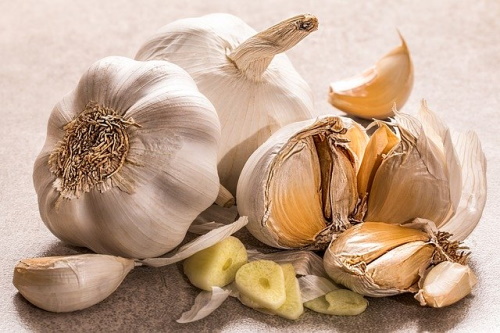
Garlic is the one “natural remedy” here with reasonably good trial data — but mostly as a supplement. A review and meta-analysis of 12 trials in 553 adults with high blood pressure found that aged garlic extract lowered systolic pressure by an average of about 8 mm Hg and diastolic by about 5.5 mm Hg, comparable to some standard medications [Ried, 2020]. Those effects came from concentrated, standardized extracts, not from the clove or two you cook with. Cooking garlic in food is fine and may help a little, but do not expect supplement-level results from seasoning. If you are curious about plant options, see our overview of herbs studied for high blood pressure.
Fatty fish and omega-3
Salmon, sardines, mackerel and herring supply omega-3 fats with a small blood-pressure benefit that is clearest at higher intakes. Just as useful: eating fish in place of processed, salt-cured meats lowers your sodium at the same time.
Oats, whole grains and soluble fiber
Swapping refined grains for oats, barley, brown rice and whole-grain bread raises fiber and tends to nudge pressure down a little as part of the wider pattern. Buy the lower-sodium versions of bread and cereal where you can — these everyday staples are surprisingly salty.
Berries
Blueberries and other berries are rich in flavonoids that may improve how blood vessels function. The trial evidence is early and the effect looks small, but berries are a low-sodium, high-fiber fruit regardless, so there is little reason not to enjoy them.
Popular foods with weaker evidence
These show up on a lot of lists. They are reasonable foods, but the proof that they lower blood pressure in people is thin, so it is fair to treat them as extras rather than treatment.
- Celery. A compound in celery relaxes vessels in animal studies, and celery is low in calories and a source of potassium. Strong human evidence is lacking, and celery does contain some sodium.
- Dark chocolate and cocoa. Cocoa flavanols can produce small, short-term drops in pressure in studies, but the amounts used are hard to match without the sugar and calories of most chocolate.
- Hibiscus tea. A few small trials suggest a mild effect. It is a pleasant, caffeine-free, salt-free drink, which is reason enough to enjoy it — just not a substitute for the basics.
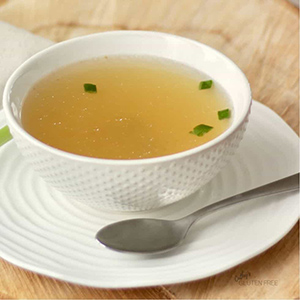
You may also see claims for “detox” vegetable broths or milk whey as blood-pressure cures. There is no good evidence that any drink “cleanses” the blood to lower pressure. A vegetable broth low in salt is simply a low-sodium food, which is helpful for ordinary reasons.
Foods and the evidence at a glance
How the main options compare, from best-supported to least:
| Food or group | Why it may help | Evidence | What to expect |
| Vegetables and fruit (the DASH base) | High in potassium, magnesium and fiber; low in sodium. Potassium helps the body shed sodium and relaxes vessel walls. | Strong | The full DASH pattern lowers systolic pressure by roughly 5–6 mm Hg within a few weeks. |
| Beans, lentils and other legumes | Deliver potassium, magnesium and soluble fiber with almost no sodium when cooked from dry. | Moderate | Small reductions as part of a higher-potassium, higher-fiber diet. |
| Beets and other nitrate-rich vegetables | Dietary nitrate converts to nitric oxide, which widens blood vessels. | Moderate / mixed | Beet juice can trim a few mm Hg, larger at higher doses; effect in people with hypertension is less certain. |
| Berries | Flavonoids (anthocyanins) may improve blood-vessel function. | Limited / early | Modest signal in some trials; useful as a low-sodium fruit either way. |
| Garlic (supplements) | Sulfur compounds may help vessels relax. | Moderate (supplements) | Aged-garlic-extract trials show meaningful drops, but mainly from concentrated supplements, not a clove on dinner. |
| Fatty fish (salmon, sardines) | Omega-3 fats; replaces saltier processed proteins. | Modest | Small blood-pressure effect, clearest at higher omega-3 intakes. |
| Celery, dark chocolate, hibiscus tea | Various plant compounds studied for vessel relaxation. | Weak / preliminary | Interesting but unproven for lowering pressure; treat as nice extras, not treatment. |
Blood-pressure changes are averages from studies; individual results vary. “mm Hg” is the unit blood pressure is measured in.
What to cut back on (this matters as much as what you add)
Adding good foods helps most when you also remove the things that push pressure up.
- Sodium. The AHA recommends no more than 2,300 mg of sodium a day, with an ideal limit of 1,500 mg for most adults; even cutting 1,000 mg a day can improve blood pressure. More than 70% of the sodium people eat comes from packaged and restaurant food, not the salt shaker [AHA, 2024].
- Alcohol. Drinking above moderate amounts raises blood pressure. Cutting back is one of the faster lifestyle changes to show an effect.
- Ultra-processed foods. Cured meats, frozen dinners, chips, instant noodles and many sauces are where the hidden salt lives. Cooking more at home is the single most effective way to control it.
Smoking does not raise your long-term pressure the way salt does, but each cigarette spikes it temporarily and damages arteries over time. If you smoke, quitting helps your heart in ways food cannot — here is a guide on how to stop smoking.
How much can food really do?
Be realistic, in both directions. Diet alone will not erase severe hypertension, and you should never stop prescribed medication on the strength of a grocery list. But the effect of eating well is not trivial either. The DASH pattern lowers systolic pressure by around 5 to 6 mm Hg on average, and adding lower sodium, weight loss, regular activity and less alcohol can stack further reductions on top [NIH ODS, 2024]. For someone with elevated or stage 1 numbers, that combination is sometimes enough to avoid medication; for someone already on treatment, it can mean better control or fewer pills. Changes usually take a few weeks to show up, so give any new routine time before judging it.
One more reality check: supplements are not the same as food. Magnesium pills, for instance, lower blood pressure only marginally in trials — roughly 2 to 4 mm Hg at best — and the mineral works better as part of a whole diet [NIH ODS, 2024]. Getting magnesium from magnesium-rich foods like nuts, seeds, legumes and whole grains is the safer route for most people.
Safety: who should be careful
“Natural” does not mean risk-free, and a few of these foods interact with common conditions and medications. Check with a clinician or pharmacist before making big changes if any of the following apply to you.
- Kidney disease. Damaged kidneys may not clear potassium well, and too much can dangerously affect the heart. If you have chronic kidney disease, do not load up on high-potassium foods or potassium-based salt substitutes without medical guidance.
- Salt substitutes and certain BP medications. Potassium-chloride salt substitutes can push potassium too high in people taking ACE inhibitors, ARBs or potassium-sparing diuretics. Ask before switching.
- Blood thinners (warfarin). Leafy greens are high in vitamin K, which can affect how warfarin works. You do not have to avoid greens — the key is to keep your intake consistent and tell your clinician.
- Grapefruit. Grapefruit and its juice change how the body processes a number of drugs, including some blood-pressure medicines such as certain calcium channel blockers and several statins, which can raise drug levels and side effects [FDA, 2024]. If you take prescription medication, check with your pharmacist before adding grapefruit.
- Supplements in general. Garlic, fish oil and other supplements can interact with medications and may not suit everyone. Tell your healthcare provider about anything you take.
- Pregnancy and breastfeeding. High blood pressure in pregnancy can be serious and needs medical care — it is not something to manage with food or supplements alone. Do not start herbal or concentrated supplements while pregnant or nursing without your provider’s okay.
When to see a healthcare professional
Food is a supporting player, not a substitute for monitoring and treatment. Get medical advice when:
- Your home or pharmacy readings are consistently 130/80 mm Hg or higher.
- Your pressure stays high despite diet and lifestyle changes — you may need medication, and that is not a failure.
- You are pregnant and notice rising pressure, swelling, severe headache or vision changes.
Seek emergency care now if a reading is above 180/120 mm Hg, or if you have chest pain, shortness of breath, sudden weakness or numbness, trouble speaking, a severe headache or vision loss. In the U.S., call 911.
| Health disclaimer This article is for general education and information only. It is not medical advice and is not a substitute for diagnosis, treatment or guidance from a qualified healthcare professional. Do not start, stop or change any medication, supplement or diet based on this page alone. If you are pregnant, breastfeeding, have kidney disease or another medical condition, or take prescription medication, talk with your doctor or pharmacist before making changes. If you think you are having a medical emergency, call your local emergency number right away. |
Frequently asked questions
What food lowers blood pressure the fastest?
No food works in minutes. Nitrate-rich options like beet juice or leafy greens can produce a small dip within hours, but it is modest and short-lived [Bahadoran, 2017]. Lasting change comes from a consistent lower-sodium, higher-potassium diet kept up over weeks.
Can I lower blood pressure with diet instead of medication?
Sometimes, for elevated or stage 1 readings, diet and lifestyle are enough — but that is a decision to make with your clinician, who can track your numbers. If you are already on medication, do not stop it on your own; diet may let your doctor lower the dose over time.
Does eating garlic really lower blood pressure?
Concentrated aged garlic extract has shown meaningful reductions in trials of people with hypertension [Ried, 2020]. Cooking with garlic is healthy but unlikely to match supplement doses. If you want to try a supplement, discuss it with your provider first.
How much potassium should I aim for, and can I get too much?
For blood pressure, the AHA suggests 3,500 to 5,000 mg a day, ideally from food [AHA, 2024]. Most people fall short. The exception is anyone with kidney disease or on certain blood-pressure drugs, who can build up too much potassium — they should get a target from their clinician rather than loading up.
How long until diet changes show in my readings?
Often a few weeks. Studies of the DASH pattern see measurable drops within that window [NHLBI, 2025]. Keep a simple log of home readings so you can see whether your changes are working.
References
- National Heart, Lung, and Blood Institute. “DASH Eating Plan.” NHLBI, NIH, 2025. → View source
- American Heart Association. “How Much Sodium Should I Eat Per Day?” 2024. → View source
- American Heart Association. “Understanding Blood Pressure Readings.” 2024. → View source
- American Heart Association. “How Potassium Can Help Control High Blood Pressure.” 2024. → View source
- National Institutes of Health, Office of Dietary Supplements. “Potassium — Health Professional Fact Sheet.” 2024. → View source
- National Institutes of Health, Office of Dietary Supplements. “Magnesium — Health Professional Fact Sheet.” 2024. → View source
- Ried K. “Garlic lowers blood pressure in hypertensive subjects, improves arterial stiffness and gut microbiota: A review and meta-analysis.” Experimental and Therapeutic Medicine, 2020;19(2):1472–1478. doi:10.3892/etm.2019.8374. → View source
- Bahadoran Z, Mirmiran P, et al. “The Nitrate-Independent Blood Pressure-Lowering Effect of Beetroot Juice: A Systematic Review and Meta-Analysis.” Advances in Nutrition, 2017;8(6):830–838. → View source
- U.S. Food and Drug Administration. “Grapefruit Juice and Some Drugs Don’t Mix.” FDA, 2024. → View source
