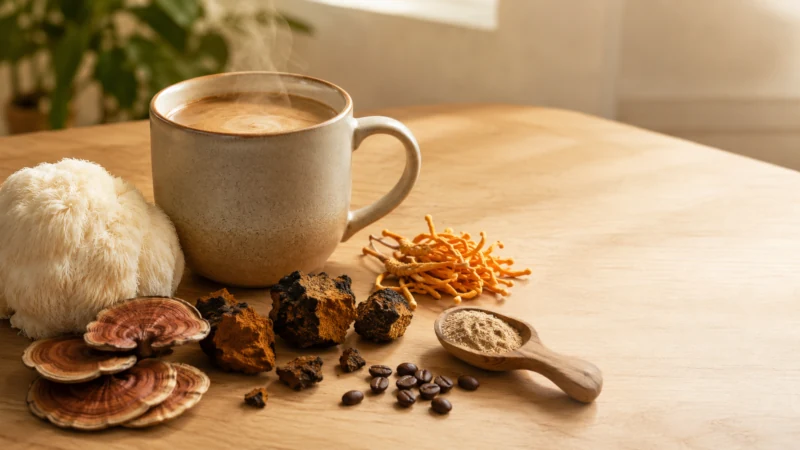
If you want a morning cup that gives you a lift without the wired-then-crashed feeling of a triple espresso, mushroom coffee is worth understanding before you buy. The best mushroom coffee brands blend real coffee (or a coffee-like base) with extracts of medicinal mushrooms such as lion’s mane, reishi, chaga, and cordyceps — usually with noticeably less caffeine than a regular cup.
The honest framing up front: people who switch often report calmer, steadier energy, and that’s plausible mostly because they’re drinking less caffeine. The deeper “brain-boosting, immune-boosting” claims are still thin on human proof. This guide sorts the well-known brands by what each one is actually good for, gives you real caffeine numbers, and flags the safety details most roundups skip.
What mushroom coffee actually is
It’s coffee with dried, extracted mushroom powder blended in — not whole mushrooms floating in your mug. Manufacturers take medicinal mushrooms (the functional kind, not the ones you sauté), dry them, pull out the concentrated compounds, and mix that powder with ground or instant coffee, or with a coffee-free base like cacao and chicory. Because it’s mostly coffee, it tastes mostly like coffee. Most people describe it as nutty or earthy, and many don’t notice the mushrooms at all, according to both Harvard Health, 2024 and Cleveland Clinic, 2023.
You’ll see three formats: instant mixes you whisk into hot water, ground coffee you brew normally, and coffee-free blends built around cacao, roasted roots, and spices for people cutting caffeine entirely. Common mushrooms include lion’s mane (marketed for focus), cordyceps (energy), reishi (calm), and chaga (antioxidants), often paired with adaptogens — plant and fungal compounds traditionally used to help the body handle stress.
What the evidence really says about the benefits
Here’s the part the marketing glosses over. There’s genuinely very little research on medicinal mushrooms conducted in humans, and essentially none conducted on mushroom coffee specifically. Most of the compelling findings come from test-tube and animal studies, and those don’t reliably carry over to people [Harvard Health, 2024]. On top of that, no one has confirmed that a mushroom’s beneficial compounds survive being dried, extracted, and brewed into your cup [UCLA Health, 2023]. So treat the promises as promising leads, not settled facts.
Focus and mental clarity
Lion’s mane is the mushroom most often tied to focus. A 2024 research review found it may promote nerve growth factor, which could support memory and focus — but the findings were mixed and need more study [Forbes Health, 2025]. Some of the steadier concentration people feel may simply come from taking in less caffeine, which softens the jittery peak-and-crash of a strong coffee.
Calm, stress, and mood
Reishi and other adaptogens are marketed for calm. Adaptogens may influence cortisol, a stress hormone, which is the proposed mechanism [UCLA Health, 2023]. One 2024 study in people with cancer suggested reishi might ease anxiety and depression, though researchers were clear that more work is needed [Forbes Health, 2025]. Reasonable to hope for; not proven to treat anxiety.
Immune support and antioxidants
Mushrooms do contain antioxidants and compounds studied for immune activity. A 2023 research review cited by both [Harvard Health, 2024] and [Forbes Health, 2025] reported that several medicinal mushrooms have immune-supporting properties in the lab and may help regulate metabolism. The catch is the same one throughout: those effects were shown in cells and animals, not in trials of people drinking mushroom coffee.
The caffeine question (with real numbers)
This is where mushroom coffee earns most of its real-world reputation. A typical blend is around half coffee, so you’re often getting roughly half the caffeine — and less caffeine can mean fewer jitters and better sleep for people who are sensitive [UCLA Health, 2023].
The numbers make it concrete. Regular brewed coffee runs about 113 to 247 milligrams of caffeine per 12-ounce cup [FDA, 2024]. Several popular mushroom blends land far lower per serving — but not all of them, so “mushroom coffee = low caffeine” isn’t a safe assumption. Check the label.
| Drink | Caffeine per serving |
| Regular brewed coffee (12 oz) | 113–247 mg (FDA) |
| MUD\WTR (1 tbsp) | ~35 mg (Forbes Health) |
| RYZE (1 heaping tbsp) | ~48 mg (Forbes Health) |
| Four Sigmatic original (1 tbsp) | ~50 mg (Forbes Health) |
| Om superfood blend (1 tbsp) | ~120 mg (Forbes Health) |
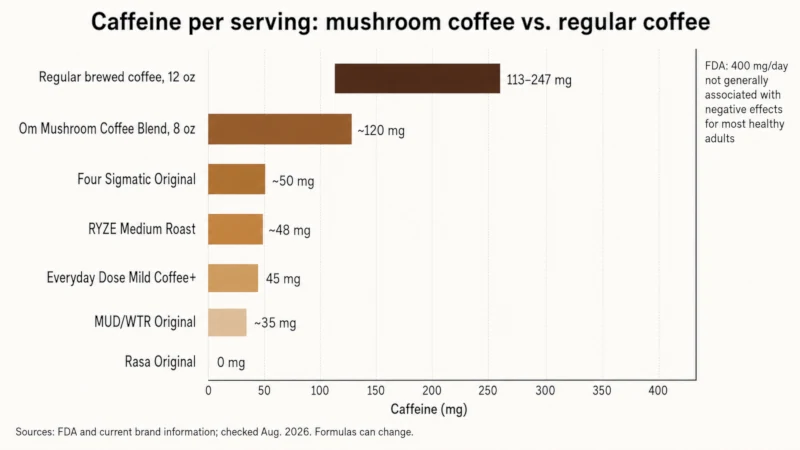
For context, the FDA considers up to 400 mg of caffeine a day generally safe for most healthy adults, while noting that sensitivity varies a lot from person to person [FDA, 2024]. If you want the fuller picture of how caffeine affects your body, that’s worth a read before you overhaul your routine.
How to choose a mushroom coffee worth buying
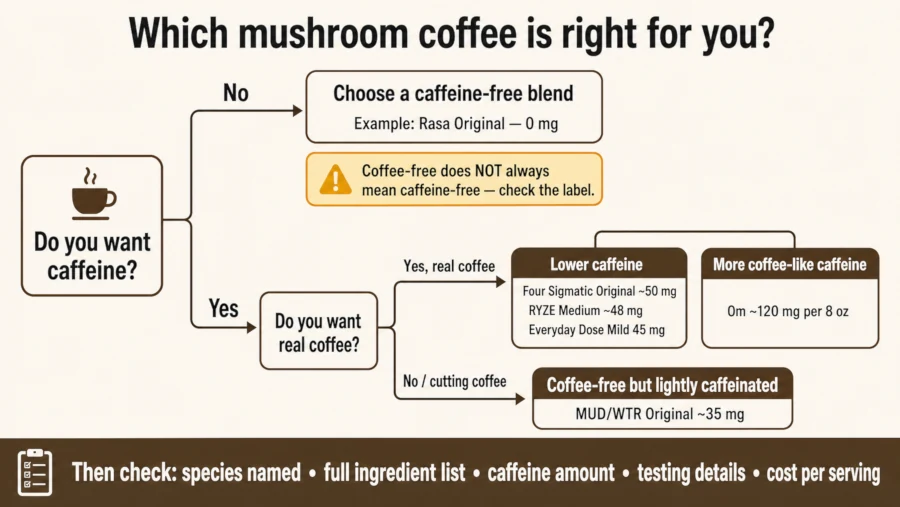
Ingredients and marketing don’t always match, so a few filters save money and disappointment:
- Look for third-party testing. Choose brands that test for purity and heavy metals and clearly label which mushroom species are inside. Dietitians specifically recommend picking a brand that’s third-party tested and names its species [Forbes Health, 2025].
- Check the format against your goal. Ground coffee tastes closest to a normal cup; instant is convenient but thinner; coffee-free blends suit anyone cutting caffeine.
- Read the caffeine content, not just the “less caffeine” tagline — as the table shows, some blends are still fairly caffeinated.
- Mind the price. Mushroom coffee typically costs about twice what regular coffee does, so decide whether the ritual is worth it to you [Cleveland Clinic, 2023].
- Start with one type and track how you feel, rather than jumping into a six-mushroom megablend on day one [Cleveland Clinic, 2023].
The best mushroom coffee brands, by what they’re best for
Rather than rank ten near-identical powders, it helps to split them by format, since that’s the choice that actually changes your morning.
Best real-coffee blends
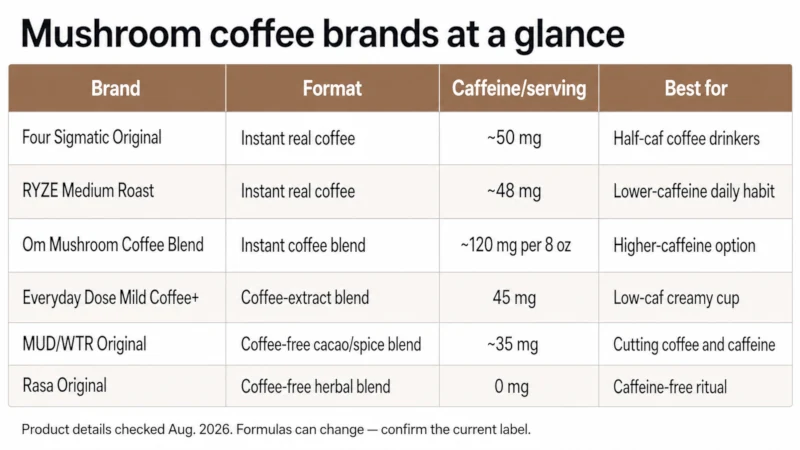
Four Sigmatic helped bring mushroom coffee to the US and remains an easy first step. Its original blend is certified organic and combines lion’s mane, chaga, cordyceps, reishi, and turkey tail, and dietitians note it’s well-formulated, lab-tested, and smooth-tasting [Forbes Health, 2025]. Expect about 50 mg of caffeine per serving. Good for: first-timers who still want it to taste like coffee.
RYZE is a creamy instant mix built on six functional mushrooms — lion’s mane, cordyceps, king trumpet, turkey tail, reishi, and shiitake — plus MCT oil powder, and it’s 100% organic with mushrooms grown in the US [Forbes Health, 2025]. At roughly 48 mg of caffeine, it’s a gentle lift. Good for: an approachable daily habit that isn’t too bitter.
Om Mushroom Superfood is third-party lab-tested and offers coffee blends and versatile powders featuring lion’s mane and cordyceps extracts, with convenient single-serve options [Forbes Health, 2025]. Worth noting: its superfood blend runs higher on caffeine (~120 mg), closer to regular coffee. Good for: people who want to match a blend to a specific goal.
Laird Superfood, Shroomi, and Everyday Dose round out the real-coffee category. Laird leans into brewed-coffee flavor and functional creamers; Shroomi focuses on ground coffee you brew like any other bag; Everyday Dose markets a creamy latte-style blend (note it includes collagen, so it isn’t vegan). These are reasonable options, though their exact formulations vary by product line — check the current label for species, dosing, and caffeine before buying.
Best coffee-free alternatives
MUD\WTR is the best-known coffee-free option: no coffee at all, built around cacao, turmeric, cinnamon, and spices with lion’s mane, chaga, cordyceps, and reishi, at only about 35 mg of caffeine [Forbes Health, 2025]. Good for: easing off caffeine while keeping a warm morning ritual. It won’t taste like coffee, which is the point.
Rasa, Spacegoods Rainbow Dust, and Atlas+ also serve the low- or no-caffeine crowd. Rasa uses roasted roots and adaptogens for a deep, roasty cup with caffeine-free options; Spacegoods Rainbow Dust is a cacao-based, coffee-free focus blend; Atlas+ offers instant superblends with a sweeter, latte-like profile. As with the brands above, confirm the specifics on the current packaging, since blends and caffeine levels change.
Side effects and who should be cautious
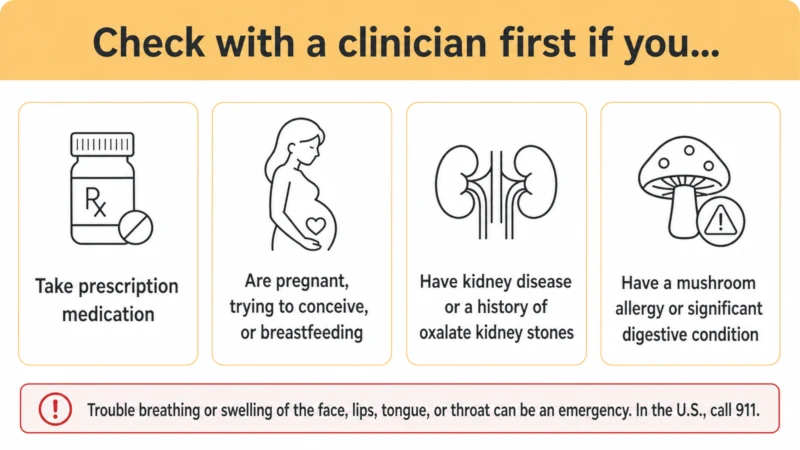
Mushroom coffee is generally well tolerated by healthy adults, but it isn’t risk-free.
Common side effects
The mushrooms and adaptogens can cause digestive upset or allergic reactions in sensitive people. Reported effects include nausea, stomach upset, diarrhea, dizziness, dry mouth, itching, rash, and even darkened stools or nail pigmentation [Forbes Health, 2025]. People with kidney or digestive issues may be more vulnerable to the digestive effects [UCLA Health, 2023]. One specific point worth knowing: chaga is high in oxalates, and a high-oxalate load raises the risk of kidney stones — so if you’ve had kidney stones, be cautious with chaga-heavy blends [Cleveland Clinic, 2023; UCLA Health, 2023].
Medication interactions
Adaptogens and medicinal mushrooms can interact with prescription drugs. If you take any medication regularly, run mushroom coffee past your doctor or pharmacist before making it a daily habit [Forbes Health, 2025].
Pregnancy and breastfeeding
Safety data for medicinal mushroom extracts during pregnancy and breastfeeding are limited, and caffeine passes to the baby. If you’re pregnant, trying to become pregnant, or breastfeeding, talk to your doctor before drinking it — and about your caffeine intake generally [FDA, 2024; Forbes Health, 2025].
Who should avoid it or check first
Anyone with a mushroom allergy, people on medications, and those who are pregnant or breastfeeding should get personalized advice before trying it [Forbes Health, 2025]. If you have a history of kidney stones, skip chaga-forward blends.
When to talk to a doctor
Most people can try mushroom coffee without incident, but see a doctor (or pharmacist for medication questions) before starting if you’re pregnant or breastfeeding, take prescription medication, or have kidney, liver, or digestive conditions. Stop and seek care if you develop signs of an allergic reaction such as hives, swelling, or trouble breathing — the last of which is a 911 emergency. And watch your total caffeine: too much can cause a racing heart, palpitations, high blood pressure, anxiety, insomnia, upset stomach, or headache, and those are worth discussing with a healthcare professional if they show up [FDA, 2024].
The realistic bottom line: mushroom coffee is a pleasant, lower-caffeine ritual that many people genuinely enjoy, and it’s likely safe for most healthy adults. Just buy it as a nicer cup of coffee, not as medicine. Pick your format, check the caffeine and the species on the label, give it two weeks, and keep the drink that actually helps you feel focused and calm.
| HEALTH DISCLAIMER: This article is for general education only and is not a substitute for professional medical advice, diagnosis, or treatment. Mushroom coffee and the medicinal mushrooms in it are not proven to treat, cure, or prevent any disease, and individual responses and product quality vary. Always talk with a licensed doctor — and a pharmacist if you take medications, or if you are pregnant, trying to become pregnant, or breastfeeding — before adding mushroom coffee or any supplement to your routine. If you experience signs of a severe allergic reaction such as swelling or difficulty breathing, call 911. Use of any information here is at your own risk. |
Frequently Asked Questions
Is mushroom coffee caffeinated?
Usually yes. Most blends contain real coffee, so they have caffeine — often less than a standard cup, but not always. Popular blends range from about 35 mg (MUD\WTR) to around 120 mg (Om’s superfood blend) per serving, versus 113–247 mg in a 12-ounce cup of regular coffee [Forbes Health, 2025; FDA, 2024]. Coffee-free versions exist if you want none. Always check the label.
Can mushroom coffee actually help with focus?
Many people report steadier focus, and part of that is likely the lower caffeine, which smooths out the crash. Lion’s mane may support memory and focus by promoting nerve growth factor, but the human evidence is mixed and early [Forbes Health, 2025]. Think “may help,” not “proven.”
How does it taste compared with regular coffee?
Real-coffee blends taste much like normal coffee — nutty or earthy, and many people don’t notice the mushrooms [Harvard Health, 2024]. Ground versions taste closest to a standard brew; instant mixes can taste thinner; coffee-free blends taste more like spiced cacao or roasted roots.
Is mushroom coffee safe?
For most healthy adults, it’s generally well tolerated [Forbes Health, 2025]. The main cautions are digestive upset, possible medication interactions, kidney-stone risk from chaga’s oxalates, and limited safety data in pregnancy [Cleveland Clinic, 2023; UCLA Health, 2023]. Choose a third-party-tested brand and check with your doctor if you have conditions or take medications.
Does mushroom coffee help you lose weight?
There’s no definitive evidence that it directly causes weight loss [Forbes Health, 2025]. Swapping a sugary drink for it may help your overall diet, but the mushrooms themselves aren’t a weight-loss tool.
Is it worth the extra cost?
That’s a personal call. It typically costs about double regular coffee [Cleveland Clinic, 2023]. If you value a lower-caffeine ritual and enjoy the taste, it can be worth it; if you’re buying it purely for proven health benefits, the evidence doesn’t yet justify the premium.
References
- Harvard Health Publishing. Mushroom coffee: Worth a taste? Lindsay Warner; reviewed by Teresa Fung, ScD, RD. June 4, 2024. View source
- Cleveland Clinic Health Essentials. What’s the Deal With Mushroom Coffee? Featuring Beth Czerwony, RD. March 7, 2023. View source
- UCLA Health. Should you switch to mushroom coffee? August 7, 2023. View source
- Forbes Health. What Are the Health Benefits of Mushroom Coffee? Heidi Borst; reviewed by Mascha Davis, MPH, RDN. Verified September 25, 2025. View source
- U.S. Food and Drug Administration. Spilling the Beans: How Much Caffeine Is Too Much? Updated August 28, 2024. View source
