
Fresh acerola is one of the most vitamin C–rich foods on earth, and one of the most fragile. Picked ripe, it bruises and molds within a day or two, and its vitamin C starts slipping away almost as soon as it leaves the branch. Unless you live where it grows — Brazil, the Caribbean, parts of southern Florida — eating the fresh fruit isn’t realistic.
Acerola cherry powder is how the rest of us get it. Drying the fruit into a concentrated powder locks in most of the vitamin C and the plant compounds that come with it, in a form that keeps for months and ships anywhere.
The catch is that powders vary a lot. How the fruit was dried, what part of the fruit was used, what got added, and how it’s stored all change what ends up in your scoop. Here’s how acerola cherry powder is made, what separates a good one from a mediocre one, how to use it, and the safety details worth knowing before you start.
For a broader look at the fruit, see the full acerola cherry guide, or the detailed nutritional profile. If you’re weighing it against another vitamin C heavyweight, there’s also acerola vs camu camu.
What Acerola Cherry Powder Is
Acerola cherry powder is the dried, concentrated form of the acerola fruit (Malpighia emarginata). Manufacturers remove the water from the juice, pulp, or whole fruit and grind what’s left into a fine powder that holds onto much of the fruit’s vitamin C and bioactive compounds.
It tastes sharply tart — more sour than most fruit powders, which tracks with how much ascorbic acid it carries. Color runs from pale yellow in spray-dried extracts to deep golden-orange in freeze-dried whole-fruit powders.
It’s concentrated: it takes roughly 10 pounds of fresh cherries to make a single pound of powder.
A quick note on where the vitamin C comes from, because acerola is genuinely unusual here. Fresh fruit runs about 1,500 to 4,500 mg of vitamin C per 100 g — somewhere around 50 to 100 times the vitamin C in an orange [Prakash & Baskaran, 2018]. The green, unripe fruit holds the most, and levels fall as it ripens to red [Mezadri et al., 2008]. That’s why many of the most potent powders are made from unripe cherries.
How Acerola Cherry Powder Is Made
The drying method is the single biggest driver of quality.
Freeze-Dried
Freeze-drying (lyophilization) pulls water out at very low temperatures under vacuum. Because no heat is applied, it holds onto more vitamin C, phytonutrients, color, and flavor than heat-based drying.
A well-made freeze-dried powder, especially one made from unripe cherries, can run 25–30% vitamin C by weight — about 250–300 mg in a single gram. Because freeze-drying doesn’t need a carrier to turn liquid into powder, the result can be 100% fruit, sometimes with a small amount (around 2%) of silicon dioxide added to keep it from clumping.
The trade-off is cost: freeze-drying runs several times more expensive than spray-drying, and the price tag reflects it.
Spray-Dried
Spray-drying is the industry workhorse. Acerola juice concentrate is sprayed into a hot chamber and flashes into powder. The heat costs some vitamin C along the way.
Spray-drying also needs a carrier — almost always maltodextrin — to form the powder, and that carrier typically makes up 20–40% of the final product by weight. A standard spray-dried powder lands around 17% vitamin C, roughly 170 mg per gram. The upside: it dissolves more easily than freeze-dried powder, which makes it handy for drinks, and it costs less.
Whole Fruit vs Juice vs Extract
The starting material matters too:
- Whole fruit powder uses the entire fruit minus the seeds — pulp and skin included. It keeps fiber, skin-bound compounds like anthocyanins, and the widest range of phytonutrients. Usually freeze-dried.
- Juice powder is made from the extracted juice alone. Fiber and skin compounds are gone. More vitamin C per gram, but a narrower nutrient profile. Usually spray-dried with maltodextrin.
- Extract is standardized to a guaranteed vitamin C percentage — commonly 17%, 25%, or 35%. Predictable potency, though it may rely on processing aids.
Freeze-Dried vs Spray-Dried: Which to Choose
| Factor | Freeze-dried | Spray-dried |
| Vitamin C content | 25–30% typical | ~17% typical |
| Processing temperature | Sub-zero, under vacuum | High heat (inlet ~150–200°C) |
| Carriers / fillers | None required (100% fruit possible) | Maltodextrin (20–40% of product) |
| Phytonutrient retention | Higher — more flavonoids, anthocyanins, carotenoids | Good, but reduced by heat |
| Color | Deep golden-orange | Pale yellow (carrier dilution) |
| Flavor | Intense, tart, fruity | Milder, slightly diluted |
| Solubility | Moderate (can clump) | High (dissolves easily) |
| Price | Several times more | Affordable |
| Best for | Supplements, smoothies, max nutrition | Beverages, baking, budget use |
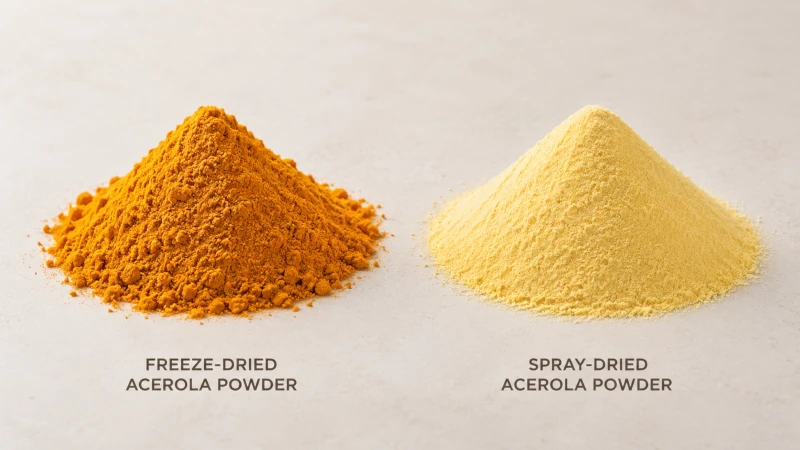
Which to choose: If nutrient retention is the priority and the budget allows, freeze-dried whole-fruit powder wins. If you want affordability or something that dissolves cleanly in a drink, a quality spray-dried powder with non-GMO maltodextrin is a sensible pick.
What Acerola Cherry Powder Actually Does
The powder’s benefits are the fruit’s benefits, concentrated and shelf-stable. Here’s what the evidence supports, and where it stops.
Concentrated whole-food vitamin C. This is the real headline. A quarter-teaspoon of a quality powder can deliver several hundred milligrams of vitamin C inside the fruit’s natural mix of bioflavonoids, polyphenols, and organic acids.
A possible absorption edge, with caveats. In a small study of healthy young men, vitamin C taken as acerola juice was retained slightly better than the same dose of plain ascorbic acid: urinary excretion was lower, and blood levels trended a little higher — though that blood difference wasn’t statistically significant [Uchida et al., 2011]. It’s a promising single-dose finding in a handful of people, not a settled fact. Treat “better absorbed” as plausible, not proven.
Antioxidant compounds beyond vitamin C. Acerola carries flavonoids, anthocyanins, and carotenoids that add measurable antioxidant activity on top of vitamin C itself [Mezadri et al., 2008]. What that means for day-to-day health in people is less defined.
A role in immune function and skin. Vitamin C contributes to normal immune function and is required for collagen synthesis; skin in particular depends on it for building collagen and for antioxidant defense against UV-induced damage [Pullar et al., 2017]. Acerola powder is one of the most concentrated food sources of that vitamin C. Worth being clear about what this isn’t: routine vitamin C doesn’t prevent the common cold in most people, and no food powder treats disease.
For each benefit with evidence grading, see the full guide to acerola cherry health benefits.
How to Use Acerola Cherry Powder
The tart, citrusy flavor is more flexible than you’d expect.
In Smoothies and Drinks
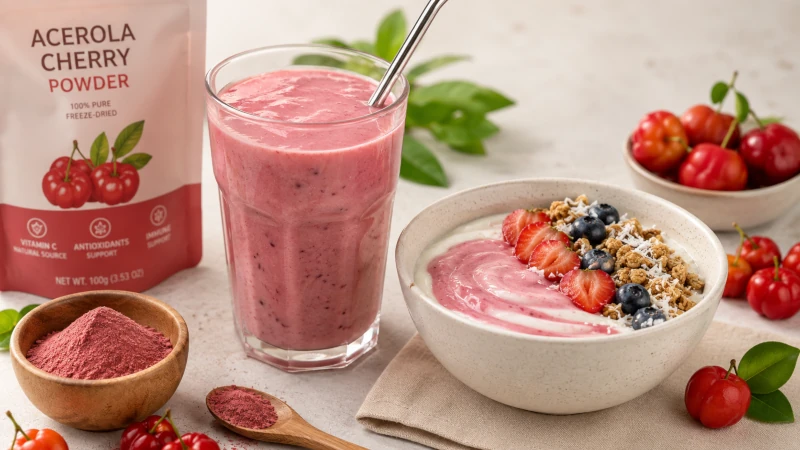
The most popular use. Stir 1/4 to 1 teaspoon into any smoothie, shake, or juice. The sourness plays well against sweeter tropical fruit — mango, banana, pineapple, papaya. You can also mix it into cold or room-temperature water, coconut water, or lemonade. Skip hot drinks: vitamin C breaks down above roughly 70–80°C (158–176°F), so a powder stirred into hot tea loses much of its point.
In Food
It works in yogurt, overnight oats, chia pudding, energy balls, and raw desserts, and it can go into salad dressing or over fresh fruit. You can bake with it, but oven heat destroys most of the vitamin C — so bake with it for flavor and the heat-stable compounds, not for the vitamin C. (Ascorbic acid’s gluten-strengthening effect is also why some bakers use acerola as a natural dough conditioner.)
As a Daily Supplement
Simplest version: mix your dose into a small glass of water or juice each morning. Some people fill their own vegetable capsules for on-the-go convenience, though that takes a little equipment. Pre-made acerola capsules and tablets exist too.
How Much Acerola Cherry Powder to Take
There’s no official dose for acerola powder specifically. Dosing follows vitamin C, since that’s the main active component.
| Powder type | ~Vitamin C per 1/4 tsp (~1 g) | ~Vitamin C per 1 tsp (~4 g) |
| Freeze-dried (25–30%) | 250–300 mg | 1,000–1,200 mg |
| Spray-dried (~17%) | ~170 mg | ~680 mg |
| Extract (35%) | ~350 mg | ~1,400 mg |
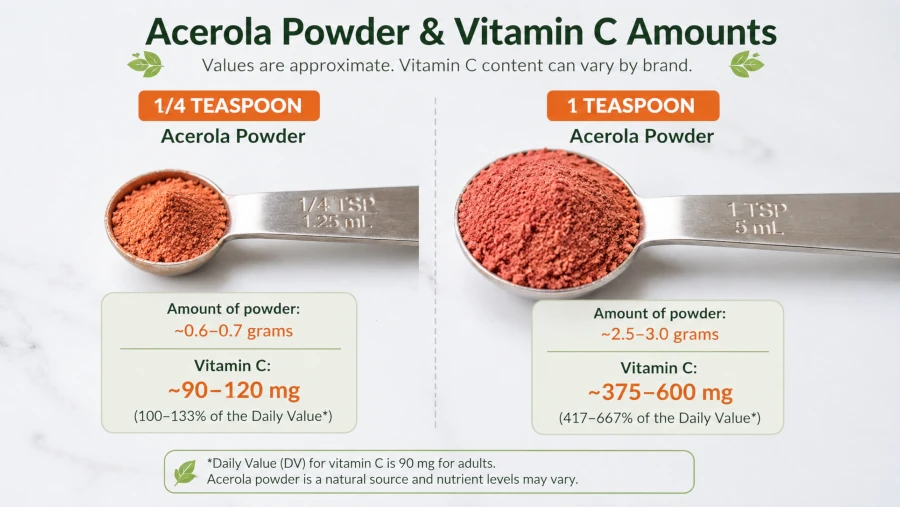
For most adults, 1/4 to 1 teaspoon a day supplies roughly 170–500 mg of vitamin C — a comfortable everyday range. For context, the recommended daily intake is 90 mg for men and 75 mg for women, and the tolerable upper limit is 2,000 mg/day; staying under that limit keeps the main risk, gastrointestinal upset, low [NIH ODS].
Start at 1/4 teaspoon. The tartness is intense, and large vitamin C doses can loosen the stomach in some people. Work up from there if you want to.
For form-specific dosing, see the acerola dosage guide, and for safety detail the guide to acerola side effects.
7 Things to Check Before You Buy
Acerola powders range from excellent to borderline misleading. These seven checks separate them.
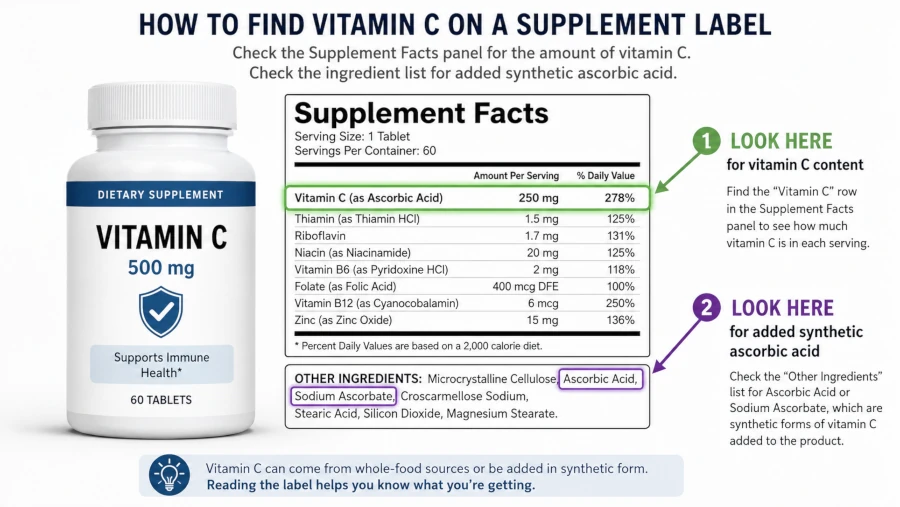
- Vitamin C content per serving, in milligrams. Non-negotiable. If a label won’t tell you the actual number, move on.
- Acerola as the only vitamin C source. Scan the ingredients. If “ascorbic acid” appears as its own line next to the acerola, synthetic vitamin C has been added to pad the number. For whole-food vitamin C, the fruit should be the sole source.
- A disclosed drying method. Companies that freeze-dry advertise it, because it’s a selling point. If the method isn’t stated, assume spray-dried. Neither is wrong — you just want to know what you’re paying for.
- A short ingredient list. The best freeze-dried powders are one ingredient: acerola (sometimes plus ~2% silicon dioxide). Spray-dried powders include maltodextrin — look for non-GMO. Long lists of fillers, flavors, and sweeteners are a step down.
- Certification you can verify. USDA Organic, EU Organic, or an equivalent tells you the fruit was grown without synthetic pesticides and the supply chain was audited. Set expectations honestly, though: evidence that organic produce is meaningfully higher in antioxidants is mixed, so treat organic as a sourcing-and-purity signal rather than a guarantee of more nutrition.
- Third-party testing. Independent testing — NSF, USP, ConsumerLab — confirms the label is accurate and screens for heavy metals, pesticides, and microbial contamination. A published Certificate of Analysis (CoA) is the strongest version of this.
- Country of origin. Brazil grows and processes more acerola than anywhere else, with the most established infrastructure, so Brazilian-sourced powder is generally the most reliable. Be more cautious with powder from places with lighter oversight, where heavy-metal contamination is a bigger question.
Red Flags to Avoid
- Hidden synthetic vitamin C. “Ascorbic acid” listed separately means it’s not pure whole-food vitamin C. Common, and easy to miss.
- Unrealistic potency. A powder claiming 50%+ vitamin C from acerola alone should make you skeptical — even the most concentrated unripe-fruit freeze-dried powders top out around 30–35%. Higher usually means synthetic vitamin C was blended in.
- No per-serving number. “Packed with vitamin C” with no milligram figure often hides a low one.
- Filler stacks. Maltodextrin in a spray-dried powder is normal. Added sugars, artificial sweeteners, colors, or flavors are not — that’s paying for additives.
- Disease claims. Any acerola product marketed as treating, curing, or preventing a disease is making claims the evidence doesn’t support and that can cross FDA labeling lines. Credible brands sell the nutrition, not miracles.
Storage and Shelf Life
Vitamin C is unstable — heat, light, moisture, and oxygen all degrade it. Storage is how you protect what you paid for.
- Container: airtight. A glass jar with a tight lid beats a resealable bag for the long haul. Minimize air every time you open it.
- Temperature: below 25°C (77°F). A cool, dark pantry is ideal; refrigeration is optional.
- Light: keep it out of direct sun. If the jar is clear, store it in a cupboard.
- Moisture: acerola powder draws water from the air, which causes clumping and speeds vitamin C loss. A silica gel packet in the container helps.
- Shelf life: stored well, freeze-dried powder generally holds its potency 12–18 months; spray-dried may last a little longer thanks to the carrier. Check the best-by date, and use an opened package within 3–6 months for best potency.
Safety, Side Effects, and Who Should Be Careful
For most healthy adults, acerola powder at everyday amounts is well tolerated — it’s food. The cautions are really about vitamin C at higher doses, plus a few specific groups.
Common side effects. Large vitamin C doses — generally above the 2,000 mg/day upper limit, but sometimes lower in sensitive people — can cause diarrhea, nausea, and stomach cramps [NIH ODS]. Starting low and splitting doses helps.
Talk to a clinician first if you’re in one of these groups:
- A history of kidney stones or kidney disease. The body converts excess vitamin C to oxalate, which can raise the risk of calcium-oxalate stones; reduced kidney function clears oxalate less well. High-dose vitamin C is best avoided here [NCI].
- Hemochromatosis or iron overload. Vitamin C increases iron absorption, which can worsen iron loading [NCI].
- G6PD deficiency. Very high doses of vitamin C can trigger red-blood-cell breakdown (hemolysis) in this group [NCI].
Medications. Because acerola is concentrated vitamin C, the interactions that matter are vitamin C’s. There’s a theoretical concern that high vitamin C intake may reduce warfarin absorption, and large doses can skew certain lab tests (some glucose meters, stool occult-blood tests). If you take warfarin or other prescription medication, check with your pharmacist or doctor before adding a concentrated source.
Pregnancy and breastfeeding. Vitamin C from food is fine and necessary, but high-dose supplementation hasn’t been well studied in pregnancy, and specific safety data for concentrated acerola supplements is lacking. Stay within normal dietary ranges and clear any supplement with your prenatal provider.
When to seek care. A food-based vitamin C powder won’t cause an emergency on its own, but don’t use it to self-treat symptoms that need attention. Severe or persistent abdominal pain, blood in the urine or stool, signs of an allergic reaction (hives, swelling, trouble breathing), or any symptom you’d otherwise see a doctor about are reasons to seek medical care rather than reach for a supplement.
| Health disclaimer This article is for general education and is not medical advice. It isn’t meant to diagnose, treat, cure, or prevent any disease. Supplements can interact with medications and health conditions. Talk with a qualified healthcare professional before changing your diet, supplements, or medications — especially if you’re pregnant, breastfeeding, managing a health condition, or taking prescription drugs. |
Frequently Asked Questions
Is freeze-dried acerola powder worth the extra cost?
If your goal is maximum vitamin C and phytonutrient retention, yes. Freeze-dried powder typically runs 25–30% vitamin C versus about 17% for spray-dried, and it keeps more of the fruit’s flavonoids, anthocyanins, and carotenoids, with no maltodextrin carrier. If budget matters more and you mainly want vitamin C, a quality spray-dried powder is still a solid choice.
How much vitamin C is in a teaspoon of acerola powder?
It depends on the product. A freeze-dried powder (25–30%) delivers roughly 1,000–1,200 mg per teaspoon (~4 g); a standard spray-dried powder (~17%) delivers about 680 mg. Always check your specific label, since concentrations vary.
Can I use acerola powder instead of vitamin C pills?
Many people use it as a whole-food alternative to synthetic ascorbic acid. A small study suggests vitamin C from acerola juice may be retained somewhat better than the synthetic form, though that evidence is preliminary. If you need precise, high-dose vitamin C for a specific medical reason, talk it through with your healthcare provider.
Does acerola powder taste good?
It’s intensely tart — closer to a very sour cherry or citrus. Most people enjoy it mixed into smoothies or juice, where sweeter ingredients balance it. It’s usually too sour to take plain in water without sweetening.
Can I bake with acerola powder?
You can, and it adds a pleasant citrusy note. But baking heat (typically 175–200°C / 350–400°F) destroys most of the vitamin C. Bake with it for flavor and the heat-stable compounds; if vitamin C is the goal, keep it unheated.
How do I know if synthetic vitamin C was added?
Check the ingredient list. If “ascorbic acid” or “sodium ascorbate” appears as a separate ingredient alongside the acerola, synthetic vitamin C has been added. A pure product lists only the fruit (and possibly maltodextrin in spray-dried versions, or a little silicon dioxide as a flow agent).
References
- NIH Office of Dietary Supplements. Vitamin C: Fact Sheet for Health Professionals. View source
- National Cancer Institute (NCI). High-Dose Vitamin C (PDQ) — Patient Version. View source
- Prakash A, Baskaran R (2018). Acerola, an untapped functional superfruit: a review on latest frontiers. Journal of Food Science and Technology, 55(9), 3373–3384. View source
- Mezadri T, et al. (2008). Antioxidant compounds and antioxidant activity in acerola (Malpighia emarginata DC.) fruits and derivatives. Journal of Food Composition and Analysis, 21(4), 282–290. View source
- Uchida E, et al. (2011). Absorption and excretion of ascorbic acid alone and in acerola juice: comparison in healthy Japanese subjects. Biological & Pharmaceutical Bulletin, 34(11), 1744–1747. View source
- Pullar JM, Carr AC, Vissers MCM (2017). The roles of vitamin C in skin health. Nutrients, 9(8), 866. View source
- USDA FoodData Central. Acerola (West Indian cherry), raw. View source
