
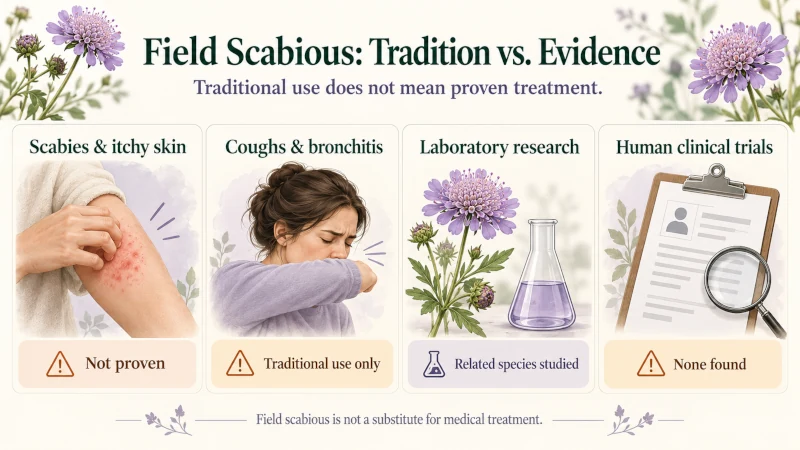
The plant was named for the itch it was meant to cure. For centuries, Europeans used field scabious — a lilac, pincushion-flowered meadow plant — against scabies, sore skin and chesty coughs. That history is real. What’s missing is proof: no study in people has shown that field scabious treats scabies, eczema, bronchitis or anything else. The closest research is laboratory work on related species [Chrząszcz et al., 2023].
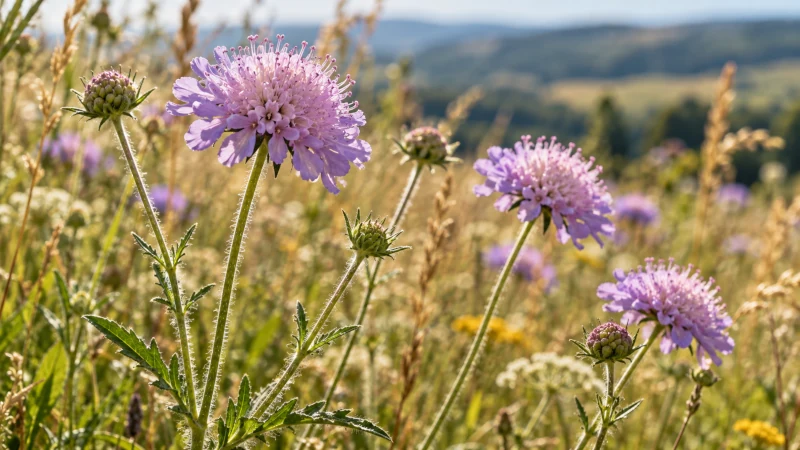
If you’re here because something itches, the practical answer is short. Scabies needs a proven scabicide, and a tea from a hedgerow plant won’t clear the mites. If you’re here because the plant interests you, it’s worth a closer look — chemically richer than it appears, and the subject of a centuries-old naming mix-up that plenty of herbal pages, including an earlier version of this one, got wrong.
Field scabious at a glance
| Field scabious | |
| Scientific name | Knautia arvensis (L.) Coult.; older name Scabiosa arvensis [POWO] |
| Family | Caprifoliaceae, the honeysuckle family. Older books place it in Dipsacaceae, the teasel family [POWO] |
| Life cycle | Biennial or perennial [POWO] |
| Native range | Europe to Siberia and the North Caucasus [POWO] |
| Introduced to | Much of southern Canada and the northern US, Iceland, and southern Argentina, among other places [POWO] |
| Typical habitat | Dry meadows, pastures, dry hillsides and open woods [Karalija et al., 2017] |
| Parts used traditionally | The flowering herb, as infusions and alcohol-based preparations [Chrząszcz et al., 2023] |
| Human clinical trials | None found |
Field scabious vs. devil’s-bit scabious: an old mix-up
Herbal books love the legend: the Devil, furious at the plant’s power to heal, bit off its root. That story belongs to a different plant. Devil’s-bit scabious (Succisa pratensis) has short roots that look cut off, which is where the tale and the name come from [Wildlife Trusts]. The older version of this article also listed Scabiosa succisa as another name for field scabious; that name is in fact a synonym of devil’s-bit scabious [POWO]. The Spanish name it gave, escabiosa mordida — “bitten scabious” — points to the same plant.
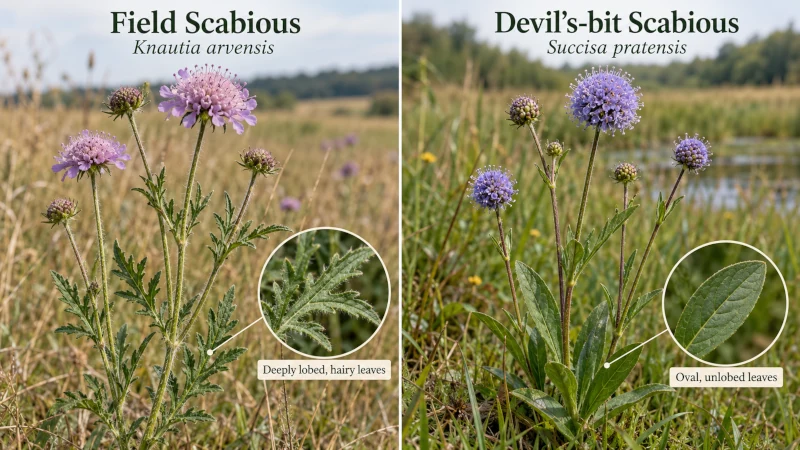
Telling them apart is easier than the names suggest. Field scabious has dark green, hairy, deeply lobed leaves; devil’s-bit has long, oval, unlobed ones and favors damp meadows, marshes and riverbanks [Wildlife Trusts]. Field scabious prefers drier ground [Karalija et al., 2017].
Why this matters to you: anything written about one plant — chemistry, dose, folklore — doesn’t automatically transfer to the other. If you’re foraging, misidentification is the first risk, not the last.
What’s actually in field scabious
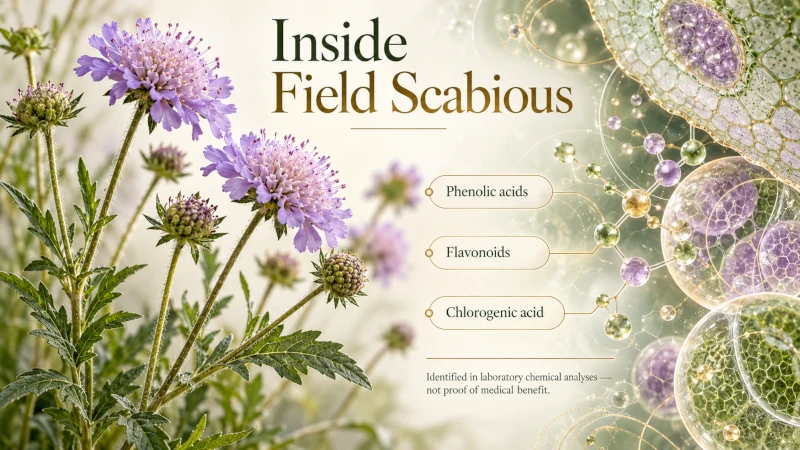
Most of the chemistry comes from the flowering tops. Polish and Italian researchers isolated eight phenolic compounds from the aerial parts, including chlorogenic and cryptochlorogenic acids and several flavone glycosides, one of them previously unknown [Moldoch et al., 2011]. A later analysis measured 14 phenolic acids and eight flavonoids, and found that composition varied more between parts of the same plant than between populations from different regions [Karalija et al., 2017]. Plants in the wider family are also known for saponins [Chrząszcz et al., 2023].
Two practical points follow. First, two jars sold as “field scabious” could differ a lot in what they contain. Second, finding antioxidant-type compounds in a plant is a long way from showing the plant treats a disease. Chlorogenic acid is also in coffee; nobody prescribes espresso for scabies.
Field scabious uses: tradition versus evidence
| Traditional use | What the evidence shows | Verdict |
| Scabies | No human studies. Effective prescription and pharmacy treatments exist. | Not supported — don’t use instead of treatment |
| Itchy skin, eczema | Long folk use; lab studies only, and on related Knautia species | Traditional use only |
| Ringworm, herpes | Nothing found | Insufficient — these are infections that need a diagnosis |
| Cough and bronchitis | Older literature describes expectorant effects of the infusion; no trials | Traditional use only |
| Asthma | Nothing found | Not supported — asthma needs prescribed care |
| “Blood-cleansing” (depurative), sweating cures | The underlying idea isn’t how the body works | Not supported |
Scabies and itchy skin
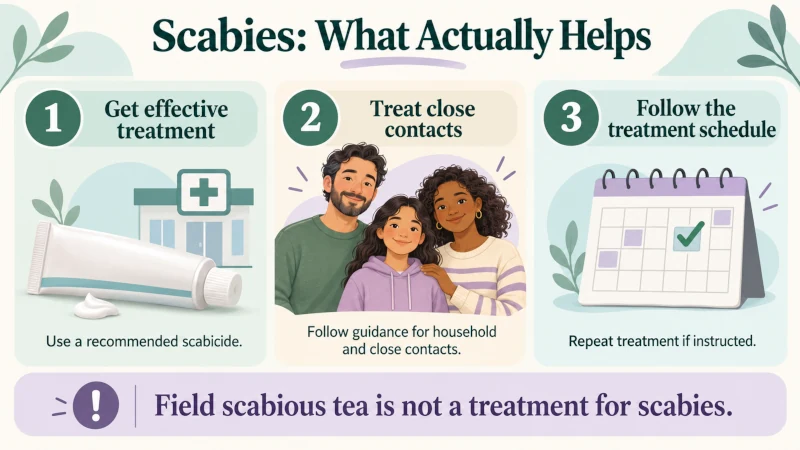
The name says scabies and old herbals agree. Modern medicine has better tools. In the United States, no over-the-counter product is approved for scabies; the first-line treatments are prescription permethrin 5% cream or oral ivermectin [CDC, 2023]. In the UK, pharmacists can supply a scabicide cream, everyone in the household is treated at the same time, the treatment is repeated seven days later, and the itch can carry on for a few weeks even after the mites are dead [NHS].
A compress of field scabious tea doesn’t do any of that. And while you’re trying it, scabies keeps spreading to the people you live with.
The nearest thing to modern research involves cousins of the plant. A 2023 laboratory study tested extracts of two other species, Knautia drymeia and K. macedonica. Some extracts scavenged free radicals, blocked inflammation-related enzymes, slowed the growth of acne bacteria in dishes, and didn’t damage cultured skin cells; the authors called for further studies to establish effects and side effects [Chrząszcz et al., 2023]. That’s a reasonable starting point for drug discovery. It isn’t evidence that field scabious helps your skin.
If eczema is the real concern, our evidence-graded guides to herbs for skin issues and herbs people use for eczema sort what helps from what doesn’t. Ringworm is a fungal infection with effective antifungal treatment — see fungal infections of the skin. Cold sores and genital herpes are viral, and a clinician can confirm the diagnosis and prescribe antivirals where they’re needed.
Coughs, bronchitis and asthma
Field scabious tea for chest complaints has a long folk history, and older literature credits an infusion of the herb with expectorant effects [Chrząszcz et al., 2023]. No clinical trial has tested it.
Most acute bronchitis is viral and gets better on its own in under three weeks. Rest, fluids, a clean humidifier and pasteurized honey (for anyone at least a year old) are the CDC’s basics, and antibiotics don’t help a chest cold [CDC, 2025]. If you want a plant for a cough, thyme and honey have better evidence than field scabious — our guide to herbs for the lungs rates them — and there’s practical advice on what to eat when you’re sick with bronchitis.
Asthma is different. It needs a diagnosis and a treatment plan from a clinician, and no herbal tea substitutes for a prescribed inhaler.
“Blood-cleansing” and sweating cures
The previous version of this page called field scabious depurative and sudorific — blood-cleansing and sweat-inducing. Skin conditions aren’t caused by toxins in the blood, and your liver and kidneys already handle metabolic waste. Our eczema guide explains why the “purifying” idea doesn’t hold up.
Is field scabious safe?
The honest answer is that nobody has studied it in people. We found no documented poisoning cases, but no reports isn’t the same as proven safe — it mostly reflects how little anyone has looked.
Side effects and skin reactions
Side effects in humans haven’t been studied. Any plant applied to skin can irritate it or cause an allergic reaction, and broken or weeping skin is more vulnerable. If you try a topical preparation anyway, test it on a small patch first — our patch-testing guide walks through how — and stop if it stings, reddens or spreads.
Medication interactions
No interactions are documented for field scabious, again because it hasn’t been studied. Herbal products in general can interact with medicines or cause problems before surgery [NCCIH]. If you take regular medication, ask your pharmacist before using any herb, including teas.
Pregnancy, breastfeeding and children
There is no safety data for field scabious in pregnancy, breastfeeding or childhood, and many herbal products have never been tested in these groups [NCCIH]. Don’t use it in any of these situations.
Who should avoid it
- Anyone pregnant, breastfeeding, or trying to conceive
- Babies and children
- People with broken, weeping or infected skin
- People taking several prescription medicines, or with liver or kidney disease
- Anyone who suspects scabies — get it treated properly instead
Why there’s no dose on this page
The earlier version recommended 50–60 grams of dried plant per liter of water, three or four cups a day, taken from a 2000 herbal encyclopedia. We couldn’t verify that figure, it may describe devil’s-bit scabious rather than field scabious, and there’s no human data to show any amount is safe or useful. So we removed it rather than pass it on. We also found no reliable information on eating the plant, so don’t forage it as food.
When to see a doctor instead
Get scabies checked or treated if:
- You have intense itching that’s worse at night, with a rash or spots — often between the fingers, around the wrists, waist or groin [NHS]
- Someone you live with is itching too
- A child under 2 has symptoms, you have a crusted, flaky rash, or your skin looks infected [NHS]
- You’re still itching 2 to 4 weeks after finishing treatment [NHS]
See a healthcare professional for a cough if you have:
- A fever lasting more than 5 days, or 104°F (40°C) or higher
- Coughing up bloody mucus, or shortness of breath
- Symptoms lasting more than 3 weeks, or repeated bouts of bronchitis [CDC, 2025]
- A baby under 3 months with a fever of 100.4°F (38°C) or higher — call right away [CDC, 2025]
Call 911 for severe trouble breathing, chest pain, or blue or gray lips.
| HEALTH DISCLAIMER: This article is for general education and is not medical advice, a diagnosis, or a treatment plan. Field scabious has not been shown to treat, cure or prevent any disease. Rashes that look alike can need very different treatment, and scabies needs a proven scabicide. Talk with a doctor, dermatologist or pharmacist before using any herbal product, especially if you are pregnant or breastfeeding, treating a child, taking prescription medicines, or living with a long-term condition. Seek medical care for any red-flag symptom above, and call 911 in an emergency. |
Frequently Asked Questions
What is field scabious used for?
Traditionally, for scabies, itchy skin conditions and coughs. Those uses rest on folk history; no human study has tested them [Chrząszcz et al., 2023].
Can field scabious cure scabies?
No. Scabies is treated with prescription permethrin cream or oral ivermectin in the US, or a pharmacy scabicide in the UK, with everyone in the household treated together [CDC, 2023] [NHS].
Is field scabious the same as devil’s-bit scabious?
No. Devil’s-bit scabious is Succisa pratensis, a damp-ground plant with oval leaves and the “bitten” root of legend; field scabious is Knautia arvensis, with hairy, deeply lobed leaves [Wildlife Trusts].
Is field scabious edible?
We found no reliable data on eating it, and no human safety studies. Don’t forage it as food.
Is field scabious tea safe to drink?
Its safety simply hasn’t been studied. Avoid it if you’re pregnant, breastfeeding, giving it to a child, or taking regular medication, and check with a pharmacist before trying it otherwise [NCCIH].
References
- Royal Botanic Gardens, Kew. “Knautia arvensis (L.) Coult.” Plants of the World Online. View source
- Royal Botanic Gardens, Kew. “Scabiosa succisa L.” (synonym of Succisa pratensis). Plants of the World Online. View source
- The Wildlife Trusts. “Devil’s-bit scabious.” Wildlife Explorer. View source
- Moldoch J, Szajwaj B, Masullo M, Pecio L, Oleszek W, Piacente S, Stochmal A. “Phenolic constituents of Knautia arvensis aerial parts.” Natural Product Communications. View source
- Karalija E, Muratović E, Tarkowski P, Ćavar Zeljković S. “Variation in phenolic composition of Knautia arvensis in correlation with geographic area and plant organ.” Natural Product Communications. View source
- Chrząszcz M, Miazga-Karska M, Klimek K, Dybowski MP, Typek R, Tchórzewska D, Dos Santos Szewczyk K. “The anti-acne potential and chemical composition of Knautia drymeia Heuff. and Knautia macedonica Griseb extracts.” International Journal of Molecular Sciences. View source
- Centers for Disease Control and Prevention. “Clinical Care of Scabies.” December 18, 2023. View source
- NHS. “Scabies.” View source
- Centers for Disease Control and Prevention. “Chest Cold (Acute Bronchitis) View source
- National Center for Complementary and Integrative Health. “Using Dietary Supplements Wisely.” NIH. View source


