
The wolfsbane plant is one of the most poisonous flowers grown in gardens anywhere in the world. Every part of it — the leaves, the hooded flowers, and above all the turnip-shaped roots — holds a toxin called aconitine that can throw the heart out of rhythm and stop a person breathing. [Poison Control] As little as about 2 milligrams of pure aconitine, or a few grams of root, can kill an adult. [Chan, 2009] People have died after eating it by mistake, after drinking herbal teas brewed from it, and in rare cases simply from handling the cut plant with bare hands.
So whether you grow it, spot it on a hike, or are just curious about the plant behind the old werewolf legends, the thing worth knowing is how to recognize it and keep away from the parts that hurt you.

What the wolfsbane plant actually is
Wolfsbane is the common name for plants in the genus Aconitum, a group of more than 250 species in the buttercup family. [NC State Extension] The same plants are sold and described under a confusing pile of names: monkshood, aconite, devil’s helmet, blue rocket, leopard’s bane, and — fittingly — queen of poisons. The species most often grown in Europe and North America is Aconitum napellus. [Poison Control] A close relative from the Himalayas, Aconitum ferox, is considered one of the most toxic plants on Earth.
It earns the comparison to foxglove, another garden plant that can both heal and kill. Both have been used as folk medicines, and both have a margin between “dose” and “deadly” that is far too thin to gamble on at home.
How to identify wolfsbane
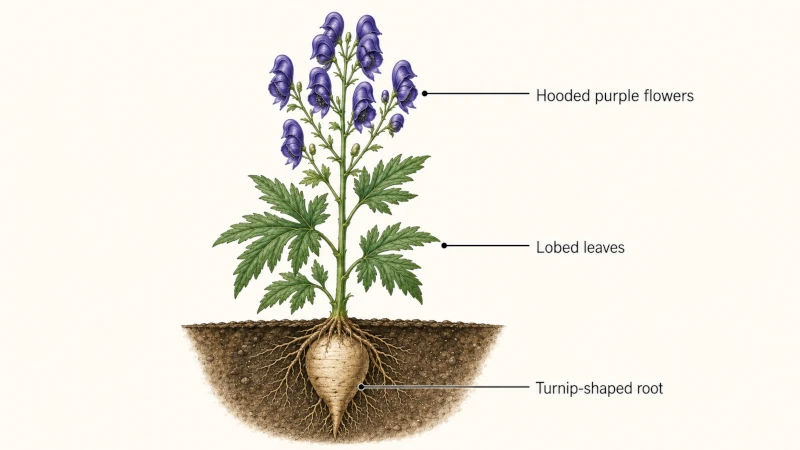
Wolfsbane grows on stiff, upright stems, usually three to four feet tall. The dark green leaves are deeply cut into several lobes with toothed edges. In summer it sends up tall spikes of flowers, and those flowers are the giveaway: the top petal forms a rounded hood or helmet, which is why “monkshood” and “helmet flower” stuck. Colors run from deep blue and violet to white, occasionally pale yellow. Underground, the roots are pale and fleshy, shaped a bit like a small turnip. [NC State Extension]
| Part of the plant | What to look for |
| Flowers | Hooded or helmet-shaped, in tall clusters; deep blue to purple, sometimes white or yellow; bloom in summer. |
| Leaves | Dark green, glossy, divided into 3–5 toothed lobes, arranged in a spiral up the stem. |
| Stems | Stiff, erect, leafy, usually unbranched; tall plants may be staked. |
| Roots | Pale, fleshy, turnip- or tuber-shaped — the most toxic part, and the part most often mistaken for food. |
| Size | Roughly 3–4 feet tall and 1–1.5 feet wide. |
The lookalikes that get people killed
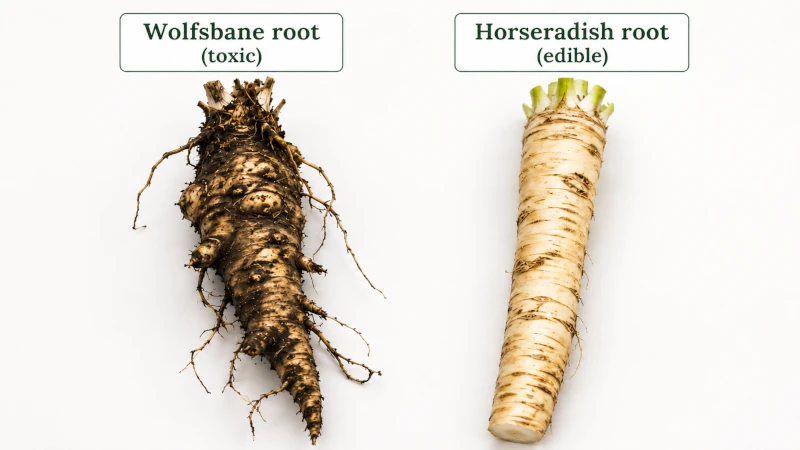
Almost every serious poisoning starts with mistaken identity. The fleshy roots have been confused with horseradish and Jerusalem artichokes, and the leaves have been taken for parsley or other wild greens. [NC State Extension] In one case reported to Poison Control, an elderly couple ate a garden salad they thought contained ground elder; it was wolfsbane, and one of them went into cardiac arrest. [Poison Control] The safe rule is blunt: never eat any part of a plant you cannot identify with certainty, and never plant wolfsbane near your vegetable beds.
Why the wolfsbane plant is so poisonous
The danger comes mainly from aconitine and a handful of related alkaloids. These molecules lock onto the sodium channels that let nerve, muscle, and heart cells fire — and hold them open, so the cells fire over and over and then can’t reset. [Chan, 2009] In the heart, that scrambles the heart rhythm and can trigger the chaotic, hard-to-treat arrhythmias that cause most aconite deaths. In the nerves, it produces the early numbness and tingling that often warn that something is badly wrong. [Lin et al., 2004]
Two details make it especially treacherous. First, there is no specific antidote — hospitals can only support the patient and steady the heart. [Poison Control] Second, aconitine can pass through skin and mucous membranes, so handling a bruised plant or its sap, not just eating it, can cause symptoms. [Chan, 2009] Severity does not track neatly with the amount swallowed, either; some people react far more strongly than others, which makes any “safe” home dose impossible to predict.
A plant with a long, dark history
Wolfsbane has been a weapon for as long as it has been a medicine. People across the ancient world smeared its juice on spears and arrows to bring down wolves, bears, and enemies; the English name comes straight from baiting wolves with poisoned meat. Ancient Romans used it as a method of execution, and in folklore it was thought to ward off werewolves and witches. [Poison Control] [JSTOR Daily]
Its medical career was always uneasy. In the 18th century the Viennese physician Anton von Störck tested aconite as a treatment for nerve pain and fever, and tinctures of it appeared in pharmacies for generations before safer drugs pushed them out. In traditional Chinese and Ayurvedic medicine, aconite roots are still used — but only after long soaking, boiling, or steaming, which breaks down most of the toxic alkaloids. When that processing is skipped or rushed, or the dose is too high, people are poisoned. [Chan, 2009]
Signs of wolfsbane poisoning
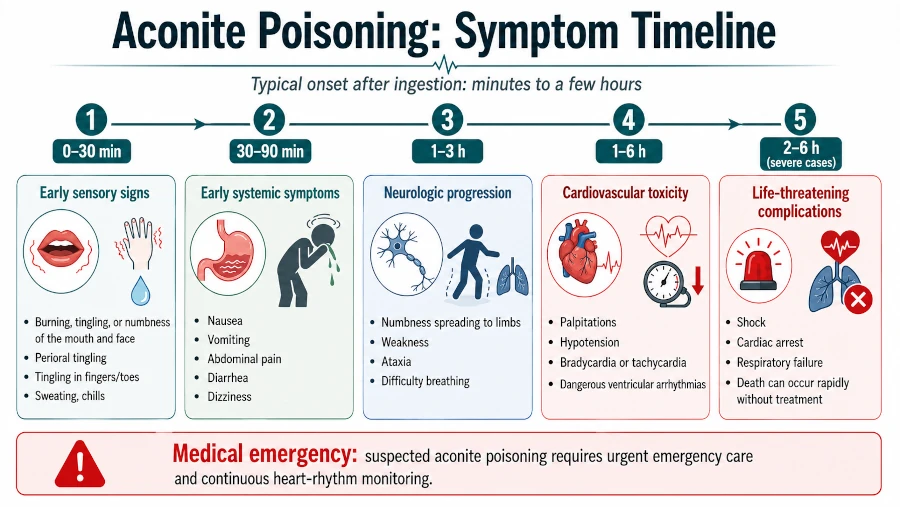
Symptoms usually start within minutes to about two hours of exposure. [Poison Control] They tend to move through the body in a recognizable order:
- Early: tingling, burning, or numbness in the mouth, then spreading to the face, hands, and feet.
- Next: nausea, vomiting, abdominal pain, and diarrhea.
- Dangerous phase: an irregular, very slow, or very fast heartbeat, low blood pressure, chest tightness, shortness of breath, and muscle weakness. Severe cases progress to life-threatening arrhythmias, seizures, and cardiac or respiratory arrest. [Lin et al., 2004]
These are not theoretical risks. A healthy 25-year-old who ate a few wild purple flowers on a coastal walk in Newfoundland was dead within hours. [Poison Control] In 2022, more than a dozen diners in Markham, Ontario, were sickened after a restaurant meal was contaminated with aconite; they reported a bitter taste, then numbness and dangerous heart rhythms, and several needed critical care. [CMAJ, 2022]
Red flags that mean call for help now
Treat it as an emergency if, after touching or eating an unknown plant, someone has numbness or tingling spreading over the body, an irregular heartbeat, fainting, chest pain, or any trouble breathing. Do not wait to see whether it passes. [Poison Control]
What to do if someone is exposed
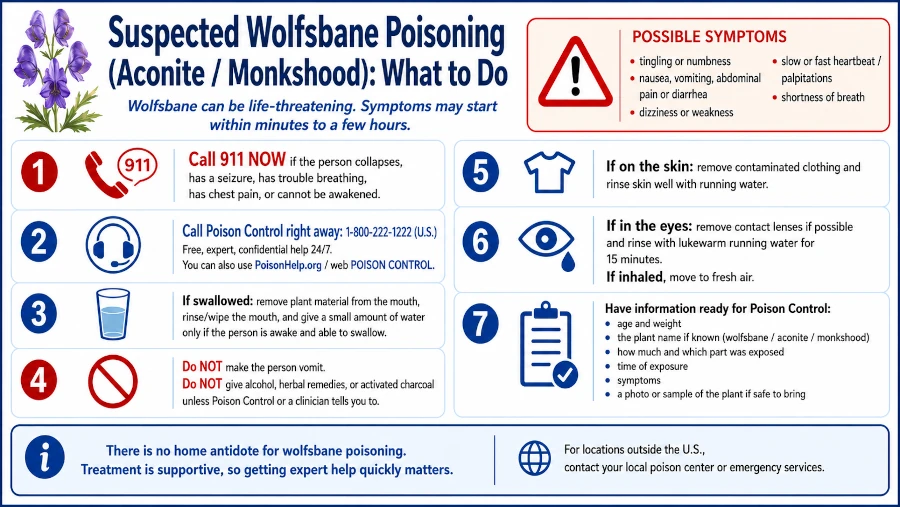
If you think someone has swallowed, chewed, or heavily handled wolfsbane, act quickly and calmly:
- Do not make the person vomit. [Poison Control]
- In the United States, call Poison Control at 1-800-222-1222. It is free, confidential, and staffed 24 hours a day, and you can also use the online tool at poison.org. [Poison Control]
- Call 911 (or your local emergency number) right away if the person has collapsed, has an irregular or very slow heartbeat, trouble breathing, or a seizure.
- If you safely can, identify or photograph the plant so clinicians know what they are treating.
Hospital care is supportive because there is no antidote: continuous heart monitoring, IV fluids, activated charcoal, and medicines to control the heart rhythm (magnesium and amiodarone are often used in severe cases), with advanced life support if needed. Most people who reach care quickly recover. [Klokman et al., 2024] Outside the US, contact your national poison center or emergency number.
Who is most at risk — and how to handle the plant safely
A few groups run into trouble far more often than others:
- Children, drawn to the bright flowers or handed bouquets.
- Foragers and gardeners who mistake the roots or leaves for food.
- People using unregulated herbal aconite products, where processing and dose are impossible to verify.
- Cats and dogs, since the plant is toxic to pets. [NC State Extension]
If you choose to grow wolfsbane as an ornamental, the precautions are simple. Wear gloves whenever you handle it and wash your hands afterward. Keep it well away from the vegetable garden so the roots can’t be mistaken for a crop. Keep cut flowers out of children’s reach, and teach kids never to eat anything from the garden. [NC State Extension]
Should you ever use wolfsbane as medicine?
The honest answer for home use is no. With raw or home-prepared aconite, the gap between a dose that might do something and a dose that harms you is essentially nonexistent, and the first sign that you got it wrong can be a collapsing heart rhythm. [Chan, 2009] Any legitimate modern use involves specially processed material handled by trained practitioners — and even then, poisonings still happen. [CMAJ, 2022]
Be wary of herbal remedies or teas labeled aconite, fu zi, chuan wu, or cao wu, especially from informal sources. There is no good human evidence that home aconite relieves pain safely, and the realistic expectation is not gentle relief but a real chance of a medical emergency. If you are dealing with chronic pain, there are far safer paths — start with a clinician.
| Health Disclaimer This article is for education and general information only. It is not medical advice and is not a substitute for diagnosis or treatment by a qualified healthcare professional. Wolfsbane (aconite) is highly poisonous; nothing here should be read as instructions for using it as a remedy. Never eat, brew, or apply any part of the plant. If you suspect a poisoning, call your local poison center (1-800-222-1222 in the US) or emergency services immediately. If you are pregnant, nursing, take medications, or have a health condition, talk with your doctor before using any herbal product. |
Frequently asked questions
Is wolfsbane poisonous to touch?
It can be. Aconitine is absorbed through skin and mucous membranes, so handling a bruised plant or its sap can cause numbness and tingling. [Chan, 2009] Wear gloves, wash your hands afterward, and seek medical advice if you develop symptoms after handling it.
What happens if you eat wolfsbane?
Symptoms usually begin within minutes to a couple of hours: numbness and tingling, then vomiting and diarrhea, then potentially dangerous changes in heart rhythm and breathing. It can be fatal. Treat any ingestion as an emergency. [Poison Control]
Is there an antidote for aconite poisoning?
No. There is no specific antidote. Hospital treatment is supportive — heart monitoring, fluids, activated charcoal, and medicines to control arrhythmias — and most people who get help quickly recover. [Poison Control]
Why is it called wolfsbane?
The name comes from its historic use as a poison to kill wolves, and it carried into folklore as a supposed defense against werewolves. [Poison Control]
Is monkshood the same plant as wolfsbane?
Yes. Monkshood, aconite, devil’s helmet, and queen of poisons are all common names for plants in the genus Aconitum. They share the same toxin and the same risks. [NC State Extension]
Can I grow wolfsbane safely in my garden?
Yes, many people grow it as an ornamental, but with care: handle it only with gloves, keep it away from vegetables, and keep children and pets clear of the flowers and roots. [NC State Extension]
References
- National Capital Poison Center (Poison Control). “Aconitum napellus (monkshood): A purple poison.” May, M.E. → View source
- North Carolina State Extension Gardener Plant Toolbox. “Aconitum (Monkshood, Wolfsbane, Aconite).” → View source
- Chan TYK. “Aconite poisoning.” Clinical Toxicology, 2009;47(4):279–285. → View source
- Lin C-C, Chan TYK, Deng J-F. “Clinical features and management of herb-induced aconitine poisoning.” Annals of Emergency Medicine, 2004;43(5):574–579. → View source
- Vogel L. “Mass poisoning in Markham highlights wolfsbane risk.” CMAJ, 2022;194(36):E1255. → View source
- Klokman VW, et al. “Intentional intoxication with monkshood plant leading to atrioventricular dissociation and ventricular ectopy.” International Journal of Emergency Medicine, 2024;17:19. → View source
- “Wolfsbane: A Poisonous Beauty.” JSTOR Daily (history and folklore context). → View source
