
Diabetic socks are a sensible, low-risk thing to wear. They are also sold on claims the research does not support. A systematic review published in February 2026 gathered every study ever done on these socks and found nine — four of them clinical trials, which scored an average of 28.6% on a standard quality scale where anything under 50% counts as low quality [Venkatraman, 2026].
That is the honest starting point for anyone shopping for diabetic socks for men. A good pair is comfortable, unlikely to hurt you, and probably reduces pressure under your forefoot by a modest amount. What keeps feet attached to legs is a daily look at your own feet, a proper exam on a schedule matched to your risk, shoes that fit, and blood glucose that hasn’t been running high for years. Socks help at the margins of that.
What diabetic socks for men actually are
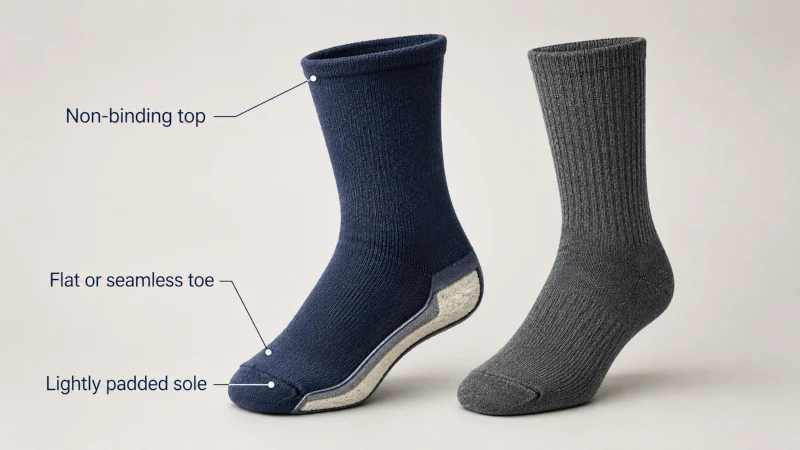
There is no regulated definition. A sock can be labeled “diabetic” and sold on any combination of these features:
- A non-binding or loose top with no tight elastic band
- A seamless or flat toe seam
- Extra padding under the forefoot, heel, or whole sole
- Moisture-wicking synthetic or blended yarns
- An antimicrobial or anti-odor finish
- White or light colors
Some of those features have research behind them. Most of what is printed on the packet does not. The 2026 review examined 17 commercially available diabetic socks alongside the published literature and concluded that the ones “reporting new types of fibres lack clinical evidence to support their claims” [Venkatraman, 2026].
A useful reality check on where these sit in medical practice: Medicare’s therapeutic footwear benefit covers custom-molded or extra-depth shoes and inserts for people with diabetes and severe diabetes-related foot disease, certified by the doctor treating your diabetes. Socks appear nowhere in that benefit [Medicare, 2026]. The American Diabetes Association recommends specialized therapeutic footwear for people at high risk of ulceration, and makes no equivalent recommendation about socks [ADA, 2026].
What the evidence actually shows
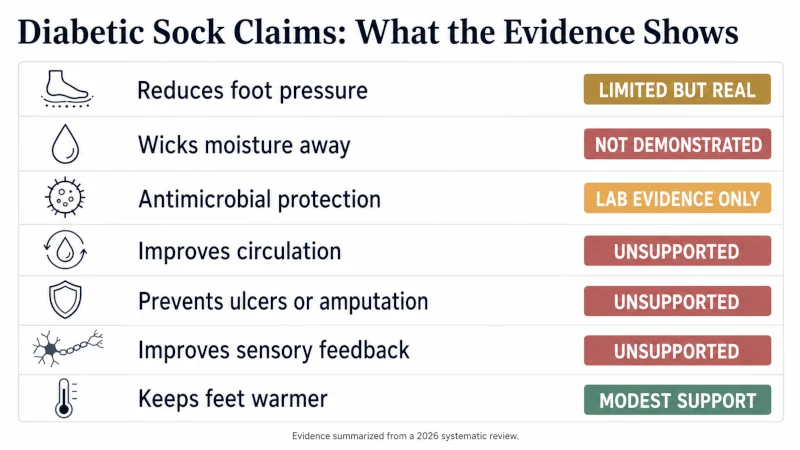
The 2026 systematic review searched four databases across 2000–2024 and found 520 articles, of which nine qualified. Six were clinical studies, assessed with the Downs & Black tool. Their average quality score was 28.6% (SD 12.4), against thresholds of high at 66.7% or above, fair at 50–66.6%, and low below 50%. The authors’ summary: the clinical studies “exhibited poor quality and were unable to demonstrate significant outcomes” [Venkatraman, 2026].
| Claim on the packet | What the studies found | Verdict |
| Reduces pressure on the foot | Best-supported feature. A double-layer padded sock cut mean plantar pressure 9% and forefoot pressure 10% against ordinary supermarket socks in 19 people with moderate-to-severe neuropathy | Limited but real |
| Wicks moisture away | The highest-quality trial, in 20 people at high risk, found no effect of sock type on transepidermal water loss, skin hydration, or skin hardness | Not demonstrated |
| Antimicrobial protection | Laboratory work only. Cotton modified with zeolite, minerals, or activated carbon inhibited bacteria and fungus on the bench; plain 100% cotton did not. No trial has measured infections in people | Lab evidence only |
| Improves blood circulation | No study in the review measured circulation at all. This is a manufacturer claim | Unsupported |
| Prevents foot ulcers and amputation | No trial has shown this. One 6-month study of 11 people reported no ulcers, but had no control group and unclear statistics | Unsupported |
| Better sensory feedback | Rests on 11 patients reporting they believed the socks reduced numbness, in an uncontrolled study | Unsupported |
| Keeps feet warm | The one clear difference found. Thicker terry-knit socks produced higher skin temperature than thinner alternatives | Supported, modestly |
Two details deserve pulling out, because they are the kind of thing that gets lost when a study becomes a marketing line.
The most eye-catching pressure numbers in the literature — reductions of 53% to 117% across seven of eight foot sites, in 32 high-risk patients — came from socks compared against bare feet, not against ordinary socks. The authors of that study noted the product “would not be compatible with wearing within most footwear” and was better understood as an indoor foot covering [Venkatraman, 2026]. Anything you can actually wear inside a shoe is being measured against a different baseline.
And the trial that ran longest and cleanest found nothing. Twenty people with type 1 and type 2 diabetes at high risk of ulceration wore a commercial control sock and then experimental merino socks over several months. Transepidermal water loss, stratum corneum hydration, and skin hardness were unchanged across sock types. Only skin temperature differed [Venkatraman, 2026]. That is a direct null result on the moisture-control claim that sells most of these socks.
Sources do not fully agree here, and it’s worth being straight about it. Mayo Clinic’s foot care guidance tells people with diabetic neuropathy to wear “clean, dry socks” made of “cotton or moisture-wicking fibers” [Mayo Clinic, 2025]. That is sensible advice and costs nothing to follow. It is expert guidance rather than trial evidence, and the one decent trial that measured skin outcomes did not find the difference the advice implies. Keeping your feet dry matters; whether a particular yarn does it better than another has not been shown.
None of this makes diabetic socks a bad purchase. Comfortable, non-binding, seamless, lightly padded socks are exactly what the national guidance describes. It makes the marketing unreliable, which matters because the price gap between a good plain sock and a branded diabetic sock can be substantial.
What actually protects your feet
This is where the strong evidence lives, and it deserves more of your attention than the sock aisle.
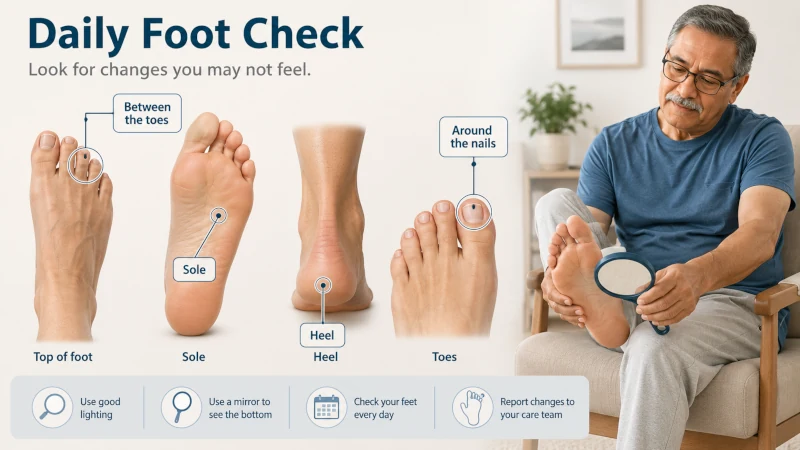
Look at your feet every day. The ADA recommends that everyone with diabetes receive foot self-care education covering how to examine their own feet, by palpation or with an unbreakable mirror, for daily surveillance of early problems [ADA, 2026]. Check for cuts, sores, red spots, swelling, blisters, ingrown nails, corns, calluses, plantar warts, athlete’s foot, and warm spots. The evening, when your shoes come off, is the natural time [NIDDK, 2017].
Get a proper foot exam on the right schedule. A comprehensive foot evaluation at least annually is a Grade A recommendation. If you have sensory loss or a prior ulcer or amputation, your feet should be inspected at every visit — also Grade A [ADA, 2026]. The exam should include skin inspection, assessment for deformities, a 10-g monofilament or Ipswich touch test plus at least one other neurological test, and a check of the pulses in your legs and feet [ADA, 2026].
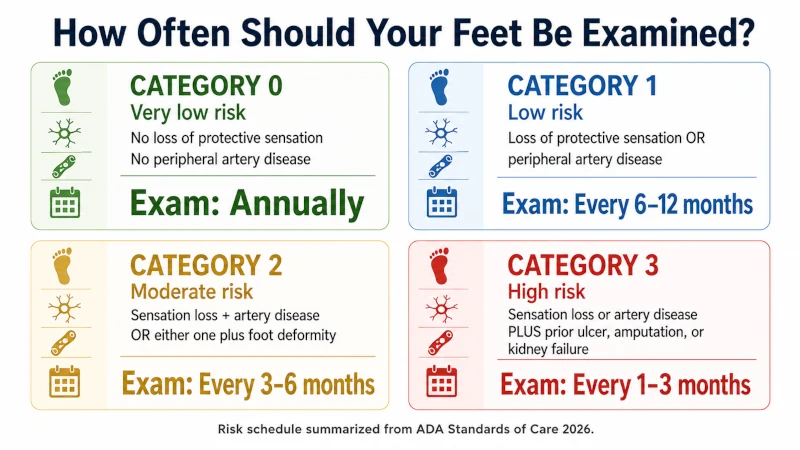
Your risk category sets the frequency:
| Category | Ulcer risk | What defines it | Foot exam frequency |
| 0 | Very low | No loss of protective sensation and no peripheral artery disease | Annually |
| 1 | Low | Loss of protective sensation or peripheral artery disease | Every 6–12 months |
| 2 | Moderate | Sensation loss + artery disease, or either one plus a foot deformity | Every 3–6 months |
| 3 | High | Sensation loss or artery disease, plus a history of foot ulcer, amputation, or kidney failure | Every 1–3 months |
International Working Group on the Diabetic Foot risk stratification, as reproduced in the ADA Standards of Care [ADA, 2026]. Frequencies reflect expert opinion and your own circumstances.
Take the shoes seriously. Therapeutic footwear is the intervention with an actual guideline recommendation behind it, for people with loss of protective sensation, foot deformities, ulcers, callus formation, poor peripheral circulation, or a history of amputation [ADA, 2026].
Keep glucose down. Chronic hyperglycemia is the best-established risk factor for the microvascular complications that put feet at risk in the first place [ADA, 2026]. Nothing you pull onto your feet substitutes for that, which is why understanding your blood sugar numbers does more for your feet than any sock will. Building meals around foods that help control blood sugar works on the cause rather than the symptom.
Stop smoking, and say so at appointments. Smoking is on the ADA’s list of factors defining an at-risk foot, and smokers with prior lower-extremity complications should be referred to a foot care specialist for ongoing preventive care and lifelong surveillance [ADA, 2026].
The scale of what this prevents is not small. Between 19% and 34% of people with diabetes will develop a foot ulcer at some point in their lives. Roughly 20% of those ulcers lead to a minor or major amputation, and five-year mortality after amputation runs 46% to 56%. Recurrence is 40% within a year and 65% within three [Venkatraman, 2026]. Peripheral neuropathy is a component cause in 78% of diabetic foot ulcerations, and infection is usually the final precipitating cause of amputation [ADA, 2026].
How to choose a pair without believing the packet
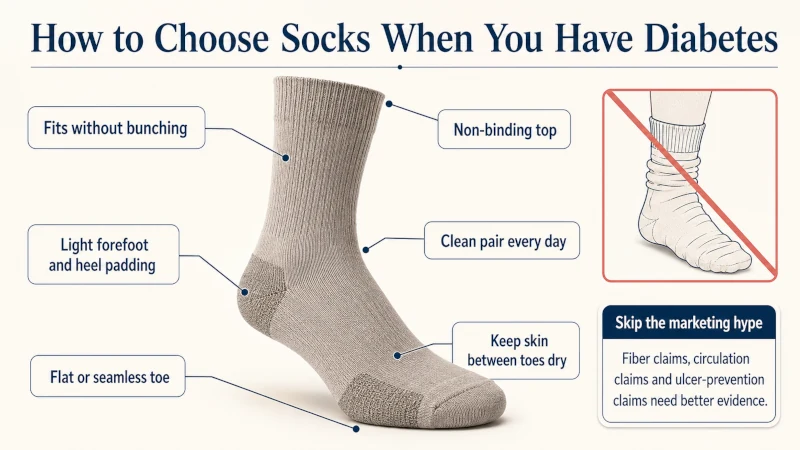
Since the branding tells you little, buy on construction and fit.
- Fit first. A sock that bunches under your foot is a pressure point you cannot feel. A sock that leaves a deep ring on your calf is too tight at the top. Neither problem is fixed by the word “diabetic” on the label.
- Seamless, or a flat toe seam. The national guidance is direct: “Socks with no seams are best” [NIDDK, 2017]. Mayo Clinic puts it from the other side — socks “should not have tight bands or thick seams” [Mayo Clinic, 2025].
- Light padding under the forefoot and heel. This is the feature with the only decent comparative trial behind it, and the mechanism makes sense — the padded sock increased contact area by 14%, spreading load [Venkatraman, 2026].
- Non-binding top, and never a rubber band. Tight hosiery restricts blood flow, and using a rubber band to hold up a loose sock is specifically warned against [NIDDK, 2017].
- Wear socks at all times, and change them daily [NIDDK, 2017]. Don’t go barefoot indoors.
- Inspect the sock, not just the foot. Staining, discharge, or blood on a light sock is information. One caveat: in the only study that asked, participants disliked the white color [Venkatraman, 2026]. A sock you refuse to wear protects nothing.
- Ignore fiber marketing. Laboratory testing does show that fiber and knit structure change breathability, friction, and thermal behavior — but no clinical trial has translated any of it into a health outcome [Venkatraman, 2026].
- Keep the skin between your toes dry. Excess moisture favors athlete’s foot, and the practical steps are washing daily and drying thoroughly between the toes rather than trusting a yarn to do it for you.
Compression socks are a different product, and the evidence is genuinely mixed
Graduated compression socks are often sold beside diabetic socks and sometimes labeled as both. They are not the same thing, and the difference matters more in this group than in almost any other.
The case for them, in one specific situation: an international consensus statement on compression therapy notes that mild compression at 18–25 mmHg has been shown efficacious and safe in people with diabetes and mild-to-moderate lower-extremity swelling, in a pilot study and a randomized controlled trial [Rabe, 2020].
The case for caution, from the same document:
- Arterial circulation should be checked before any compression therapy begins. If your foot or ankle pulse is weak or not palpable, an ankle-brachial pressure index should be measured first [Rabe, 2020].
- Severe peripheral arterial disease — systolic ankle pressure below 60 mmHg, or toe pressure below 30 mmHg — is a contraindication to compression stockings [Rabe, 2020].
- With impaired perfusion (ABI under 0.9), the effect on leg blood supply should be monitored carefully, because non-healing skin breaks can develop even under low-pressure stockings [Rabe, 2020].
- People with diabetes or neuropathy need special caution against pressure-induced nerve damage. Sensory loss from diabetic neuropathy is named specifically as a reason people fail to notice pressure damage as it happens [Rabe, 2020].
- The consensus cites a 76-year-old patient with diabetes treated with 40–60 mmHg stockings who developed deep necrosis over the ankle tendon, apparently after the stocking rolled over a tissue defect [Rabe, 2020].
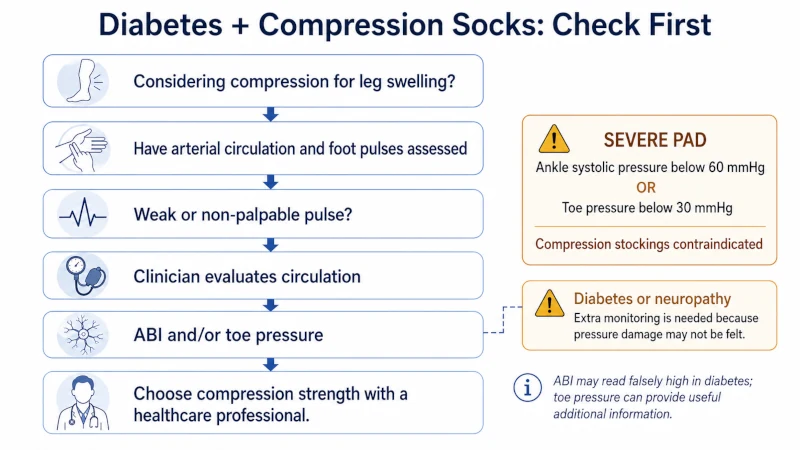
There is a further wrinkle specific to diabetes. The ankle-brachial index is known to read inaccurately in people with diabetes because the vessels can be non-compressible, so toe systolic pressure is the more reliable measurement [ADA, 2026]. The standard screening number used to clear people for compression is the one number that behaves badly in exactly this population.
The conclusion is not “never.” It is that compression is a treatment with real contraindications, that whether it is safe for you depends on an arterial assessment you cannot do at home, and that the strength matters a great deal. If you have swelling and are considering compression — including for varicose veins — that is a conversation with your doctor or podiatrist before the purchase, not after it.
Side effects and who should be careful
Plain, well-fitting socks are close to risk-free. The risks that exist come from the situations below.
If you have neuropathy. This is the central problem, and no sock solves it. Loss of protective sensation means a seam, a wrinkle, a foreign object, or a badly fitting sock can do damage you will not feel. The answer is looking, daily. Claims that socks improve “sensory feedback” rest on 11 patients’ subjective impressions in an uncontrolled study [Venkatraman, 2026].
If you have peripheral artery disease. Anything that compresses the leg needs medical clearance first, at the thresholds above [Rabe, 2020]. Poor blood flow also means sores and infections heal slowly, and severe cases can progress to gangrene [NIDDK, 2017].
Skin reactions. Skin irritation, discomfort, and pain are the most commonly reported adverse events with compression garments, and dark dyes have been associated with allergic contact dermatitis [Rabe, 2020]. If a new sock leaves your skin red, itchy, or marked, stop wearing it and look closely at the skin underneath.
New or one-sided swelling. Swelling in one leg, or swelling that is new, is not something to manage with a sock. Get it assessed.
Pregnancy and gestational diabetes. Socks are a garment, not a treatment, and nothing about pregnancy changes basic foot hygiene. Compression is a different matter — pregnancy alters both circulation and swelling patterns, so the arterial-assessment rule above still applies and should go through the clinician managing the pregnancy.
When to see a doctor rather than buy a sock
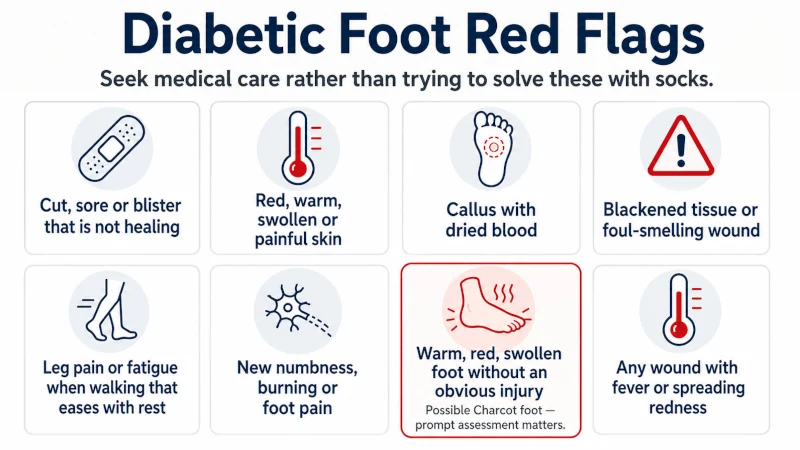
Seek care promptly for:
- A cut, sore, or blister on your foot that is not healing
- Skin that is red, warm, swollen, or painful
- A callus with dried blood inside it
- Blackened tissue, or a foul smell from a wound — these can indicate gangrene and need urgent attention [NIDDK, 2017]
- Pain or fatigue in your legs when walking that eases with rest, which can signal peripheral artery disease [ADA, 2026]
- New numbness, burning, or pain in your feet [ADA, 2026]
- A warm, red, swollen foot without an obvious injury, especially if you have neuropathy. Clinicians are told to suspect Charcot neuroarthropathy in exactly this presentation, and it carries a 17% annual risk of ulceration [Song & Chambers, 2025]
- Any wound with fever or spreading redness
Infection can move fast in a foot with poor circulation and damaged nerves, often without pain that matches the severity [ADA, 2026]. Waiting is the expensive option.
| Health disclaimer: This article is for general information and education. It is not medical advice, and it is not a substitute for diagnosis or treatment by a qualified healthcare professional. Socks — including any sold as diabetic socks — do not treat, cure, or prevent diabetes, neuropathy, peripheral artery disease, or foot ulcers. Talk to your doctor or podiatrist before starting compression socks of any strength, particularly if you have peripheral artery disease, neuropathy, heart failure, or swelling in one leg. If you have a wound, a sore that is not healing, or any of the warning signs above, seek care rather than waiting to see whether a change of socks helps. |
Frequently Asked Questions
Do diabetic socks actually prevent foot ulcers?
No trial has shown that they do. The 2026 systematic review found no clinical study capable of demonstrating ulcer prevention, and rated the clinical literature as low quality overall [Venkatraman, 2026]. What does have guideline support is daily self-inspection, a comprehensive foot exam at least annually, and therapeutic footwear if you are at high risk [ADA, 2026].
Are diabetic socks worth the extra money over ordinary socks?
Sometimes, for one reason: padding. A double-layer padded sock reduced forefoot pressure by 10% compared with standard supermarket socks in people with neuropathy [Venkatraman, 2026]. If a plain sock already fits well, has no prominent seam, and doesn’t bite at the top, you are already getting most of what the national guidance asks for [NIDDK, 2017].
Can men with diabetes wear compression socks?
Some can, but not without checking first. Mild compression at 18–25 mmHg has pilot and randomized trial support for mild-to-moderate swelling in diabetes, while severe peripheral arterial disease is a contraindication and neuropathy calls for special caution [Rabe, 2020]. Arterial circulation should be assessed before compression starts, and in diabetes that assessment is trickier than usual because the ankle-brachial index can read falsely high [ADA, 2026].
How often should I change my socks?
Daily. The guidance is to wear socks at all times and to choose clean, lightly padded socks that fit well [NIDDK, 2017]. Changing daily also builds in a routine moment to look at both the foot and the sock.
Should I wear white socks so that bleeding shows up?
It’s a reasonable idea with no trial behind it, and one real drawback. Light socks do make discharge or blood easier to notice, but in the only study that asked, participants disliked the white color [Venkatraman, 2026]. A daily foot check does the same job whatever color your socks are.
References
- Venkatraman PD, Orlando G, Culmer PR, Turnbull RP, Bradbury K, Yoldi I, Corser J, Russell DA, Boulton AJM, Reeves ND. Diabetic Socks: A Systematic Review of the Literature and Commercially Available Products. Diabetes/Metabolism Research and Reviews. 2026 Feb 21;42(2):e70138. DOI 10.1002/dmrr.70138. PMID 41721720. PMCID PMC12924646. View source
- American Diabetes Association Professional Practice Committee. 12. Retinopathy, Neuropathy, and Foot Care: Standards of Care in Diabetes—2026. Diabetes Care. 2026;49(Supplement_1):S261–S276. DOI 10.2337/dc26-S012. PMID 41358886. Published 8 December 2025. View source
- National Institute of Diabetes and Digestive and Kidney Diseases. Diabetes and Foot Problems. Last reviewed January 2017. View source
- Rabe E, Partsch H, Morrison N, Meissner MH, Mosti G, Lattimer CR, et al. Risks and contraindications of medical compression treatment – A critical reappraisal. An international consensus statement. Phlebology. 2020 Mar 2;35(7):447–460. DOI 10.1177/0268355520909066. PMID 32122269. PMCID PMC7383414. View source
- Mayo Clinic Staff. Diabetic neuropathy — Symptoms and causes. Mayo Clinic. Dated 10 June 2025. View source
- Song K, Chambers AR. Diabetic Foot Care. In: StatPearls. Treasure Island (FL): StatPearls Publishing. Last updated 15 September 2025. View source
- Centers for Medicare & Medicaid Services. Therapeutic shoes or inserts coverage. Medicare.gov. View source
