
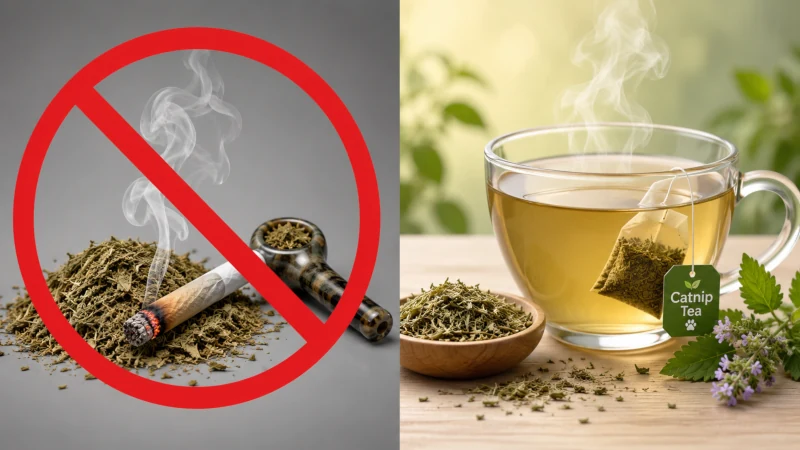
Yes, you can smoke catnip in the literal sense: dried catnip leaves will burn. But the better answer is simpler: you probably should not. Smoking catnip is unlikely to give you the playful, euphoric reaction cats have, and inhaling smoke from any burned plant material can irritate your lungs. If you searched can you smoke catnip, the practical takeaway is to skip the lighter and use a safer route, if you use catnip at all.
Catnip has a long history as an herbal tea, but modern human evidence is thin. Drugs.com’s professional monograph notes that there is “little clinical data” to support human uses of catnip, except some evidence around insect repellent, and that there is no clinical evidence to guide dosage [Drugs.com Natural Products, 2025]. That does not mean catnip is useless. It means the page should treat it as a mild traditional herb, not a proven treatment or a safe smoking herb.
Can You Smoke Catnip? The Practical Answer
Smoking catnip is a bad trade-off. You get the risks of smoke exposure without a well-established human benefit. Catnip does not contain nicotine, and the famous “catnip effect” is not a cannabis-like high. Older reports described people smoking catnip for euphoric effects in the 1960s, but Drugs.com notes that the identity of those plants was questioned and that no clinical evidence supports catnip as a central nervous system stimulant in humans [Drugs.com Natural Products, 2025].
A person who smokes catnip might notice a harsh herbal taste, coughing, throat irritation, dizziness, nausea, headache, or nothing at all. None of those outcomes makes smoking it worthwhile.
| Question | Careful answer |
| Will smoking catnip get you high? | There is no good clinical evidence that catnip produces a reliable human high. |
| Is it safer than smoking tobacco? | It avoids nicotine, but inhaling smoke from burned plant material still exposes the lungs to irritants and combustion byproducts. |
| Is catnip tea the same as smoking catnip? | No. Tea does not expose the lungs to smoke, but human evidence and dosing guidance remain limited. |
| Should pregnant or breastfeeding people use catnip? | No. Avoid catnip during pregnancy and lactation unless a qualified clinician specifically advises otherwise. |
Why Catnip Affects Cats Differently Than Humans
Catnip’s reputation comes from cats, not from strong human research. In cats, the response is largely smell-driven. A BMC Veterinary Research study tested catnip, silver vine, Tatarian honeysuckle, and valerian root in 100 domestic cats. The authors describe the catnip response as sniffing, licking, head rubbing, chin or cheek rubbing, rolling, drooling, and similar behaviors. They also found that about one in three domestic cats did not respond to catnip [Bol et al., 2017].
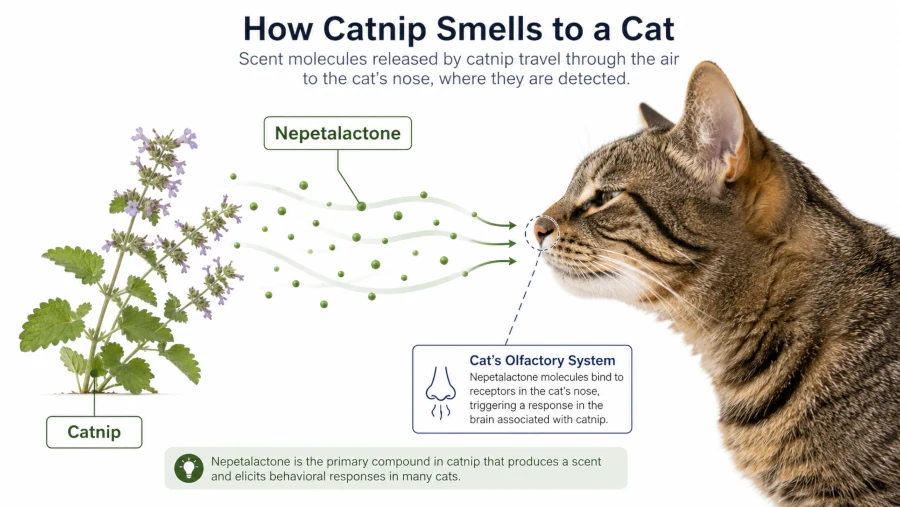
The same paper identifies nepetalactone as the compound associated with catnip’s effect in cats [Bol et al., 2017]. That does not prove a comparable effect in people. Human use of catnip is usually discussed as tea, flavoring, insect repellent research, or traditional herbal use. Turning a cat-specific olfactory response into a human smoking claim is where weak articles go wrong.
Risks and Side Effects of Smoking Catnip
Lung irritation and smoke exposure
The main problem is not that catnip is uniquely toxic when smoked. The problem is smoke. The American Lung Association states that smoke is harmful to lung health and that toxins and carcinogens are released from the combustion of materials, including burning wood, tobacco, or marijuana [American Lung Association, n.d.]. Catnip has not been studied like tobacco or cannabis smoke, so the safest editorial position is not to pretend it has a clean safety profile. If you burn dried leaves and inhale the smoke, your lungs are still dealing with hot gases and fine particles.
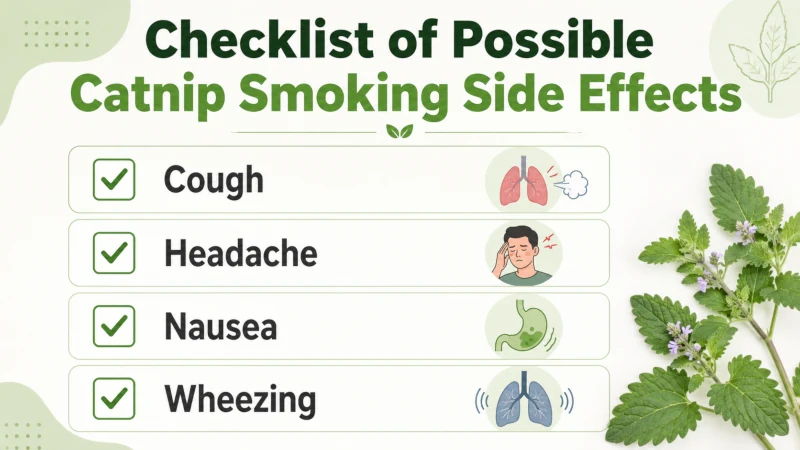
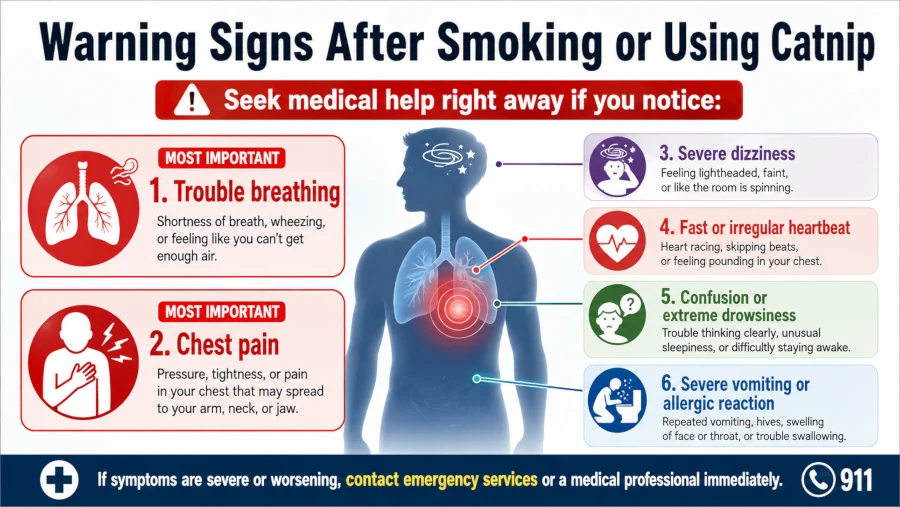
This matters more if you have asthma, COPD, chronic bronchitis, allergies, frequent wheezing, a recent respiratory infection, or any condition that makes your airways reactive. Smoking catnip could trigger coughing, throat burning, chest tightness, or shortness of breath. If that happens, stop immediately and get fresh air.
Headache, nausea, dizziness, and allergic reactions
Catnip itself can also cause unwanted effects. Drugs.com lists headache, malaise, conjunctival irritation, and skin redness among reported adverse reactions, and notes that excessive ingestion may cause headache and malaise while large amounts of tea may induce vomiting [Drugs.com Natural Products, 2025]. Smoke exposure can add another layer: burning plant material may irritate the eyes, nose, throat, and lungs.
A true allergic reaction is also possible with herbs and essential oils. Treat difficulty breathing, swelling of the lips or tongue, widespread hives, faintness, or chest tightness as urgent symptoms, not as “detox” or a normal herbal reaction.
What to Do If You Already Smoked Catnip
If you tried it once and feel fine, you probably do not need to panic. Stop using it, drink water, and avoid more smoke exposure. If your throat or chest feels irritated, move to fresh air and monitor your breathing.
Get medical help now if you have trouble breathing, wheezing that does not settle, chest pain, blue lips, fainting, confusion, severe dizziness, repeated vomiting, swelling of the face or throat, or symptoms after using a product that may have been contaminated or mixed with another substance. If a child swallowed catnip essential oil or a concentrated catnip product, contact Poison Control or local emergency services.
Safer Ways to Use Catnip Without Smoking It
“Safer” does not mean proven, risk-free, or right for everyone. It means you are not inhaling smoke. If you want to experiment with catnip, keep expectations modest and use a product meant for human use, not loose pet-store catnip.
Catnip tea
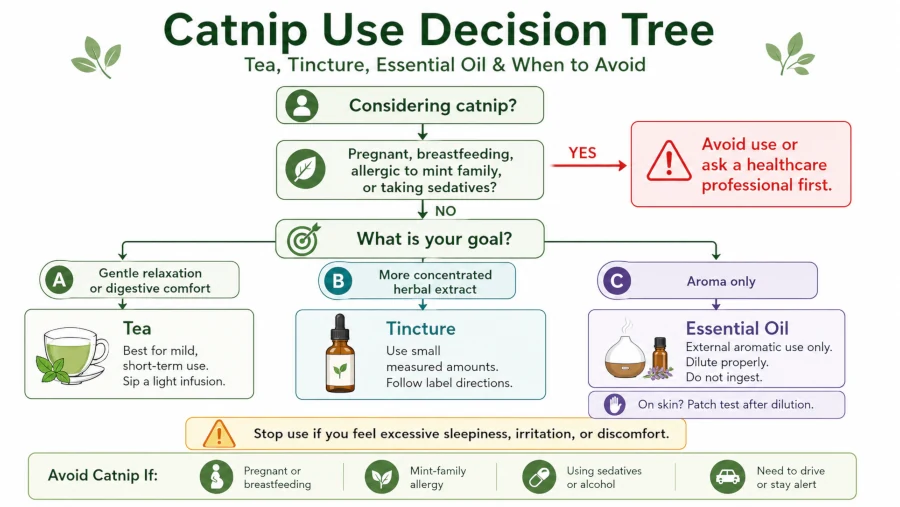
Catnip tea is the most reasonable route for most curious adults. Historically, catnip leaves and flowers have been used in teas and infusions, and traditional use includes digestive and calming purposes [Drugs.com Natural Products, 2025]. But clinical evidence for treating anxiety, insomnia, colic, or digestive problems is not strong enough to make disease-treatment claims.
Start small rather than brewing a very strong cup. Avoid using catnip tea daily for a long stretch unless a qualified clinician says it fits your situation. If your goal is a gentle evening herbal drink, you may prefer familiar tea herbs such as German chamomile or lavender, both of which already have related pages on this site.
Tinctures or supplements
Catnip tinctures and capsules vary by brand, strength, extraction method, and quality. Drugs.com states there is no clinical evidence to guide catnip dosing [Drugs.com Natural Products, 2025]. That makes label directions and professional guidance especially important. Do not combine catnip tinctures casually with alcohol, sedatives, sleep aids, anti-anxiety medications, or multiple calming supplements.
Catnip essential oil and topical use
Catnip essential oil is much more concentrated than tea. Do not swallow it unless a product is specifically formulated and labeled for that route under professional guidance. Poison Control warns that misuse of essential oils can cause serious poisoning, that some oils can cause rashes or be poisonous if swallowed or absorbed through the skin, and that aspiration can cause pneumonia [Poison Control, n.d.].
For topical products, dilute as directed, keep the oil away from eyes and damaged skin, and do a patch test before wider use. If you want broader essential-oil safety context, the site’s page on lemon balm essential oil is a useful internal comparison because it clearly separates tea, extract, and essential-oil forms.
Who Should Avoid Catnip or Ask a Healthcare Professional First
Avoid smoking catnip altogether. Also avoid catnip by mouth or as a concentrated oil unless a clinician approves it if you are pregnant, trying to become pregnant, or breastfeeding. Drugs.com specifically advises avoiding catnip during pregnancy and lactation because adverse effects such as emmenagogue and abortifacient effects have been documented [Drugs.com Natural Products, 2025].
Talk with a doctor or pharmacist before using catnip if you:
- take prescription medications, sedatives, sleep aids, anti-anxiety medicines, or several supplements;
- have asthma, COPD, chronic cough, allergies, or fragrance sensitivity;
- have a history of severe plant allergies or reactions to mint-family herbs;
- are planning surgery or a medical procedure;
- are giving it to a child or older adult;
- are using essential oils around pets, children, or anyone with breathing problems.
The honest answer is not “catnip is dangerous for everyone.” It is that smoking it adds avoidable lung risk, while the claimed benefits for humans are not strong enough to justify that route.
| Health Disclaimer: This article is for educational purposes only and does not diagnose, treat, cure, or prevent any disease. Catnip, catnip tea, tinctures, and essential oils can cause side effects and may not be appropriate during pregnancy, breastfeeding, childhood, medication use, lung disease, or allergy-prone conditions. Ask a qualified healthcare professional before using catnip for a health purpose, and seek urgent care for trouble breathing, chest pain, severe allergic symptoms, fainting, confusion, or repeated vomiting. |
Frequently Asked Questions
Does smoking catnip get you high?
There is no good clinical evidence that catnip produces a reliable human high when smoked. The catnip reaction people see in cats is a cat-specific olfactory response, not proof that humans will feel euphoric.
What happens if you smoke catnip?
You might cough, feel throat or lung irritation, get a headache, feel dizzy or nauseated, or feel nothing. Because smoke from burning plant material can irritate the lungs, smoking catnip is not a recommended route.
Is catnip tea safer than smoking catnip?
Yes, tea avoids smoke exposure, which is the biggest practical safety improvement. But catnip tea still has limited human evidence, no established clinical dose, and pregnancy/breastfeeding cautions.
Can you smoke catnip instead of marijuana or tobacco?
No. It is not a good substitute. Catnip is not tobacco and does not contain nicotine, but inhaling smoke still exposes your lungs to irritants. If you are trying to stop smoking, use evidence-based quitting support rather than replacing one smoked product with another.
Who should avoid catnip?
Pregnant or breastfeeding people should avoid catnip unless a clinician specifically advises otherwise. People with lung disease, fragrance sensitivity, plant allergies, medication use, or planned surgery should ask a clinician or pharmacist first.
Is catnip essential oil safe?
It can be risky if misused. Essential oils are concentrated; do not swallow catnip essential oil, apply it undiluted, use it on damaged skin, or keep it within reach of children or pets. Stop use if it causes rash, coughing, wheezing, headache, or nausea.
References
- Drugs.com. “Catnip Uses, Benefits & Dosage.” Drugs.com Natural Products Professional, last updated August 22, 2025. View source
- Bol S, Caspers J, Buckingham L, et al. “Responsiveness of cats (Felidae) to silver vine, Tatarian honeysuckle, valerian and catnip.” BMC Veterinary Research, 2017;13:70. DOI: 10.1186/s12917-017-0987-6. View source
- American Lung Association. “Marijuana and Lung Health.” View source
- Centers for Disease Control and Prevention. “Cigarette Smoking.” September 17, 2024. View source
- Poison Control / National Capital Poison Center. “Essential oils: Poisonous when misused. View source
