
The giant reed (Arundo donax) is a tall Mediterranean grass that has been used in folk medicine for over two thousand years, most often as a mild diuretic and to discourage milk production after weaning. The Greek physician Dioscorides recommended it for increasing urine flow in the 1st century AD, and Mediterranean herbalists have prepared decoctions of its rhizome — the underground stem — for the same purpose ever since. Modern research, however, is limited.
Most of what is “known” about giant reed comes from traditional use and from laboratory or animal studies of its alkaloid content, not from clinical trials in people. The plant also contains pharmacologically active compounds that carry real safety considerations, so this guide separates what tradition claims from what the evidence actually supports. [Kumar et al., 2021]
What Giant Reed Is
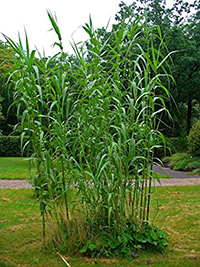
Giant reed (Arundo donax L.) belongs to the grass family, Poaceae. It grows in clumps along riverbanks, ditches, and damp ground, reaching 3 to 9 metres in height with hollow stems and broad lance-shaped leaves. The plant is probably native to the warmer parts of Asia and the Mediterranean, has been cultivated for thousands of years, and is now naturalized across the Americas, North Africa, Australia, and southern Europe. [Kato-Noguchi & Kato, 2025]
A few identification notes matter, because the plant is often confused with bamboo:
- Common names: giant reed, giant cane, Spanish reed, Spanish cane, canne de Provence (French), caña común (Spanish), narakata (Hindi).
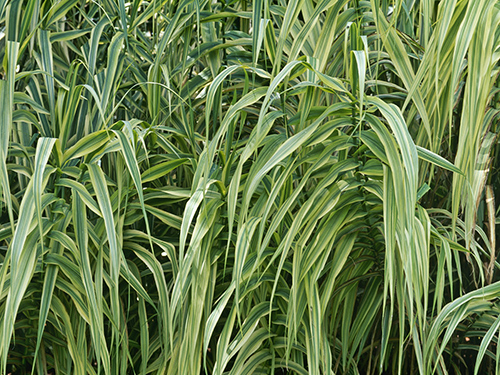
- Not a bamboo: only one leaf grows at each stem node on Arundo donax, and the stems are different in structure to true bamboos.
- Parts used in herbal tradition: the rhizome (underground stem) and the roots.
Two further facts about the plant set context. First, it is listed among the world’s 100 worst invasive alien species — it crowds out native vegetation along waterways in many regions. Second, the cane “reeds” used in clarinets, oboes, and saxophones come from Arundo donax. Those are different reeds from anything you would drink. [Kato-Noguchi & Kato, 2025]
Traditional Uses of Giant Reed
Folk and traditional uses of Arundo donax span Europe, North Africa, and the Indian subcontinent — and they do not always agree. The same plant has been used for opposite purposes in different parts of the world.
Mediterranean and European Tradition
In European herbalism, the rhizome was used as a:
- Mild diuretic — to slightly increase urine output, often given for kidney colic and as part of a “depurative” (cleansing) routine. People prone to kidney stones were among those for whom older European texts recommended it; the rationale was that more urine flow would discourage crystal formation.
- Galactofuge — to dry up milk production in women weaning a child or unable to breastfeed for medical or personal reasons.
Ayurvedic and South Asian Tradition
In Ayurvedic and South Asian medicine the root is, perhaps surprisingly, used to increase breast milk production in lactating women — the opposite of the European application. The root is also used externally as a paste for eczema and herpes, and internally for burning urination, abdominal pain, and as a hemostatic. Older Ayurvedic and Unani formulations such as Virataradi Kashaya included Arundo donax for urinary stones and retention of urine. [Kumar et al., 2021]
The honest takeaway from this split tradition: the historical record on giant reed should be read as cultural use, not as confirmed clinical evidence. Different cultures used the same plant for opposite purposes, and no human trial has settled the question either way.
What the Science Actually Shows
Phytochemistry — the Alkaloids That Matter
Phytochemical studies have identified several classes of compounds in Arundo donax. Most pharmacological attention has focused on its indole alkaloids, which are concentrated in the leaves and rhizomes:
- Gramine — present mainly in young shoots and leaves; toxic to many animals and insects and used by the plant as a chemical defence.
- Bufotenidine and dehydrobufotenidine — quaternary indolealkylamines that have shown neuromuscular blocking activity in animal studies dating back to 1972.
- Donaxine, donaxarine, donaxanine, arundamine, arundine — additional indole alkaloids identified in leaves and rhizomes.
- Tryptamine and N-acetyltryptamine — simpler indolealkylamines also present in the rhizome.
- Sterols, triterpenoids, phenolics, and saccharose — non-alkaloid constituents that account for some of the plant’s antioxidant activity. [Kumar et al., 2021]
Laboratory and Animal Findings
In laboratory studies — meaning test tubes, cell cultures, or animal models, not humans — extracts of giant reed have shown antibacterial activity against several pathogens (including E. coli and Pseudomonas aeruginosa), antifungal effects in some studies, anti-inflammatory and anti-spasmolytic activity in animal tissue, and anthelmintic (antiparasitic) activity in livestock. The rhizome lectin showed anti-proliferative effects against some human cancer cell lines in a 2005 study. None of these findings have been confirmed in clinical trials in humans. [Kumar et al., 2021]
A Note on Lidocaine
Giant reed has a small footnote in the history of modern medicine. In the 1930s, researchers investigating gramine as an insecticide accidentally synthesized a related compound with an anaesthetic effect on the tongue. Further work on this discovery eventually led to the development of lidocaine, the local anaesthetic still widely used today. The active anaesthetic is now made synthetically and has no direct connection to herbal preparations of the plant. [Cambridge Botanic Garden]
What is missing from the literature is worth saying clearly: there are no published randomized controlled trials in humans testing giant reed for any indication. Not for diuresis, not for kidney stones, not for stopping or increasing lactation, not for blood sugar, not for blood pressure, not for any inflammatory condition. Major reviews of the plant reach the same conclusion — the traditional uses have not been clinically validated, and further research is needed. The evidence sits at the limited / early-stage end of the spectrum.
How Giant Reed Has Traditionally Been Prepared
The Mediterranean herbal tradition for giant reed uses a decoction of the rhizome:
- Slice or grind the dried rhizome.
- Use roughly 50 grams of rhizome per litre of water.
- Boil for 15 minutes.
- Strain and drink two to four cups per day.
This is the figure cited in older European herbal compendia. It is a folk dosage, not a clinically established one. There is no published dose-finding study, no toxicology data on this preparation in humans, and no standardized extract. If you are reading about it for historical interest, that is the recipe; if you are considering using it medicinally, please read the safety section below carefully and talk to a healthcare professional first.
Safety, Side Effects, and Who Should Avoid Giant Reed
Giant reed is not a standardized herbal medicine in the United States, has not been evaluated by the FDA for safety or efficacy as a dietary supplement, and contains pharmacologically active alkaloids. Be cautious.
Pharmacologically Active Alkaloids
The plant contains indole alkaloids including gramine and bufotenidine. Bufotenidine demonstrated neuromuscular blocking activity in animal experiments published in 1972, and gramine is recognised as toxic to many animal species. The actual concentration of these compounds varies with the part of the plant, the harvesting season, and the preparation method, so the alkaloid dose in any homemade decoction is essentially unpredictable. [Kato-Noguchi & Kato, 2025]
Pregnancy and Breastfeeding
Traditional uses are directly contradictory — some sources claim the herb dries up milk, others claim it increases milk. No human safety data exist for either purpose. The National Center for Complementary and Integrative Health and MotherToBaby both advise against using herbal preparations during pregnancy and breastfeeding when human safety data are not available. Giant reed falls squarely into that category. Avoid it. [NCCIH] [MotherToBaby]
Children
Not recommended. Alkaloid effects in children have not been studied, and there is no established safe dose.
People With Kidney or Liver Disease
Avoid. The traditional diuretic claim is not validated, and the alkaloid content adds an unpredictable burden on organs that filter and metabolize compounds. For a more practical approach to kidney-protective habits and herbal options that have been studied, see this overview of herbal remedies for the urinary system.
Possible Medication Interactions
These have not been studied directly, but reasonable theoretical concerns include:
- Sedatives or CNS depressants — indolealkylamines can affect neurotransmission.
- Antihypertensive medications.
- Prescription diuretics, due to additive effects on fluid balance and electrolytes.
- Antidepressants and other drugs metabolized by liver pathways that may also handle plant alkaloids.
Quality and Contamination
Herbal preparations — especially from wild-harvested plants — can contain contaminants such as heavy metals, pesticide residues, or misidentified plant material. Both NCCIH and MotherToBaby flag this as a general concern for the herbal supplement market. There is no certifying body checking the purity of giant reed rhizome products. [NCCIH]
If you nonetheless choose to use a giant reed preparation, talk to your healthcare provider first. Start with a small amount and stop immediately if you notice nausea, dizziness, palpitations, fatigue, weakness, or any other unusual symptom. Giant reed is also closely associated in folk practice with conditions involving uric acid build-up — if that is your concern, dietary and medical approaches with better evidence should be your first stop.
When to Talk to a Healthcare Professional
Do not rely on a herbal preparation as a substitute for medical evaluation. Seek prompt medical care if you experience any of the following:
- Persistent flank or lower back pain — can indicate kidney stones or infection.
- Pink, red, or brown urine, or any visible blood in the urine.
- Fever, chills, or vomiting with urinary symptoms.
- Difficulty urinating or sharply reduced urine output.
- Trouble producing breast milk, or painful engorgement when stopping breastfeeding — a lactation consultant or your obstetric provider can help safely.
- Unexplained dizziness, fast heartbeat, or weakness after taking a herbal preparation.
Health Disclaimer
| HEALTH DISCLAIMER The information on this page is for general education and is not medical advice, diagnosis, or treatment. Giant reed (Arundo donax) has not been evaluated by the U.S. Food and Drug Administration as a treatment for any condition. Traditional uses described here are not validated by clinical trials in humans, and the plant contains pharmacologically active alkaloids that may interact with medications or cause unpredictable effects. Do not use giant reed during pregnancy or breastfeeding, in children, or in place of medical care for kidney, urinary, or lactation concerns. Talk with a qualified healthcare professional before using any herbal preparation — especially if you take prescription medication, have a chronic condition, or are pregnant or nursing. |
Shell Ginger (Alpinia zerumbet) — A Related but Different Plant
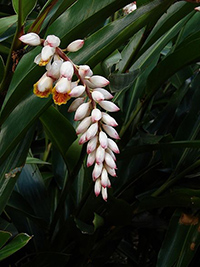
Older herbal references sometimes group “spiked alpinia” alongside giant reed, but the two plants are not related. The plant typically known by that name is Alpinia zerumbet (synonym: Alpinia speciosa), commonly called shell ginger or shellflower in English. It belongs to the ginger family (Zingiberaceae), not the grass family. [Britannica]
Traditional uses across South America, the Caribbean, Japan, and Southeast Asia include treatment of high blood pressure, mild diuretic and digestive uses, and as a calming tea. In coastal Brazil the leaves are boiled into infusions and used in folk medicine for hypertension. Animal studies of Alpinia zerumbet leaf extract show reductions in blood pressure and improvements in vascular function in spontaneously hypertensive rats, providing a plausible mechanism for at least some of the traditional cardiovascular uses. Human clinical trials remain limited. [Costa et al., 2025]
Decoction-style preparation in folk tradition is similar to giant reed: 50 grams of mashed stems, roots, or leaves per litre of water, boiled for 15 minutes, two to four cups per day, often sweetened with honey. Same caveats apply: shell ginger should not replace prescribed treatment for high blood pressure or any other condition, and the same general herbal-safety guidance applies to pregnancy, breastfeeding, and children.
Frequently Asked Questions
What is giant reed traditionally used for?
In European herbalism, the rhizome is used as a mild diuretic and to suppress milk production after weaning. In Ayurvedic medicine, it is used to increase milk production and to treat skin conditions, urinary complaints, and abdominal pain. None of these uses are confirmed by clinical trials in humans. [Kumar et al., 2021]
Is giant reed safe to drink as a tea?
The plant contains indole alkaloids — including gramine and bufotenidine — with pharmacological activity, and concentrations vary widely with preparation. There is no human safety data and no FDA evaluation. Avoid during pregnancy and breastfeeding, in children, and if you take medications that affect the nervous system, blood pressure, or kidney function. Talk to a healthcare professional before use.
Does giant reed actually stop breast milk?
European folk tradition says yes; Ayurvedic tradition uses it for the opposite purpose. No human trial has tested either claim. If you need help stopping or supporting breastfeeding, contact a lactation consultant or your obstetric provider — there are safer, evidence-based options.
Is giant reed the same as bamboo?
No. Giant reed (Arundo donax) is in the grass family but has only one leaf at each stem node, smaller stems, and a different growth pattern. True bamboos belong to a different subfamily of grasses with woodier, multi-branched stems. The two are sometimes confused at a glance because both are tall, hollow-stemmed grasses.
Are giant reed and shell ginger (“spiked alpinia”) the same plant?
No. Shell ginger is Alpinia zerumbet in the ginger family (Zingiberaceae) and is botanically unrelated to giant reed, which is in the grass family (Poaceae). They have some overlapping folk uses (mild diuretic, traditional herbal teas) but different chemistry and different safety profiles.
References
1. Kumar P, Singh S, Sharma A, Kaur G, Kaur R, Singh AN. Arundo donax L.: An overview on its traditional and ethnomedicinal importance, phytochemistry, and pharmacological aspects. Journal of Herbmed Pharmacology. 2021;10(3):269–280. DOI: 10.34172/jhp.2021.31. → View source
2. Kato-Noguchi H, Kato M. The Invasive Mechanism and Impact of Arundo donax, One of the World’s 100 Worst Invasive Alien Species. Plants. 2025;14(14):2175. DOI: 10.3390/plants14142175. → View source
3. Cambridge University Botanic Garden. Giant Reed (Arundo donax) — Medicines from Plants trail. → View source
4. Encyclopædia Britannica. Zingiberaceae — the ginger family. → View source
5. National Center for Complementary and Integrative Health (NCCIH), NIH. Herbs at a Glance. → View source
6. MotherToBaby fact sheets. Herbal Products. NCBI Bookshelf, NBK582743. Organization of Teratology Information Specialists. → View source
7. Costa GP, Camporez D, Garcia GJ, et al. Alpinia zerumbet leaf extract reverses hypertension and improves adverse remodeling in the left ventricle and aorta in spontaneously hypertensive rats. Frontiers in Pharmacology / PMC11793142, 2025. → View source
8. Bhattacharya SK, Sanyal AK. Neuromuscular blocking activity of bufotenidine isolated from Arundo donax L. Die Naturwissenschaften. 1972;59(12):650–651. DOI: 10.1007/BF00609561. → View source
