
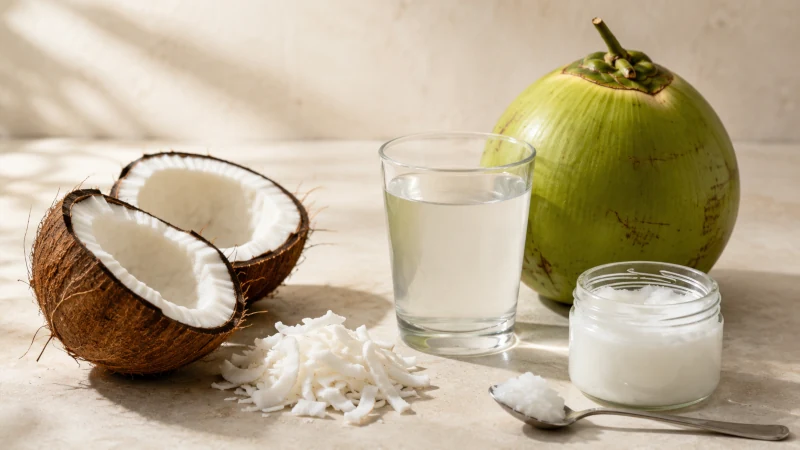
Coconut is three different foods wearing one name, and they don’t deserve the same reputation.
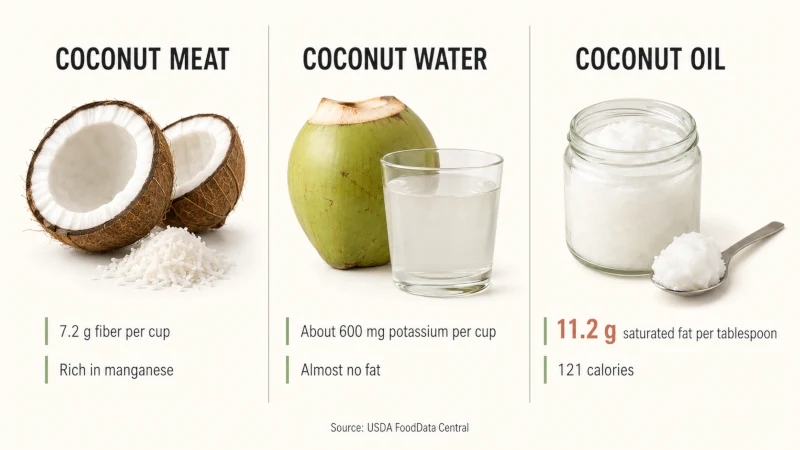
The meat is a nutrient-dense whole food — a cup of fresh shredded coconut carries about 7 grams of fiber and roughly half a day’s manganese. Coconut water is a light, faintly sweet drink with real potassium in it and almost no fat. Coconut oil is the part that got famous, and it’s the part the research has been least kind to.
That distinction is most of the story. The coconut health benefits that hold up come mainly from eating the fruit and drinking the water. The oil is the piece where the marketing outran the science, and the reason has a name: lauric acid.
What’s actually in a coconut
Fresh coconut meat is rich, chewy, and surprisingly high in trace minerals for a food most people think of as just fat and fiber.
Raw coconut meat, 1 cup shredded (80 g)
| Nutrient | Amount | % Daily Value |
| Calories | 283 | — |
| Total fat | 26.8 g | — |
| Saturated fat | 23.8 g | 119% |
| Carbohydrate | 12.2 g | — |
| Fiber | 7.2 g | 26% |
| Sugars | 5 g | — |
| Protein | 2.7 g | — |
| Manganese | 1.2 mg | 52% |
| Copper | 0.35 mg | 39% |
| Selenium | 8.1 mcg | 15% |
| Iron | 1.9 mg | 11% |
| Magnesium | 26 mg | 6% |
| Potassium | 285 mg | 6% |
Calculated from USDA per-100-gram values [USDA FoodData Central, raw coconut meat, 2019]. Percent Daily Values use FDA reference amounts for adults [FDA Daily Value reference].
Two numbers in that table matter more than the rest. The fiber and manganese are the reason coconut meat earns a place in a real diet. The saturated fat — one cup exceeds the entire FDA Daily Value — is the reason it belongs there in modest amounts rather than by the bowlful.
The other forms shift those numbers considerably:
- Coconut water (1 cup, 240 g): about 46 calories, 600 mg potassium (13% DV), 60 mg magnesium (14% DV), 252 mg sodium, and roughly 6 g of naturally occurring sugar. Almost no fat.
- Coconut oil (1 tablespoon, 13.6 g): 121 calories, 13.5 g fat, of which 11.2 g is saturated — 56% of the FDA Daily Value in one spoonful.
- Fresh-pressed coconut milk (1 cup, 240 g): roughly 550 calories and 57 g fat. Canned versions vary widely by brand and by whether they’re labeled “light,” so read the panel rather than assuming.
Calculated from USDA per-100-gram values for [coconut water], [coconut oil], and [coconut milk], USDA FoodData Central, 2019.
Coconut water is worth a note on potassium and what it does in the body, because that mineral is both the drink’s main selling point and its main caution. More on that below.
The saturated fat question, and why “medium-chain” isn’t the whole story
Here’s the claim you’ve probably met: coconut fat is different from animal fat because it’s made of medium-chain triglycerides, which the body burns for energy instead of storing or turning into cholesterol.
The first half is partly true. The second half is where it falls apart.
Coconut oil is about 83% saturated fat, and roughly half of that is lauric acid, a 12-carbon fatty acid [USDA FoodData Central, coconut oil, 2019]. Lauric acid sits at the boundary of the medium-chain category, and it does not behave like the short medium-chain fats used in MCT research. As Harvard’s Nutrition Source puts it, lauric acid “is absorbed more slowly and metabolized like other long-chain fatty acids” [Harvard T.H. Chan School of Public Health, The Nutrition Source]. Much of the flattering MCT research was done with purpose-formulated MCT oil, not with the coconut oil sold in supermarkets.
When researchers tested the actual oil in actual people, the result was consistent. A meta-analysis of 16 clinical trials in Circulation found that coconut oil raised LDL cholesterol by 10.47 mg/dL compared with non-tropical vegetable oils, and raised HDL by 4.00 mg/dL. It had no significant effect on body weight, body fat, waist circumference, fasting glucose, or C-reactive protein [Neelakantan et al., Circulation, 2020].
That LDL number is the part that matters for heart risk. The American Heart Association’s presidential advisory on dietary fats concluded, from randomized trials, that replacing saturated fat with polyunsaturated vegetable oil lowered cardiovascular disease by roughly 30% [American Heart Association presidential advisory on dietary fats, 2017].
How much saturated fat is too much?
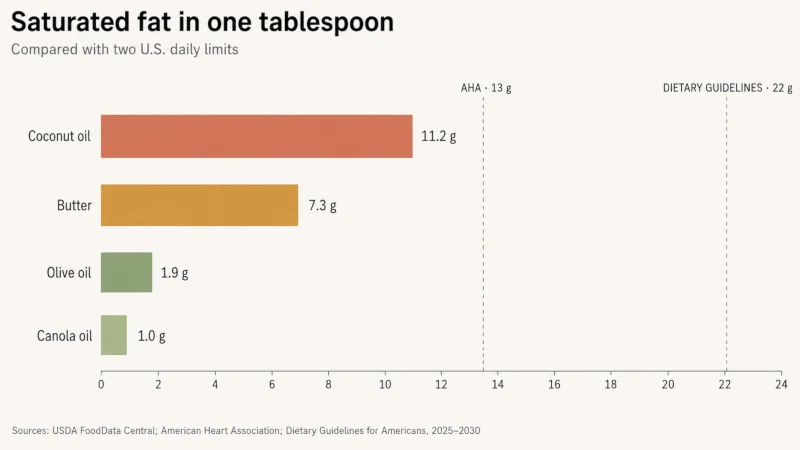
The two major US authorities give different numbers, and it’s fair to know both:
- The American Heart Association recommends less than 6% of total calories from saturated fat — about 13 grams a day on a 2,000-calorie diet [American Heart Association on saturated fats].
- The Dietary Guidelines for Americans, 2025–2030 state that saturated fat consumption “should not exceed 10% of total daily calories” — about 22 grams [Dietary Guidelines for Americans, 2025–2030].
One tablespoon of coconut oil is 11.2 grams. Against the AHA’s target, that’s most of the day in a single spoon. Against the federal guideline, it’s about half.
None of this makes coconut oil harmful in small amounts. It makes it a saturated fat that deserves the same handling as other saturated fats: fine as an occasional cooking choice you enjoy the flavor of, poor as a daily replacement for olive or canola oil, and not something to take by the spoonful. If you’re already working on your numbers, our guide to a heart-healthy diet covers the swaps that move LDL the most.
The coconut health benefits with the strongest support
Fiber and trace minerals from the meat (well established)
This is the least glamorous benefit and the most solid one. Whole coconut meat is a real source of fiber, and it’s an unusually good source of manganese and copper — two minerals most people never think about but that participate in enzyme systems throughout the body. If you’re mapping out where your minerals come from, our pages on manganese and foods high in phosphorus fill in the picture.
Coconut also carries small amounts of magnesium — 26 mg per cup shredded, or 6% of the Daily Value. That’s a contribution, not a solution. Adults need 310 to 420 mg of magnesium a day depending on age and sex [NIH Office of Dietary Supplements, magnesium fact sheet], so anyone trying to close a gap should look at magnesium-rich foods with far higher concentrations, such as pumpkin seeds or spinach. The same goes for the minerals that support the skeleton — coconut helps a little, but foods for bone and muscle health do far more of the work.
Rehydration from coconut water (limited but genuine)
Coconut water does rehydrate you. What it doesn’t do is beat plain water.
In a crossover trial, 12 exercise-trained men lost about 2% of body mass through treadmill exercise, then rehydrated on four separate occasions with bottled water, pure coconut water, coconut water from concentrate, or a carbohydrate-electrolyte sports drink. All four restored fluid similarly, and there was no significant difference in subsequent time to exhaustion. Participants generally reported feeling more bloated and having more stomach upset with the coconut water conditions [Kalman et al., Journal of the International Society of Sports Nutrition, 2012].
Twelve people is a small study, so hold the conclusion loosely. But it points the right way: coconut water is a pleasant, low-calorie, potassium-containing drink. Choose it because you like it, not because you expect it to outperform a glass of water.
Moisturizing dry, eczema-prone skin (moderate, topical only)

The most convincing coconut research isn’t about eating it at all. In a randomized, double-blind trial, 117 children with mild-to-moderate atopic dermatitis used either virgin coconut oil or mineral oil on the skin for eight weeks. Mean SCORAD severity scores dropped 68.2% in the coconut oil group versus 38.1% with mineral oil, and transepidermal water loss improved more in the coconut oil group [Evangelista et al., International Journal of Dermatology, 2014].
That’s one trial, in children, against mineral oil rather than a modern prescription treatment. It supports virgin coconut oil as a decent emollient for dry, itchy skin. It does not make it a treatment for eczema, and it shouldn’t replace anything a dermatologist has prescribed. Patch-test a small area first, and don’t apply it to broken or infected skin without asking your doctor.
Claims that outrun the evidence
Fat burning and weight loss. The Circulation meta-analysis specifically looked for effects on body weight, percentage body fat, and waist circumference across the trials that measured them. It found none that reached significance [Neelakantan et al., Circulation, 2020]. A smaller 12-week trial in 40 women with abdominal obesity did find a reduced waist circumference and a higher HDL with 30 mL of coconut oil daily alongside a reduced-calorie diet and 50 minutes of daily walking [Assunção et al., Lipids, 2009] — but with a diet and exercise program running in both arms and only 20 women per group, that’s a hypothesis, not a result to act on.
Brain health and Alzheimer’s disease. Medium-chain fats do raise circulating ketone bodies, and ketones can serve as an alternative fuel when brain glucose use is impaired. A systematic review of 17 studies confirmed the ketone rise consistently. The cognitive results were another matter: four studies found no improvement, eight found improvement, and two found improvement only in people who don’t carry the APOE ε4 allele [Castro et al., Nutrition Reviews, 2023]. A 2024 meta-analysis of seven studies reported better cognitive scores with coconut oil, though the evidence base is small and the authors describe it as adding to an emerging picture rather than settling it [Bafail et al., Diseases, 2024]. Most of this work used MCT supplements, not culinary coconut oil. Treat it as an open question.
Killing germs and boosting immunity. Lauric acid genuinely is antibacterial in a dish. In one well-cited study it inhibited Propionibacterium acnes at concentrations more than 15 times lower than benzoyl peroxide, and reduced bacterial colonization and swelling in mouse ears [Nakatsuji et al., Journal of Investigative Dermatology, 2009]. A 2024 narrative review reaching the same conclusion noted that the work is largely in vitro and in animals, and called for research in humans [Ameena et al., Cureus, 2024]. Nobody has shown that eating coconut oil, or swishing it, clears an infection or an acne breakout in people.
Oil pulling. The American Dental Association is direct about this one: “Currently, there are no reliable scientific studies to show that oil pulling reduces cavities, whitens teeth or improves oral health and well-being,” and on that basis the ADA “does not recommend oil pulling as a dental hygiene practice” [American Dental Association, MouthHealthy]. Swishing oil isn’t dangerous, but it’s not a substitute for brushing with fluoride toothpaste and flossing.
Coconut’s fatty acid profile
For anyone who wants the underlying chemistry, here’s what’s in 100 grams of coconut oil.
| Fatty acid | Carbons | Type | Grams per 100 g |
| Caproic | 6 | Saturated | 0.48 |
| Caprylic | 8 | Saturated | 6.80 |
| Capric | 10 | Saturated | 5.39 |
| Lauric | 12 | Saturated | 41.80 |
| Myristic | 14 | Saturated | 16.70 |
| Palmitic | 16 | Saturated | 8.64 |
| Stearic | 18 | Saturated | 2.52 |
| Oleic | 18 | Monounsaturated | 6.27 |
| Linoleic | 18 | Polyunsaturated | 1.68 |
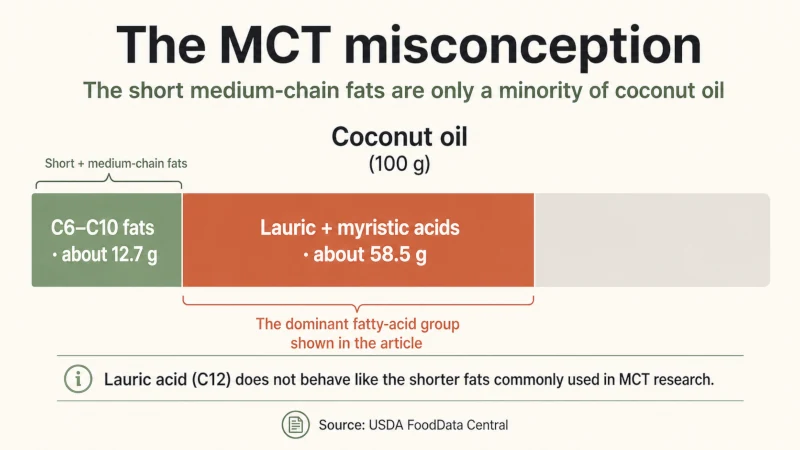
[USDA FoodData Central, coconut oil, 2019]. Totals: 82.5 g saturated, 6.3 g monounsaturated, 1.7 g polyunsaturated.
The genuinely short and medium-chain fats — caproic, caprylic, and capric — add up to about 12.7 grams, or roughly 13% of the oil. Lauric and myristic acid together make up nearly 59 grams. That ratio is the whole argument in one table.
How to buy, open, and use a coconut
Picking one
Shake it. A fresh coconut sloshes, and the sound tells you there’s still water inside. If it’s silent, the fruit is old or dry and the meat is often spoiled. Check the three “eyes” at one end for mold or damp patches, and skip any nut with cracks.
Opening it
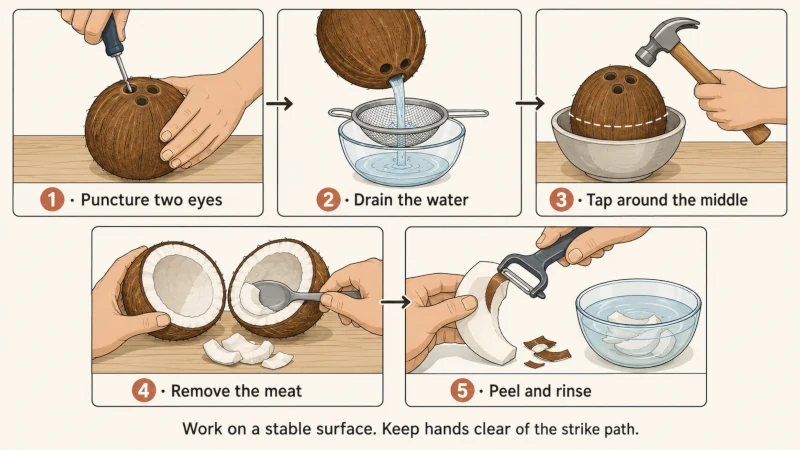
- Puncture two of the three eyes — one to pour from, one to let air in. A clean screwdriver, a corkscrew, or a hammer and nail all work.
- Pour the water into a glass through a strainer.
- Hold the drained coconut over a bowl and tap firmly around its middle with the back of a heavy knife or a hammer, rotating as you go. A crack will form along the equator and the shell will split.
- Pry the white meat away from the shell with a sturdy spoon or butter knife.
- Peel off the thin brown skin with a vegetable peeler if you want a cleaner texture, and rinse the meat.
Work on a stable surface, keep your steadying hand behind the strike line, and don’t try to open a coconut in your palm.
Making coconut milk at home
- Grate the fresh meat, or blitz it in a blender.
- Add about two cups of very hot water per cup of grated meat and let it steep for 30 minutes.
- Pour the mixture into a nut-milk bag or a doubled square of cheesecloth set over a bowl.
- Gather the cloth and twist hard until the liquid stops running.
- Repeat with fresh hot water on the leftover pulp for a thinner second pressing, good for soups and smoothies.
Homemade coconut milk keeps in the refrigerator for three to four days and separates as it sits — shake before using.
The forms, at a glance
| Form | What it is | Best for |
| Young (green) coconut meat | Soft, spoonable, more water and fewer concentrated nutrients | Eating straight from the shell |
| Mature meat | Firm, white, fatty | Grating, toasting, curries, baking |
| Coconut water | The liquid inside the nut | A light drink; casual rehydration |
| Coconut milk | Pressed from grated meat and water | Curries, soups, sauces |
| Desiccated or flaked | Dried meat | Baking and toppings — check whether it’s sweetened |
| Copra | Sun-dried meat | Commercial oil production |
| Coconut oil | Pressed from copra or fresh meat | Occasional cooking, in small amounts |
Safety, side effects, and who should be careful
Coconut is a food, not a drug, and for most people the risks are small. A few situations deserve real attention.
If you have a coconut allergy. True coconut allergy exists but is uncommon. According to the American Academy of Allergy, Asthma & Immunology, “the vast majority of tree nut-allergic individuals also tolerate coconut without difficulty, since coconut is not truly a nut, but rather a fruit” [AAAAI on tree nut allergy]. Labeling has recently changed to reflect this: coconut is no longer listed among tree nuts in the FDA’s food allergen labeling guidance, so it will no longer appear in “Contains” statements, though it still shows up in ingredient lists [FDA food allergen labeling FAQ, 2025]. If you’ve reacted to coconut before, that change doesn’t apply to you — keep avoiding it and read ingredient lists.
If you have kidney disease or take certain blood pressure medications. A cup of coconut water carries around 600 mg of potassium. That’s harmless for most people and a problem for some. The NIH notes that in people with impaired potassium excretion from chronic kidney disease or from medications including ACE inhibitors, ARBs, or potassium-sparing diuretics, even intakes below the recommended level can cause hyperkalemia [NIH Office of Dietary Supplements, potassium fact sheet]. If you’re in one of those groups, ask your doctor or pharmacist before making coconut water a daily habit.
If you’re managing cholesterol or heart disease. Given the LDL effect measured across 16 trials, coconut oil is not the cooking fat to build a heart-protective diet around. Olive, canola, and other non-tropical vegetable oils are the better default.
Digestive effects. Coconut meat is high in fiber, so a large serving on an unaccustomed gut can cause gas or loose stools. Coconut water caused more bloating and stomach upset than plain water in the rehydration trial above. Concentrated MCT oil is a well-known cause of cramping and diarrhea when people start too high a dose.
Pregnancy and breastfeeding. Coconut eaten as a food — the meat, the water, the milk in cooking — is generally considered fine in normal amounts. Concentrated coconut oil or MCT supplements taken at therapeutic doses haven’t been studied for safety in pregnancy or lactation, so there’s no evidence base to reassure you either way. That’s a reason to stick to food amounts and ask your doctor before taking any supplement version.
On the skin. Patch-test before applying coconut oil widely, avoid broken or infected skin, and don’t substitute it for a prescribed treatment.
When to get medical help
Call 911 or go to an emergency room if you develop signs of a severe allergic reaction after eating coconut: swelling of the lips, tongue, or throat, trouble breathing, widespread hives, dizziness, or fainting.
Contact your doctor promptly if you have kidney disease or take a potassium-affecting medication and notice muscle weakness, numbness or tingling, an unusually slow or irregular heartbeat, or unexplained fatigue — these can signal high potassium.
Make an appointment if your LDL cholesterol has risen, if a skin rash worsens or shows signs of infection such as spreading redness, warmth, pus, or fever, or if digestive symptoms persist for more than a couple of weeks.
| HEALTH DISCLAIMER: It cannot account for your medical history, medications, or individual risk, and it is not a substitute for diagnosis or treatment from a qualified professional. Talk with your doctor, registered dietitian, or pharmacist before making significant dietary changes or starting any supplement — particularly if you are pregnant or breastfeeding, have kidney disease, heart disease, or a known food allergy, or take prescription medication. If you think you are having a medical emergency, call 911. |
Frequently Asked Questions
Is coconut oil healthier than butter?
They’re closer than the labels suggest. Coconut oil has more saturated fat per tablespoon than butter does, though it contains no cholesterol. Neither is the fat to cook with by default. In the trials pooled in Circulation, coconut oil raised LDL cholesterol compared with non-tropical vegetable oils [Neelakantan et al., Circulation, 2020], which is the same direction butter moves it. If you like the flavor of coconut oil in a curry or a baked good, use it there and use olive oil for everything else.
How much coconut can I eat in a day?
There’s no official limit for coconut itself. The practical limit is saturated fat. A quarter to a half cup of fresh or unsweetened dried coconut — roughly 6 to 12 grams of saturated fat — fits comfortably in most people’s day alongside the AHA’s 13-gram target or the federal 10%-of-calories guideline. If you’re eating coconut milk curries and coconut oil too, those add up quickly.
Is coconut water good for hydration?
Yes, and so is water. In the one crossover trial that compared them directly, coconut water, coconut water from concentrate, a sports drink, and plain bottled water all restored fluid similarly after dehydrating exercise, with no difference in performance afterward [Kalman et al., Journal of the International Society of Sports Nutrition, 2012]. Coconut water does supply potassium and magnesium that plain water doesn’t, so it’s a reasonable choice — just not a superior one.
Does coconut oil help you lose weight?
The pooled clinical trial evidence says no. Across the studies that measured it, coconut oil consumption had no significant effect on body weight, body fat percentage, or waist circumference compared with other oils [Neelakantan et al., Circulation, 2020]. At 121 calories a tablespoon, adding it to your diet is far more likely to move weight in the other direction.
Can people with a tree nut allergy eat coconut?
Usually, yes — but check with your allergist first rather than testing it at home. The AAAAI states that most people with tree nut allergy tolerate coconut, since it’s botanically a fruit rather than a nut [AAAAI on tree nut allergy]. Isolated coconut allergy does occur, so anyone with a history of reacting to coconut should continue to avoid it.
Is virgin coconut oil better than refined?
For skin, virgin is what the atopic dermatitis trial used [Evangelista et al., International Journal of Dermatology, 2014], so it’s the version with evidence behind it. For eating, virgin coconut oil retains more of the coconut flavor and small amounts of vitamin E and polyphenols, but its fatty acid profile is close to refined — which means the LDL effect applies to both.
References
- USDA FoodData Central. Nuts, coconut meat, raw (SR Legacy, FDC ID 170169). U.S. Department of Agriculture, Agricultural Research Service, 2019. View source
- USDA FoodData Central. Nuts, coconut water (liquid from coconuts) (SR Legacy, FDC ID 170174). USDA ARS, 2019. View source
- USDA FoodData Central. Oil, coconut (SR Legacy, FDC ID 171412). USDA ARS, 2019. View source
- USDA FoodData Central. Nuts, coconut milk, raw (liquid expressed from grated meat and water) (SR Legacy, FDC ID 170172). USDA ARS, 2019. View source
- USDA FoodData Central. Butter, salted (FDC ID 173410); Oil, olive, salad or cooking (FDC ID 171413); Oil, canola (FDC ID 172336). USDA ARS, 2019. Used for the comparison values in Image 2. View butter · View olive oil · View canola oil
- U.S. Food and Drug Administration. Daily Value on the Nutrition and Supplement Facts Labels. FDA. View source
- Harvard T.H. Chan School of Public Health. Coconut Oil. The Nutrition Source. View source
- Neelakantan N, Seah JYH, van Dam RM. The Effect of Coconut Oil Consumption on Cardiovascular Risk Factors: A Systematic Review and Meta-Analysis of Clinical Trials. Circulation. 2020;141(10):803–814. DOI 10.1161/CIRCULATIONAHA.119.043052. View source
- Sacks FM, Lichtenstein AH, Wu JHY, et al. Dietary Fats and Cardiovascular Disease: A Presidential Advisory From the American Heart Association. Circulation. 2017;136(3):e1–e23. DOI 10.1161/CIR.0000000000000510. View source
- American Heart Association. Saturated Fats. heart.org. View source
- U.S. Department of Agriculture and U.S. Department of Health and Human Services. Dietary Guidelines for Americans, 2025–2030. View source
- National Institutes of Health, Office of Dietary Supplements. Magnesium: Fact Sheet for Health Professionals. View source
- National Institutes of Health, Office of Dietary Supplements. Potassium: Fact Sheet for Health Professionals. View source
- Kalman DS, Feldman S, Krieger DR, Bloomer RJ. Comparison of coconut water and a carbohydrate-electrolyte sport drink on measures of hydration and physical performance in exercise-trained men. Journal of the International Society of Sports Nutrition. 2012;9(1):1. DOI 10.1186/1550-2783-9-1. View source
- Evangelista MTP, Abad-Casintahan F, Lopez-Villafuerte L. The effect of topical virgin coconut oil on SCORAD index, transepidermal water loss, and skin capacitance in mild to moderate pediatric atopic dermatitis: a randomized, double-blind, clinical trial. International Journal of Dermatology. 2014;53(1):100–108. DOI 10.1111/ijd.12339. View source
- Assunção ML, Ferreira HS, dos Santos AF, Cabral CR Jr, Florêncio TMMT. Effects of dietary coconut oil on the biochemical and anthropometric profiles of women presenting abdominal obesity. Lipids. 2009;44(7):593–601. DOI 10.1007/s11745-009-3306-6. View source
- Castro CB, Dias CB, Hillebrandt H, et al. Medium-chain fatty acids for the prevention or treatment of Alzheimer’s disease: a systematic review and meta-analysis. Nutrition Reviews. 2023;81(9):1144–1162. DOI 10.1093/nutrit/nuac104. View source
- Bafail D, Bafail A, Alshehri N, Alhalees NH, Bajarwan A. Impact of Coconut Oil and Its Bioactive Metabolites in Alzheimer’s Disease and Dementia: A Systematic Review and Meta-Analysis. Diseases. 2024;12(11):272. DOI 10.3390/diseases12110272. View source
- Nakatsuji T, Kao MC, Fang JY, et al. Antimicrobial property of lauric acid against Propionibacterium acnes: its therapeutic potential for inflammatory acne vulgaris. Journal of Investigative Dermatology. 2009;129(10):2480–2488. DOI 10.1038/jid.2009.93. View source
- Ameena M, Meignana Arumugham I, Ramalingam K, Shanmugam R. Biomedical Applications of Lauric Acid: A Narrative Review. Cureus. 2024;16(6):e62770. DOI 10.7759/cureus.62770. View source
- American Dental Association. Oil Pulling. MouthHealthy. View source
- American Academy of Allergy, Asthma & Immunology. Everything You Need to Know About Tree Nut Allergy. AAAAI. View source
- U.S. Food and Drug Administration. Frequently Asked Questions: Food Allergen Labeling Guidance for Industry. FDA, updated March 26, 2025. View source
