

The castor bean plant gives you two things that could hardly be more different. One is castor oil — a laxative so well characterized that the FDA has approved it for the temporary relief of occasional constipation. The other is the raw seed, which contains ricin, a protein toxin with no antidote.
Same plant. The difference is chemistry: ricin dissolves in water, not oil, so it stays behind in the leftover press cake when the oil is squeezed out. That one fact is why a bottle of castor oil sits on a pharmacy shelf as a regulated over-the-counter drug, and why a handful of castor beans is a call to Poison Control.
Below is what castor oil is genuinely good for, what it has been oversold for, who should stay away from it, and what to do if someone swallows the seeds.
What the castor bean plant is
Ricinus communis L. belongs to the spurge family, Euphorbiaceae. It probably originated in Africa, grows wild across tropical and subtropical regions, and turns up as an ornamental almost everywhere else — a fast, dramatic plant with large palm-shaped leaves and spiny seed pods. It also goes by palma Christi, castor-oil plant, ricino, and ricin. Ancient Egyptians, Greeks, and Romans all used it, historically as a laxative and for infection and inflammation. Around a million tonnes of castor beans are harvested each year, with India, China, and Brazil the major producers (Worbs et al., Toxins, 2011).
Three components matter:
- Ricin — a ribosome-inactivating protein, present at up to 5% of seed weight (Worbs et al., 2011).
- Ricinine — an alkaloid making up roughly 0.2% of the seed. Far less toxic than ricin, but useful as a forensic marker of exposure (Worbs et al., 2011).
- The oil — dominated by ricinoleic acid, which accounts for roughly 87% to 90% of its fatty acid content (Optometric Management, 2024).
Ricinoleic acid is the interesting one. It is an unusual hydroxylated fatty acid, and it is responsible both for the oil’s thick, sticky texture and for nearly everything the oil does in your gut.
Why the oil is safe when the seeds are not
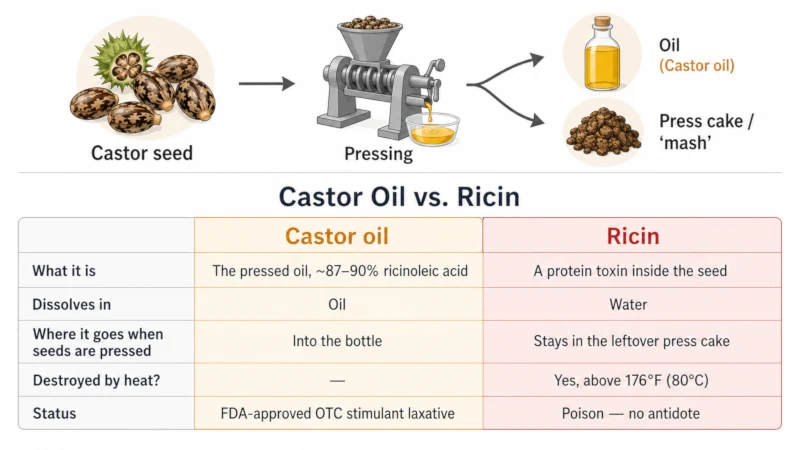
Ricin is water-soluble, so it does not follow the oil out of the seed during pressing. It ends up in the defatted press cake instead. Reviewers of the toxicology literature have concluded on that basis that industrial-grade castor oil is safe (Worbs et al., 2011). Heat helps as well: ricin is inactivated above 176°F (80°C) (CDC ricin fact sheet, 2026). Commercial castor oil is further purified during extraction, and toxicology reviews describe it as safe for human consumption with minimal toxic effects in both acute and chronic settings (StatPearls, 2024).
So: the pharmacy bottle is not a diluted poison. But the seed it came from should never be chewed.
The one use with strong evidence: short-term constipation
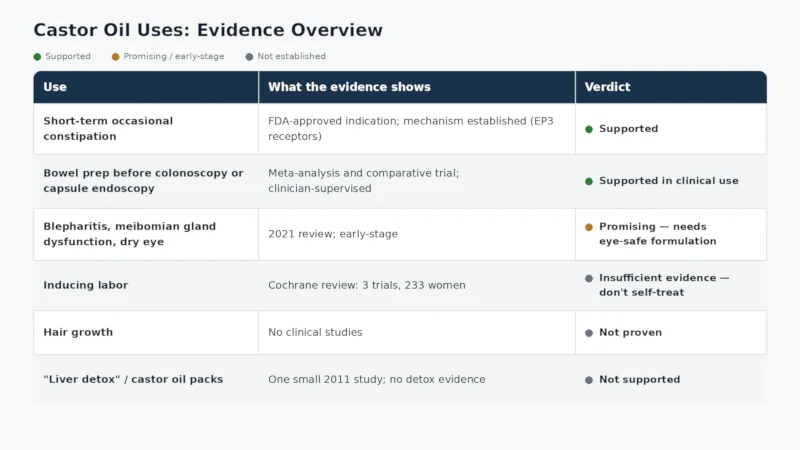
This is the claim that holds up. Castor oil is FDA-approved as a stimulant laxative for the temporary relief of occasional constipation (StatPearls, 2024).
The mechanism was worked out only recently. Intestinal lipase splits castor oil into ricinoleic acid, which activates EP3 prostanoid receptors on intestinal smooth muscle, producing a calcium surge and forward propulsion. In mice engineered to lack EP3 receptors in smooth muscle, castor oil simply does not work (Tunaru et al., PNAS, 2012). Those same receptors sit in the uterus — which matters later.
Source: StatPearls, 2024
It is not a gentle laxative
Castor oil is often described as mild and cramp-free. The comparative data point the other way. In a study comparing castor oil with senna syrup for bowel preparation, the senna group had fewer adverse effects and better preparation. Castor oil is more likely than sennosides to cause abdominal cramping, vomiting, bloating, and dizziness (StatPearls, 2024). That is a large part of why current guidelines do not place it first-line — better-tolerated options exist.
If constipation keeps coming back, a stronger purgative is the wrong lever. Fiber, fluids, and movement come first, then gentler bulk-forming or osmotic options — our guide to herbs for constipation covers the milder plant options, and cascara sagrada is another stimulant in the same family of effects, with the same caution about long-term use.
Bowel prep: where castor oil still earns its place
A meta-analysis found that adding castor oil to bowel-preparation regimens for colon capsule endoscopy improved completion rates and polyp detection, with the treatment appearing safe though needing further study. A separate comparison of a 2-litre polyethylene glycol plus castor oil regimen against the standard 4-litre split PEG prep in hospitalized patients found better bowel-cleansing scores, a higher rate of adequate preparation, and fewer adverse effects in the castor oil group (StatPearls, 2024).
This is a supervised, prescribed regimen with a measured dose and a defined purpose. It is not a reason to drink castor oil the night before a procedure on your own initiative.
What castor oil is oversold for
Inducing labor — insufficient evidence, and not a do-it-yourself project
A Cochrane review pooled three trials involving 233 women. It found no evidence of a difference in cesarean section rates, instrumental delivery, meconium-stained fluid, or Apgar scores below seven at five minutes — while noting the studies were too small to detect anything but a large effect, and were at risk of bias from poor methodological quality. One finding was unambiguous: every woman who ingested castor oil felt nauseous (Kelly, Kavanagh & Thomas, Cochrane, 2013).
Castor oil is no longer used for this in hospitals in high-income countries. Potential complications include meconium staining and maternal electrolyte abnormalities from diarrhea, and because ingesting it during pregnancy may induce labor, its use as a laxative in pregnancy is contraindicated (StatPearls, 2024). If you are past your due date, that is a conversation with your OB or midwife — not a bottle from the pharmacy.
Eyes — genuinely promising, but not the bottle in your bathroom
This is the most interesting active area. A 2021 review argued that castor oil has real therapeutic potential in blepharitis, meibomian gland dysfunction, and dry eye disease, based on its anti-microbial, anti-inflammatory, antioxidant, and wound-healing properties (Sandford, Muntz & Craig, Clin Exp Optom, 2021). It is early: reviewers describe the therapeutic potential as needing more research to be fully understood (StatPearls, 2024).
Two warnings before you try it:
- Drugstore castor oil is not made for eyes. Products sold on general shelves or online may contain dyes, preservatives, or fragrance, and may not be sterilized — which can cause irritation or infection. Castor oil already appears, in eye-appropriate formulations, in some artificial tear emulsions and in prescription cyclosporine drops (Optometric Management, 2024).
- The viral claims are not supported. Social-media claims that castor oil cures eye infections, glaucoma, or cataracts, or reduces your need for glasses, have no data behind them (Optometric Management, 2024). If you have an eye condition, see an eye doctor before putting anything in your eye. Our eye and vision section covers related topics.
Hair growth — no clinical proof, and a rare irreversible risk
Castor oil is a staple of hair-oiling routines, but the case-report literature is blunt: although castor oil is used in naturopathy for various purposes, there are no studies on its benefits for hair, so the effect is not scientifically proven (Maduri, Vedachalam & Kiruthika, Int J Trichology, 2017).
What is documented is acute hair felting. In the reported case, castor oil combined with coconut oil was applied to long hair and washed with warm water, and the entire scalp’s hair matted into a hard, tangled mass. The high viscosity and stickiness of castor oil were considered the cause. The condition is irreversible — the hair has to be cut off (Int J Trichology, 2017). This is rare. It is still worth knowing before an overnight scalp soak, particularly if your hair is long, fine, or textured. Diluting castor oil in a lighter carrier oil and rinsing gently reduces the risk.
Castor oil packs and “liver detox” — one small study, and it did not show what people claim
The most relevant human research was conducted at two rest homes in Manisa, Turkey. Castor oil pack use did not change the number of bowel movements or the amount of stool produced. It did lower the stool-consistency score and reduce straining during defecation. Eighty percent of participants had been constipated for ten years or more (Arslan & Eşer, Complement Ther Clin Pract, 2011). Small study, narrow population, not replicated.
Feeling better after a warm compress on your abdomen is real, and warmth and gentle pressure are plausible reasons for it. Attributing that relief to toxins being drawn out of your liver is a separate claim, and it does not have the evidence behind it.
Skin
Castor oil is a legitimate emollient and appears widely in cosmetics and personal care products. It has also been identified as a trigger for allergic contact dermatitis, particularly in lip care products, where susceptible people may develop itching and redness on the lips (StatPearls, 2024). Patch test on a small area first, especially with a lip product.
Safety: side effects, interactions, and who should avoid it
Common side effects
Abdominal cramping, vomiting, bloating, and dizziness are the ones that show up most in comparative studies. With heavier or repeated use, the bigger concern is loss of water, bicarbonate, and electrolytes. Rapid breathing, confusion, sleepiness, vomiting, and weakness can signal an electrolyte or acid-base disturbance, and these can become dangerous if ignored (StatPearls, 2024).
Who should not take castor oil by mouth
| Group | Why |
| Pregnant women | Contraindicated. Castor oil acts on uterine smooth muscle and can provoke contractions. |
| Breastfeeding women | No data on excretion of castor plant components into breast milk, or on safety in nursing infants. Other laxatives are generally preferred. |
| Infants and newborns | Administering castor oil to newborns is not advisable and should be avoided; a case report from rural Haiti documents the dangers of castor oil tea in neonates. |
| Suspected bowel obstruction, appendicitis, perforation, or inflammatory bowel disease | Contraindicated for all stimulant laxatives. |
| Older adults | Use cautiously — higher risk of adverse effects related to kidney and heart function, and to fluid and electrolyte imbalance. |
| Anyone with unexplained abdominal pain | A laxative can worsen an undiagnosed obstruction. Get assessed first. |
Source: StatPearls, 2024
Interactions
Do not combine castor oil with other stimulant laxatives — the risk of gastrointestinal complications rises. And because castor oil is a potent laxative, the absorption of other oral drugs may be significantly affected (StatPearls, 2024). If you take a daily medication where the dose matters — thyroid hormone, an anti-seizure drug, a heart medication, hormonal contraception — ask a pharmacist about timing before you use it.
A note on regular use
Stimulant laxatives are not designed for daily, long-term use. If you find yourself relying on one, the useful next step is a doctor’s assessment of why, not a stronger product. Laxative misuse also carries real risk of mineral, nutritional, and electrolyte loss (StatPearls, 2024). If laxatives have become part of how you manage weight or eating, that is worth raising with a doctor or registered dietitian — it is a common thing to struggle with, and there is genuine help for it.
The seeds: what actually happens, and what the “how many” question gets wrong
Ricin works by getting inside cells and stopping them from making the proteins they need. Cells that cannot make proteins die, and the damage accumulates across organs. No cure exists; treatment is supportive care (CDC, 2026).
When ricin is swallowed, first symptoms usually appear in less than 10 hours: vomiting, diarrhea that may be bloody, severe dehydration, and low blood pressure. Seizures, blood in the urine, and liver, spleen, and kidney failure can follow (CDC, 2026). Case-series reviews put symptom onset in the 3-to-20-hour range, with a late phase of kidney, liver, and adrenal toxicity typically appearing two to five days after exposure (Worbs et al., 2011; StatPearls, 2024).
About that number
Confident figures circulate widely — three seeds kill a child, eight to fifteen kill an adult. The actual case literature does not support that precision, and the reason matters.
Across reported clinical cases, the number of seeds causing anything from mild symptoms to a fatal outcome ranges from a single seed up to about 30 (Worbs et al., 2011). Emergency medicine reviewers note that oral absorption depends on the type and size of the seed, the region where it was grown, and how thoroughly it was chewed — which makes lethality extremely difficult to estimate from a seed count alone (Journal of Emergency Medicine, 2017). In one documented case, a man in Japan swallowed roughly 30 seeds whole without chewing them and was discharged from hospital eight days later (Worbs et al., 2011).
Two things are true at the same time, and both belong in an honest answer:
- Deaths from eating seeds are now rare. Fatalities occurred mainly before modern supportive care existed. In a review of US poison center data from 1983 to 2009, researchers found 45 deaths among more than two million plant poisonings — and only one was attributed to Ricinus communis (Worbs et al., 2011).
- People have still died. Injecting an extract made from the seeds is far more dangerous than swallowing them, and most fatal modern cases involved injection (Worbs et al., 2011).
The practical rule is not a number. Never eat any part of a castor seed, and treat any ingestion as a poison emergency regardless of how many were swallowed.
Children and pets
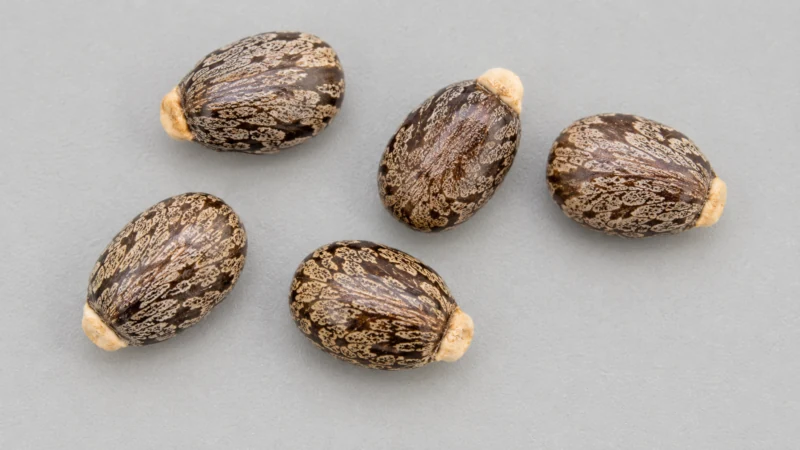
Most accidental poisonings happen in children who are drawn to how the seeds look (Worbs et al., 2011). Documented cases include seeds swallowed off an ornamental necklace and seeds mistaken for hazelnuts. If you grow Ricinus communis as an ornamental — and it is a popular garden plant — cut the seed pods off before they mature.
Dogs are poisoned by organic fertilizer and soil conditioner made from castor press cake. Case reports from Germany covering 1980 onward account for 34 poisoned dogs, 12 of them fatal (Worbs et al., 2011). Check the label before spreading a castor-based fertilizer where a dog can reach it.
Red flags: when to stop and get help
Call 911 or go to the emergency room if you see:
- Bloody vomiting or bloody diarrhea after any suspected seed ingestion
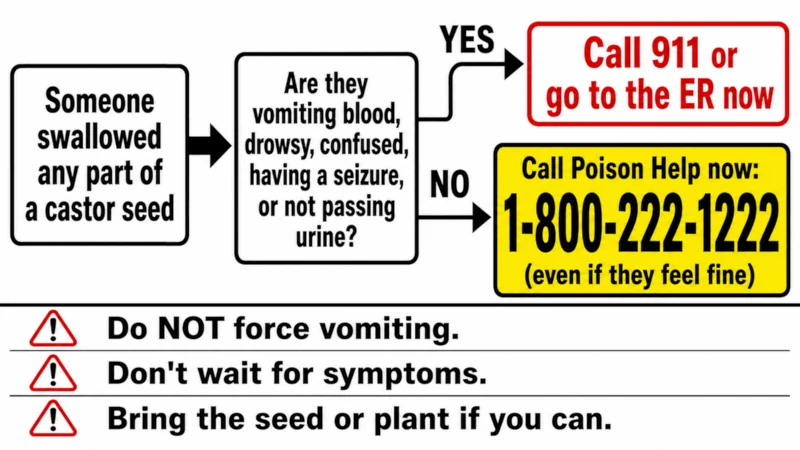
- Confusion, seizure, fainting, or a sharp drop in urine output
- Severe abdominal pain with vomiting and no gas or stool passing — a possible obstruction, in which case do not take a laxative
- Difficulty breathing or chest tightness after exposure to castor seed dust or powder
Call Poison Help at 1-800-222-1222 right away if anyone swallows any part of a castor seed — even one, even if they feel fine. Do not force vomiting (CDC, 2026). The line is free and staffed around the clock: poisonhelp.org.
See a doctor rather than reaching for a laxative if you have:
- Blood in your stool, or unexplained weight loss
- New constipation that starts after age 50
- Constipation that persists beyond a few days of self-care
- A pattern of needing a laxative to have a bowel movement at all
Where this leaves you
Castor oil is a real drug with a real, narrow indication: occasional constipation, short-term, when you have decided the cramping is an acceptable trade. It has a legitimate supervised role in bowel preparation. Its use in eye surface disease is promising and worth watching, though not with the bottle from your bathroom cabinet. Everything past that — labor induction, hair growth, liver detox — is either unproven or actively contradicted by the evidence.
And the plant that produces it deserves respect. Grow it if you like how it looks. Just keep the seeds away from children and dogs, and never treat them as a remedy. More on gut health in our digestive health section.
| A NOTE ON MEDICAL ADVICE: This article is for education and general information. It is not a substitute for diagnosis, treatment, or advice from a qualified medical professional, and it is not personalized to your situation. Talk to your doctor before using castor oil if you are pregnant or breastfeeding, if you have any digestive condition, or if you take prescription medication. Ask a pharmacist about timing if castor oil could affect how your other medicines are absorbed. Never give castor oil to an infant. If you suspect anyone has swallowed a castor seed, call Poison Help at 1-800-222-1222 immediately, or 911 if they are seriously unwell. Do not wait for symptoms and do not force vomiting. |
Frequently Asked Questions
Is castor oil the same thing as ricin?
No, and the distinction is the single most important thing on this page. Ricin is a water-soluble protein, so it does not dissolve into the oil during pressing — it stays behind in the leftover press cake. Toxicology reviewers have concluded on that basis that industrial-grade castor oil is safe (Worbs et al., 2011), and heat above 176°F inactivates ricin as well (CDC, 2026).
How long does castor oil take to work?
Usually one to three hours (StatPearls, 2024). Take it in the morning when you can stay near a bathroom, and expect it to be more urgent and more crampy than a bulk-forming or osmotic laxative.
Can I use castor oil to bring on labor?
Not on your own. A Cochrane review of three trials in 233 women found insufficient evidence to draw conclusions about effectiveness, and every woman who ingested castor oil felt nauseous (Cochrane, 2013). Hospitals in high-income countries no longer use it, and using it as a laxative in pregnancy is contraindicated (StatPearls, 2024). If your pregnancy is past term, raise it with your OB or midwife.
Does castor oil make your hair grow?
There is no clinical evidence that it does. A case report in a trichology journal states plainly that there are no studies demonstrating benefits of castor oil for hair, and describes a case of irreversible acute hair felting after application to long hair (Int J Trichology, 2017). It may make hair look shinier as an emollient. That is a different claim from growth.
Is it safe to put castor oil in my eyes?
Not the kind sold on a general store shelf. Those products may contain dyes, preservatives, or fragrance and may not be sterile, creating an irritation and infection risk (Optometric Management, 2024). Castor oil does appear in some eye-appropriate artificial tear emulsions, and a 2021 review found real potential in blepharitis, meibomian gland dysfunction, and dry eye (Sandford et al., 2021). Ask an eye doctor which formulation is appropriate rather than improvising.
What should I do if my child swallows a castor bean?
Call Poison Help at 1-800-222-1222 immediately, even if the child seems fine and even if only one seed was swallowed. Symptoms after ingestion typically begin within 10 hours and can include vomiting, bloody diarrhea, and severe dehydration. Do not force vomiting (CDC, 2026). Go to the emergency room or call 911 if the child is vomiting blood, drowsy, confused, or not passing urine.
References
- Alookaran J, Tripp J. Castor Oil. StatPearls [Internet]. StatPearls Publishing; updated May 24, 2024. Bookshelf ID NBK551626. View source
- Tunaru S, Althoff TF, Nüsing RM, Diener M, Offermanns S. Castor oil induces laxation and uterus contraction via ricinoleic acid activating prostaglandin EP3 receptors. Proc Natl Acad Sci USA. 2012;109(23):9179–84. PMID 22615395; PMC3384204. View source
- Centers for Disease Control and Prevention. Ricin — Chemical Fact Sheet. Last reviewed June 11, 2026. View source
- Worbs S, Köhler K, Pauly D, Avondet M-A, Schaer M, Dorner MB, Dorner BG. Ricinus communis intoxications in human and veterinary medicine — a summary of real cases. Toxins (Basel). 2011;3(10):1332–72. PMID 22069699. View source
- Kelly AJ, Kavanagh J, Thomas J. Castor oil, bath and/or enema for cervical priming and induction of labour. Cochrane Database Syst Rev. 2013;(7):CD003099. PMID 23881775. View source
- Sandford EC, Muntz A, Craig JP. Therapeutic potential of castor oil in managing blepharitis, meibomian gland dysfunction and dry eye. Clin Exp Optom. 2021;104(3):315–22. PMID 33037703. View source
- Koetting C. Dry Eye: Here’s castor oil in your eye! Optometric Management, July/August 2024. View source
- Maduri VR, Vedachalam A, Kiruthika S. “Castor Oil” — The Culprit of Acute Hair Felting. Int J Trichology. 2017;9(3):116–18. PMID 28932063. View source
- Arslan GG, Eşer İ. An examination of the effect of castor oil packs on constipation in the elderly. Complement Ther Clin Pract. 2011;17(1):58–62. PMID 21168117. View source
- Ricin Poisoning after Oral Ingestion of Castor Beans: A Case Report and Review of the Literature and Laboratory Testing. J Emerg Med. 2017. View source
