
Here is the honest version up front: the radish is a genuinely good everyday vegetable, and it is not a medicine. The radish plant (Raphanus sativus) gives you vitamin C, a lot of water, a little fiber, and the same family of sulfur compounds found in broccoli, cabbage, and kale — all for roughly 16 calories per 100 grams [USDA FoodData Central, 2025]. That earns it a place on your plate. What the radish plant will not do is cure liver disease, dissolve a gallstone, or reverse anything, however often the root appears in old herbal writing.
Below, each radish health benefits are graded by how strong the evidence actually is — well established, promising but limited, mixed, or traditional use only — followed by the handful of situations where radishes deserve caution.
What the radish plant is
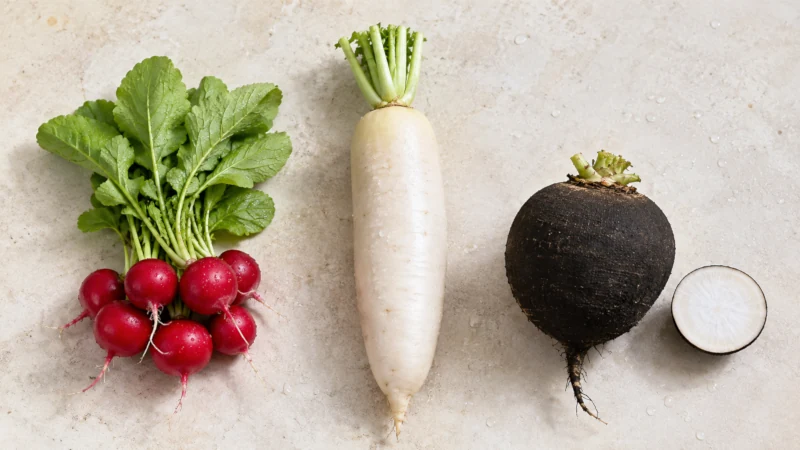
Radish is a root vegetable in the Brassicaceae (cruciferous) family, alongside broccoli, cabbage, mustard, kale, and horseradish [National Cancer Institute, 2012]. It comes in more than a hundred varieties — the small red globe radish in most U.S. salads, the long white daikon common in East Asian cooking, and the dark-skinned black radish (Raphanus sativus var. niger), the one most often sold as a supplement for digestion. The root gets most of the attention, but the peppery leaves, sprouts, and seeds are all edible and nutritious too.
Radish nutrition at a glance
Radishes are mostly water, which is why they are so low in calories. The numbers below are for about 100 grams of raw red radish (roughly a cup, sliced) [USDA FoodData Central, 2025].
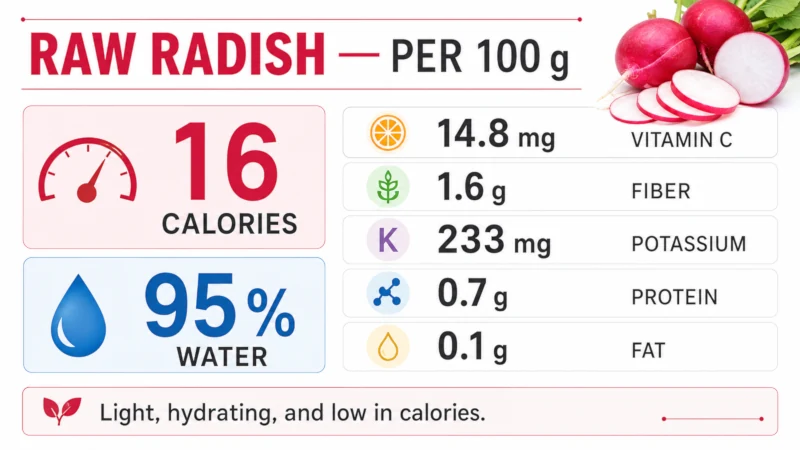
| Per 100 g (raw) | Amount | Notes |
| Calories | ~16 kcal | Very low energy density |
| Water | ~95% | Hydrating, filling |
| Vitamin C | ~14.8 mg | About 16% of the Daily Value |
| Fiber | ~1.6 g | Modest; supports regularity |
| Potassium | ~233 mg | Small contribution |
| Fat / protein | ~0.1 g / 0.7 g | Negligible |
The realistic takeaway: radishes are a light, crunchy way to add water, a little fiber, and vitamin C to a meal — not a concentrated source of any one nutrient.
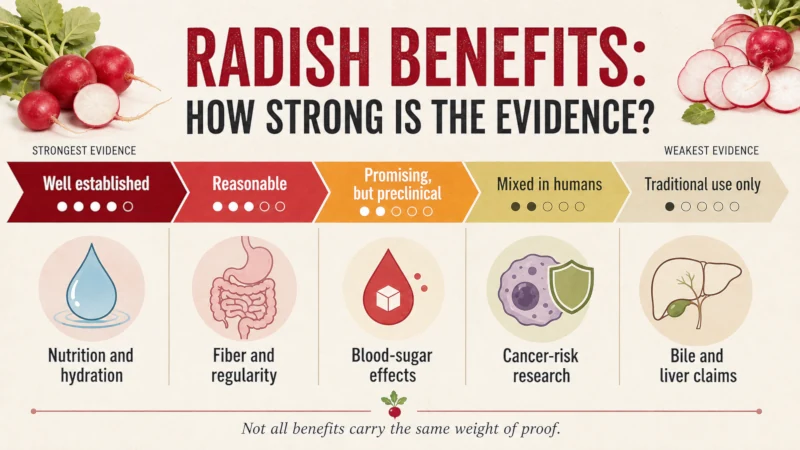
Radish health benefits, graded by the evidence
Everyday nutrition and hydration — well established
This is the least glamorous benefit and the most certain. Radishes deliver vitamin C, water, and fiber for almost no calories, which makes them an easy addition to a vegetable-forward diet. Vitamin C supports normal immune function and helps the body absorb plant iron. None of that is unique to radishes, but it is real, and it is the reason to eat them.
Digestion and fiber — reasonable
The fiber in radishes and their leaves adds bulk that supports regular bowel movements, and cruciferous vegetables in general fit the high-fiber, plant-rich pattern associated with better gut health. Expect a modest contribution rather than a cure for digestive problems. For a broader look at plants traditionally used this way, see our guide to herbs for the digestive system.
Bile, the liver, and black radish — traditional use and animal data, not a disease treatment
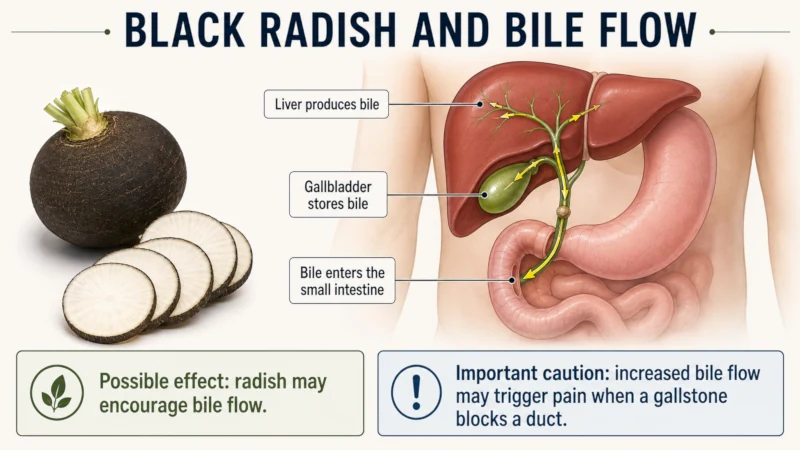
This is where radishes carry their biggest reputation and their biggest overstatements. Black radish root has been used for centuries in European and Mexican folk medicine to “move bile,” and there is preclinical support for the idea: in mice fed a gallstone-forming diet, black radish root juice significantly reduced cholesterol gallstones and lowered blood cholesterol and triglycerides over six days [Castro-Torres et al., 2012]. Other laboratory and animal studies point to antioxidant and liver-protective effects.
Here is the part that matters: those results are in animals and cells, not people. There are no solid human trials showing that radish treats hepatitis, cirrhosis, fatty liver, or alcohol-related liver damage. A plain-language medical summary puts it directly — people use radish for bile-flow and liver complaints, but there is no good scientific evidence to support those uses [WebMD, 2026]. Enjoy black radish as a food; do not treat it as therapy for a diagnosed liver or gallbladder condition. For the fuller evidence picture on this topic, see our guides to the gallbladder diet and herbs for the gallbladder and liver.
Blood sugar — promising but preclinical
Radish is one of the more-studied vegetables for blood sugar. A systematic review of more than three decades of research concluded that radish shows antidiabetic effects — improving antioxidant defenses, glucose uptake, and how much glucose the gut absorbs — but the same review is explicit that these findings still need confirmation in human clinical trials [Banihani, 2017]. Treat radish as a sensible part of a blood-sugar-friendly diet, not as a substitute for diabetes care. (If you take diabetes medication, see the safety note below.)
Antioxidants and the cancer question — mixed in humans
As a cruciferous vegetable, radish contains glucosinolates that break down during chopping, chewing, and digestion into biologically active isothiocyanates. In animals and in lab dishes, these compounds can protect cells from DNA damage, help inactivate carcinogens, and trigger cancer-cell death. In people, though, the evidence is honestly mixed — studies linking cruciferous intake to lower cancer risk have produced inconsistent results [National Cancer Institute, 2012]. The reasonable reading is that eating plenty of vegetables, radishes included, fits a healthy pattern — not that radishes prevent cancer on their own.
How to use the radish plant

Radishes are easiest to enjoy raw — sliced into salads, shaved onto tacos, or eaten whole with a little salt. Roasting or sautéing mellows the peppery bite and makes them gentler on the stomach. The leaves are edible and can be treated like any peppery green, and daikon is a staple grated, pickled, or simmered in soups. Black radish is more pungent and is often grated thin or juiced.
On juice and “detox” regimens, keep expectations grounded: there is not enough reliable information to define a medicinal dose of radish [WebMD, 2026], and concentrated juice is where side effects and interactions are most likely. If you simply like radish juice, small amounts as part of a meal are reasonable for most healthy adults.
Safety, side effects, and who should be careful
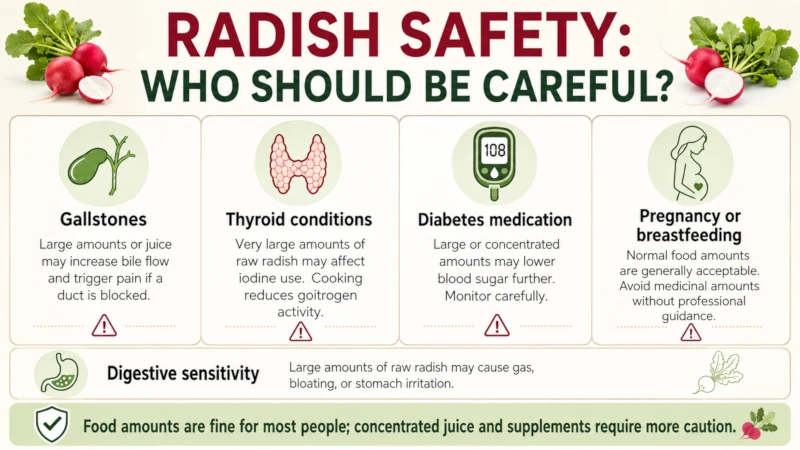
For most people, radishes are safe as food. The cautions below apply mainly to large amounts, concentrated juice, or supplements — and to a few specific groups.
- Digestive upset: large amounts of raw radish can cause gas, bloating, or stomach irritation. Start small and cook them if raw radish bothers you.
- Gallstones — important: radish increases bile flow, which can raise the risk of sudden pain if a stone blocks the bile duct. If you have gallstones, use radish cautiously and talk to your doctor before juicing it [WebMD, 2026]. The very “bile-moving” quality behind radish’s traditional reputation is also what makes concentration a bad idea when a duct is blocked.
- Thyroid: like other cruciferous vegetables, radish contains goitrogens that can interfere with iodine use by the thyroid when eaten raw in large amounts. In rats, chronic radish feeding produced signs of an underactive thyroid even with adequate iodine [rat study, 2006]. Moderate food amounts are generally fine; cooking lowers goitrogen activity. If you have a thyroid condition, discuss large or raw intakes with your clinician.
- Blood sugar and surgery: radish may lower blood sugar, so taking large amounts alongside diabetes medications could push it too low — monitor closely. Because of this effect, it is reasonable to stop medicinal amounts at least two weeks before scheduled surgery [WebMD, 2026].
- Pregnancy and breastfeeding: radish is fine as a normal food, but there is not enough reliable information on larger, medicinal amounts during pregnancy or breastfeeding — stick to food quantities [WebMD, 2026].
- Allergy: uncommon, but allergic reactions to radish have been reported. Stop and seek care if you develop hives, swelling, or trouble breathing.
When to talk to a professional — and red flags
Food is not the answer for a gallbladder or liver problem that is actually causing symptoms. Contact a doctor promptly, and go to urgent care or call 911 for severe symptoms, if you have any of the following:
- Upper-right abdominal pain that lasts several hours or is severe
- Yellowing of the skin or the whites of the eyes (jaundice)
- Fever or chills with abdominal pain
- Persistent nausea and vomiting, or pale stools with dark urine
| Health Disclaimer: This article is for education and general information only. It is not medical advice and is not a substitute for diagnosis or treatment by a qualified clinician. Foods, juices, and supplements can interact with prescription medicines, and some are not appropriate in pregnancy, while breastfeeding, or with certain conditions. Do not start, stop, or change any treatment based on what you read here. If you have gallbladder or liver symptoms — pain in the upper-right abdomen, yellowing skin or eyes, fever with chills, persistent vomiting, or pale stools with dark urine — contact a doctor, and call 911 or go to the nearest emergency room if symptoms are severe or worsening. |
Frequently Asked Questions
Is the radish plant good for your liver?
Radish is a healthy vegetable and has traditional use for bile and liver complaints, with supportive animal and lab data. But there is no good human evidence that it treats any liver disease [WebMD, 2026]. Eat it as food; see a clinician for liver symptoms.
Are radishes good for people with diabetes?
They fit a blood-sugar-friendly diet — low in calories and carbohydrates — and research suggests antidiabetic effects that still need confirmation in human trials [Banihani, 2017]. If you take diabetes medication, watch for lower blood sugar with large amounts.
Can I eat radishes if I have gallstones?
Be cautious. Radish increases bile flow, which can trigger sudden pain if a stone blocks the duct [WebMD, 2026]. Talk to your doctor before eating large amounts or juicing radish.
Should I eat radishes raw or cooked?
Both are healthy. Raw radishes keep more vitamin C and the sharp flavor; cooking softens the bite, is easier on the stomach, and lowers goitrogen activity if thyroid concerns apply.
Do radish greens and daikon count?
Yes. The leaves are edible and nutrient-dense, and daikon and black radish share the same core profile as red radish. Variety mostly changes flavor and texture, not the basic benefits.
References
- U.S. Department of Agriculture, Agricultural Research Service. FoodData Central — Radishes, raw. USDA, 2025. → View source
- National Cancer Institute. Cruciferous Vegetables and Cancer Prevention. NIH, reviewed 2012. → View source
- WebMD / Therapeutic Research Center. Radish — Uses, Side Effects, and More. WebMD, 2026. → View source
- Castro-Torres IG, et al. Antilithiasic and hypolipidaemic effects of Raphanus sativus L. var. niger on mice fed with a lithogenic diet. J Biomed Biotechnol. 2012;2012:161205. DOI 10.1155/2012/161205; PMID 23093836. (Mouse study.) → View source
- Banihani SA. Radish (Raphanus sativus) and Diabetes. Nutrients. 2017;9(9):1014. DOI 10.3390/nu9091014; PMID 28906451. (Review.) → View source
- Chronic radish feeding and thyroid status in rats. PubMed record, 2006; PMID 16924836. (Animal study.) → View source
