
Ask someone why tomatoes are good for you, and they’ll usually say one word: lycopene. That part holds up. What doesn’t hold up as well is the bigger story often told around it — that a few tomatoes a day will meaningfully protect you from cancer or “cleanse” your blood. The real health benefits of tomatoes are more specific, more modest in places, and in a few areas genuinely well-supported by research on heart health, blood pressure, and antioxidant intake.
Tomatoes are also a case study in a food that changed reputation entirely. When Spanish traders brought them back from Mexico and Peru in the sixteenth century, much of Northern Europe treated them with suspicion for two centuries because they resembled toxic nightshade relatives — a caution that, as you’ll see below, turns out to have a small kernel of truth for unripe fruit. Today the tomato is a defining ingredient of the Mediterranean diet and one of the most-studied vegetables in nutrition science.
Below is what a 100-gram serving actually contains, what the research supports and doesn’t, and the handful of situations where a little more caution is warranted.
Tomato Nutrition Facts
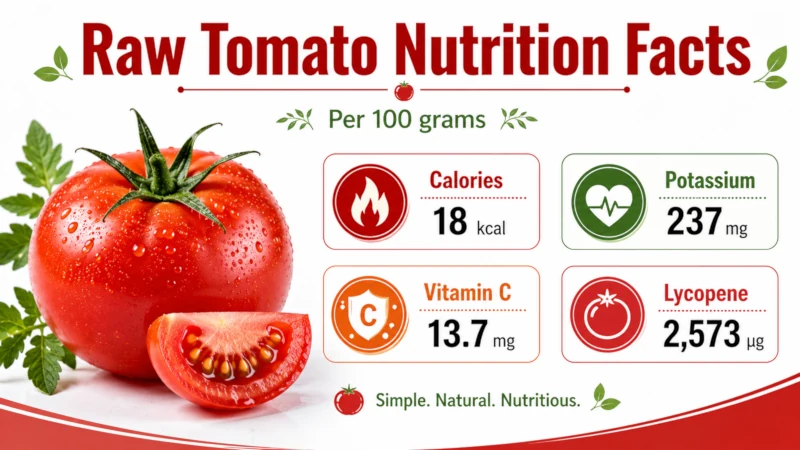
A raw, ripe tomato is mostly water — about 94 percent — which is part of why it’s so low in calories for its volume.
| Nutrient (per 100 g raw) | Amount | % Daily Value |
| Calories | ~18 kcal | – |
| Protein | ~0.9 g | – |
| Carbohydrate | ~3.9 g | – |
| Fiber | ~1.2 g | ~4% |
| Potassium | ~237 mg | ~5% |
| Vitamin C | ~13.7 mg | ~15% |
| Lycopene | ~2,500-4,000 mcg | no established DV |
| Beta-carotene (provitamin A) | ~450 mcg | ~6% (as vitamin A) |
Daily Values are based on FDA reference intakes for adults. Figures are drawn from USDA FoodData Central and cross-checked across independent secondary sources.
A few things worth flagging in that table. At 18 calories per 100 grams, tomatoes are genuinely one of the lowest-calorie foods you can eat in volume — lower than most other vegetables. Their vitamin C content (about 15 percent of the daily value per 100 grams) is respectable but not exceptional; citrus and bell peppers carry considerably more. What actually sets the tomato apart nutritionally is lycopene, the red carotenoid pigment that gives tomatoes their color and is the subject of most of the research below.
One number from the earlier feature-length version of this page needs a correction: an average tomato does not carry as much usable iron as an egg. Tomatoes contain some iron, but it’s non-heme iron — the plant form the body absorbs far less efficiently than the iron in animal foods — so a tomato pairs well with iron-rich foods (as a vitamin C source that improves absorption) rather than functioning as an iron source on its own.
Health benefits of tomatoes: What the Evidence Actually Supports
Heart and Blood Vessel Health
This is where the evidence for tomatoes is strongest. Two things are doing the work: potassium and lycopene.
Potassium helps the kidneys clear excess sodium and eases tension in blood vessel walls, and the American Heart Association recommends 3,500 to 5,000 mg of potassium daily — ideally from food — for people managing blood pressure [American Heart Association, 2025]. A single tomato won’t get you there on its own, but tomatoes are a real contributor to a potassium-forward, DASH-style eating pattern.
On the lycopene side, a 2021 analysis of roughly 102,000 US adults followed for a median of 17 years found that people with moderate raw-tomato or lycopene intake had a meaningfully lower risk of dying from cardiovascular disease than those with the lowest intake, and moderate lycopene intake was also linked to lower all-cause mortality [Xu et al., 2021]. Interestingly, the relationship wasn’t a straight line — very high tomato intake didn’t add extra benefit over moderate intake, a useful reminder that “more is always better” doesn’t hold for every nutrient.
That’s an observational study, so it shows an association, not proof that tomatoes themselves caused the lower risk — people who eat more tomatoes may also eat more vegetables generally, exercise more, or smoke less. Still, it’s consistent with a broader body of research connecting lycopene and tomato intake to lower cardiovascular risk.
Cancer Risk — A More Modest Story Than You’ve Heard
This is the section where the older, more confident version of this claim needs the most correction. Lycopene has real antioxidant properties and has been studied extensively for a possible role in cancer prevention, particularly prostate cancer — but the human evidence is modest and, in places, genuinely mixed, not the “essential in preventing prostate cancer” framing you may have seen elsewhere.
A 2015 systematic review and meta-analysis pooling 34 studies and nearly 600,000 participants found that higher dietary lycopene intake was associated with a modest reduction in prostate cancer risk (roughly 14 percent lower risk comparing highest to lowest intake), and higher blood lycopene levels were associated with about a 19 percent lower risk [Wang et al., 2015]. Those associations were statistically significant but not large, and the same analysis found that lycopene did not appear to lower the risk of advanced prostate cancer specifically — an important distinction the more enthusiastic claims tend to skip.
The honest summary: lycopene-rich foods, tomatoes included, appear to modestly lower prostate cancer risk in population studies, but the effect is not large, doesn’t clearly extend to advanced disease, and isn’t something dietary changes alone can be relied on to prevent. If cancer prevention is a priority, tomatoes are one reasonable part of a much larger picture that includes overall diet pattern, weight, alcohol, and screening — not a stand-alone shield.
Vitamin C, Immunity, and Antioxidant Support
Vitamin C acts as an antioxidant in the body, supports collagen production for wound healing, and helps the immune system function normally [NIH Office of Dietary Supplements, 2021]. Tomatoes are a real, if moderate, source — a 100-gram serving supplies roughly 15 percent of the daily value.
It’s worth being precise here, because this is a place where enthusiasm often outruns the evidence: research on high vitamin C intake and immune function shows people who eat more vitamin-C-rich fruits and vegetables tend to have somewhat lower cancer risk, but taking vitamin C as a supplement has not been shown to prevent cancer, and vitamin C supplements don’t meaningfully reduce the risk of catching a cold for most people, though they may modestly shorten one already underway [NIH Office of Dietary Supplements, 2021]. None of that is a knock against tomatoes — food-based vitamin C is genuinely useful as part of an overall diet — it’s a reason not to expect a tomato to work like medicine.
Raw or Cooked? Getting More Lycopene From Your Tomatoes
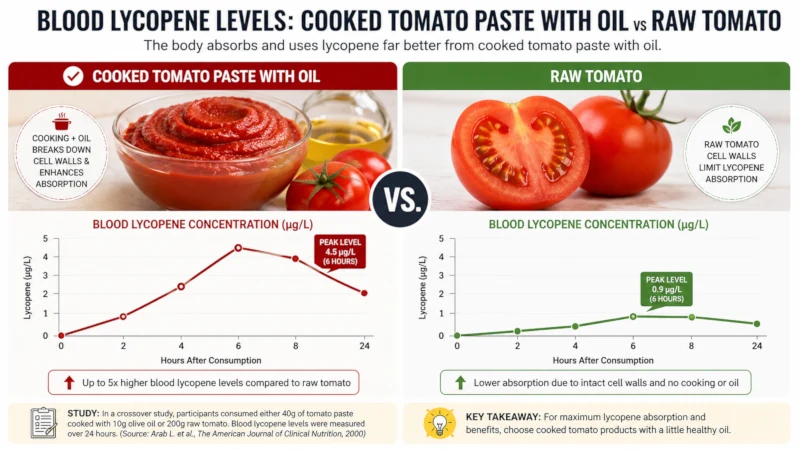
Here’s a genuinely useful, well-replicated finding: your body absorbs lycopene better from cooked tomatoes than raw ones, and better still when there’s some fat in the meal. A controlled feeding study found that lycopene from tomato paste eaten with a small amount of oil produced roughly 2.5 times higher peak blood lycopene levels than the same amount of lycopene from fresh tomatoes [Gärtner et al., 1997]. Heat breaks down the plant cell walls that trap lycopene and shifts some of it into a form the body absorbs more readily, and the added fat helps carry the fat-soluble pigment into circulation.
Practically, that means:
- Tomato sauce, paste, and cooked tomatoes are a better lycopene source than a raw tomato slice — not a lesser one.
- A drizzle of olive oil with cooked tomatoes (a classic marinara move) isn’t just flavor — it measurably helps absorption.
- Raw tomatoes still contribute meaningfully to vitamin C intake, which is more heat-sensitive than lycopene, so there’s a reasonable case for eating tomatoes both ways rather than picking one.
Tomatoes and Common Concerns
Oxalates and Kidney Stones
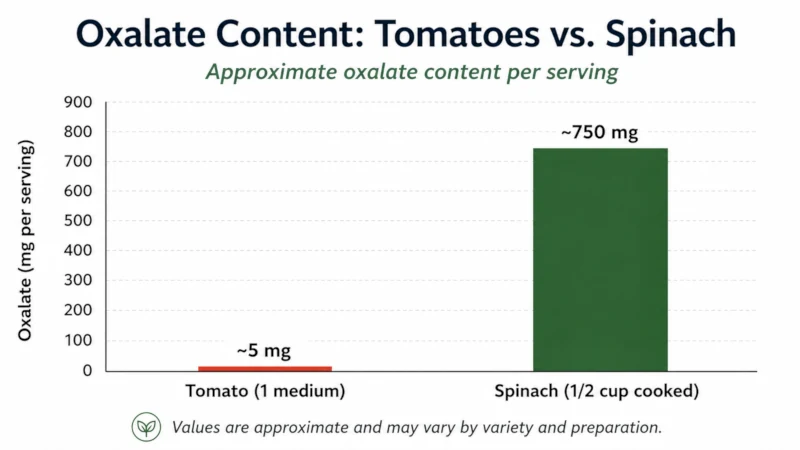
Tomatoes were once routinely restricted for people with kidney stones because of their oxalic acid content. That advice has mostly softened, and here’s why: tomatoes are actually fairly low in oxalate compared with foods genuinely worth watching. A half-cup of cooked spinach carries roughly 755 mg of oxalate — one of the highest amounts of any common food — while a tomato’s oxalate content is a small fraction of that [WebMD, 2024]. For most people, including those managing kidney stone risk, tomatoes aren’t a significant oxalate concern; spinach, beets, and almonds deserve far more attention on that front. For more on which foods actually carry a meaningful oxalate load, see our spinach guide, which covers this in detail.
Gout
The older idea that tomatoes “cleanse” the blood of uric acid and help gout doesn’t reflect current evidence — but the news for tomato-eaters with gout is still good, for a different reason. Purine-rich plant foods, tomatoes included, don’t behave like purine-rich animal foods in the body: large cohort research has found that purine-rich vegetables aren’t linked to higher gout risk, while red meat and seafood are (see our detailed breakdown in Foods That Cause Gout). In practice, that means people managing gout generally don’t need to limit tomatoes.
Unripe, Green Tomatoes
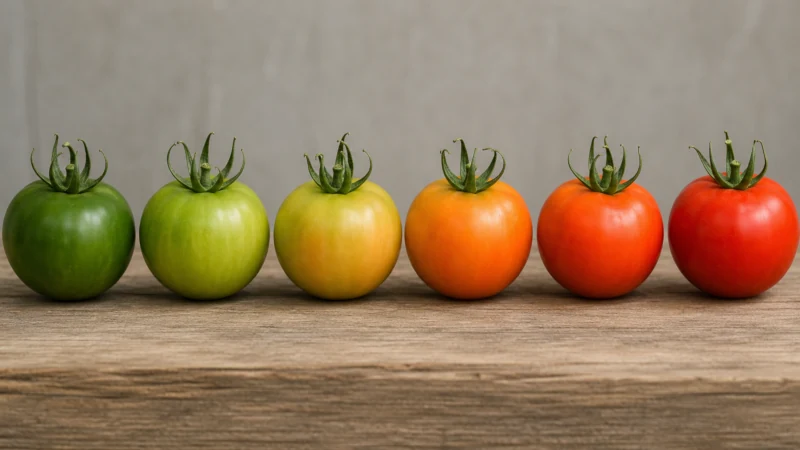
Unripe, fully green tomatoes contain more solanine than ripe ones — a bitter-tasting alkaloid found throughout the nightshade family (tomatoes, potatoes, peppers, eggplant). At the low levels present in these foods, solanine is considered safe to eat, but in larger amounts it can irritate the gut and cause nausea or diarrhea [Cleveland Clinic, 2023].
As a tomato ripens from green to red, solanine content drops, which is part of why ripe tomatoes aren’t a practical concern for most people. Fried green tomatoes and similar dishes made from intentionally unripe fruit are a long-standing part of some regional cuisines and are eaten in normal culinary portions without issue — the caution applies to eating large quantities of raw, fully green tomatoes, not to occasional cooked green-tomato dishes.
Tomato Allergy and Oral Allergy Syndrome
True tomato allergy exists but is uncommon. More frequently, people with grass pollen allergies (hay fever) experience oral allergy syndrome — also called pollen food allergy syndrome — when eating raw tomatoes: itching or mild swelling in the mouth or throat that starts shortly after eating and usually resolves quickly [ACAAI, 2019]. Because the proteins responsible break down with heat, many people with this reaction can eat cooked tomatoes and tomato sauce without any trouble. Reactions that spread beyond the mouth, involve difficulty swallowing or breathing, or don’t resolve quickly are not typical oral allergy syndrome and warrant prompt medical evaluation.
Who Should Be Extra Careful
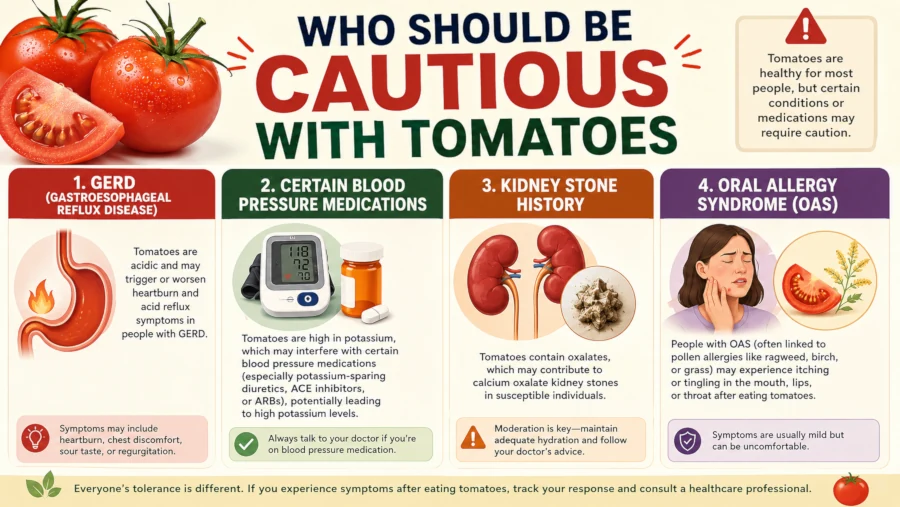
- People with acid reflux or GERD. Tomatoes are naturally acidic and are a commonly reported trigger for reflux symptoms in people prone to them, even though they’re not inherently harmful.
- People on blood pressure medications that raise potassium (certain ACE inhibitors, ARBs, or potassium-sparing diuretics) or with kidney disease. Tomatoes’ potassium content is moderate, not extreme, but if you’ve been told to watch potassium intake, ask your care team where tomatoes fit into your totals.
- People with a history of oral allergy syndrome to grass pollen or ragweed. Cooked tomato products are usually better tolerated than raw.
- People managing calcium-oxalate kidney stones. Tomatoes are a low-priority food on this front, but your nephrologist or dietitian may still want it accounted for as part of your overall pattern.
- Anyone with a new, persistent, or severe reaction after eating tomatoes — beyond mild mouth itching — should see a healthcare professional or allergist rather than self-diagnose.
| Health Disclaimer: This article is for general education and is not medical advice. It is not a substitute for diagnosis, treatment, or guidance from a qualified healthcare professional. Tomatoes are a food, not a treatment for any disease, and no food can prevent, cure, or reverse cancer, heart disease, or any other condition on its own. If you are pregnant, breastfeeding, managing kidney disease, taking blood pressure medication, or have any ongoing medical condition, talk with your doctor, pharmacist, or a registered dietitian before making significant changes to your diet. |
Getting More Tomatoes Into Your Week
- Cook them for lycopene, eat some raw for vitamin C. A simple marinara or roasted-tomato side covers the former; a salad or sliced tomato with a bit of salt covers the latter.
- Add a fat source when cooking tomatoes. Olive oil isn’t just tradition — it helps lycopene absorption.
- Ripe means red (or fully colored for other varieties). Let tomatoes finish ripening on the counter rather than eating them while still green, unless they’re part of a dish specifically built for unripe tomatoes.
- Watch the extras, not the tomato. Store-bought tomato sauces, juices, and ketchup can carry substantial added sodium and sugar — the tomato itself isn’t the problem, the jar often is. Checking labels matters more than avoiding the fruit.
Frequently Asked Questions
Do tomatoes really help prevent prostate cancer?
The evidence supports a modest association between higher lycopene intake and somewhat lower prostate cancer risk in population studies — not a proven preventive effect, and it doesn’t clearly extend to more advanced prostate cancer. Tomatoes can reasonably be part of a cancer-conscious diet, but they shouldn’t be relied on as a preventive measure on their own.
Are cooked tomatoes healthier than raw ones?
For lycopene specifically, yes — cooking (especially with a little oil) roughly doubles or more the amount your body actually absorbs. For vitamin C, raw is generally better, since heat and processing reduce vitamin C content. Eating tomatoes both ways covers both nutrients.
Can people with gout eat tomatoes?
Generally, yes. Unlike purine-rich meat and seafood, purine-rich plant foods including tomatoes haven’t been linked to higher gout risk in large studies.
Are green tomatoes actually poisonous?
Fully unripe, green tomatoes contain solanine, which can cause stomach upset in meaningful quantities, and levels drop as the fruit ripens. Cooked dishes made from intentionally green tomatoes are eaten safely in normal portions by many people; the concern applies to large quantities of raw, fully green fruit rather than occasional culinary use.
Why do my lips or mouth itch after eating raw tomatoes?
That’s most often oral allergy syndrome, a mild cross-reaction some people with grass pollen allergies have to raw tomato proteins. It typically resolves quickly and often doesn’t happen with cooked tomatoes, since heat breaks down the responsible proteins. If symptoms spread beyond your mouth or you have trouble breathing, seek medical care.
Do tomatoes have as much iron as eggs?
No — this is a persistent myth. Tomatoes contain a modest amount of non-heme (plant-form) iron, which the body absorbs far less efficiently than the heme iron in eggs or meat. Tomatoes are more useful alongside iron-rich foods, thanks to their vitamin C content improving iron absorption, than as an iron source themselves.
References
- National Institutes of Health, Office of Dietary Supplements. “Vitamin C — Consumer.” Updated March 22, 2021. View source
- American Heart Association. “How Potassium Can Help Prevent or Treat High Blood Pressure.” Last reviewed Aug 14, 2025. View source
- Gärtner C, Stahl W, Sies H. “Lycopene is more bioavailable from tomato paste than from fresh tomatoes.” Am J Clin Nutr. 1997;66(1):116-122. DOI 10.1093/ajcn/66.1.116. View source
- Xu X, Li S, Zhu Y. “Dietary Intake of Tomato and Lycopene and Risk of All-Cause and Cause-Specific Mortality: Results From a Prospective Study.” Front Nutr. 2021;8:684859. DOI 10.3389/fnut.2021.684859. View source
- Wang Y, Cui R, Xiao Y, Fang J, Xu Q. “Effect of Carotene and Lycopene on the Risk of Prostate Cancer: A Systematic Review and Dose-Response Meta-Analysis of Observational Studies.” PLOS ONE. 2015;10(9):e0137427. View source
- WebMD. “Foods High in Oxalates.” Medically reviewed July 18, 2024. View source
- American College of Allergy, Asthma & Immunology. “Pollen Food Allergy Syndrome.” Reviewed March 21, 2019. View source
