
Vitamin B6 benefits show up everywhere from prenatal advice to the label on your multivitamin, but the evidence behind them is uneven: some claims are settled science, others rest on blood-level studies rather than results that matter to you. This guide separates the strong evidence from the hopeful, drawing on the NIH Office of Dietary Supplements and other major medical sources, so you can see what B6 reliably does, how much you need, where to get it from food, and the one safety issue worth knowing before you reach for a high-dose pill.
The short version: vitamin B6 is an essential nutrient your body can’t make, it runs more than 100 enzyme reactions, and most people get enough from food [NIH ODS, 2023]. Supplements have a clear role in a few specific situations — pregnancy nausea is the standout — but for heart disease, memory, and most chronic conditions, the trial evidence has largely come up empty.
What vitamin B6 actually does in the body
Vitamin B6 is the umbrella name for six related compounds. The form your body puts to work, pyridoxal 5′-phosphate (PLP), acts as a coenzyme — a helper molecule that lets enzymes carry out their reactions [NIH ODS, 2023]. Spread across more than 100 of those reactions, its work comes down to a handful of jobs:
- Building and breaking down amino acids, the raw material for the body’s proteins
- Helping turn carbohydrates and fat into usable energy
- Making neurotransmitters such as serotonin, dopamine, and GABA, the chemical messengers that carry signals in the brain
- Producing hemoglobin, the protein in red blood cells that carries oxygen
- Keeping homocysteine — an amino acid linked to heart risk when it runs high — within a normal range
- Supporting normal immune function
Those roles are why B6 touches so many systems. They’re also why a true shortfall, although uncommon, can cause a scattered mix of symptoms rather than one obvious sign. B6 works closely with the other B-complex vitamins, especially B12 and folate, which is part of why deficiencies tend to cluster together.
Vitamin B6 benefits backed by evidence
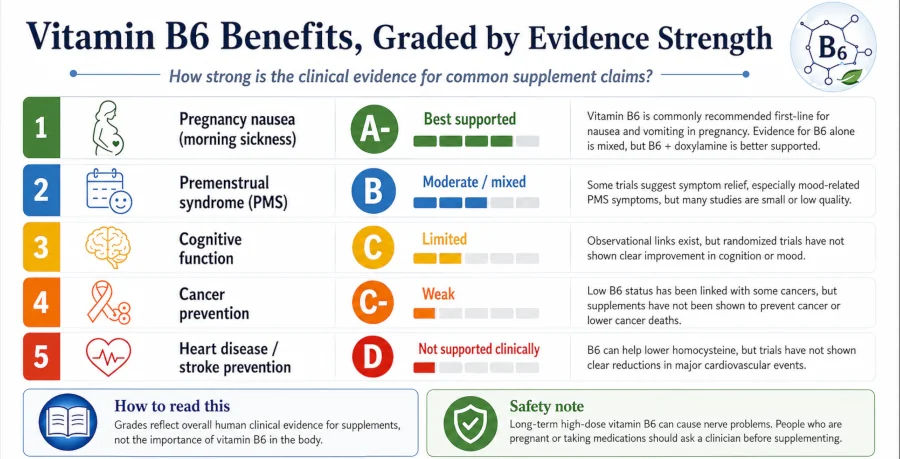
Not every claim about B6 holds up. The table below sorts the common ones by how strong the research is, and the sections that follow explain each in plain terms.
| Use | What the research shows | Strength of evidence |
| Correcting a B6 deficiency | Restores normal levels and reverses deficiency signs such as anemia and skin changes | Strong (settled) |
| Nausea and vomiting in pregnancy | Reduces nausea; recommended by ACOG as a first-line option, often with doxylamine | Moderate to strong |
| Premenstrual syndrome (PMS) | May ease mood-related symptoms, but most trials were small and lower quality | Limited / mixed |
| Heart disease and stroke | Lowers homocysteine, but large trials show no drop in cardiovascular events | Not supported |
| Memory and cognitive decline | No clear benefit in randomized trials, alone or with B12 and folate | Not supported |
| Cancer | Higher intake linked to lower colorectal cancer risk in observational data only | Early / observational |
Easing nausea and vomiting in pregnancy
This is the most solid reason to use a B6 supplement. In two randomized, placebo-controlled trials, 30–75 mg of pyridoxine a day reduced nausea in pregnant women who were already feeling sick [NIH ODS, 2023]. The American College of Obstetricians and Gynecologists recommends vitamin B6 — 10–25 mg, three or four times a day — as a first-line treatment, adding the antihistamine doxylamine if symptoms don’t ease [ACOG, 2004]. That combination is tied to about a 70% drop in nausea and vomiting [NIH ODS, 2023]. It tends to help more with nausea than with vomiting, and it doesn’t work for everyone. Because several daily doses can approach the safe upper limit, start it with your doctor or midwife rather than on your own [MedlinePlus, 2024].
Premenstrual syndrome (PMS)
Here the evidence is thinner. A systematic review of nine trials involving almost 1,000 women found B6 outperformed placebo for PMS symptoms — but the authors cautioned that most studies were small and had methodological weaknesses [Wyatt et al., 1999]. A later trial of 94 women taking 80 mg daily over three cycles reported meaningful reductions in moodiness, irritability, bloating, and especially anxiety [NIH ODS, 2023]. Promising, not proven. If you want to try it, stay within the safe range and don’t assume a bigger dose works better.
Correcting a deficiency
The clearest benefit is also the most basic: if you’re low in B6, restoring it fixes the problems that being low causes. Isolated deficiency is uncommon and usually travels with low levels of other B vitamins [NIH ODS, 2023]. When it does occur, it can show up as a particular kind of anemia, a scaly rash, cracked lips, a sore tongue, low mood or confusion, and a weaker immune response.
Heart disease and homocysteine — where the evidence falls short
B6, along with B12 and folate, helps keep homocysteine down, and high homocysteine tracks with cardiovascular disease. That led to a reasonable idea: lower homocysteine with B vitamins, protect the heart. Large trials tested it and mostly came up empty. Combined data from two Norwegian trials in 6,837 patients with heart disease found no benefit from B6 on major cardiovascular events [NIH ODS, 2023]. Lowering the marker, it turns out, hasn’t translated into fewer heart attacks or strokes.
Memory and cognitive decline
Same story. A systematic review of 14 randomized trials found insufficient evidence that B6 — by itself or with B12 and folate — improves thinking or memory, whether in people with normal cognition or with dementia [Balk et al., 2007]. A separate Cochrane review reached the same conclusion for short-term use. Low B6 is linked to poorer cognition, but topping up healthy people hasn’t been shown to help.
Cancer
A meta-analysis found people with the highest B6 intake had roughly a 20% lower risk of colorectal cancer than those with the lowest [Larsson et al., 2010]. That’s an association from observational data, though, not proof that B6 prevents cancer — and the few supplement trials run so far have not shown that taking B6 lowers cancer rates [NIH ODS, 2023].
How much vitamin B6 you need
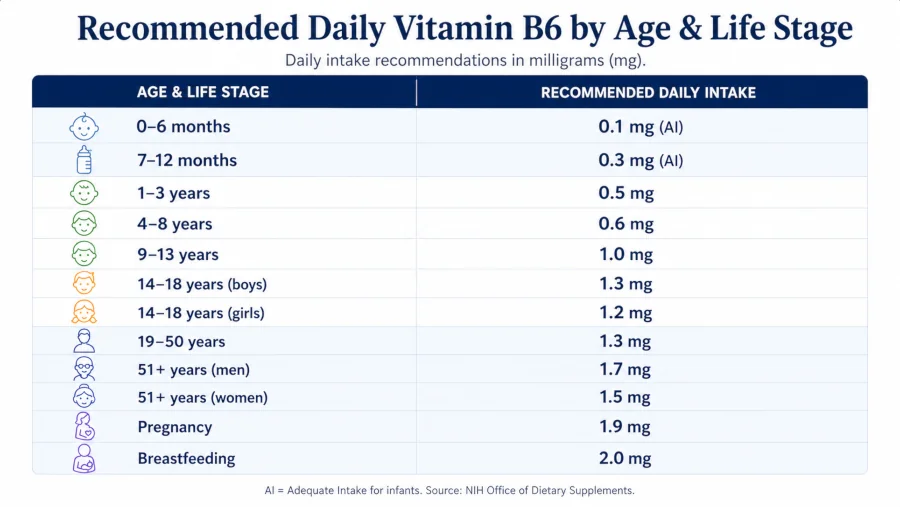
Most adults need 1.3 mg a day, rising to 1.7 mg for men and 1.5 mg for women after age 50, and to 1.9 mg in pregnancy and 2.0 mg while breastfeeding [NIH ODS, 2023]. For perspective, a cup of chickpeas or a few ounces of tuna covers more than half of a day’s requirement.
| Age / stage | Recommended daily amount |
| 1–3 years | 0.5 mg |
| 4–8 years | 0.6 mg |
| 9–13 years | 1.0 mg |
| 14–18 years | 1.3 mg (male) · 1.2 mg (female) |
| 19–50 years | 1.3 mg |
| 51+ years | 1.7 mg (male) · 1.5 mg (female) |
| Pregnancy | 1.9 mg |
| Breastfeeding | 2.0 mg |
Recommended Dietary Allowances; infant values are set separately as Adequate Intakes.
Best food sources of vitamin B6
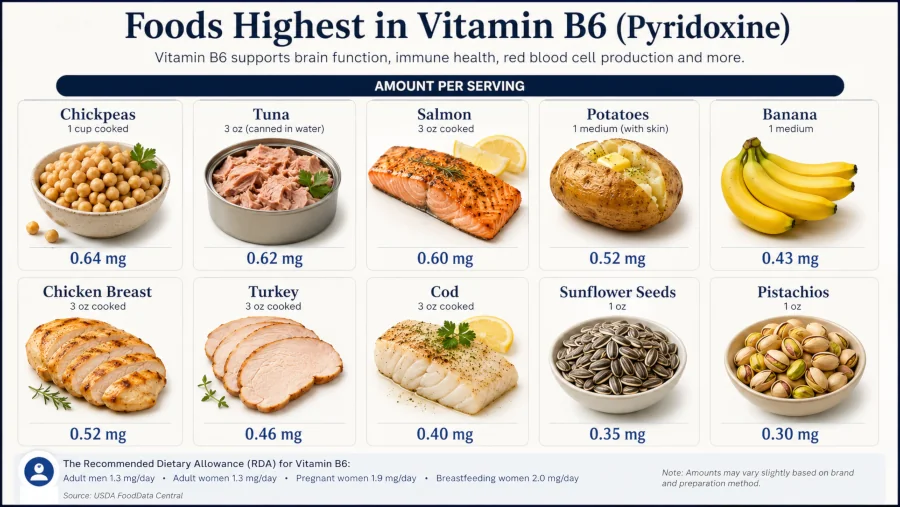
B6 is spread across both animal and plant foods, so a varied diet usually covers it. Among the richest everyday sources are chickpeas, fish such as tuna and salmon, beef liver, poultry, potatoes, and bananas [NIH ODS, 2023]. About 75% of the B6 in a mixed diet is absorbed, and the forms in animal foods tend to be slightly more available than the plant forms found in some fruits, vegetables, and grains [Harvard T.H. Chan].
| Food | Serving | Vitamin B6 | % Daily Value |
| Chickpeas, canned | 1 cup | 1.1 mg | 65% |
| Tuna, yellowfin, cooked | 3 oz | 0.9 mg | 53% |
| Beef liver, pan-fried | 3 oz | 0.9 mg | 53% |
| Salmon, sockeye, cooked | 3 oz | 0.6 mg | 35% |
| Chicken breast, roasted | 3 oz | 0.5 mg | 29% |
| Potatoes, boiled | 1 cup | 0.4 mg | 25% |
| Banana | 1 medium | 0.4 mg | 25% |
| Fortified breakfast cereal | 1 serving | 0.4 mg | 25% |
Percent Daily Value is based on 1.7 mg. Source: NIH Office of Dietary Supplements.
One practical note: some B6 is lost during cooking and during the refining of grains, which is part of why many breakfast cereals are fortified with it [NIH ODS, 2023]. You don’t need to track this — eating a range of whole foods across the week handles it.
Who’s most likely to run low
Frank deficiency is rare in the United States, but some people carry a higher risk of marginal B6 and may benefit from closer attention [NIH ODS, 2023]:
- People with kidney disease, including those on dialysis, who tend to clear B6 faster
- People with autoimmune or inflammatory conditions such as rheumatoid arthritis, celiac disease, Crohn’s disease, or ulcerative colitis, where inflammation and poor absorption lower B6
- People with alcohol dependence, because alcohol interferes with how the body holds onto B6
- Pregnancy, which raises B6 requirements
Signs of a vitamin B6 shortfall
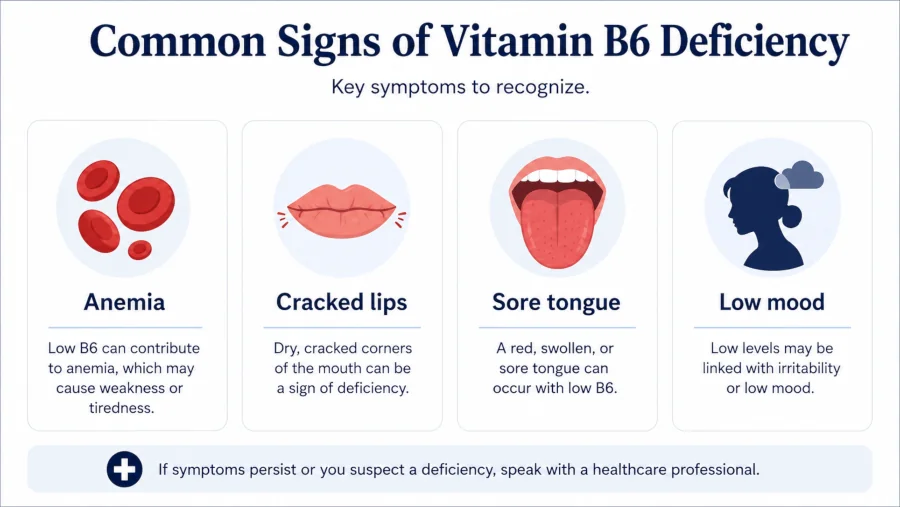
Mild or borderline B6 status may cause no symptoms for months. As a deficiency deepens, it can produce anemia, a greasy, scaly rash, cracks at the corners of the mouth, a swollen or sore tongue, depression, confusion, and a weakened immune response [NIH ODS, 2023]. In infants, low B6 can cause irritability and, in severe cases, seizures. These signs overlap with many other conditions, so they point toward a conversation with a clinician and a blood test, not self-diagnosis.
Supplements, safe limits, and the nerve-damage risk
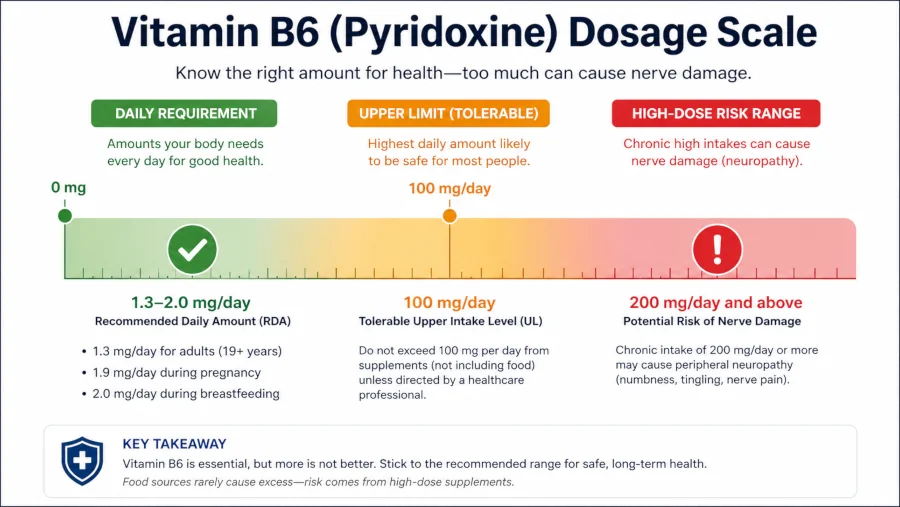
Here’s the part that often gets skipped. You can’t overdose on B6 from food, but high-dose supplements can cause real harm. Taking very large amounts — historically grams per day for 12 months or longer — can damage sensory nerves, producing numbness, tingling, and an unsteady, poorly coordinated gait, a condition called sensory neuropathy [NIH ODS, 2023]. The damage is usually dose-related and often eases once the supplements stop, though recovery isn’t guaranteed.
To build in a safety margin, U.S. authorities set the tolerable upper intake level — the most you should take long-term from all sources — at 100 mg a day for adults [NIH ODS, 2023]. In 2023, European regulators went much lower, setting their limit at 12 mg a day after a closer look at when nerve symptoms begin [EFSA, 2023]. Either way, a typical multivitamin dose and the doses used for pregnancy nausea sit below the U.S. limit. The trouble comes from standalone high-dose B6 products, sometimes taken for months without anyone realizing how much they add up to. With this nutrient, more is not better.
Who should be cautious
- Pregnant and breastfeeding people: don’t exceed the upper limit; the doses used for nausea can approach it, so use them under medical guidance [NIH ODS, 2023].
- Anyone considering long-term high-dose B6: there’s no proven benefit for the general population and a genuine neuropathy risk.
- People on the medications below: review your B6 intake with a pharmacist or doctor.
Medication interactions worth flagging
Vitamin B6 and several medications can affect each other [NIH ODS, 2023]. A few of the better-documented examples:
- Cycloserine (a tuberculosis antibiotic) increases B6 loss; supplemental B6 can offset it.
- Antiepileptic drugs such as valproic acid, carbamazepine, and phenytoin can lower B6 levels — and high-dose B6 can in turn reduce phenytoin and phenobarbital levels, which matters for seizure control.
- Theophylline (used for asthma and other lung conditions) is associated with low B6.
Isoniazid, another tuberculosis drug, is a long-recognized cause of B6 depletion and nerve symptoms, which is why pyridoxine is often prescribed alongside it. If you take any of these, don’t start or stop B6 without checking with your prescriber [Mayo Clinic].
Realistic expectations, and when to see a professional
For most people eating a varied diet, a B6 supplement won’t add a noticeable benefit. The real gains appear when you’re correcting a shortfall or treating a specific problem like pregnancy nausea under guidance — not from topping up levels that are already fine.
It’s worth talking to a healthcare professional if you:
- Have numbness or tingling in your hands or feet (which can signal either too little B6 or too much from supplements)
- Have ongoing fatigue, mouth or skin changes, or unexplained anemia
- Are pregnant and considering B6 for nausea
- Take antiepileptic drugs, theophylline, or tuberculosis medications
Seek prompt medical care for severe or worsening numbness or weakness, or for pregnancy vomiting so persistent that you can’t keep fluids down, which can be a sign of hyperemesis gravidarum and needs evaluation.
| Health Disclaimer This article is for general education and information only. It is not medical advice and is not a substitute for diagnosis or treatment from a qualified healthcare professional. Vitamin B6 needs, safe doses, and medication interactions vary from person to person. If you are pregnant, breastfeeding, take prescription medication, or have a health condition, talk to your doctor, pharmacist, or a registered dietitian before starting any supplement. |
Frequently asked questions
Can vitamin B6 help with morning sickness?
Yes. This is the best-supported reason to use a B6 supplement. The American College of Obstetricians and Gynecologists recommends vitamin B6 as a first-line treatment for nausea and vomiting in pregnancy, typically 10–25 mg taken three or four times a day, with the antihistamine doxylamine added if needed [ACOG, 2004]. Because the repeated doses can approach the safe daily limit, start it under the guidance of your doctor or midwife.
How much vitamin B6 is too much?
You can’t get too much from food. The risk comes from high-dose supplements. U.S. authorities set the tolerable upper intake level at 100 mg a day for adults [NIH ODS, 2023]; European regulators set a much lower limit of 12 mg a day in 2023 [EFSA, 2023]. Taking grams per day for months to years can damage sensory nerves, so avoid standalone high-dose B6 unless a clinician directs it.
What foods are highest in vitamin B6?
Chickpeas, tuna, beef liver, salmon, chicken, potatoes, and bananas are among the richest everyday sources [NIH ODS, 2023]. A single cup of chickpeas covers about two-thirds of an adult’s daily requirement.
Should I take a vitamin B6 supplement?
Most people who eat a varied diet don’t need one. A supplement makes sense if you’re correcting a deficiency, managing pregnancy nausea, or taking a medication that lowers B6 [NIH ODS, 2023]. Check with a healthcare professional before adding a standalone B6 product.
Does vitamin B6 prevent heart disease or dementia?
The evidence says no. B6 lowers homocysteine, an amino acid tied to heart and brain risk, but large randomized trials have not found that B6 supplements reduce heart attacks, strokes, or cognitive decline [Balk et al., 2007].
What does vitamin B6 deficiency feel like?
True deficiency is uncommon and usually occurs alongside low levels of other B vitamins. Signs can include a type of anemia, cracked lips, a sore tongue, a scaly rash, low mood or confusion, and a weaker immune response [NIH ODS, 2023].
References
- MedlinePlus (U.S. National Library of Medicine). Morning sickness. Updated 2024. → View source
- National Institutes of Health, Office of Dietary Supplements. Vitamin B6: Fact Sheet for Health Professionals. Updated 2023. → View source
- National Institutes of Health, Office of Dietary Supplements. Vitamin B6: Fact Sheet for Consumers. Updated 2023. → View source
- American College of Obstetricians and Gynecologists. Practice Bulletin: Nausea and Vomiting of Pregnancy. Obstet Gynecol. 2004;103:803–814. → View source
- Wyatt KM, Dimmock PW, Jones PW, O’Brien PMS. Efficacy of vitamin B-6 in the treatment of premenstrual syndrome: systematic review. BMJ. 1999;318:1375–1381. → View source
- Larsson SC, Orsini N, Wolk A. Vitamin B6 and risk of colorectal cancer: a meta-analysis of prospective studies. JAMA. 2010;303:1077–1083. → View source
- Balk EM, Raman G, Tatsioni A, et al. Vitamin B6, B12, and folic acid supplementation and cognitive function: a systematic review of randomized trials. Arch Intern Med. 2007;167:21–30. → View source
- EFSA Panel on Nutrition, Novel Foods and Food Allergens. Scientific opinion on the tolerable upper intake level for vitamin B6. EFSA Journal. 2023;21(5):8006. → View source
- Mayo Clinic. Vitamin B6 (Pyridoxine): drugs and supplements overview. → View source
- Harvard T.H. Chan School of Public Health, The Nutrition Source. Vitamin B6. → View source
