
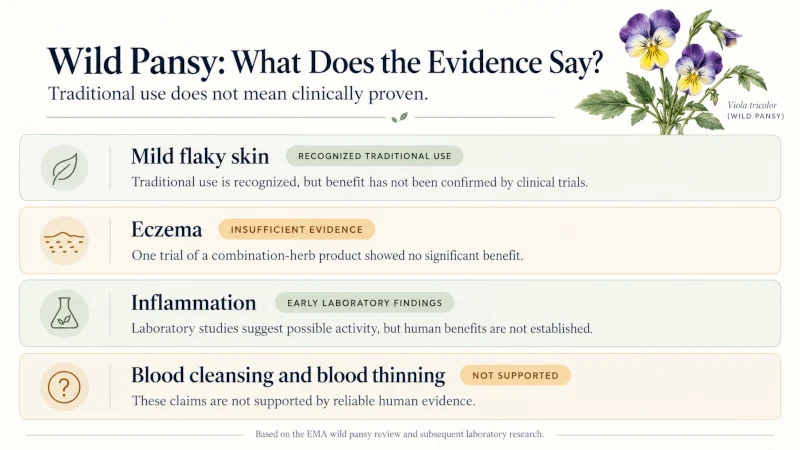
Wild pansy has one use that holds up: as a tea or a cool compress for mild, flaky, seborrheic-type skin, the kind that shows up as scaling on the scalp, eyebrows or sides of the nose. European regulators accept that use as traditional, meaning it rests on long, documented practice rather than clinical trials [EMA, 2010a]. Most of the other pansy plant health benefits you’ll see listed online, from “blood cleansing” to blood thinning, have no human evidence behind them.
If you’re weighing it for a stubborn rash, the details matter: which plant, how much, for how long, and whether you’re in one of the groups who should skip it.
Wild pansy is not the pansy in your flower bed
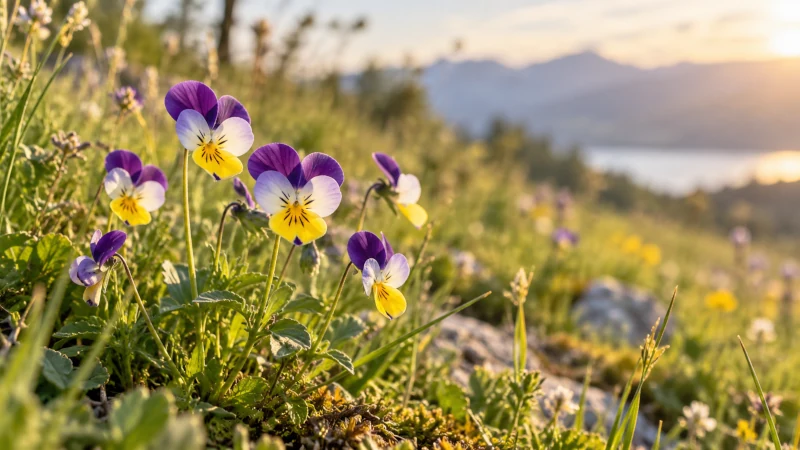
The herbal remedy comes from Viola tricolor, a small European wildflower in the violet family, also called heartsease or Johnny-jump-up (pensée in French, pensamiento in Spanish). It grows as an annual or short-lived perennial and tops out around 20 cm, or 8 inches [PFAF, n.d.]. The big-faced pansies sold at garden centers are a different plant, Viola × wittrockiana, a hybrid developed in the early 1800s from V. tricolor and other parent species [MDC, n.d.].
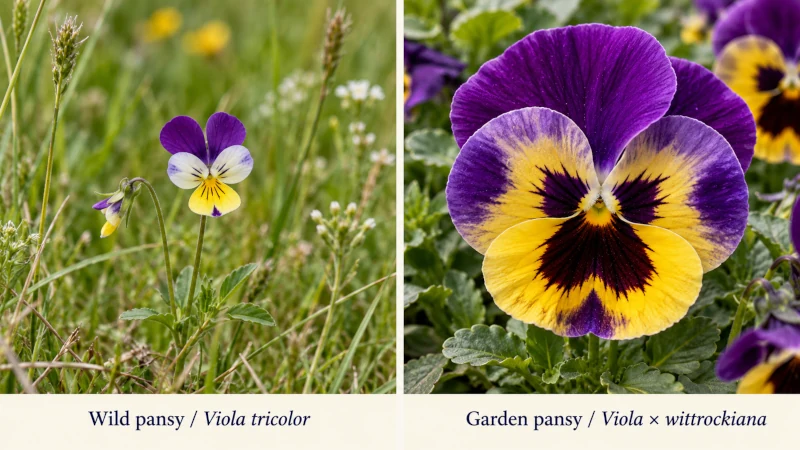
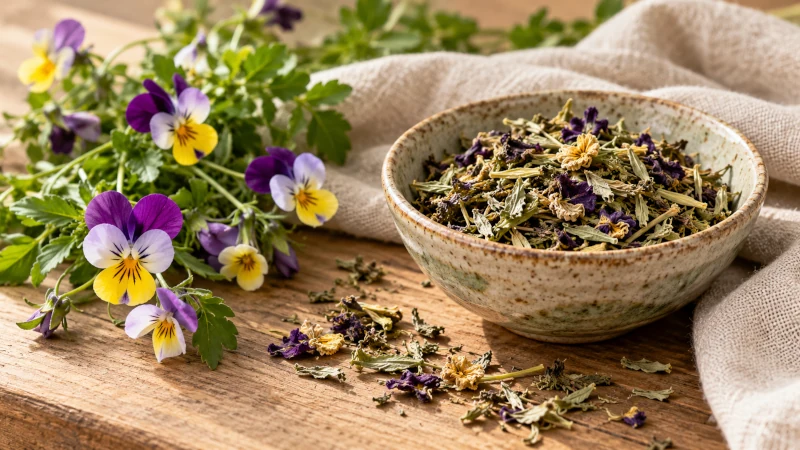
Herbal-grade wild pansy is the dried, flowering top of V. tricolor or its close relative, field pansy (V. arvensis), and the European Pharmacopoeia sets a minimum flavonoid content for it [EMA, 2010b]. Garden pansies aren’t held to that standard. If you buy it, look for dried herb labeled with the species name, Viola tricolor.
What’s in wild pansy
According to the EMA’s review of the research, the dried herb contains [EMA, 2010b]:
- Flavonoids, at least 1.5% by pharmacopoeia standard, mostly rutin
- Mucilage, about 10%: slippery, gel-forming carbohydrates, part of why herbalists favor the plant for irritated skin
- Tannins, roughly 2.4–4.5%
- Salicylic acid and related compounds, including methyl salicylate, roughly 0.06–0.3%
- Cyclotides, unusually stable ring-shaped peptides that researchers are studying in the lab
Two corrections to older descriptions, including an earlier version of this page. Saponins were once reported in the herb, but a later analysis didn’t confirm them, so they can’t be credited with any effect [EMA, 2010b]. And the dry herb does contain vitamin C, about 690 mg per 100 g [EMA, 2010b], but a 3 g tea serving holds only around 20 mg before you brew it. For vitamin C, ordinary food does far better; see our guide to vitamin C rich foods.
Pansy plant health benefits: how strong is the evidence?
The honest summary: one traditional use with regulatory backing, a handful of lab findings, and, as of the EMA’s review, no clinical trial of wild pansy on its own [EMA, 2010b].
| Claimed benefit | What the evidence shows | Evidence level |
| Mild seborrheic skin (flaking, dandruff-type rash) | Accepted by the EMA as a traditional use based on long-standing practice; no controlled trials [EMA, 2010a] | Traditional use, regulator-recognized |
| Eczema (atopic dermatitis) | One randomized trial tested a cream combining pansy with two other herbs; it wasn’t significantly better than the plain base cream [EMA, 2010b] | Insufficient; the one trial was negative |
| Acne, impetigo, itching, psoriasis | Long folk use. Lab extracts killed some skin bacteria, but weakly next to standard antibiotics [EMA, 2010b] | Traditional and lab only |
| Calming inflammation | Effects on immune signaling in isolated human cells [Retzl et al., 2023] | Early lab research |
| Coughs and colds | Traditional expectorant; no clinical studies [EMA, 2010b] | Traditional only |
| Diuretic (“water pill”) | Traditional use; an early animal experiment found no increase in urine volume [EMA, 2010b] | Insufficient, conflicting |
| Blood thinning | One lab test of a solvent extract showed anti-clotting activity; no human data [EMA, 2010b] | Not supported |
| Laxative, fever-reducing | Mentioned in older herbal texts only [EMA, 2010b] | Not supported |
| Cancer | Isolated cyclotides killed cancer cells in a dish, but non-selectively [EMA, 2010b] | Not supported for human use |
The skin use regulators recognize
In 2010, the EMA’s herbal medicines committee concluded that wild pansy can be registered as a traditional herbal medicine for the symptomatic treatment of mild seborrheic skin conditions [EMA, 2010a]. That status reflects at least 30 years of medicinal use, including 15 in the European Union. It is not a finding that the herb works; the same review noted there were no clinical trials of wild pansy [EMA, 2010b].
Seborrheic dermatitis is a common, non-contagious rash that causes scaling on oily areas such as the scalp and face. Dandruff is its mildest form. In babies it’s called cradle cap, and it usually clears on its own within a few months [AAD, n.d.]. Wild pansy was traditionally used for that infant scalp crust [EMA, 2010b], but current EU guidance doesn’t recommend it on the skin for children under 12, or by mouth for anyone under 18, because there isn’t enough safety data [EMA, 2010a].
If you want to compare it with aloe, tea tree oil and other options, our guide to herbs for skin issues and the evidence behind them grades each one.
Eczema: the one trial that didn’t pan out
The closest thing to a clinical test is a randomized, double-blind trial in 88 adults with mild to moderate atopic dermatitis. For four weeks they applied an ointment containing extracts of wild pansy, Oregon grape (Mahonia aquifolium) and gotu kola (Centella asiatica). Symptoms improved slightly more than with the plain base cream, but the difference wasn’t statistically significant. A sub-analysis hinted the cream might help more in cold, dry weather, which is a lead, not a result [EMA, 2010b].
Because the ointment mixed three herbs, it can’t tell you anything about pansy alone. For eczema, moisturizing and avoiding your triggers remain the foundation; our article on how to treat dermatitis covers those basics.
What lab studies suggest
The most interesting recent work is on cyclotides. In a 2023 study using human immune cells in the lab, hot-water decoctions of wild pansy suppressed T-cell multiplication and the release of two inflammatory signaling proteins, and boiling the herb longer made the effect stronger [Retzl et al., 2023]. That’s notable because hot water is how the tea is made. But these were isolated cells, not people, and the researchers were exploring inflammatory bowel disease, not skin.
Older lab work found antioxidant and antibacterial activity in pansy extracts [EMA, 2010b]. Those findings make the traditional skin use plausible. They don’t show that a cup of tea or a compress does the same thing on your body.
Claims it’s time to retire
“Blood purifying.” Wild pansy has a long reputation in folk medicine as a blood-cleansing herb [EMA, 2010b]. There’s no evidence it removes toxins from the blood, and the idea predates the modern understanding of skin disease.
Blood thinning. The only support is one lab experiment with a methylene chloride extract, a solvent nobody uses at home [EMA, 2010b]. Don’t count on wild pansy to thin your blood, and don’t treat that claim as reassurance either way if you take an anticoagulant.
Diuretic, laxative and fever-reducing. All three come from traditional texts. The one animal test of the diuretic claim found no increase in urine volume [EMA, 2010b].
How to use wild pansy
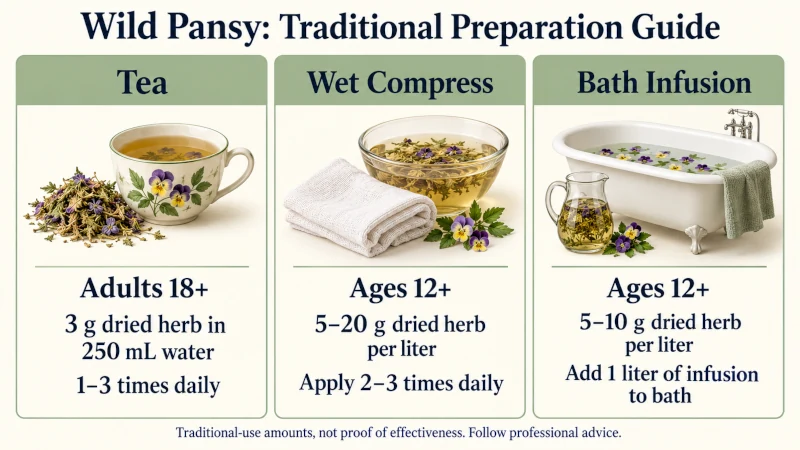
If you want to try it for mild flaking, these are the amounts in the European monograph [EMA, 2010a]. They are far lower than the 40–50 grams per liter suggested in an earlier version of this article, and they come with age limits that version left out.
| Form | Who | Amount | How often |
| Tea (by mouth) | Adults, including older adults | 3 g of dried, cut herb as an infusion (the EMA assessment describes this as 3 g per 250 ml of water) | 1 to 3 times a day |
| Wet compress | Age 12 and up | Infusion made with 5–20 g of dried herb per liter of water | On the affected skin 2 to 3 times a day |
| Bath additive | Age 12 and up | 1 liter of infusion made with 5–10 g of dried herb per liter, added to the bath | Not specified in the monograph |
Sources: [EMA, 2010a]; [EMA, 2010b].
A few practical points:
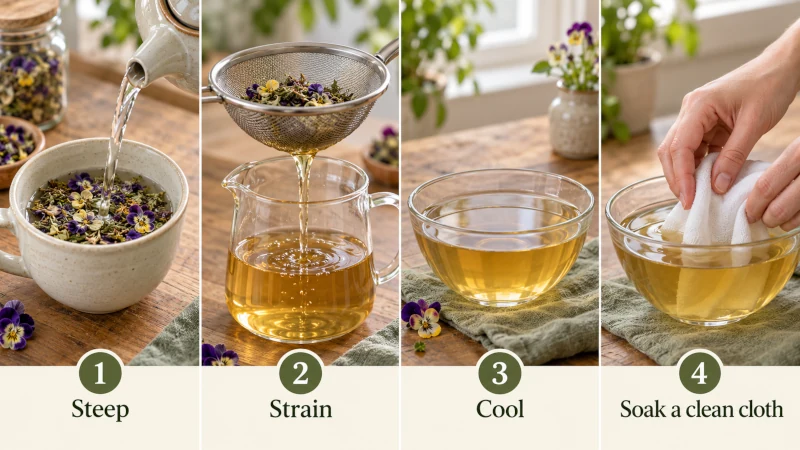
- Making the infusion. Pour hot water over the dried herb, cover, steep and strain. Registered Polish wild pansy teas direct a 5- to 7-minute steep [EMA, 2010b].
- For a compress, let the infusion cool, soak a clean cloth in it and lay it on the affected skin.
- Test a small area first before covering a larger patch of skin. Our guide to patch testing explains how to test a new product at home and what a reaction looks like.
- Keep it off open wounds and large areas of damaged skin [EMA, 2010a].
- Give it a time limit. If your symptoms last longer than four weeks while using it, see a doctor or other qualified practitioner [EMA, 2010a].
Side effects, interactions and who should avoid wild pansy
Few side effects have been reported, partly because the herb has been studied so little. EU member states reported no adverse effects to the EMA, though the agency flags possible allergy to plants in the violet family [EMA, 2010b]. Standard tests for reproductive toxicity, genetic damage and cancer risk have not been done [EMA, 2010a].
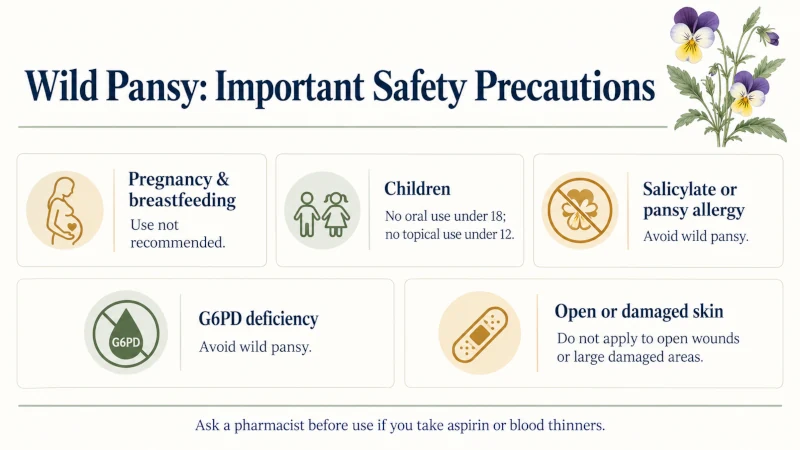
Skip wild pansy if you:
- Are allergic to wild pansy or to salicylates, the aspirin-related compounds the herb contains [EMA, 2010a]
- Are pregnant or breastfeeding; its safety hasn’t been established, so use isn’t recommended [EMA, 2010a]
- Are giving it to a child: not by mouth under 18, and not on the skin under 12 [EMA, 2010a]
- Have G6PD deficiency. A 9-month-old with this inherited enzyme condition developed hemolysis, a breakdown of red blood cells, after drinking half a cup of boiled wild pansy extract [EMA, 2010b]
- Would be applying it to open wounds or large areas of broken skin [EMA, 2010a]
- Have a fever, an infection, heart failure or high blood pressure, in which case avoid hot herbal baths [EMA, 2010a]
Medication interactions. The EMA lists none reported [EMA, 2010a]. That isn’t the same as none existing; very few people have been studied. Because of its salicylate content, a herbal safety reference cited by the EMA classes wild pansy as an herb to use with caution [EMA, 2010b]. If you take a blood thinner or a daily aspirin, check with your pharmacist before using it.
Where sources disagree. The Plants for a Future database lists wild pansy’s known hazards as “none known” [PFAF, n.d.], while the EMA lists contraindications, age limits and a pregnancy warning [EMA, 2010a]. This page follows the EMA, because its advice comes from a formal regulatory safety review.
When to see a doctor instead
An herbal compress is for a mild rash you already recognize. Get medical advice if:
- You aren’t sure what the rash is. Many conditions cause itchy, scaly skin, and a dermatologist can tell them apart [AAD, n.d.].
- It hasn’t improved after four weeks of using wild pansy [EMA, 2010a].
- It may be infected. Get an urgent same-day appointment if the skin becomes blistered, crusty or weepy, develops pus-filled spots, turns painful, swollen or warm, suddenly worsens, or you have a fever or feel unwell [NHS, n.d.-a].
- You have signs of a severe allergic reaction after using any herb: sudden swelling of the lips, mouth, throat or tongue, trouble breathing or wheezing, a tight throat, or fainting. Call emergency services (911 in the US) right away [NHS, n.d.-b].
HEALTH DISCLAIMER: This article is for general information. It isn’t a substitute for advice, diagnosis or treatment from a doctor, pharmacist or other qualified health professional. Wild pansy is a traditional herbal remedy, not a proven treatment for any skin disease. Talk to a professional before using it if you are pregnant or breastfeeding, treating a child, taking prescription medicines, or managing a long-term health condition.
Frequently Asked Questions
Is wild pansy tea safe to drink?
For most adults at the EMA’s traditional dose, 3 g of dried herb as tea up to three times a day, no serious problems have been reported to European regulators [EMA, 2010b]. It isn’t recommended for anyone under 18, during pregnancy or breastfeeding, or for people allergic to salicylates [EMA, 2010a], and people with G6PD deficiency should avoid it [EMA, 2010b].
Can I use wild pansy on my baby’s cradle cap?
It was used that way traditionally, but current EU guidance doesn’t recommend wild pansy on the skin of children under 12 because of a lack of safety data [EMA, 2010a]. Cradle cap usually clears on its own within a few months [AAD, n.d.]. Ask your pediatrician what to use in the meantime.
Does wild pansy help acne?
There’s no clinical evidence that it does. The idea comes from folk use and from lab tests in which pansy extracts had weak antibacterial effects compared with standard antibiotics [EMA, 2010b].
Does pansy thin your blood?
There’s no human evidence that it does; the claim traces back to a single lab test of a solvent extract [EMA, 2010b]. The herb does contain small amounts of salicylates, so if you take a blood thinner or daily aspirin, ask your pharmacist before using it.
How long does wild pansy take to work?
No trials have measured that. The EMA advises seeing a doctor or qualified practitioner if symptoms last longer than four weeks while you’re using it [EMA, 2010a].
References
- European Medicines Agency, Committee on Herbal Medicinal Products. Community herbal monograph on Viola tricolor L. and/or subspecies Viola arvensis Murray (Gaud) and Viola vulgaris Koch (Oborny), herba cum flore. View source
- European Medicines Agency, Committee on Herbal Medicinal Products. Assessment report on Viola tricolor L. and/or subspecies Viola arvensis Murray (Gaud) and Viola vulgaris Koch (Oborny), herba cum flore. View source
- Retzl B, Zimmermann-Klemd AM, Winker M, Nicolay S, Gründemann C, Gruber CW. Exploring immune modulatory effects of cyclotide-enriched Viola tricolor preparations. View source
- Plants For A Future. Viola tricolor – L. (Heartsease). View source
- Missouri Department of Conservation. Johnny-Jump-Up (Field Pansy) field guide. View source
- American Academy of Dermatology. Seborrheic dermatitis: overview. View source
- NHS. Atopic eczema: complications. View source
- NHS. Anaphylaxis. View source


